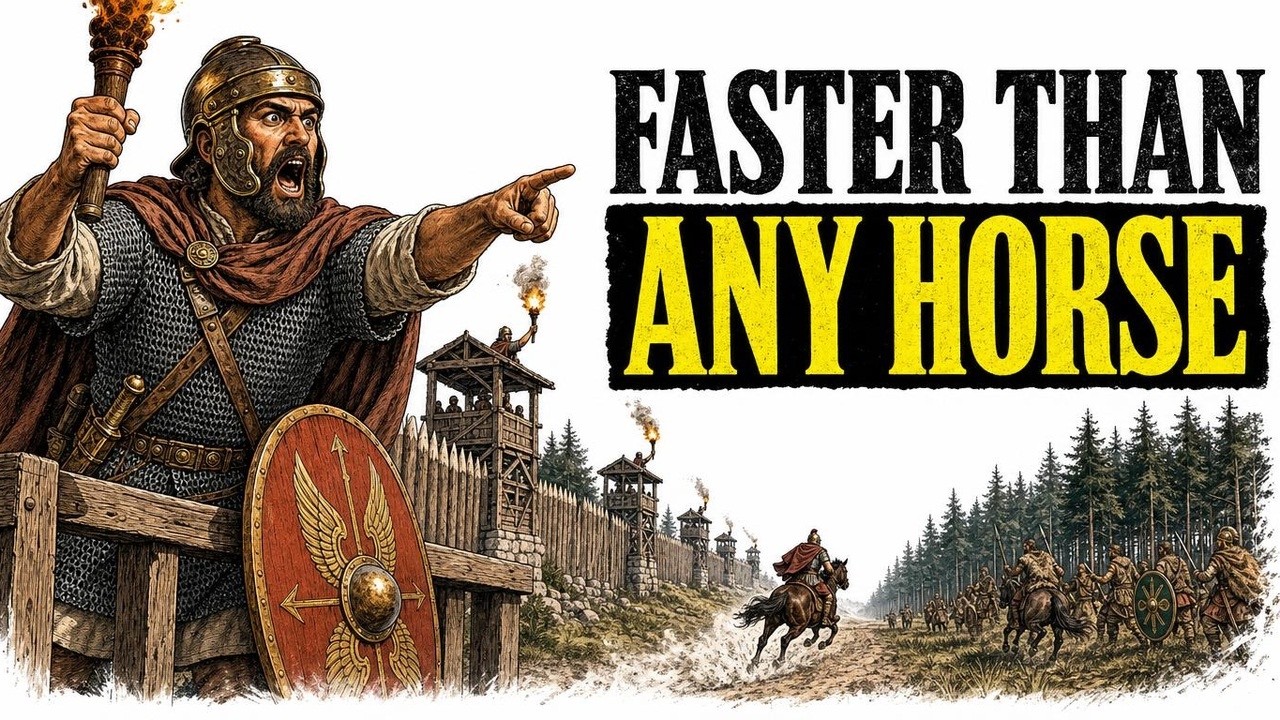
Rome’s frontier defense was built on a network of signal towers that used fire to transmit warnings across the empire faster than any messenger could travel. These structures, known as speculae, formed a system designed to coordinate military responses across vast distances. The towers were placed on high ground with clear lines of sight, allowing signals to jump from peak to peak. A message could cross the entire province of Britannia in under an hour.
The word “limes,” which originally meant a cleared path through wild country, came to describe the fortified boundary surrounding the Roman Empire. By the reign of Hadrian, this included thousands of miles of ditches, palisades, roads, and towers. The historian Tacitus, writing near the end of the first century, described the German frontier as a wound that never healed. The construction of these towers was a brutal process.
Roman surveyors used a tool called the groma to lay out straight lines across conquered land. Legionaries provided the labor, equipped with entrenching tools known as “Marius’s mules. ” Local tribesmen were often forced into the work, chained together in quarries where they cut stone for their own prison. Working conditions were punishing, and the builders frequently did not survive to see the towers completed.
Life inside a tower was grim. Garrisons were typically made up of auxiliaries from conquered provinces, deliberately stationed far from home to prevent bonds from forming between guards and the local population. The Vindolanda tablets, wooden writing tablets preserved in the wet ground near Hadrian’s Wall, offer a rare glimpse into their daily lives. Soldiers’ requests for beer, warm clothing, and supplies survive, along with an invitation to a birthday party.
One officer’s report lists men unfit for duty, including those with eyes ruined by staring at the horizon in all weather. The towers were not designed to hold off an attack. Their purpose was to raise the alarm. By day, soldiers sent up columns of smoke.
By night, they lit fires. The writer Vegetius described how beams raised and lowered, or torches shown and hidden, could convey more than a simple warning and could communicate numbers, direction, and speed of an approaching force. The Greek historian Polybius had earlier documented a system of fire signals that functioned as a form of alphabet. The disaster in the Teutoburg Forest in AD 9, where three Roman legions were destroyed by Germanic forces led by Arminius, was a turning point.
Arminius, a German prince who had served in the Roman army, had lured the legions into the forest and ambushed them. The Emperor Augustus was said to have been so devastated that he beat his head against a door, crying out for Varus to return his legions. This humiliation led Rome to build the tower network as a way to avoid ever walking blind into hostile territory again. Hadrian’s Wall, built in the year 122, has often been described as a defensive line, but it functioned more like a cage.
Stretching 117 kilometers across the north of Britannia, the wall was designed to let raiders cross, then trap them between the wall, a deep ditch, and the military road. Signal towers along the wall relayed alarms, allowing troops to move into position to cut off any escape. The design was a trap, not a barrier. The same blueprint was repeated across the empire.
From Syria to the Rhine and Danube frontiers to the edge of the Sahara, towers of the same design were constructed. The Fossatum Africae, a ditch and wall system in North Africa, employed the same principles to watch desert tribes. Rome had developed a standardized architecture of control that could be applied wherever it conquered. The system was also a tool of terror.
It ensured that Rome always struck first, allowing the legions to gather and respond before an enemy could organize. Cassius Dio recorded the toll of the British revolt led by Queen Boudica in AD 60, when 70,000 people died. The tower network was built to ensure that no such uprising could ever gather strength unseen again. The signal code used on the frontier was not a means of diplomacy.
It was a vocabulary of violence, with specific patterns of fire meaning specific threats and specific responses. A single torch held still meant a minor incursion. Two torches raised high meant a major attack. Three torches dropped in a slow beat meant total war.
The men who ran these signals were drilled until the code was instinctive. Following a single signal illustrates how the system worked. A scout spotting a war band would light a torch and swing it in a set pattern. The next tower would copy the pattern immediately, passing the message down the line at the speed of light.
The enemy, still miles away, would not know they had been seen. By the time the signal reached the field commander, escape routes were already being sealed, and heavy infantry was being directed to a single point. The system made possible a doctrine the Romans called vastatio, the systematic stripping of enemy land. Tacitus described this in his account of the campaigns of Agricola in Caledonia.
Villages were burned, livestock slaughtered, and grain stores destroyed. The aim was not just to defeat an army but to erase a people’s ability to survive. The tribes beyond the frontier learned to read the machine’s weaknesses. Dense fog, heavy rain, and blizzards could blind the network.
Ammianus Marcellinus recorded that Rome’s enemies timed their attacks for the worst weather and the darkest nights. In the year 367, a coordinated assault known as the Barbarian Conspiracy struck Britain from all sides at once, and the province fell apart before the system could respond. A general named Theodosius was sent to rebuild the line, and the towers were restored. For the conquered peoples of the empire, the Pax Romana was not peace.
It was constant surveillance, backed by the threat of overwhelming violence. Tacitus put this understanding into the mouth of a British chieftain: “They make a solitude, and they call it peace. ”
Eventually, the system collapsed under the weight of the empire’s own decline. By the year 410, the Emperor Honorius told the cities of Britain to see to their own defense.
The soldiers drifted away, the pay stopped, and the codebooks were never recut. The towers stood empty, watching nothing. But the ruins remain, and the ground they were built to control still remembers.