John Bell Hood spent the rest of his life explaining what went wrong in Atlanta, and he never quite landed on an answer that satisfied him. He wrote about it in letters. He wrote about it again in the memoirs he dictated in his final years in New Orleans, while he was dying and broke. His children were orphaned days after his death when the same yellow fever epidemic that killed him also took his wife within 48 hours, leaving the children with almost nothing.
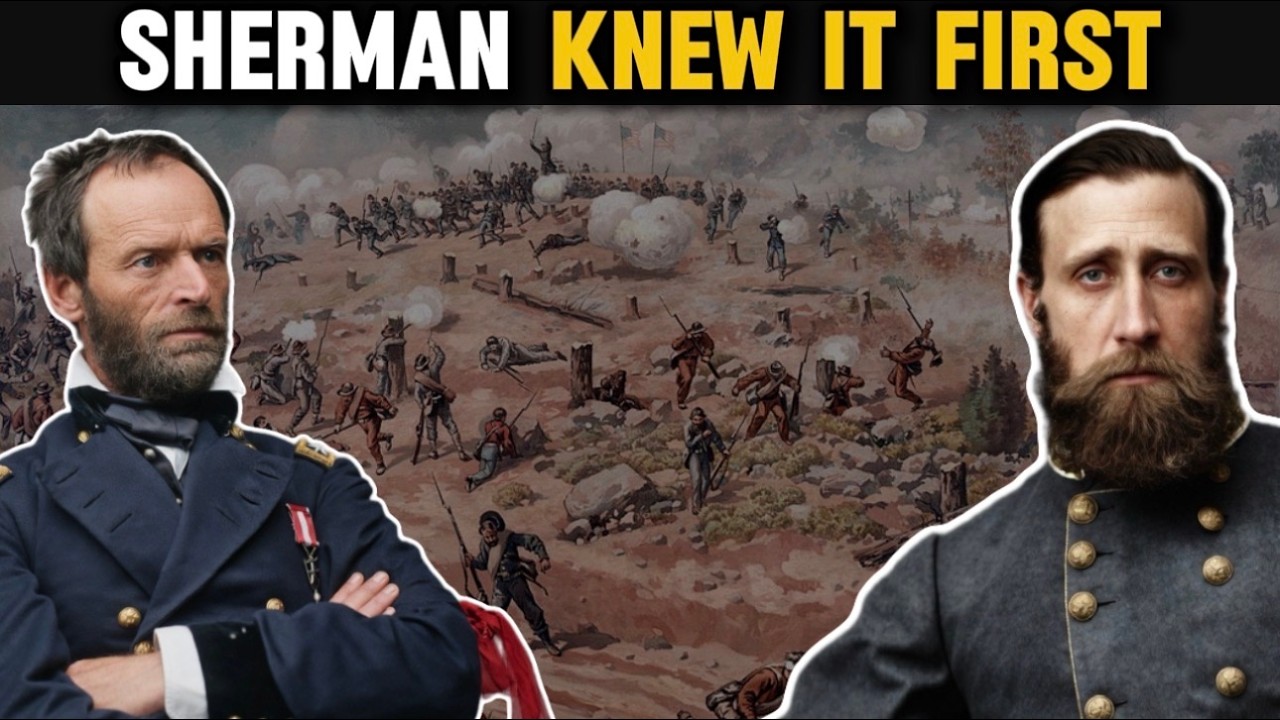
He wrote about Hardee. He wrote about Davis. He wrote about the cavalry that was never where he needed it. He wrote about nearly everyone except for the one explanation the documentary record keeps returning to.
The explanation he came closest to admitting only once, in such a brief passage that most readers of his memoirs passed over it without noticing what he had actually said. He said Sherman understood the ground around Atlanta, the actual terrain, the roads, the rail lines, and the weak points in a defensive perimeter built by another man, better than the general who was supposed to defend it. That is an extraordinary thing for a Confederate general to write about the man who defeated him. It is not the kind of admission professional soldiers typically make, even decades later, even when the war is long over and honesty costs nothing.
When protecting pride costs nothing, the temptation to protect it must be enormous. Robert E. Lee never wrote anything like that about Grant. Joseph Johnston never wrote anything like that about Sherman, even though he spent four months retreating before him across northern Georgia.
But Hood did, about the campaign that destroyed his reputation more deeply than any Confederate general’s reputation was destroyed in a single summer of fighting. He buried the admission in a single sentence surrounded by paragraphs of blame aimed at everyone else who was in Atlanta that summer. Most readers missed it. But that sentence is the key to understanding why a general with one leg and one arm, known in both armies for his unrelenting aggression, lost a city in six weeks that his predecessor had managed to preserve through patient maneuver for more than three months.
It explains why Sherman kept finding the gaps in Hood’s lines before Hood himself knew they were weak. And it explains why, of all the things Hood might have admitted about the worst campaign of his career, this was the one truth that slipped onto the page. The situation Hood inherited on July 18, 1864, was not one any general could handle easily. Joseph Johnston had spent the spring and early summer of 1864 executing one of the most methodical fighting retreats in American military history, falling back from Dalton to the outskirts of Atlanta in a series of maneuvers designed to preserve his army while forcing Sherman to pay in time and casualties for every mile he took in Georgia.
Johnston’s strategy was defensible on its own logic. He believed, with reasonable evidence to support him, that the only way the Confederacy could survive in the Western Theater was to keep his army intact, force Sherman into a war of attrition that favored the defender, and wait for Northern political will to collapse before the November elections. It was a strategy of subtraction, not addition. Do not lose the army.
Do not lose the war by losing the army. Everything else was negotiable. Jefferson Davis did not see it that way. The correspondence between Richmond and Johnston’s headquarters during May and June 1864 reads like a conversation between two men who could not hear each other, with no real agreement on what the war required.
Davis wanted Atlanta defended the way fortresses are defended, by holding it, fighting for it, and denying it to the enemy no matter the cost. Johnston wanted to preserve Atlanta the way an asset is preserved, keeping it available as leverage for as long as possible, trading it for time and losses rather than sacrificing it in one decisive battle. Those goals were not compatible, and the gap widened every week Johnston pulled his army back a few more miles without offering the kind of battle Davis was waiting to hear about. By mid-July, with Sherman’s forces approaching the city’s outer defenses, Johnston had given no clear indication that he intended to fight for Atlanta itself rather than give it up under pressure.
In the same way he had abandoned Dalton, Resaca, and Kennesaw Mountain before, Davis ran out of patience. He sent his special military adviser, Braxton Bragg, to assess Johnston’s intentions directly. The reports that came back convinced Davis that Johnston had no plan to hold the city at all, and that the retreat would simply continue across the Chattahoochee River and into Atlanta itself if no one intervened. Davis replaced him with Hood, a man whose combat reputation was built entirely on the opposite of Johnston’s instincts.
Hood had led a division and then a corps under Lee in Virginia, and what he was known for, what made him noticed and promoted over more senior men, was aggression executed without hesitation. A willingness to throw his command directly at the hardest part of the enemy line while other officers were still looking for the weak part. He had lost the use of an arm at Gettysburg, shattered by a shell fragment during the second day of fighting. He lost a leg at Chickamauga less than two months later.
The wound was so severe and the amputation so close to the hip that he had to be strapped into the saddle to ride, and could not mount or dismount alone for the rest of the war. He carried his combat record on his body in a way few generals on either side could match. That record told Davis exactly what he wanted to hear. Here at last was a man who would attack instead of retreat.
What it did not tell Davis, because courage on the battlefield and operational command are two different skills that do not always come together, was whether Hood could manage an army the size of the Army of Tennessee, manage its logistics, read a complex defensive perimeter built by someone else, and make the kind of patient, terrain-aware decisions Johnston had been making for months. Hood had never held independent command of an army before. He had excelled as a subordinate, executing someone else’s plan with maximum violence. Atlanta required him to be the one making the plan.
The fortifications surrounding Atlanta in July 1864 were not built by Hood. They were designed under Johnston’s supervision and built over weeks by Confederate engineers and impressed laborers, including a large number of enslaved workers forced into the work. These were not improvised earthworks thrown up overnight. They were a deliberate engineering system, interlocking strong points, artillery positioned to cover approach routes, and forts designed to catch attacking enemy infantry in crossfire.
Johnston understood that system deeply because he had overseen its construction and spent weeks walking the lines, identifying weak points, and ordering adjustments. Hood inherited the finished product on his fourth day of command of an army at war, with Sherman’s forces already converging on multiple routes, and he did not have time to walk every mile of the perimeter himself before he had to start making decisions about where the real threats were. Meanwhile, Sherman had been studying the approaches to Atlanta for weeks. His army’s engineers had been mapping roads, crossings, and rail lines since the earliest weeks of the campaign in May, building an accumulating picture of the terrain around the city that improved with every mile of advance from Dalton through Resaca, Cassville, New Hope Church, and Kennesaw Mountain.
Sherman did not need to learn the geography of Atlanta in four days. He had been learning it continuously since the campaign began, gathering reconnaissance reports, cavalry scouts from commanders like Kenner Garrard and Judson Kilpatrick, prisoner interrogations, testimony from pro-Union local civilians, and escaped enslaved people who knew the area, into an operational picture that grew more detailed and reliable with every passing week. This was not an accidental accumulation of background knowledge. Sherman personally reviewed engineer reports and map updates almost daily, treating terrain information as a vital campaign resource as important as ammunition or supplies.
By the time Hood took command, Sherman’s staff knew which roads could move an army corps and which could not. Where the rail lines converged south of the city, and which river crossings on the Chattahoochee were defensible and which were not. And which parts of Atlanta’s outer perimeter had been weakened as Confederate troops shifted to cover other threatened points. That knowledge did not come from any single stroke of genius.
It came from the accumulated, unglamorous work of staff officers who walked the same roads again and again, compared notes, corrected earlier maps based on new information, and built a shared picture across the entire Union command structure that any corps commander could draw on when planning a move. It was infrastructure, not inspiration. And that kind of infrastructure takes months to build properly. That disparity is what Hood’s memoir admission is actually pointing to, even though Hood did not phrase it in those terms.
He was not simply beaten in Atlanta. He was out-mapped by his opponent. Sherman’s command of the terrain was the cumulative product of months of meticulous, unglamorous staff work. The kind of work that never shows up in battle reports, but determines whether an army arrives at the right place at the right time with the right information.
The first test came almost immediately, and it came on terrain Hood had controlled for only two days. On July 20, Hood ordered an attack against the Army of the Cumberland while it was crossing Peachtree Creek north of the city, hoping to catch Union forces split by the waterway and destroy part of Sherman’s army before it could concentrate on the south bank. The plan had genuine tactical merit on paper. Attacking an enemy mid-crossing before it can mass its full strength on your side of the water is sound doctrine that any West Point-trained officer would recognize as logical.
The problem was never the concept. The problem was that executing it required precise timing, close coordination among division commanders who had served under Johnston’s more cautious style for months and were not yet used to how Hood operated, and accurate knowledge of Union positions at a specific hour. Hood did not have any of those fully ready yet. The attack came late, delayed by orders that took longer to reach the front than planned, and by a shift in Confederate positions that became necessary when Union cavalry probes threatened a completely different sector of the line.
By the time Confederate divisions actually advanced, the Army of the Cumberland under George Thomas had nearly completed its crossing and had the opportunity to prepare thoroughly for the kind of attack Hood was trying to launch. The assault came in pieces rather than as the coordinated mass Hood had envisioned. Divisions began reaching the Union lines at staggered times instead of arriving together, allowing Thomas’s defenders to concentrate their fire on each wave individually rather than facing the combined weight of the entire force at once. Union troops held their positions and inflicted about 2,500 casualties on the Confederates in the day’s fighting.
These were losses the Army of Tennessee, already significantly smaller than Sherman’s combined forces, could not easily replace. It was the first sign that ambition without command-level cohesion and precise terrain timing produces only costly failure, not the decisive victory Hood had come to deliver. Two days later came the Battle of Atlanta on July 22, Hood’s boldest gamble of the campaign and the clearest example of the gap between Hood’s knowledge of the terrain and Sherman’s. Hood ordered William Hardee’s corps to make a long night march around the Union left flank, aiming to launch a surprise attack on the rear of James McPherson’s Army of the Tennessee.
It was a bold idea, the kind of maneuver that, if executed with precise timing, might have shaken Sherman’s entire position east of the city. But the march was longer and harder than Hood had planned, crossing rough, wooded terrain in darkness, with maps and local knowledge that were no substitute for months of acquired familiarity with the ground. Hardee’s men arrived late and exhausted, and their attack began hours behind schedule, losing the element of surprise the plan depended on entirely, because Union scouts had already spotted movement on the flank, and McPherson had time to adjust his positions before the blow came. McPherson himself was killed in the fighting that followed, shot while riding alone to assess the developing attack near a wooded gap in his lines, becoming the second-highest-ranking Union officer killed in battle during the entire war, after only John Reynolds at Gettysburg.
The battle that saw his death inflicted heavy casualties on Union forces and created a genuine crisis moment in Sherman’s lines, with Confederates at one point fighting all the way to the Union rear before being pushed back by a desperate counterattack. But the Confederate attack, for all its ferocity and the real chaos it caused, did not break the Union position as a whole, and Hood’s army suffered about 8,000 casualties in a single day of fighting, a rate he could not sustain against an opponent with nearly twice his numbers. The pattern in these engagements was never a lack of aggression. Hood delivered exactly what Davis wanted when he appointed him: relentless, costly attacks against an enemy Johnston had spent months avoiding direct confrontation with.
That alone makes the comparison with Johnston worth pausing on. Johnston’s critics, Davis chief among them, accused him of cowardice and unwillingness to risk the army in open battle. Hood proved within his first 10 days in command that willingness to risk the army had never been the missing ingredient. What Johnston had and Hood did not was the time spent reading the same ground over and over until he understood exactly where an attack would pay off and where it would not.
Hood had the boldness Davis wanted. He did not have the months of accumulated familiarity with the terrain that might have told him which of his bold plans were actually viable. So the problem was never courage divorced from aggression. It was aggression divorced from precise terrain knowledge and tight command coordination.
And that combination does not produce victories no matter how willing the men executing it are to die for it. Hood kept identifying what looked like genuine opportunities on the map before him. An enemy split at a creek crossing. An exposed flank east of the city.
A weak point west of the rail lines. And he kept discovering that by the time his attacks were ready to go, the terrain and timing had shifted in ways his compressed planning process had not accounted for. Sherman’s forces, reading the ground more thoroughly and moving with better-coordinated staff work built on months of preparation rather than days, kept closing the gaps before Hood’s attacks could exploit them, again and again, until the gaps stopped opening at all. By late August, after a third costly attack at Ezra Church on July 28 failed to dislodge the Union forces threatening the rail lines leading into Atlanta from the west, Hood’s army had lost nearly 15,000 men in just two weeks of fighting under his command.
Losses a much larger Union army could absorb in a way the Army of Tennessee, already the smaller of the two forces before Hood took command, could not. The Ezra Church attack followed the same pattern as the two previous ones. A tactically reasonable objective, an attempt to strike Union forces spread west of the city before they could complete their flanking maneuver toward the rail lines, undermined by an attack launched without full knowledge of how strongly the Union position had been fortified by the time the Confederates arrived. Stephen D.
Lee’s corps, which led the assault, ran into Union earthworks that had been strengthened in the hours before the attack arrived, and the result was another lopsided casualty count, with Confederate losses roughly three times the Union losses that day. Sherman changed his approach after Ezra Church. Instead of continuing to probe Atlanta’s defenses directly through a series of costly frontal engagements that bled his army, even if they bled Hood’s faster, he swung the bulk of his forces in a wide arc to cut the remaining rail lines feeding the city from the south, calculating accurately that severing Atlanta’s supply lines would force Hood out of his defenses without requiring another direct assault on fortifications already proven expensive to attack. This was exactly the kind of terrain and logistics knowledge that had distinguished Sherman’s command style throughout the campaign, identifying the supply structure that made a position viable and attacking that structure rather than the fortifications built to protect it.
It was a decision that required precisely the kind of detailed knowledge of the rail network and road system around Atlanta that Sherman’s staff had spent months gathering, and that Hood, four weeks into his command, was still working to fully absorb. Hood tried to counter this movement, sending forces under William Hardee to contest the rail cut at Jonesboro on August 31, but the Confederate position there was weaker than Hood’s planning had anticipated, and the forces sent to hold it were less than the mission required. Troops detached from an army already exhausted by defending multiple threatened points simultaneously. Union forces under Oliver Howard held their positions against the initial Confederate attack, then pushed the Confederate defenders back the next day, completing the severing of the last effective rail line connecting Atlanta to the rest of the Confederacy.
With that connection gone, Hood had no choice. He ordered the evacuation of Atlanta on the night of September 1, destroying military supplies and an ammunition train of 81 cars that could not be moved out of the city in time. The explosion was so massive it was heard for miles in every direction, described by residents for years afterward as the sound that told them the war for Atlanta was finally and irreversibly over. Sherman’s forces occupied the city on September 2, and within days Sherman sent his famous telegram to Washington announcing the fall of Atlanta.
The news reached the North at the very moment Lincoln’s reelection chances appeared weakest. It helped decisively shift the political tide of 1864 in Lincoln’s favor. What makes Hood’s later admission of Sherman’s terrain knowledge worth taking seriously is not that it excuses the losses at Peachtree Creek, the Battle of Atlanta, or Ezra Church. Hood made real tactical errors in each of those engagements.
March timings he failed to account for. Coordination he failed to impose on subordinate commanders who needed clearer guidance than he gave them. Attacks launched on intelligence that was incomplete or outdated by the time it reached the front. Those were his mistakes, and the documentary records and after-action reports from his subordinates make that clear enough.
But beneath those specific tactical failures was a structural problem no amount of personal courage could fix. Hood was reading a map Sherman had been planning on for months, while Hood himself had only owned it for a few days. That, in the end, is the real distinction the Atlanta campaign makes between the two commanders.
And it is a distinction that gets lost when the campaign is remembered simply as a story of failed Confederate attacks against Union defense.