In December 1944, Adolf Hitler committed the last significant strength of the German army in the West to a single gamble. The plan depended on elite armored divisions, including the Waffen-SS tank formations, driving through the Ardennes forest toward the port of Antwerp. Almost everything hinged on a small Belgian town where seven roads met: Bastogne. Defended by American paratroopers of the 101st Airborne Division, the town would become the focal point of one of the most brutal sieges of World War II.
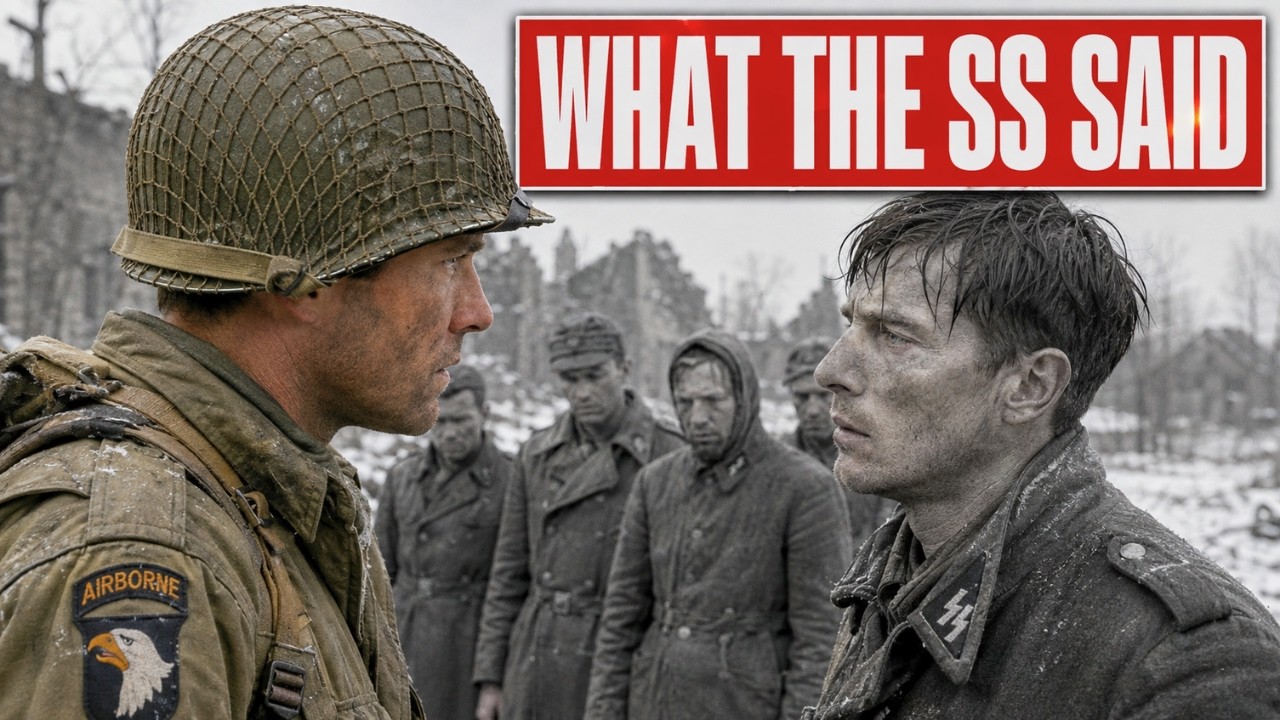
Often remembered for one defiant word spoken during the siege, the fuller story of what happened when Hitler sent his SS divisions directly against these paratroopers, and what German commanders wrote in their own records afterward, is more complex than legend suggests. By the first week of December 1944, the men of the 101st Airborne were not thinking about Belgium. They were thinking about hot food, dry socks, and sleep. The division had just come out of Holland after Operation Market Garden, a campaign that kept them on the front lines for more than 70 days, far longer than airborne planners had intended.
They had jumped in September expecting a short, decisive fight. Instead, they fought through the autumn along a single exposed road that soldiers called “Hell’s Highway. ” By late November, they were completely exhausted. The army pulled them back to Camp Mourmelon-le-Grand near Reims, France, for rest and refitting.
Refitting was the problem. The division lacked nearly everything a soldier needed to fight in winter. Replacements for the dead and wounded had not fully arrived. Ammunition stocks were low.
Winter clothing, overshoes, and heavy coats were scarce because the men had been told they would not return to combat until properly equipped. Many officers and soldiers were on leave, some as far away as Paris. The division’s two senior commanders were also absent. Major General Maxwell Taylor, the division commander, had traveled to Washington for a staff conference.
The assistant division commander was in England. That left the division artillery commander, Brigadier General Anthony McAuliffe, as the senior officer present. McAuliffe was an artillery officer, not a paratrooper by practice, a West Point graduate who had spent most of the war organizing guns rather than jumping from planes. He was competent, calm, and plain-spoken.
In mid-December, he was running a worn-out division that believed its next real assignments were still months away. None of that survived the collision with what was happening 100 miles to the northeast. The rest the Screaming Eagles had earned was about to be canceled, and the equipment they were still waiting for would never reach them in time. The blow came on December 16, 1944.
In the pre-dawn darkness, along 80 miles of the Ardennes forest, the German army launched its last major offensive of the war. The plan was called Operation Wacht am Rhein, Hitler’s personal idea imposed despite the doubts of his senior commanders. Three armies would strike across the lightly defended forests, cross the Meuse River, and head northwest toward the port of Antwerp. If they reached it, they would split the American and British armies apart.
Hitler believed that would force the Western Allies to negotiate. Everything depended on speed and a breakthrough before the Americans realized what was happening. In the first two days, it nearly worked. In the north, the Sixth Panzer Army under Sepp Dietrich smashed through American lines.
In the center, the Fifth Panzer Army under General Hasso von Manteuffel drove straight toward the heart of the Ardennes, its objective a small Belgian market town called Bastogne. Bastogne mattered for one reason: seven paved roads met there along with a railway line. In a region of narrow passes, steep valleys, and dense forests, any army wanting to move its armor quickly toward the West had to pass through that junction. Whoever controlled Bastogne controlled the pace of the entire southern offensive.
Standing in the way of that offensive were tired, unprepared American units. The 106th Infantry Division was overrun in the first days, with thousands of its men captured. To the south, however, the 28th Infantry Division fought a stubborn delaying action. Its 110th Infantry Regiment, commanded by Colonel Hurley Fuller, was spread across small positions on the ridges east of Bastogne.
Although shattered, the regiment made the Germans pay for every hour. Those hours were priceless. They gave the Allied high command enough time to react. At his headquarters, Supreme Commander Dwight Eisenhower realized faster than most that this was not a local raid but a major offensive requiring his reserves.
On December 17, he released the only force not yet committed: the XVIII Airborne Corps with its two veteran divisions, the 82nd and 101st. The 82nd would head north to the shoulder of the German breakthrough. The 101st, resting at Reims and expecting nothing, would be sent to seize and hold the road junction at Bastogne. The order reached Mourmelon-le-Grand on the evening of December 17.
It was blunt and urgent. The division had to move at once, with no time to wait for missing equipment or men on leave. Trucks were collected from wherever the army could find them. Many were open trailers designed for cargo, not soldiers.
The paratroopers climbed aboard in darkness, packed standing and sitting in the cold, and the long convoys began moving north on the night of December 18. The distance from Reims to Bastogne was over 100 miles, and the roads were jammed with traffic in both directions. As the trucks slowly made their way through the freezing night, the men of the 101st saw a grim sight coming from the opposite direction. American vehicles, stragglers, and defeated units were flowing to the rear.
Some were survivors of divisions the Germans had already shattered. The paratroopers heading toward the sound of the guns watched other men fleeing from it. They departed lacking almost everything. Due to the sudden move, many soldiers had little ammunition, and some carried none at all, expecting to be resupplied at the front.
There were not enough machine-gun rounds, mortar shells, or artillery ammunition for a sustained battle. Winter clothing was still missing. The men rode and later fought in field jackets and jump boots in temperatures that dropped below freezing, in snow and frozen mud. Medical supplies were scarce, and the division’s surgical capacity was seriously limited from the start.
All of this would make a huge difference in the days ahead. A lightly armed airborne division was thrown into battle against tanks and heavy artillery, into a siege, with only what men could carry and what could be hurriedly gathered. The shortage of ammunition in particular made time their enemy. Every shell fired in the coming week had to be calculated because there was no promise more would arrive.
The decision to send the 101st immediately, before it was ready, gave Bastogne its defenders. It also ensured those defenders would spend the next week fighting a battle of scarcity, hoarding rounds and waiting for a break in the weather that might allow supplies to reach them by air. The paratroopers were not the first Americans to enter Bastogne, a fact almost everyone quietly forgot except the men who were there on the evening of December 18. Before the 101st arrived, Combat Command B of the 10th Armored Division had entered the town.
It was commanded by Colonel William “Pete” Roberts, a seasoned armor officer, who made a decision that shaped the entire battle. Instead of keeping his tanks together, he split his command into three small task forces and sent them east and north to meet the Germans as far from Bastogne as possible. Each team took the name of its commander. Team Cherry, led by Lieutenant Colonel Henry Cherry, headed east toward Longvilly.
Team Desobry, led by Major William Desobry, moved north to the village of Noville. Team O’Hara, led by Lieutenant Colonel James O’Hara, covered the southeastern entrance near Wardin. They were joined in the fighting by the remnants of the 9th Armored Division’s combat command reserve under Colonel Joseph Gilbreth, which had already taken heavy losses along the Longvilly road. These forces were not large.
A few dozen tanks and a few hundred men stood in the way of entire German divisions. They were effectively ordered to buy time at the cost of themselves, and that is almost what happened. Team Desobry fought a fierce battle at Noville against the lead elements of the 2nd Panzer Division, holding a village they had no real hope of keeping, sacrificing tanks and men for hours. Team Cherry was destroyed near Longvilly.
Along the eastern approaches, these small teams forced the Germans to stop, deploy, and fight rather than rush straight toward Bastogne. A tank destroyer battalion, the 705th, arriving from the north, added its guns to the line. The hours they bought were exactly the hours the 101st needed to arrive and dig in. General McAuliffe never forgot that.
In his Christmas message to the defenders, he mentioned the armor crews and tank destroyers who stood with the paratroopers. Long after the war, he stated clearly that Combat Command B of the 10th Armored Division reached Bastogne before the airborne troops, fought fiercely before the Screaming Eagles dug in, and never received the recognition it deserved. The legend became attached to the paratroopers, but the first blood shed in Bastogne was shed by tank crews. While the armor was bleeding on the eastern approaches, the race for control of Bastogne was being decided by hours and by chance.
The German division tasked with taking the town from the south was Panzer Lehr, one of the strongest armored formations in the German army, commanded by Lieutenant General Fritz Bayerlein. He had orders to take Bastogne quickly while it was still weakly protected. In theory, he had plenty of time. In practice, he lost it.
On the night of December 18, heading toward the town, Bayerlein chose a side road a local guide told him was passable. It was not. His column got stuck in a muddy farm track, and hours were wasted in the dark. When his lead units finally reached the outskirts of Bastogne on December 19, Bayerlein hesitated, unsure of the strength of the defense and wary of pushing his armor into the town in darkness.
That caution, along with the delay on the road, proved fatal to the German timetable. Meanwhile, the 2nd Panzer Division, commanded by Colonel Meinrad von Lauchert, had been ordered not to get drawn into a fight for the town at all. It was to bypass Bastogne to the north and push on toward the Meuse. The task of seizing the junction was largely left to the 26th Volksgrenadier Division under Colonel Heinz Kokott.
The Americans got there first. The lead elements of the 101st reached the Bastogne area in the early hours of December 19 after a night on the road. There was no time for rest. The 501st Parachute Infantry Regiment under Lieutenant Colonel Julian Ewell received orders to move east of the town immediately, toward the village of Neffe.
On the morning of December 19, they collided head-on with advancing German forces. The battle for the high ground east of Bastogne had begun, and the paratroopers were there to meet it. That was the first turning point of the battle, decided before the siege even started. By arriving a few hours ahead of the enemy, and by the sacrifice of the armored teams that held the roads, the Americans prevented a quick German seizure of Bastogne.
Now it could be defended. But holding it meant being surrounded. As the paratroopers spread out to build a defensive ring around Bastogne, German columns were already slipping past them on both sides, closing the roads to the rear one by one. On December 19, the 501st had made first contact at Neffe, and over that day and the next, fighting extended to the villages of Bizory, Mageret, and Wardin in the high ground east of town.
At Wardin, a company of the 501st was caught in the open by German tanks and infantry and was completely crushed. It was an early, brutal lesson that lightly armed paratroopers could not simply stand against armor. The line settled where men could hold it, on the ridges and in the stone villages, and there they dug in. The fiercest fighting in those first days was in the north at Noville.
The village sat on a height overlooking the road coming from the north and had to be held long enough for the defensive front to form. The 1st Battalion of the 506th Parachute Infantry Regiment, under Lieutenant Colonel James LaPrade, was sent to join Major Desobry’s armored team there. Paratroopers and tank crews fought together against the lead elements of the 2nd Panzer Division in thick morning fog that lifted without warning to reveal German tanks at close range. They destroyed several and held the village far longer than the Germans expected.
The price was heavy. On December 20, a German shell hit the command post at Noville, killing Lieutenant Colonel LaPrade and seriously wounding Major Desobry, who was later captured when the aid station where he lay was overrun. With the position no longer defensible as the defensive perimeter formed behind them, the survivors were ordered to withdraw from Noville to Foy, giving up the village but having achieved the delay required of them. By the end of December 20, the shape of the defense was set.
The 502nd Parachute Infantry Regiment held the northwest around Longchamps and Champs. The 506th held the north at Foy. The 501st held the east. The 327th Glider Infantry Regiment under Colonel Joseph Harper held the long southern and western arc.
Inside this ring were nearly 11,000 men of the division itself, plus thousands more from the armor and artillery units that had joined them. The defensive perimeter was about 16 miles around. A circle a man could walk across in a few hours, and everything inside it was now within range of German guns. The paratroopers had won the race to Bastogne.
Now they had to survive what was coming. The ring closed on December 21. Over the previous day, German columns had slipped around Bastogne on both sides, cutting the roads to the rear one by one. The last open road to the southwest, toward Neufchâteau, was severed on December 21, and from that moment the garrison was completely surrounded.
The two strong panzer divisions, the 2nd Panzer and most of Panzer Lehr, did not remain to fight for the town. Their orders were to move west toward the Meuse. The task of crushing Bastogne was given to the 26th Volksgrenadier Division under Colonel Heinz Kokott, reinforced by a regiment from Panzer Lehr and later by other units. Kokott faced a problem that defined the entire siege.
His forces were scattered around the perimeter and did not have enough strength to attack everywhere at once. So his attacks came in sequence, sector by sector, first in one place then another. That gave the American commanders a decisive advantage. Because the perimeter was small, the division’s artillery could be moved quickly from one point of threat to another, allowing the fire of several battalions to be concentrated on whatever attack was active at that moment.
The compact ring that made the garrison vulnerable also made it defensible. Inside the pocket, the supply shortages that had followed the paratroopers from Reims began to bite painfully. Artillery ammunition was so limited that gun crews were ordered to fire only at clear, worthwhile targets. On some days, batteries were asked to make do with just a few shells.
The medical situation was even worse. On the night of December 19, a German attack swept through the division’s main field hospital west of Bastogne, capturing its surgical sections and most of its equipment in one blow. That loss meant seriously wounded soldiers inside the perimeter could not receive the surgery they needed. Their wounds were dressed, they were given whatever morphine remained, and they were placed in cellars and garages in the town, where many slowly worsened in the cold.
The weather made everything harder. Temperatures fell far below freezing. The ground turned to iron, and low gray clouds covered the Ardennes day after day. Those clouds were the garrison’s worst enemy because they prevented the transport planes that could bring ammunition, food, and medical supplies, and they kept fighter-bombers from striking the German columns.
As long as the sky remained closed, Bastogne had to hold with what it had. The Germans, aware of this, prepared to demand its surrender. On the morning of December 22, four Germans advanced under a white flag along the Arlon road south of Bastogne near the village of Remoifosse. Two were officers, a major and a lieutenant who spoke English.
They carried a printed document addressed to the American commander. They were met by men of the 327th Glider Infantry, blindfolded, and their message was taken into town. The document was a formal demand for surrender. It claimed the American forces in and around Bastogne were completely surrounded, that strong German artillery was in position, and that the only way to spare the garrison total destruction was to surrender the town within two hours.
It was signed simply “The German Commander. ” The man behind it was General Heinrich von Lüttwitz, commander of the XLVII Panzer Corps. This point deserves accuracy because the story told later often blurred this fact. The surrender demand at Bastogne did not come from Waffen-SS forces.
It came from a regular German army, Wehrmacht, panzer corps. The elite SS divisions for which the broader battle is remembered were not yet facing the 101st. The demand was delivered to Brigadier General Anthony McAuliffe. He was told the Germans wanted a written reply.
By all accounts, he was more annoyed than alarmed, and his first reaction became the official response. His operations officer, Lieutenant Colonel Harry Kinnard, suggested the general’s first remark could not be improved upon, so it was typed on paper. The American reply read in full: “To the German Commander, NUTS! From the American Commander.
” Colonel Joseph Harper carried the paper back to the waiting German officers. When they read the single word and asked what it meant, Harper told them it meant “go to hell” in English, and that if they continued the attack, the Americans would kill every German who tried to enter the town. The officers saluted stiffly and returned to their lines. The refusal committed both sides to a fight.
The Germans had offered surrender because they too were racing against time, aware that American forces were massing to the south and preparing to drive west. After the refusal, they had no choice but to take Bastogne by force, and every attack from that moment cost them men and tanks they could not afford to lose. For the garrison, the reply settled the question hanging over the town since the siege began. There would be no surrender.
Now they only had to hold out long enough for the weather to change. The weather changed on December 23. A cold, dry pressure system moved over the Ardennes and the sky quickly cleared. For the first time in a week, the sun shone over Bastogne.
For the Germans, that meant exposure. Allied fighter-bombers were soon over them, hunting their columns and supply roads. For the garrison, it meant the one thing they needed most. Transport planes could finally fly.
Early that morning, a small team of pathfinders parachuted into the perimeter to guide the drop. Their job was to set up a radar beacon and marking panels in a field just outside the town so incoming pilots could find the drop zone through the haze and smoke. Included among them was Sergeant Jake McNiece. It was work that had to be done in the open under fire, and it was done quickly.
Behind them, transport planes were already forming up over France. On December 23, roughly 241 C-47 transport planes flew over Bastogne and dropped their loads by parachute onto the marked field. The bundles fell under parachutes of different colors, each color telling the men on the ground the contents of the drop, so ammunition, rations, and medical supplies could be sorted and moved as soon as they landed. Paratroopers and town residents raced amid shell bursts to drag the containers inside.
Over the following days, more drops continued. Hundreds of additional planes arrived, and gliders were also sent in, bringing among other things surgeons to replace those captured. The supply drops did not end the siege, nor did they ease the garrison’s discomfort. Even after the first drops, artillery ammunition remained limited, and McAuliffe imposed strict limits on how many shells his guns could use.
But it changed the arithmetic of the battle. No longer were the defenders simply draining a fixed, shrinking stock of everything they had. They could now respond with firepower, treat some of their wounded, and eat. They could also see who was working for them: finally, the white parachutes descending slowly, and the fighter-bombers circling in the clear air over the German lines.
The Germans fully understood what this change meant, and it forced their hand. The clear weather that fed the garrison was striking their forces from the air, and the American relief column was drawing closer from the south with each passing day. If Bastogne was to be taken, it had to be now, before the corridor to the town was opened. The German command set Christmas Day for the decisive blow.
The main German attack came in the dark hours of December 25. Kokott studied the perimeter and chose the northwestern side, between the villages of Champs and Hemroulle, as the point of penetration. It was one of the weaker sectors, so he massed there what remained of his striking force: a regiment of his own infantry, plus panzergrenadier battalions and about 18 tanks from the 15th Panzer Division. The plan was to break through the paratroopers on the edge and push straight into Bastogne.
At first, it seemed to work. In the early morning, German armor found a gap near the boundary between the 502nd Parachute Infantry Regiment and the 327th Glider Infantry Regiment, and pushed through, splitting into two groups, one heading toward Hemroulle and the other toward the edge of Champs. For a brief moment, there were German tanks inside the American perimeter, moving through the snow toward the town, and the situation was as grave as any the garrison had faced. But it did not last.
The paratroopers held on the edge and let the tanks pass, then turned to face the German infantry coming behind them, separating the two so the armor had to fight alone. Inside the perimeter, the tanks were hunted down and destroyed by a combination of arms: the 502nd under Lieutenant Colonel Steve Chappuis, the glider infantry of the 327th, the tank destroyers of the 705th, and supporting artillery firing over open sights. Almost all the German tanks that had broken through were destroyed. The infantry that followed them were killed or captured in the fields around Champs and Hemroulle.
By midday on Christmas, the attack was over, and with it, the last real German chance to break into Bastogne from the inside died. Kokott had spent the striking force he had saved for one concentrated blow and gained nothing but wreckage. The northwestern sector, which the Germans had considered the weak point of the ring, had held. There was a grim symmetry to it.
The German command had launched the Christmas attack on Bastogne precisely because the relief force was approaching, hoping to eliminate the garrison before help arrived. Instead, they broke their own attacking strength against the walls of the perimeter. And the relief force was now only a day away. The next move was not for the Germans.
To the south, the tanks of Patton’s Third Army were about to reach the edge of the ring. Relief came from the south and arrived on December 26. Since December 22, the 4th Armored Division of Patton’s Third Army had been driving north toward Bastogne through stubborn resistance, from village to village, through the same cold and snow. By the afternoon of December 26, the CCR had fought its way to Assenois, a village just southwest of the perimeter.
With only a thin screen of German troops between him and the garrison, the decision to make the final dash rested with Lieutenant Colonel Creighton Abrams, commander of the 37th Tank Battalion. Instead of waiting and massing, Abrams chose to drive straight through Assenois immediately, betting that speed would get a small column through before the Germans could close the gap. Assenois was shelled by artillery, and the tanks went in behind its fire. At the head of the column was a single Sherman tank named Cobra King, commanded by Lieutenant Charles Boggess of Company C.
Boggess drove his tank through Assenois under fire, past German positions on both sides, and out the far end toward the American perimeter. Late on the afternoon of December 26, southwest of Bastogne, his tank reached a line of foxholes held by engineers of the 326th Airborne Engineer Battalion. The paratroopers came out cautiously, and the road into Bastogne was open. Cobra King survived the war and stands today in the National Museum of the United States Army.
The linkup was a real relief, but the corridor was narrow, a single road under German fire, and it had to be fought over and widened for days before it was secure. Breaking the siege did not end the battle. It changed its nature. As long as the Americans held Bastogne, the town was a bulge in the side of the German offensive, a fortified road junction threatening the flank and rear of everything they had pushed to the West.
That could not be tolerated, and the German high command knew it. Bastogne, which had begun as one objective among many on the road to Antwerp, had become the center of gravity of the entire battle. Hitler ordered the bulge eliminated and the corridor cut. To do it, he began sending new divisions, including the elite armored SS divisions on which the offensive had been built in the first place.
The fight for Bastogne was about to enter its second phase, and this time the SS would be in the battle. The division sent to lead the new effort was the 1st SS Panzer Division, Hitler’s Leibstandarte, commanded by SS-Brigadeführer Wilhelm Mohnke. It had begun the offensive on the northern front, where its spearhead under Joachim Peiper had driven deep and then been surrounded and destroyed. Now, battered by that fighting, it was moved south and thrown into the fight for the Bastogne corridor at the end of December.
On the American side, this front was not under the 101st’s control but under the units coming up from the south to keep the corridor open, chiefly the 35th Infantry Division and the 4th Armored Division. On December 30, the Germans attacked from both sides to pinch off the corridor. The eastern attack, built around the Leibstandarte and the 167th Volksgrenadier Division, came around the villages of Lutrebois and Villers-la-Bonne-Eau. Here the facts deserve to be stated plainly because they are often told inaccurately.
Lutrebois was taken that morning not by SS troops but by an infantry regiment of the 167th Volksgrenadier Division, and the men fighting there were from the 35th Infantry Division. The SS armor arrived behind and alongside that infantry attack and ran into disaster. That disaster was arranged by a handful of American tanks. An observer from the 4th Armored Division, flying over the battlefield in a small Piper Cub reconnaissance plane, spotted a column of German tanks moving through the woods southeast of Lutrebois and dropped a message to the tank crews below.
Lieutenant John Kingsley, commanding Company B of the 37th Tank Battalion, was leading six Sherman tanks and a platoon of tank destroyers from the 701st Tank Destroyer Battalion. He positioned them behind a low rise so that only their turrets showed, and waited. As the fog briefly lifted, the leading German tanks turned toward another American company, exposing their sides. Kingsley’s first shot destroyed the German commander’s tank, and the rest were picked off one by one as they flailed without finding the guns that were hitting them.
A second group of German tanks advanced and was also destroyed, and the tank destroyers took out the assault guns that followed in a short, one-sided battle. About a dozen German tanks were left burning in the woods. These were the elite Waffen-SS armored forces, the strength around which the entire offensive had been built, and in their first serious clash with the Bastogne corridor they were stopped completely and bled white. Not even by the paratroopers who are remembered for facing them, but by the infantry and tanks that held the road.
The German command drew a clear, harsh conclusion. Cutting the corridor was proving too costly. What remained was to direct the SS directly against the perimeter itself, against the 101st, in the first days of the new year. The German command had learned an expensive lesson at the corridor.
Cutting the road to Bastogne was costing them tanks they could not replace. So the effort shifted. If the bulge could not be cut from the sides, then the town itself would be stormed from the north, and this time the elite divisions would be sent directly against the paratroopers on the perimeter. In the early days of January 1945, the Waffen-SS finally faced the 101st Airborne Division.
The attack came on the night of January 3, 1945, against the northwestern side of the perimeter around the village of Longchamps. The attacking force was drawn from the 9th SS Panzer Division Hohenstaufen, with the 19th SS Panzergrenadier Regiment leading the assault and tanks in support. To the northeast, the 12th SS Panzer Division Hitlerjugend pressed on the sector defended by the 501st Parachute Infantry Regiment. The ground the 101st had chosen to defend was frozen and hard.
The paratroopers were dug in, and the compact perimeter that had served them throughout the siege served them again. At Longchamps, the SS grenadiers and their tanks advanced against the 502nd Parachute Infantry Regiment. The fighting was violent and close, and for a time German armor penetrated the American positions. But the attack achieved no more than the ones before it.
The paratroopers held in their foxholes, allowed the infantry to be separated from the armor, and the guns did the rest. The division’s artillery, the tank destroyers, and direct fire broke the attack, and the SS tanks that pushed deep were destroyed in the snow. By the next day, the attack on the northern perimeter had failed, and the Hohenstaufen and Hitlerjugend divisions had gained nothing they could hold. These January attacks were part of the last broad German efforts against the perimeter, and they came in the worst weather of the campaign.
Alongside enemy tanks and infantry, the paratroopers had to fight the brutal cold. Temperatures remained far below freezing. Snow lay deep on the ground, and both sides constantly lost men to frostbite and trench foot, injuries that took soldiers out of the battle as surely as bullets. The 101st fought its final defensive battles frozen, sleep-deprived, and lacking winter clothing, and still it held.
This was the moment the tide of the battle turned. The elite Waffen-SS armored divisions, the formations Hitler had bet on to reach the Meuse and Antwerp, were finally thrown directly against the 101st Airborne Division on ground the paratroopers had chosen, and they were stopped. There was no breakthrough, no collapse of the ring, no repeat of the panic the offensive had caused in its first days. The men who refused to surrender in December held their lines against the best the German army had left, and the initiative around Bastogne passed permanently to the Americans.
The counteroffensive began on January 9, 1945. The 101st was not relieved and sent to rest as its men had expected. Instead, it was ordered to attack north out of the perimeter it had held, to help pinch off the German salient from the southern side of the bulge. The paratroopers who had spent three weeks in frozen foxholes now had to climb out and advance through deep snow and bitter cold against an enemy with every reason to hold.
The 506th Parachute Infantry Regiment led the attack on the northern axis. On January 9, it retook Recogne. On January 10, it fought through the Bois de Corbeau, the belt of woods protecting the road to the next objective. On January 13, it assaulted Foy, the small village on the northern road the division had given up in the first days of the siege.
The Battle of Foy is the most famous of all, because one of its companies was Easy Company of the 506th, whose story was told to later generations through film. The attack across the snow-covered open ground toward the village stalled under German fire when the company commander, Lieutenant Norman Dike, lost control of the attack in the open. From the tree line, the battalion executive officer, Captain Richard Winters, made an immediate decision. He sent Lieutenant Ronald Speirs forward to take command of the company on the spot, in the middle of the assault.
Speirs reached the stalled company, got it moving again, and completed the attack, taking Foy. The village was captured. The story is remembered for the drama of relieving an officer under fire, but its real significance is simpler. It was a small part of a systematic, costly advance that fought its way north village by village.
Each of those positions had to be taken the same way: paratroopers advancing through machine-gun and artillery fire across snow-covered open ground toward houses and tree lines, then holding what they took against counterattacks. The division that had held fast surrounded at Bastogne was now paying a second price to push the Germans away from it. The fighting to retake these villages was among the bloodiest the division saw in the entire war, and some of its companies emerged from the January attacks with fewer men than they had at the worst of the siege. The advance continued through mid-January against heavy resistance.
On January 15, 1945, the 506th Parachute Infantry Regiment recaptured Noville, the village where LaPrade’s and Desobry’s men had bought time at such cost in the first days of the battle. On January 16, the paratroopers took Rachamps just behind it. On January 17, the 327th Glider Infantry Regiment and the 502nd Parachute Infantry Regiment took Bourcy to the northeast. With Bourcy in American hands, the 101st had pushed the German line back almost exactly to where it had been on December 19, the day the division first arrived and dug in.
The ground lost in the initial German rush, and held as an island throughout the siege, had been regained inch by inch. On January 18, the division was finally pulled off the lines around Bastogne. Its part in the battle was over. By then, the larger battle was also drawing to a close.
While the 101st was fighting north from Bastogne, two American armies were closing the neck of the German bulge from opposite directions. The First Army pressed down from the north, and the Third Army pushed up from the south. On January 16, 1945, they met at Houffalize, a town northeast of Bastogne. The linkup cut the neck of the bulge, leaving the German forces to the west in danger of being trapped.
From that point, the offensive not only stalled but reversed. The Germans were retreating toward the border they had come from a month earlier, abandoning the ground they had seized and most of the armor they had spent to seize it. The price the 101st paid can be stated clearly. U.
S. Army figures for the division’s losses in the Bastogne fighting come to 341 killed, 1,616 wounded, and 1 missing. Nearly 2,000 casualties in a division that had entered the battle already drained by the autumn. Over the entire war in Europe, the 101st Airborne suffered about 9,328 battle casualties, of whom roughly 2,155 were killed, and a significant share of that total occurred in and around this one Belgian town in a single winter month.
It is worth correcting a figure often attached to Bastogne. The number of 19,000 killed sometimes associated with the story is not the 101st’s losses nor Bastogne’s. It is the approximate number of American soldiers killed in the entire Battle of the Bulge, a month-long battle across the whole Ardennes front, of which Bastogne was part. The garrison’s dead numbered in the hundreds, not thousands.
German losses in front of Bastogne are harder to establish with the same confidence, and honesty requires saying so. German records of these operations are incomplete, and some American claims cannot be matched against them. The tank ambushes at Lutrebois are a good example. A single action there destroyed about twelve tanks, a figure well documented.
But larger American claims about the fighting around Lutrebois, reaching roughly 50 German tanks destroyed, are certainly higher than the number of tanks the 1st SS Panzer Division had allocated to the attack. The official U. S. Army history notes this and treats the larger figure as an exaggeration.
What is certain is that the elite German divisions sent to take Bastogne or isolate it were drained there of men and armor, and those losses fell on formations Germany could not rebuild. The western flank of the German offensive fared no better. There, the Führer Begleit Brigade, an army armored unit, tried to break through from the northwest in those same days and was thrown back with its own losses. This brings us back to the question of what the SS men said after facing the 101st Airborne.
The honest answer begins with a correction. There is no neat quote, no captured message in which an SS officer records his admiration for the American paratroopers by name. The story is sometimes told that way, but that is not what the records show. The SS did not surround the 101st at Bastogne.
They were in a wider bulge. They were thrown into the battle later, to erase the bulge the paratroopers had created, and they were defeated first by the infantry and tanks that held the corridor at Lutrebois, and then directly by the 101st when they struck their perimeter at Longchamps. What the Germans left behind was not tribute but acknowledgment. The war diary of Field Marshal Gerd von Rundstedt, the German commander in the West, recorded at the end of December the report he received from Army Group B describing the ferocity of the fighting around Bastogne and concluding that the forces committed there were not sufficient to achieve the objective assigned to them.
That is the German high command’s own admission in its own files that Bastogne could not be taken with the force available. And there is the picture left by General Ludwig Heilmann, whose 5th Parachute Division fought south of the town. He described the view of Bastogne at night: “You could see as far as the West Wall, a procession of burning vehicles, like a torchlight parade. ” The German convoys destroyed from the air along the roads they needed.
That is what the German army, including the SS, said after Bastogne. Not flattery, but war diaries admitting defeat and a landscape littered with the wreckage of their tanks. The divisions on which the entire offensive had been built were thrown, one after another, against a small road junction held by a light division without a single tank of its own, and they could neither take it, cut it off, nor break the will of the men defending it. Bastogne was the fulcrum of the Battle of the Bulge.
The failure to seize it in the first hours wrecked the timetable of the last German offensive in the West and consumed the armored divisions, including the SS, that Germany could not replace. Within weeks, the bulge was flattened and the offensive was over. With it died the last real German capability to attack in strength.