In the autumn of 1887, a 46-year-old land surveyor named Ortwin Le Merle was hired by a Pittsburgh company called Hessler and Coin to map a remote stretch of mountain in what was then loosely charted territory in eastern Kentucky. Locals called the ridge Burnt Knob. The timber company believed the slopes were thick with untouched old-growth chestnut, walnut, and oak. Le Merle, the son of a French Huguenot father and a German mother, had spent his career walking the kinds of places that had never been properly mapped.
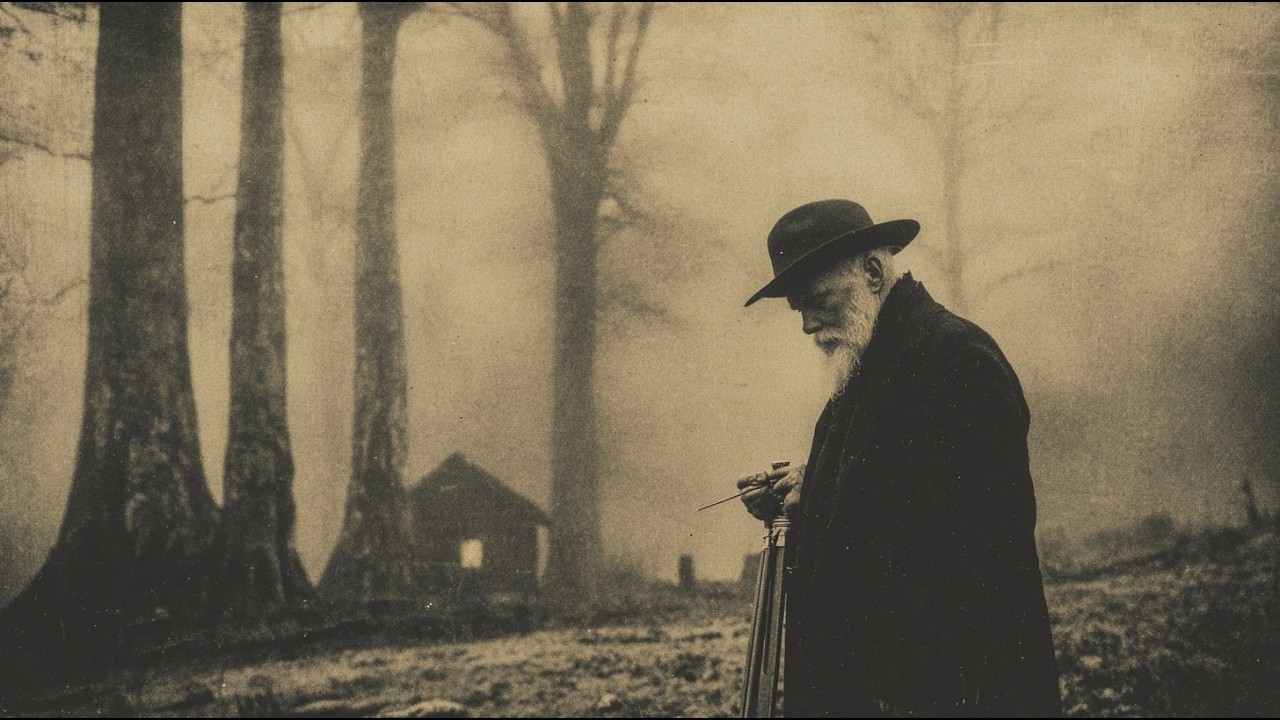
Before he left Pittsburgh, a nervous company agent named Housefield handed him a folded piece of paper. On it were the names of seven men who had gone up Burnt Knob in the previous four years and never come back down. Housefield told him, “You should know what you are walking into. ” Le Merle folded the paper into his coat pocket and, for two full days, thought nothing of it.
Men got lost in the mountains all the time. Seven in four years sounded like a lot, but the woods took who they took. Le Merle traveled by train to a small rail stop called Airyville. From there, he hired a guide named Pelham Chestnut, who led him as far as a hollow called Trinity Fork and then flatly refused to go further.
Chestnut pointed up at the ridge, turned his mule around, and left without a word. Le Merle stood alone with his pack, his theodolite, and the list of seven names. By the evening of October 7, he set up his first camp at the base of the knob. His journal, which still exists and has been read by others, records his first impression in his own words: “The silence was wrong.
” He noted that there were no birds, not even a distant woodpecker. He wrote that the wind moved through the trees, but the trees did not seem to move with it. The air smelled faintly of something burning, yet there was no smoke and no fire. At about 3:00 in the morning, he was woken by the sound of someone walking in a circle around his tent.
The steps were slow and deliberate, pausing every few feet. They circled his tent four times, paused at the flap, and then walked off into the trees. In the morning, the ground was soft from the previous day’s rain, and his own boot prints were clear in the mud. There were no other footprints.
He told himself it was a bear and wrote “bear” in his journal, even though he knew a bear is heavy and leaves prints and does not pause at the flap of a tent. Le Merle began his survey work the next morning. By the first ridge, something more troubling happened. He set his brass compass down on a flat stone.
When he looked back at it, the needle was slowly drifting in a different direction. Not toward magnetic north, but toward the crown of the mountain. He tested it again and again. Each time, after a few seconds of stillness, the needle settled and then drifted, always in the same direction, always toward the top of Burnt Knob.
He wrote in his journal: “The mountain wants to be looked at. ” The handwriting was steady. He was a careful, methodical man. Over the next four days, he worked his way up the slope.
Each night, between 2:00 and 4:00 in the morning, the steps came back. On the third night, he heard a voice. It was the voice of his mother, who had been dead for 19 years. She said his name once, the way she used to call him in for supper when he was a boy.
He did not answer. On the fourth night, the voice was Housefield’s, coming from inside his tent, repeating the same words from the Pittsburgh office: “You should know what you are walking into. ”
On the morning of October 11, he reached a clearing near the top of the knob and found a cabin. It was not abandoned.
The roof had been patched with fresh shingles. The windows had glass in them, which was rare that high in the mountains in 1887, since glass had to be hauled in on a mule and usually broke on the way. Someone cared about this place. He called out a greeting.
There was no answer. He pushed the door open. Inside was a single room with a table, two chairs, a bed, and a cold cast-iron stove. On the center of the table lay a leather-bound book.
It was a journal. The first entry was dated June 14, 1883. The last entry was dated September 2, 1887, just five weeks before Le Merle walked through the door. The journal belonged to a man who called himself Cadman Verost.
He had been a teacher of Latin at a small college in Pennsylvania for 22 years. In the spring of 1883, he had come up Burnt Knob to get away from people. He had built the cabin himself, with the help of a man named Pelham. Le Merle recognized the name: the same Pelham Chestnut who had guided him to Trinity Fork and turned around.
Cadman wrote about the same things Le Merle was experiencing. The silence was wrong. The steps in the night. A voice calling his name, this time the voice of his sister, who had died of fever in 1869.
His compass had drifted toward the ridge, and when he climbed to the top, the needle spun slowly in a circle, like it was looking for something. One line stopped Le Merle cold: “The mountain is not haunted. The mountain is the haunting. ”
Cadman’s entries grew stranger over time.
He described feeling that the mountain was alive in some way he could not explain. He wrote that it had been there a very long time and had been waiting for attention. “Look at it long enough,” he wrote, “and it will look back. ” And: “Map it, and it will know your name.
”
By 1884, he was hearing voices during the day. By 1885, objects in the cabin moved while he slept. By 1886, he was having dreams about a flat stone at the top of the mountain, carved with marks that he felt were looking at him. In the autumn of that year, he wrote a single sentence: “Today I climbed to the top and the top climbed back down inside of me.
”
The 1887 entries were short, spaced far apart, the handwriting less steady. He wrote about not eating, not sleeping, going outside at night and not knowing how long he had stood in the clearing before coming back in. He wrote about feeling that there were now several of him: one sitting at the table writing, one standing at the top of the ridge, one still walking up the trail, one not yet come into the world. The last entry in the journal was a single line: “Today I learned the seventh name and the seventh name is mine.
”
Le Merle closed the journal and sat for a long time. He thought about taking it with him. He thought about burning it. In the end, he set it back down on the table, exactly where he had found it.
He left the cabin door open behind him, walked back down to his camp, packed his things, and started walking. He walked all night, then sat with his back against a tree until dawn. Twice during that long walk, he heard the steps behind him. The first time, he ran.
The second time, he stopped, turned, and waited. There was nothing in the path. The steps stopped too. Then they started again.
But they were no longer behind him. They were beside him, a few feet off the path in the brush, walking at his pace. They walked with him for almost a mile, then fell away. By October 14, he was back in Airyville.
He slept for 16 hours at a boarding house run by a widow named Safrona Mott. When he woke, the brass compass was on the table next to the bed. He had not put it there. He remembered stuffing it deep into his pack before leaving.
The needle was pointing west, toward the knob. He threw it out the window. The next morning, it was back on the table. The door had been locked from the inside, and Mott said no one had been in the room.
She looked at him and asked quietly, “You went up there, didn’t you? ” He did not answer. She nodded, as if he had. Le Merle stayed in Airyville for three weeks.
He wrote to Hessler and Coin, telling them in careful language that the survey could not be completed. He said the country was too rough and his equipment had failed. He gave no other explanation. On November 4, a reply came.
It was not from the company. It was a telegram from a sheriff in a town called Heskerville, on the far side of Burnt Knob. The telegram said his equipment had been recovered and asked him to come and identify it. Le Merle had never been to Heskerville.
He had come back the way he went up. He had left only a few small tools at his camp on the eastern slope. He wrote back that there must be a mistake. The reply came the next day: “No mistake.
Come. ”
He rode around the southern end of Burnt Knob, taking the long way through low country rather than crossing the ridge. In Heskerville, a small mining town, Sheriff Oberon Skelf took him to a shed behind the sheriff’s office. Inside, on a wool blanket on the floor, was everything Le Merle had carried up the mountain and back down: his theodolite, his pack, his tent, his journal, his notebook, his compass.
Everything that should have been 60 miles away in his room at the boarding house. Sheriff Skelf told him it had been found at the foot of the ridge on the western side three days earlier. Then he added: “It was not the first time. ”
Skelf showed him a thick leather ledger.
It contained a list of dates going back to 1879. Next to each date was a name and a list of items. Le Merle recognized four of the seven names from the list Housefield had given him in Pittsburgh. Each man’s equipment had been found at the foot of the ridge on the western side.
None of the men had ever been found. Skelf explained that before 1879, men went up and never came back, and the things they carried went with them. After 1879, the things came back. The men did not.
Le Merle asked what was on top of the mountain. The sheriff said he didn’t know. No one who had gone up had come back. Le Merle told him, “I came back.
” Skelf looked at him and said: “Did you? ”
Le Merle did not sleep that night. In the morning, he gathered his equipment and left town. The sheriff shook his hand and warned him, “Do not go back up that mountain.
” Le Merle said he was going home. The sheriff replied, “That does not always matter. ”
Halfway back to Airyville, Le Merle stopped at a creek. He took out the compass.
The needle was pointing west, back toward Burnt Knob. He remembered Cadman’s words: “Map it and it will know your name. ”
He returned to Pittsburgh on November 22, 1887. He went directly to the Hessler and Coin offices.
When Housefield saw him, his face went pale. “You came back,” he said. Le Merle told him, “You knew. ” Housefield said he knew what people said, but not what was true.
Le Merle placed the unfinished map on the desk. There was nothing on it. He resigned that afternoon. He moved into a boarding house on the west side of the city and told the landlady he was retired.
He was 46. For three years, he lived quietly. The compass, no matter how often he took it apart or how many watchmakers examined it, continued to point west. He bought three new compasses over the next year.
All three did the same thing within a week of being in his possession. He stopped buying compasses. At 3:00 in the morning, he began to hear footsteps in the boarding house, walking in a circle around his bed. He did not see anything.
The steps would pause at the foot of the bed and walk off through the wall. He told no one. Years later, the landlady told her sister that she sometimes heard the same footsteps on the floor above her own bedroom, at exactly 3:00 in the morning, and that she had learned not to ask Mr. Le Merle about them, because the one time she did, he looked at her with such a tired sadness that she wanted to cry.
In the spring of 1888, a letter arrived from Sheriff Skelf. A man had come down off the knob. He said his name was Cadman Verost. He was not in his right mind.
He was asking for Le Merle by name. Skelf wrote, “He says the mountain told him you would come. ” Le Merle did not go. He wrote back that he was sorry, he could not help.
He did not sleep for two nights. In the autumn of 1889, a second letter arrived. Cadman Verost had died the previous month. He had never recovered his mind, but in his last week, he was lucid for one hour, and he wrote a list.
Skelf enclosed it. On the paper were seven names. Six were the names from the original list Housefield had given Le Merle. The seventh name was Ortwin Le Merle’s own.
Le Merle sat in his room with the letter in one hand, the list in the other, and the compass on the table, the needle pointing west. Then he stood up and wrote a letter to his cousin in Lancaster, a man named Wilford Pierce, whom he had not seen in 11 years. The letter began: “If you are reading this, then I have gone back. ”
He explained everything that had happened on Burnt Knob.
He explained the cabin, the journal, the seven names, the compass, the footsteps. He wrote that he had been resisting for two years a feeling he could only describe as an invitation. “The mountain is calling me back,” he wrote. “I do not know if it is calling me to die or to do something else.
I only know that the calling has gotten louder every month and that I cannot continue to live with it. ”
He gave the sealed letter to the landlady with instructions to send it on the 1st of June. It was May 3, 1890. He left Pittsburgh the next day.
He arrived in Airyville on May 7. Safrona Mott was still there. When she saw him in the doorway, she said, “You should not have come back. ” He said, “I know.
” He tried to hire Pelham Chestnut again, but Pelham made the sign of the cross and refused. He said he would not take Le Merle anywhere, would not even sell him a mule. He told him, “The thing up there knows you are coming. It has been telling me in my dreams for two years.
” When Le Merle asked what it told him, Pelham said only: “It tells me your name. ”
Le Merle went up alone. He took no theodolite. He took no compass.
He left the brass compass on the table in his room at the boarding house; as he walked out, the needle was pointing west. He carried a small pack with ten days of food, a wool blanket, his mother’s Bible, and the folded list of seven names. He passed his old camp. He climbed to the clearing.
The cabin was still there. The shingles had weathered to gray. The glass in one window was cracked. The door was closed, although he had left it open three years earlier.
He pushed it open. On the table, in the very center, was the leather-bound journal. He sat down and opened it. The journal had a new entry.
It was in his own handwriting. It was dated May 14, 1890, four days in the future. It was a single line: “Today I learned the seventh name, and the seventh name is mine. ”
He closed the journal, stood up, and walked outside.
The clearing was quiet. It was watching him. He turned and looked up at the top of Burnt Knob, about half a mile above him through dense forest. Cadman had described the top: a place where trees grew in a perfect circle around a flat stone, and the stone had something carved into it.
He had written that the marks were not letters in any language, but that they made him want to weep and want to stay, and that he had only come down once, and only because he ran, and he had run for three days, and he had still felt the marks pulling at him from inside his own mind. Le Merle began to climb. The forest was thicker on the ridge. Some trees were so wide, he later wrote, that two grown men holding hands could not have reached around them.
The light was green and slow. The silence was complete. Every 20 or 30 steps, he felt a powerful urge to turn around. Once he stopped and read the 23rd Psalm aloud in a voice that did not sound like his own.
By late afternoon, he reached the place Cadman had described. The trees grew in a circle. The flat stone was in the middle. The marks were carved into the stone.
He walked up and looked down. They were not letters. They were not symbols. The only word he used for them in his journal was “eyes.
” Not pictures of eyes. Eyes, carved so that when he looked at them, he had the immediate, unshakable conviction that they were looking back. He counted them. He wrote: “I counted 49 eyes.
49, 7 × 7. ”
He stood at the edge of the stone for what he later estimated was two hours. He wrote, on the single page he composed during that second trip: “I understand now what Cadman meant. The mountain is not haunted.
The mountain is the haunting. ” He described something inside the mountain that had been awake longer than any people had been alive. “It watches. It looks.
And when you look back, when you stand on its slope, and you measure it, and you map it, and you make notes about it, when you give it your attention, it gives you its attention in return. And once it has noticed you, it does not stop noticing. It does not let you go. ” He wrote that the compass is the first thing, the footsteps the second, the voice in the night the third.
“The seventh is when you finally come back because you cannot bear to be looked at from such a distance any longer, and you climb to the top, and you stand in the circle of trees, and you see that the whole mountain has been a face this entire time. A face buried in the earth. And the face has 49 eyes, and the face has been looking at you every day, every hour, for as long as it has known your name. ”
He wrote: “I am one of the seven now.
”
He closed the journal and set it on the flat stone, on top of the eyes. He set his mother’s Bible on top of the journal. He sat down at the edge of the circle of trees with his back against a trunk, folded his hands in his lap, and waited for the night. The night was very long.
In the morning, his pack was at the bottom of the eastern slope, at the site of his first camp from three years earlier. The Bible was inside. The journal was inside. There was no sign of Ortwin Le Merle.
A hunter found the pack at the end of May and sent word to Sheriff Skelf. Skelf recovered it and logged it in the ledger. He wrote next to it the name Ortwin Le Merle and the date, June 3, 1890. The seventh name on the list.
The list was now complete. Skelf sent the journal in a wooden crate to Wilford Pierce in Lancaster, with a brief letter explaining where it had been found. The brass compass was not in the pack. As far as Skelf was concerned, it had never been found at the foot of the eastern slope.
It had been left in Le Merle’s room in Airyville. When Safrona Mott finally went into the room, two weeks after Le Merle failed to return, she found the brass compass on the table, the needle pointing west. She picked it up, walked to the bridge over the creek that ran through Airyville, and threw it as hard as she could into the water. She later told her sister that she watched the needle, even underwater, even as it sank.
It was still pointing west. Wilford Pierce received the package in mid-June. He opened it. He read the journal.
He read the letter that the landlady had sent on June 1, exactly as instructed. He sat with both in his study for an entire evening. He did not call the police. He did not write to Hessler and Coin.
As far as anyone knows, he did not even tell his wife. He put the journal in a box in the bottom drawer of his desk, locked the drawer, and did not open it again for 36 years. Pierce died in 1926. His will left the contents of that drawer, along with other private papers, to a small historical society in eastern Pennsylvania, with instructions that the material not be opened or cataloged for another 50 years.
The box sat in a back room, filed under the name Pierce, Wilford. The papers were not opened until 1976. They were cataloged by a junior archivist, filed away again, and forgotten. In the autumn of 1978, a researcher named Marisol Vande Kamp came across the file while looking for something else.
She was a historian with a doctorate in American social history, working on a project about land surveyors in the post-Civil War period. She expected to find a few letters and a contract or two. What she found was the journal, the list of seven names, the landlady’s letter, and Sheriff Skelf’s note. She tried to verify the story.
The state of Kentucky told her there had been a mining town named Heskerville in the late 1800s, abandoned in 1904, and that its sheriff’s records had been destroyed in a fire in 1912. She asked about Airyville. The state replied that there had never been such a place. She asked about Burnt Knob.
There were several ridges by that name in eastern Kentucky, they said, and asked which one. She did not know. She tried three times over the next two years to find the place on a map. On all three occasions, she gave up.
In 1981, she told a colleague that she had begun to feel watched while working on the file. She did not say watched by whom. He remembered years later that she had laughed when she said it, and that the laugh had not sounded like her laugh. She put the file back in the drawer, left the historical society in 1983, moved to Oregon, and, as far as anyone knows, never spoke of the case again.
The journal is still in the drawer. The list of seven names is still folded inside it. In the same archive, there is a small glass case in the corner of the reading room. Inside is a brass compass on a leather cord.
It was not part of Wilford Pierce’s bequest. Nobody knows where it came from. It was simply there one morning in the spring of 1992, sitting on the desk of the head archivist when she came into work. The night watchman swore no one had come into the building.
The compass was placed in the glass case. The needle does not point north. It points west, always west. They have stopped trying to fix it.
They tell visitors it is a curiosity. They do not tell visitors what it is pointing toward. There is a footnote in the margin of the last page of Ortwin’s journal, in handwriting that matches no one known. It is written in pencil.
It is short. It says: eight. The archivist who first noticed it, a man named Garrick Holm, swore it had not been there the day before. He had been photographing pages of the journal the previous afternoon for a request from a university library.
The photograph of the last page showed no footnote. The next morning, he opened the journal to that same page, and the word eight was there, in a hand he did not recognize. He locked the archive that night and did not come back to work for two weeks. When he did return, he never spoke about the journal again.
He retired in 2004 and moved to a small house in Maine. He died in 2011. In his obituary, his sister wrote that he had spent the last seven years of his life with all the windows of his house facing west covered in heavy black cloth. She did not explain why.
Shortly after his death, the journal acquired a new line in the margin. It happened again in 2007, when a graduate student researching Appalachian folk belief asked to see the journal. She photographed every page. When she looked at her photographs that night, she saw that the footnote said something different than she remembered.
It said eight, and then a comma, and then a name. The name was her own. She did not finish the dissertation. She left academia.
She lives, as far as anyone has been able to determine, in a small town in Vermont. She does not have a phone. She does not answer letters. The mountain is still there.
It has not been logged. The timber companies that bought the land from Hessler and Coin after 1891 tried twice to send crews up. Both crews came back early. Neither crew said why.
The land is now part of a national forest. There are no trails on Burnt Knob. The Forest Service does not maintain any. Hikers occasionally try to summit it, and most turn around before reaching the top.
The few who claim to have made it describe a circle of very old trees and a flat stone in the middle. None of them mention the eyes. The final footnote in the margin of the journal has not been seen by this writer. The journal is still in the archive.
The note beyond the word eight remains a detail no one has been able to explain.