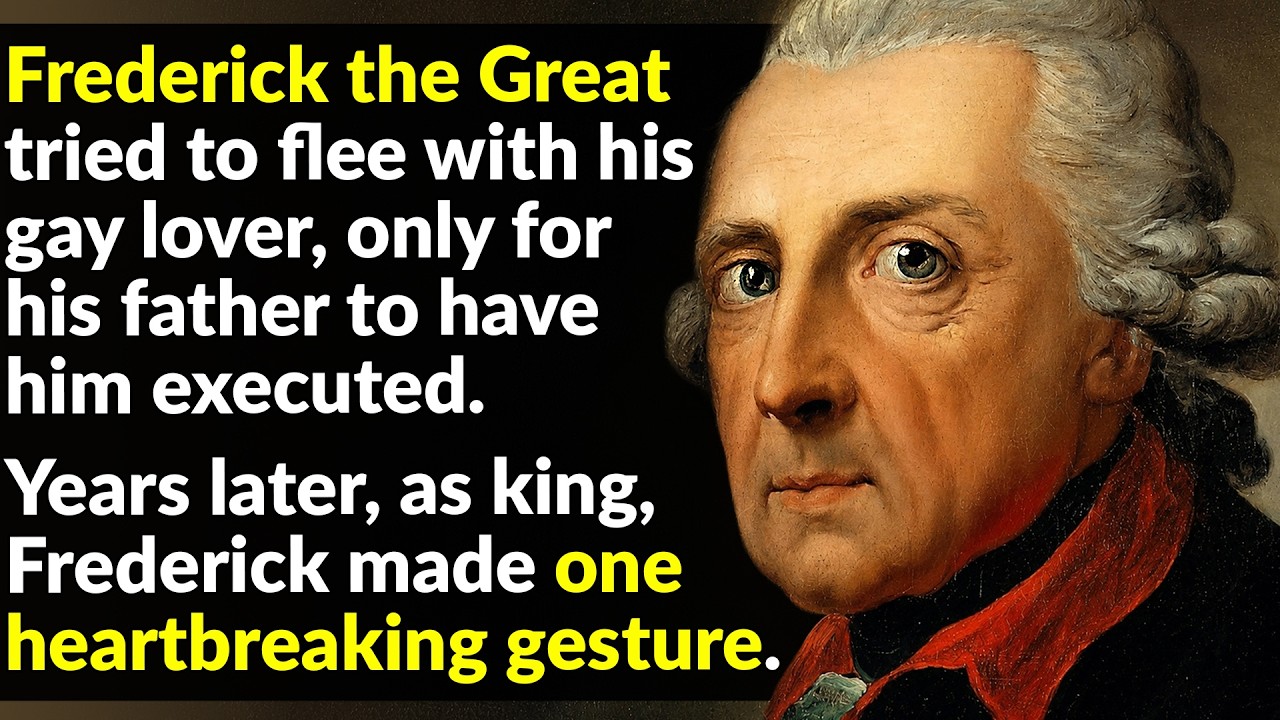
Frederick the Great spent his entire life trying to escape the shadow of his brutal father. That escape came at a terrible cost, ending with the execution of the man he loved most, carried out directly beneath his prison window. Born in January 1712, Frederick was the answer to the Prussian royal family’s desperate prayers. His grandfather had already buried two grandsons, and the line of succession seemed perilously fragile.
But by the time the old king died a year later, the new crown prince was healthy and happy. His father, however, already looked upon him with suspicion. From the very beginning, it was clear that Frederick had no interest in fulfilling his father’s vision of a strict military heir. The Soldier King wanted a warrior.
What he got was a boy who modeled his entire personality on his mother, Sophia Dorothea. She was educated, poised, and refined, descended from the British royal family. She held more progressive views, and contemporaries described her as polite, charismatic, and learned. When his father berated him, she comforted him.
Frederick knew exactly which parent he wanted to emulate. Frederick’s passion was his education, and he threw himself into it with a group of brilliant tutors who trained him in languages, history, the classics, and rhetoric. But that was only half of it. Behind his father’s back, and with the help of one of those tutors turned accomplice, he quietly amassed a secret library of three thousand forbidden volumes, poetry, philosophy, French literature, and the classics of Greece and Rome.
Secret palace libraries, however, rarely stay secret for long. One day in June 1730, the Soldier King returned home early, and Frederick’s double life unraveled in an instant. The king stumbled upon the secret stash of books and fine clothing and did what any stern Prussian father would do. He threw everything he found into the flames.
Anything that survived the fire was sold or auctioned off. It was meant as a warning. Frederick ignored it. Frederick’s father could burn his books, but he could not control who his son was drawn to.
When a seventeen-year-old boy named Peter von Keith arrived at court, Frederick was the first to notice him. The two became inseparable almost immediately. So inseparable, in fact, that the court could not help but speculate, and even Frederick’s sister, Wilhelmine, noted that Keith served her brother out of genuine devotion. When rumors of something beyond friendship reached the king, his response was swift.
Keith received a promotion that conveniently moved him as far away from Frederick as possible. Frederick’s heart did not remain broken for long. In 1729, during a private mathematics lesson, he met Hans Hermann von Katte, who was cultured, worldly, and everything the crown prince admired. The two bonded over their love of poetry and the flute, and the court quickly took notice.
One observer remarked that the pair behaved like a lover with his mistress. Frederick’s sister admired Katte’s intelligence and manners, but she could not shake a feeling of dread. As it turned out, her concern was justified. By 1730, Frederick had reached his breaking point.
He was done with the drills, done with the mockery, and done with Prussia itself. He wanted out. Katte, his closest confidant, begged him to reconsider, but Frederick would not listen to anyone. That month of June, they planned his escape from the camp at Ziethen together.
It might have gone smoothly if he had only been able to find a pair of horses. His next attempt to escape the confines of Prussian royal life would end in disaster. On the fifth of August 1730, while the royal procession camped near Mannheim, Frederick made his move. With Katte’s help, Frederick slipped away in the early morning hours toward horses waiting for him.
He might have become the prince of history who got away, had his servant not caught him and raised the alarm. But the worst was still to come. Guards arrested Frederick and Hans and confined them to the fortress at Küstrin. The crown prince of Prussia had become his father’s prisoner.
Frederick worried less about himself than about his co-conspirators. “Go and save yourself. Everything has been exposed,” he wrote to Keith. Keith did not need to be told twice.
With the help of the British ambassador, Lord Chesterfield, Keith escaped to The Hague, then made his way to England. Frederick’s father found other ways to punish his son. Frederick had managed to get Keith out of the king’s reach, so the king turned to creative methods. Unable to touch his son’s partner and friend, Frederick William I hanged an effigy of Keith on the gallows in his place.
A straw figure swung in place of the man who had escaped punishment. It might have been almost funny, had Frederick William I stopped there. For Hans, Frederick begged his father to show mercy. So, when the court sentenced Hans to life imprisonment for his role in the escape plot, Frederick breathed a sigh of relief.
But not for long. Frederick William I tore up the sentence and ordered Hans’s head cut off, reasoning that it was better for Hans to perish than for justice to vanish from the world. Frederick was not alone in pleading for his friend’s life. The envoy of Emperor Charles VI, Count Seckendorff, also intervened, begging Frederick William I to show clemency.
But the Soldier King ignored every word spoken to him. His cold resolve was clear in a letter he wrote to Hans’s father: “Your son is a scoundrel, and so is mine. What can fathers do about that? ”
Frederick witnessed the devastating answer to that question.
Frederick’s father showed just how cruel he could be on November 6, 1730. That morning, guards led Hans to an execution platform designed by the king to be directly beneath Frederick’s window. “Please forgive me, dear Katte,” the prince cried out. “For God’s sake, forgive me.
” Hans replied quietly, “There is nothing to forgive. ” He said he would go to his grave with a heart full of joy. Then the blade fell, and Frederick collapsed to the floor unconscious. By order of Frederick William, Hans’s body remained on the platform through the night, just outside Frederick’s window.
The loss of his friend, and possibly his lover, was unbearable. Frederick withdrew from people for three days. Then grief turned into something worse, absolute silence. For the rest of his long life, Frederick never mentioned Hans’s name, nor did he once visit his grave.
Meanwhile, Frederick’s own punishment had only just begun. About two weeks after Hans’s execution, Frederick received his sentence, or his pardon, though it did not feel like one. His father stripped him of his rank, kept him imprisoned, and forced him into rehabilitation in the art of governance and administration. His only break from the monotony came when the king allowed him to travel to Berlin for his sister’s wedding.
Frederick’s own wedding bells were already ringing. To him, they sounded more like death bells. Frederick regained his freedom on February 26, 1732. The price was marriage.
The king released him from Küstrin with one non-negotiable condition: he was to marry Elisabeth Christine of Brunswick-Bevern, a bride chosen by his father. To sweeten the deal, Frederick regained his position in the prestigious Prussian army, taking command as a colonel. He accepted the deal but never accepted the bride. Frederick made no secret of his feelings about his engagement.
“There can be no love or friendship between us,” he confided to his sister about his future bride. In moments of despair, he even spoke of ending his own life rather than going through with the marriage. But when June 12, 1733, arrived, Frederick swallowed his despair and spoke his wedding vows. He kept that vow the way he kept all unwanted things, by keeping them at a distance.
Frederick finally brought joy to his father’s heart when he marched toward the Rhine to fight the French in the War of the Polish Succession. But the irony was on Frederick himself. While serving under Prince Eugene of Savoy, the most celebrated commander of the age, the prince realized he was more shrewd at strategic planning than Eugene. Frederick made a note for the future: Austria could be his for the taking.
Now finally satisfied with his son, Frederick’s father made a rare reconciliatory gesture and gave him Rheinsberg Palace. But not much changed in the relationship between father and son. Frederick immediately filled his new palace with everything his father despised: painters, actors, musicians, books, plays, and his own musical compositions. He would remember those years as one of the happiest periods of his life.
And certainly they were among his most productive. Frederick spent his leisure time at Rheinsberg in intellectual struggle with Machiavelli. In 1739, he wrote “Anti-Machiavel,” a critical essay refuting “The Prince” and its pessimistic view of power. Of course, he could never publish it under his own name.
So he had his close friend Voltaire distribute the anonymous edition from Amsterdam, and readers across Europe devoured it. The world was about to discover what Frederick’s principles looked like in practice. Frederick’s life changed completely on May 31, 1740. King Frederick William I breathed his last, and the twenty-eight-year-old philosopher prince became the third King of Prussia.
But his new kingdom looked more like a military barracks. As King of Prussia, Frederick took command of the fourth-largest fighting force in Europe, one that consumed eighty-six percent of the budget and put one man in uniform for every twenty-eight citizens. Everyone expected the flute-playing king to let this military machine rust. Everyone was wrong.
One of King Frederick’s first acts had nothing to do with running the state. Within a month of taking the crown, he promoted Hans’s father to field marshal and hereditary count, a gesture Europe immediately understood as an apology, arriving ten years late for the grave injustice his father had committed against Hans. But Frederick still never spoke his friend’s name aloud. Shaking off his father’s legacy proved harder than he thought.
Despite all his suffering, Frederick could not entirely erase his father from his life. The new king admitted years later, “What a terrible man he was, but he was intelligent and skilled at managing affairs. Through his efforts, and through his tireless work, I was able to achieve everything I have accomplished since. ” And he accomplished a great deal.
Frederick continued to free himself from his father’s legacy, down to his marriage. The new king housed Elisabeth in Schönhausen Palace, barred her from his court at Potsdam, and saw her only on official occasions. In fact, her birthday was one of the few days he appeared before her out of uniform. To her credit, she remained a faithful wife to the end.
Frederick, for his part, reserved his devotion for conquest. Frederick spent his first month on the throne realizing that the ideals he had expressed in “Anti-Machiavel” remained confined to its pages. On December 16, 1740, his troops poured into Austrian Silesia without provocation, and within weeks, Frederick swallowed nearly the entire province. In one stroke, he doubled his subjects, expanded his kingdom by a third, and gained control of the navigable Oder River.
Even Machiavelli himself could not have planned it better. But there was one embarrassing obstacle. Frederick the Great was not always so great. At the Battle of Mollwitz in 1741, an Austrian attack scattered Frederick’s cavalry.
The newly crowned king fled the battlefield, certain all was lost. Thanks to Field Marshal Kurt Schwerin, who held the line, Frederick’s men regrouped and won anyway. Frederick, his face flush with shame, later admitted his humiliation at abandoning command and called Mollwitz his school. Fortunately, he was a quick learner.
To defeat the Austrians, Frederick had to win victories both on and off the battlefield. After an intensive campaign to place a friend on the imperial throne, he finally got his way. On January 24, 1742, precisely on his thirtieth birthday, the electors granted his man, Charles VII, the title of Holy Roman Emperor. By June, exhausted Austria signed away Silesia and the county of Glatz to Frederick.
The victories kept piling up, and so did the titles. Christmas Eve 1745 brought him the gift of a lifetime. The Treaty of Dresden confirmed his control of Silesia for good, cementing his legacy just five years into his reign. It was such a stunning achievement that people began calling him “Frederick the Great,” the strategic and tactical genius who had humiliated mighty Austria twice.
But Frederick wanted to be remembered as more than a conqueror. Frederick the Great wanted to be great off the battlefield as well. Through a series of sweeping reforms, he restructured Prussia’s judicial system, banned brutal interrogation practices, and relaxed restrictions on the press. He also made sure people’s pockets stayed full by building new canals and lowering internal duties and protective tariffs.
Under Frederick’s rule, Berlin grew into a cultural capital of Europe, complete with a composer as king. Frederick the Great preferred orchestras to armies, and in 1746, after securing Silesia, he returned to his musical scores. In a first for a Prussian king, Frederick personally presented a melody of his own composition to Johann Sebastian Bach. The maestro turned it into canons and fugues within his famous musical work.
Frederick decided to compose a follow-up concerto using the canon. Frederick the Great woke in 1756 to find Europe’s chessboard rearranged against him. Austria had allied with France and Russia, two old rivals. Frederick was left with only England as a strong ally, surrounded by enemies half a continent away.
Frederick did not wait long. He struck first. On August 29, 1756, he invaded Saxony, igniting a continental conflict that lasted until 1763. But this time, Frederick’s audacity carried a heavy price.
Frederick’s treatment of Saxony shocked even the most cynical observers. When the besieged Saxon forces surrendered at Pirna in October 1756, Frederick did not release them. He incorporated them into his ranks. Admiring their fighting prowess, Frederick forced the defeated men to join his army despite their objections.
Europe feared that the son of the Soldier King was worse than his father. Frederick’s reign nearly ended abruptly and early on August 12, 1759. At Kunersdorf, combined Austrian-Russian forces crushed Frederick’s army, destroying nearly half of it. The king himself survived by sheer luck.
An enemy bullet struck the snuffbox he carried, saving his life by inches. Total defeat and a disgraceful end seemed inevitable. Then, incredibly, the victors stopped advancing. The stunned Frederick called it the “Miracle of the House of Brandenburg.
” He would need another miracle before the end. By January 1762, the supposedly invincible Frederick the Great had lost all hope. Russian troops were marching toward Berlin, and the king began writing like a defeated man. “We must now think of preserving what can be saved of our lands for my nephew, through negotiations, from the greed of my enemies,” he confided to Count von Finkenstein.
Days later, fate handed him the greatest luck of his life. Frederick’s salvation came in the form of an obituary. Empress Elizabeth of Russia died suddenly in January 1762, and her successor, Tsar Peter III, happened to be one of Frederick’s greatest admirers. The new tsar, who had once wished he were a Prussian general rather than Russia’s tsar, ordered the Russian advance stopped immediately.
Frederick the Great had survived a situation that seemed impossible. Now it was time for settlement. Frederick the Great emerged from the long conflict in 1763 with his kingdom intact and set to work immediately. With the signing of the Treaty of Hubertusburg, he divided his government into specialized ministries, pushed settlers into undeveloped lands across the kingdom, and promoted two simple crops that fed generations.
Turnips and potatoes. Frederick the Great saved his greatest conquests for 1772, and he did not need to fight a single battle to achieve them. In agreement with Catherine the Great and Maria Theresa, he simply agreed to the partition of Poland. Frederick’s share, thirty-eight thousand square kilometers and six hundred thousand new subjects, finally connected his scattered territories.
He even changed his title from King in Prussia to King of Prussia. Frederick’s new subjects were about to see his crueler side. It turned out Frederick’s Enlightenment principles stopped at the Polish border. The king scorned his new subjects, dismissed them as neglected Polish scum, and set about remaking the region by force.
German settlers flooded in, land ownership of crown and monasteries changed hands, conscription was imposed, and a harsh tax system drained the Polish nobility. Frederick the Great, the philosopher king, remained a Prussian at heart. Frederick the Great took his deepest secrets to the grave, almost. Historians who study the king’s life now generally agree that he was inclined toward men, with his strong youthful bonds to Peter Keith and Hans Hermann von Katte at the center of the debate about his orientation.
How far those intimate relationships went remains one of history’s open questions. Where Frederick’s heart truly lived was never in doubt. It was with the artists, writers, and musicians with whom he filled his court. Though sometimes it went beyond admiration.
Frederick the Great carried on a fiery emotional affair with the French writer Voltaire, leading to the biggest scandal of the Prussian king’s life. While Frederick was initially fascinated by Voltaire, the two fell out, and Voltaire was forced to flee Prussia. Later, Voltaire wrote about the relationship in his memoirs. Though he never revealed Frederick’s secrets, thieves stole the work and published it for the whole world to see.
Europe was shocked. The greatest general on earth had been involved with another man. For his part, Frederick simply ignored the pamphlet and went on with his life. He never felt ashamed of who he was.
Frederick the Great died where he was always happiest, on August 17, 1786. The seventy-four-year-old king passed away at Sanssouci, the rococo palace in Potsdam that he loved more than any other place on earth. But because of his loveless marriage, he left no children and no heir.
Instead, the crown passed to his nephew, Frederick William II, and just as Frederick had wished, Sanssouci became his final resting place.