The city underneath her is never named, not once in two hours. That was a decision rather than an oversight. Audiences in the autumn of 2003 got a war between two species fought in the dark for six centuries, staged with enough conviction that most people never stopped to ask where any of it had come from. What they could not see was the chaos behind it all.
It started with a director nobody would hire and a story stitched together from other people’s movies. Len Wiseman told the Los Angeles Times he initially assumed he was making something “cheesy,” and only came around once he understood how good the film could be if the studio left him alone with it. At that point, his entire industry standing rested on prop work and music videos. A studio wanted a werewolf picture.
That was the whole brief. Wiseman took it to his friend Kevin Grevioux, an actor who also wrote, and what came back was stranger than the assignment. Cross Blade Runner with The Howling and you get a man hunting werewolves through a rain-soaked modern city at night. Layer Romeo and Juliet over the top, and the two species stop being monsters.
They become warring families instead. Danny McBride, a stunt performer who had moved into screenwriting, came in as the third writer, so the three of them could build the story from nothing. One decision from those early sessions shaped everything that followed. McBride wanted the word “werewolf” dropped, arguing that decades of bad horror had worn it past the point of usefulness.
The script shortened “lycanthrope” and called them “Lycans. ” It sounded clinical, almost medical, which suited what Grevioux was about to do to the mythology. On paper, it should have been an easy sell. Vampires against werewolves, guns, leather, a built-in audience that had been waiting years for somebody to take the idea seriously.
In the room, it kept getting refused. The problem was the man attached to direct. Wiseman’s resume ran to prop work and general duties at Roland Emmerich’s Centropolis effects, working on Stargate, Independence Day, and Godzilla. There were music videos too.
Executives asked one question: how many features had he made? The honest answer was none. The obvious fix was to hand the script to somebody with credits and take a story fee instead. He would not do it.
After years of refusals, Lakeshore Entertainment agreed to make the thing. The director nobody would trust with a first feature ended up launching five films across 13 years, a series that has taken well over half a billion dollars worldwide. Watch the mansion scenes closely, and something is missing. These vampires pass mirrors and show up in them.
The Lycans change without waiting for a full moon. No one in the coven flinches at a crucifix. Garlic never comes up at all. Seventy years of genre furniture was carried out of the room.
That came from Kevin Grevioux, who graduated from Howard University with a degree in microbiology and had moved toward graduate work in genetic engineering before dropping out for film. He wanted science holding the mythology up, not superstition. He built a viral mutagen shared by both species, turning vampirism and lycanthropy into two strains of one illness. An illness has carriers, mutations, a first patient, and a family tree, so a genealogy takes the place of folklore.
That single choice is why the plot hinges on a bloodline, why a hybrid is possible at all, and why four sequels had somewhere to go afterward. Most vampire films in 2003 were still working from rules audiences could recite by heart. The critic at Salon called the film many unkind things while still allowing that the backstory had been meticulously worked out. Kate Beckinsale told the BBC she assumed a vampire job involved a ginger wig, a long nightgown, a great deal of screaming, and garlic, and she was ready to pass on it without much thought.
She had built a career in period drama and light romantic comedy. Horror held no interest for her whatsoever. What changed her mind arrived attached to the script. Wiseman had storyboarded the entire picture himself in pencil, showing precisely what every sequence would look like before a single location had been booked.
Those panels sold her on a slick action film rather than what she was bracing for. Wiseman has said the artwork was the only argument he had in a business where nobody knew his name. Scott Speedman, fresh off Felicity, admitted he had not even read the script when the artwork convinced him the visual style was off the charts. There was a second reason Beckinsale said yes.
Selene as written could have been a man without a single line of dialogue changing. She liked that about the part. The coldest sequence in the picture is the one the entire plot bends around. Stone walls, chains, and a shaft of daylight opened above a woman who could not survive it.
Her father had given the order. He stood and watched it happen, and he made the man who loved her watch as well. Grevioux has been open about where it came from. The Romeo and Juliet framing, he said, was largely a device to sell the pitch.
The real source was years of dating outside his race, the biracial children he had met along the way, and the hostility he had watched land on couples who did not match in the eyes of strangers. He translated it into a species war so it could reach people who would switch off anything that addressed the subject directly. Sonia was carrying Lucian’s child, which made her a threat to the purity of a bloodline. So her own father had her put to death for it and called it duty to his people.
Take away the fangs and the ceremony, and what is left is ordinary prejudice followed to its end point. Grevioux’s summary still lands hardest: “50 years on from the marches, people seem to have learned nothing whatsoever about brotherhood. ”
Halle Berry was on the short list for Selene, alongside Milla Jovovich and Rhona Mitra. Berry pulled on her own skintight black costume the following year for Catwoman, and the two performances now sit in film history as a lesson in how much the material matters.
Jovovich had already headlined Resident Evil a year earlier and ended up on the soundtrack instead, singing on a track produced by Danny Lohner. Mitra, passed over for the lead, was cast six years later as Sonia, the daughter whose death sets the whole war in motion in Underworld: Rise of the Lycans. Later editions of the first film swap her into the flashbacks. The actress who lost the part ended up inside it anyway.
For weeks, the production could not find the right actor to lead the Lycans. The role had to carry the film’s entire moral argument in a handful of scenes. The suggestion came from Beckinsale. Michael Sheen was her partner at the time and the father of her daughter, and she put his name forward.
He read for Wiseman, impressed him, and took the part. What followed is usually told as gossip. During the production, Beckinsale’s relationship with Sheen ended, and she began one with Wiseman, whom she married in 2004. The part that rarely gets repeated is the gracious footnote.
Sheen later helped Wiseman with casting on Underworld Evolution. Their daughter Lily plays the young Selene in that sequel, and Beckinsale has described Sheen as her best friend in the years that followed. Week one was shot underground in a disused station with no air conditioning during a heatwave with most of the cast in full-length leather coats. Then Budapest turned Arctic almost overnight.
The latex costume behaved exactly like the weather. Beckinsale has described it as a second skin, clinging everywhere, and peeling out of it at the end of a day took an age with help. She reportedly lived on chicken and cabbage for the duration since the outfit forgave nothing. The cast had two weeks of wire work and weapons training, which is not a great deal of preparation for what the schedule was about to ask.
Day two of the Budapest schedule, the lead actress had almost no training on firing weapons. The sequence waiting for her involved emptying two handguns into concrete while Lycans closed in from the dark. Exactly one support had been rigged with squibs to blow out on cue, and there was no money to rig a second, which meant the shot existed once or not at all. Wiseman’s remembered framing was “no pressure.
But if you get it wrong, the whole thing is ruined. ”
He pointed out on the DVD track that the entire film cost roughly what the highway chase in The Matrix Reloaded had cost by itself. As for the shot, she got it first time, then she shook. She has said her hands felt as though she had drunk 20 cups of coffee and that it took hours to come down again.
The head arrived in its own case. A muzzle wired to an animatronic rig. Yak hair punched into the skin one strand at a time and a small video feed mounted inside so the performer could see where he was going. Patrick Tatopoulos had designed the Lycans to be built rather than drawn, which was already an unfashionable position in 2003.
Each creature was a foam latex bodysuit with leg extensions made for one specific performer, so the loping walk came from a human being balancing on stilts. A single werewolf in frame took four people to operate, which is why the creatures appear in short bursts instead of long sustained shots. Before filming started, Beckinsale asked for the revealing material to come out of the screenplay, and it came out. Her reasoning was sharper than simple reluctance.
Selene had to read as the film’s actual hero, and nobody demands that kind of shot of Bruce Willis in Die Hard. She also pointed out that the latex outfit was already doing plenty of work without any help from the camera. In the first draft, Selene does not save the day at the end. Wiseman has said Beckinsale raised the problem at their very first meeting, before she had the part, which means the ending audiences got exists because the lead pushed back on a script she had not yet been hired to perform.
The champagne cellar under the city had been sealed for decades, and the walls had gone soft with growth five inches thick. That cellar became the Lycan den. Beckinsale has said the film was shot largely in condemned buildings, a fair number of them full of asbestos, and that the cellar made people ill. She came down with pneumonia.
A large portion of her performance was filmed while she was sick, coughing between takes and going straight back in. The abandoned steel mill was worse. During production, part of the roof came down, smashing onto the soundtrack below and forcing an evacuation. Nobody was hurt.
Wiseman’s joke was the blackest thing on the commentary track: whenever the schedule ran behind, he thought about sending production assistants up to knock a bit more of it loose, because a building coming apart around you is the one delay an insurance company pays for without an argument. Bill Nighy gave the BBC the word “unspeakable” for the process of having his head and body cast for prosthetics. Victor had to look like a vampire elder dragged out of a century of hibernation, which meant roughly six hours in the chair before work could start on any day he was needed. He was in his early 50s, better known for British television and the stage, and he made almost no complaints.
In the climax, he performed much of his own fighting despite never having done so much as a stage fight before. Wiseman admitted later that they beat him up badly and that he never once said it was too much. Around the 37-minute mark, guard animals are let loose on Michael outside the vampire mansion. The animals available were tame and playful.
Wiseman shot short clips of them running toward camera, then layered savage barking over the top in post. Look closely at any of those shots, and the giveaway is right there in frame because the tails never stop moving. Two performers split the work in the chase. Michael Sheen handled the close material himself, while stuntman Todd Schneider took the long shot of Lucian tearing along the road at what reads on camera as better than 50 miles an hour.
The trick was an elaborate rig towed behind the car, so a man genuinely was traveling at that speed a few feet from the vehicle. The sprawling underground network where the final battle takes place was never built. What existed was a single small set of broken concrete shot from different angles, relit each time, dressed slightly differently, and cut together to read as several distinct locations. Wiseman laughed about it on the DVD commentary and pointed out exactly where the trick had been used.
The tally of injuries runs longer than its reputation suggests. Beckinsale caught stunt coordinator Scott Mrooy hard enough to break his nose, and he deliberately kept it from her. Speedman broke stunt performer Mike Gunther’s nose during their fight, then took a hit to the head himself and came away with a concussion. Beckinsale’s own list runs to four entries she can still recite: shrapnel in the face, a permanent scar from being dragged over a nail, a wrenched knee, and a heavy collision with a window frame.
The funniest entry did no damage to anybody. She misjudged a shot and fired into the mattebox, taking it clean off the front of the camera in front of everyone. Crew members began turning up to work in what amounted to hockey gear. On paper, the reception was a burial.
The film holds a 30% rating on Rotten Tomatoes with a consensus calling it stylish to look at and derivative underneath. The people buying tickets disagreed. It opened at number one with roughly $21. 8 million, finished on $95.
7 million worldwide against a $22 million budget, and took a B+ from CinemaScore. Days before the American opening, the president of Screen Gems greenlit both a sequel and a prequel. The charge that stuck hardest was that the black latex and the gunplay had been lifted wholesale from The Matrix. Wiseman’s reply was to ask what else he was supposed to put a vampire in.
Fuchsia. Beckinsale was blunter, pointing out that nobody accuses one police film of copying another for putting men in uniform. Roger Ebert gave the film two stars out of four and explained that it was so impossible to care about the characters that he did not mind which side won the war. Twenty years on, his review is still the most quoted thing anybody published about it.
At the formal feast, one seat was meant to be filled by somebody else entirely. Wiseman wanted David Bowie at that table playing a vampire, a direct nod to The Hunger. It collapsed for the dullest reason available: scheduling. The detail that stings arrived later when the production heard that Bowie would have been interested.
Lucian was introduced as the thing in the dark that has to be put down. By the closing scenes, he is arguably the only figure in the story with a clear conscience, and that was never the plan. The revelation comes in three parts. The Lycans had been slaves to the vampires.
Lucian had loved Victor’s daughter. Victor had her put to death for it and made Lucian watch. Wiseman has said there was a push to keep Lucian a flat villain and Victor a straightforward ally, and that the team had to fight to hold the backstory in place. They won, and the entire moral architecture of the film came with it.
Several of the faces in the coven scenes belong to people who had no business being in front of a camera at all. Danny McBride plays the vampire Mason, and Wiseman has joked that his single shot, a gun being dropped, took 19 takes before he went back and used the first one. Wiseman appears himself, though only his hands do. Grevioux plays Lucian’s enforcer, Raze, and the production has confirmed his extraordinarily deep voice is entirely natural with no modulation applied.
The night before the confrontation was filmed in a hotel in Budapest, the team was still rewriting it. Victor’s admission that he had killed Selene’s family, and his own daughter before that, is the loadbearing scene of the entire picture. Nobody wanted to be the one to tell Bill Nighy that the pages he had learned were gone. He took the news entirely in his stride, learned the new pages between setups, and by Beckinsale’s account, preferred the new version.
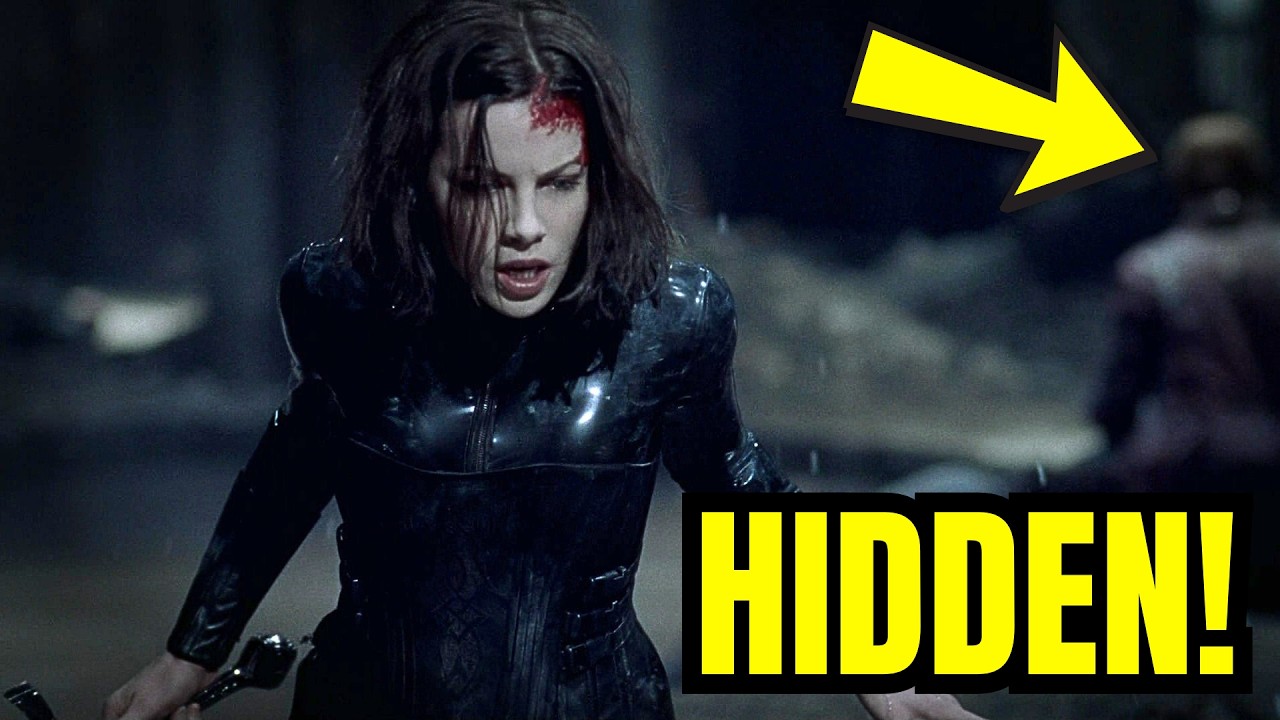
Everything the cast spent that shoot covered in came out of a supermarket. The red was cranberry, poured cold, sticky, drying into the leather between takes. Wiseman was obsessive about the color. He wanted something dark, almost brown, and rejected anything that read as bright.
A good deal of the film was removed before release. Michael’s full backstory monologue went first, along with a subplot fleshing out Erika’s part in the conspiracy, a flashback showing the Lycans branded as Victor’s property, and a kiss between the two leads that made it into the trailer and never into cinemas. Wiseman stated the commercial reason outright: a film’s runtime determines how many times a cinema can screen it in a day. An extended edition later restored several of those scenes.
In a federal court in Atlanta on September 4, 2003, two weeks before the picture reached cinemas, White Wolf Incorporated and author Nancy A. Collins filed against Sony Pictures, Screen Gems, and Lakeshore Entertainment. The claim ran to 17 counts of copyright infringement and more than 80 points of what the plaintiffs called unique similarity. Among them, a vampire and werewolf hybrid referred to as an abomination.
Collins added that the script closely resembled her 1994 story “The Love of Monsters. ”
The plaintiffs asked for an injunction, which would have stopped the release outright. A judge granted White Wolf an expedited hearing. No verdict was ever reached.
The case closed in a confidential settlement whose terms have never been made public. What Underworld turned out to be is stranger than its reputation. A film assembled from one rubble set, borrowed dogs, a disused subway station, and a cast working through illness became the template for a decade of leather-coated supernatural action, turned a period drama actress into one of the very few women to headline an original action franchise for 13 years, and proved that an invented mythology worked out properly can outlive every review written about it.