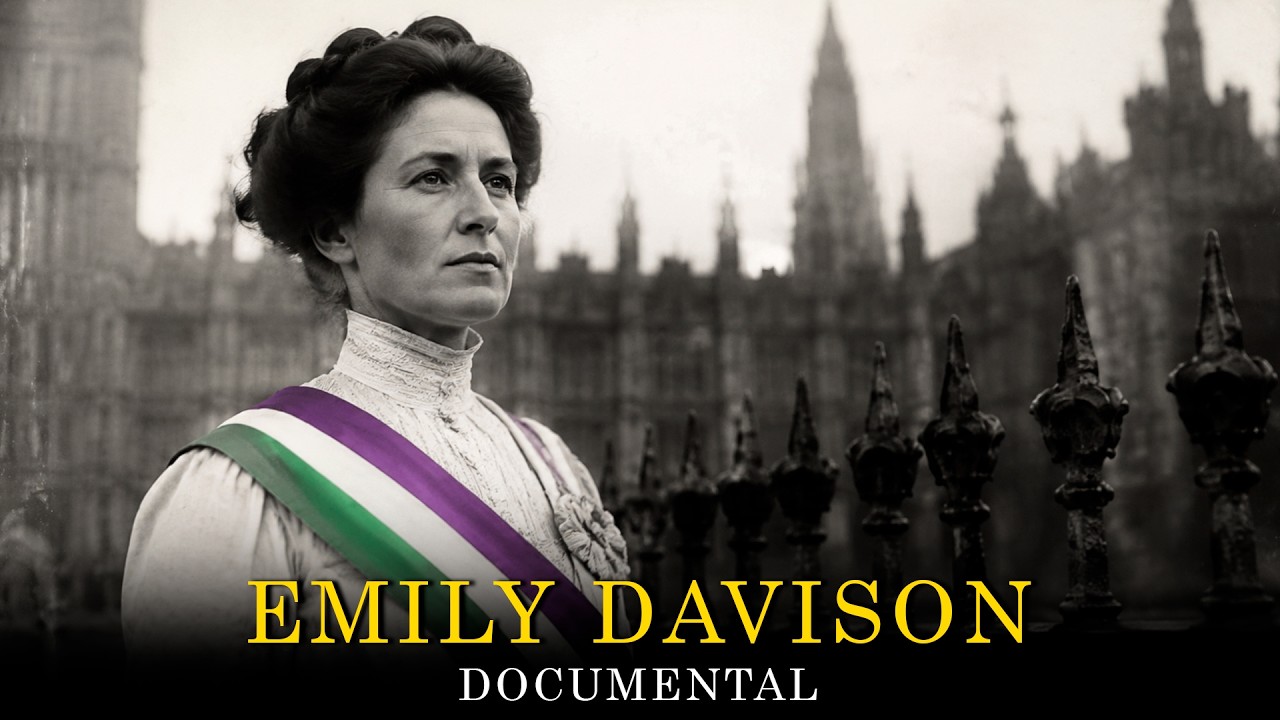
The 1913 Epsom Derby was meant to be a celebration of British sporting life, attended by the King and Queen and watched by hundreds of thousands. Instead, it became the stage for one of the most dramatic political acts in British history. Emily Wilding Davison, a 40-year-old suffragette, stepped onto the track at Tattenham Corner and raised her hands toward the reins of the King’s horse, Anmer. Within six seconds she had been struck down.
Four days later she was dead. Davison was born in Blackheath in 1872, the daughter of a retired merchant from Morpeth. The family was comfortably middle class, and Emily received a strong education, attending Kensington High School and then Royal Holloway College. In 1893, her father died suddenly.
The family’s income dropped sharply, and Emily could no longer afford her place at Royal Holloway. She withdrew and began working as a teacher and governess, saving her salary until she could afford to study again. She enrolled at St Hugh’s Hall, Oxford, as an external student. In 1895, she completed the final honours course in English Language and Literature.
The examiners awarded her a first-class degree, the highest distinction the university could give. She was never granted a certificate. Oxford did not permit women to graduate until 1920, twenty-five years later. She left Oxford with the examiners’ verdict in a leather portfolio and the beginning of a lifelong anger.
The British state classified her as a domestic servant. The 1901 census recorded her as a resident governess in Worthing. Her salary was about £65 a year. A male teacher with the same qualifications could expect considerably more.
Women could not vote. They could not sit on juries. They could not stand for Parliament. A married woman’s legal independence was still a recent reform.
Emily, unmarried, was technically more free than her married sisters, but the state she paid taxes to gave her no voice in how that money was spent. In October 1906, she attended a meeting in London where Annie Kenney, a former Lancashire mill worker, spoke about her time in Strangeways Prison and the difference between asking for the vote and seizing it. Emily joined the Women’s Social and Political Union that November. She was 34 years old.
She had found a cause that fit the shape of her anger. For the 1911 census, the WSPU organized a boycott. Women were urged to refuse to be counted. Emily went further.
She spent the night hidden in a broom cupboard in the crypt of St Mary Undercroft within the Palace of Westminster. On the census form, her address was recorded as the House of Commons. She had achieved exactly what she wanted. She was the only person known to appear twice in the same census, in two different places on the same night.
The authorities were embarrassed. The Speaker ordered the cupboard locked. Emily was imprisoned seven times. In March 1912, she was sentenced to six months for breaking windows in Whitehall.
The Home Office decided, without her request, that her health required force-feeding. She was force-fed forty-nine times. The procedure involved leather restraints, a metal gag, and a rubber tube inserted through the throat or nostril into the stomach. The pain was severe, but the after-effects were worse.
The tube tore the mucous membranes. Vomiting could cause pneumonia. Doctors who refused to perform the procedure resigned and gave public testimony. In June 1912, she climbed onto an iron balcony in Holloway Prison and jumped.
The fall was about nine meters. A wire netting, installed after previous suicide attempts, broke her fall, but she still fell four and a half meters to the stone floor below. She suffered a broken collarbone, cracked ribs, spinal bruising, and a head injury. She wrote an article afterward, titled “The Price of Liberty,” smuggled out of prison in folds of paper.
She wrote that she felt only through the sacrifice of a human life could the nation realize the terrible suffering of their women. She asked what a glorious end it would be if she had been killed instantly. The prison balcony was a rehearsal for Tattenham Corner. The state did not stop the force-feeding.
She concluded that the death the cause required must be public, must occur at a national event, and must be impossible for the government to absorb into a Home Office statement. She left Holloway in autumn 1912, thinner and walking with a slight limp. She immediately resumed her work as a militant. She had been involved in arson attacks and window-smashing campaigns.
She was known for her attacks on postboxes. In December 1911, she damaged a postbox in Parliament Square with a chemical mixture of phosphorus and potassium chlorate, burning the letters inside. In February 1913, she was involved in the bombing of Lloyd George’s new country house, an attack that destroyed part of the roof. No one was injured.
By April 1913, the government had passed the Prisoners (Temporary Discharge for Ill Health) Act, known as the Cat and Mouse Act. It allowed the Home Office to release a hunger-striking prisoner on temporary license when her health deteriorated, then rearrest her once she recovered. The government hoped this would end the martyrdom narrative. They miscalculated.
The Act had three consequences for Emily. It ended the usefulness of hunger strikes. It confirmed that constitutional protest was exhausted. And it removed the moral pressure of public sympathy for force-fed prisoners.
On June 2, 1913, she wrote her last article for The Suffragette. She argued the cause now required a single act of public witness the state could not absorb. She mailed it and went out to buy a return train ticket to Epsom. The Derby was forty-eight hours away.
She woke on the morning of Wednesday, June 4, 1913. She sewed two flags into the lining of her coat. Each flag was about 45 centimeters long and 61 centimeters wide, in the movement’s colors: purple, white, and green. Each was held in place by a series of small loops she had sewn with cotton thread the night before.
She ate breakfast. She wrote a short letter to her mother that she never sent. She wrote a second letter to her landlady, leaving it on the kitchen table. It thanked her for her kindness and asked her to send a telegram to the WSPU office if anything happened.
She took the tube from Russell Square to Charing Cross, then walked to Victoria Station. She bought a second-class return ticket to Epsom Downs. The ticket cost 95 pence. The fact that it was a return ticket has puzzled historians for over a century.
A woman intending suicide does not usually buy a return ticket. A woman planning a public demonstration with a fifty percent chance of survival might. She boarded the 11:17 train and sat by the window. The carriage was full of men in straw hats on their way to the races.
No one paid her any attention. By two o’clock she had taken her place at Tattenham Corner. This is the long left-hand curve, six furlongs from the finish, where the field is most spread out and the viewing angles are the best. She stood among the spectators, leaning against the white inside rail.
She did not look at the paddock. She did not bet. She waited. The race began at 3:15.
As the leaders rounded Tattenham Corner, Emily bent smoothly under the white wooden rail. She stepped onto the turf. She did not run; she advanced perhaps two meters on foot. The first four horses passed her at full gallop.
She turned to face the next group as they rounded the bend. The King’s horse, Anmer, ridden by Herbert Jones, was at the back of this group. She raised her hands. Film analysis shows her hands were reaching toward the horse’s bridle, not his body.
She appeared to be trying to attach something to the horse. The analysis concluded she was trying to fix one of her flags to the bridle or saddle. Anmer was traveling at approximately 56 kilometers per hour. Emily’s right shoulder struck the horse’s chest.
The horse’s front legs hit her at waist level. She fell. Anmer’s hooves struck her head and chest. The horse turned over completely.
Herbert Jones was thrown through the air and landed heavily on the grass. The total time between Emily stepping onto the track and the collision was about six seconds. The collision itself lasted less than half a second. The race continued.
Aboyeur was declared the winner after the favorite, Craganour, was disqualified. The crowds cheered. The royal box, half a kilometer away at the finish line, knew nothing of the accident for several minutes. The first telegram that evening from King George V asked about his jockey.
The text survives: “Very disappointing day. Poor Anmer fell. Jones badly concussed. ” Queen Mary wrote one word in her diary: “Dreadful.
” Neither mentioned Emily by name. Emily was taken by ambulance to Epsom Cottage Hospital. She was admitted at 4:10 pm with a fractured skull, a fracture at the base of the spine, and severe internal bruising. The surgeon on duty, Dr.
Hilbert Peacock, recorded that she was unconscious and breathing shallowly. He expected her to die within hours. She did not die within hours. She remained on a single bed in a small room, isolated from the other patients, for four days.
Two suffragette nurses were allowed to attend her. Telegrams arrived from across the country. Some contained abuse. One, written in large rough capitals, read: “Hope you suffer torture till you die.
”
The hospital staff sorted the mail and burned the worst letters before her sister Letitia, summoned from Brittany, could see them. The newsreel footage of the collision was shown in cinemas across Britain within 48 hours. By the evening of June 5, an estimated four million people had seen the moving images of Emily Davison colliding with the King’s horse. It was the largest audience ever for a news film in British history up to that point.
The Home Office realized almost immediately that the political damage was on a scale they had never faced. Whatever Emily Davison’s intention, she had achieved something like a political communications event on the scale of a coronation. The press divided immediately. The Times called her a desperate woman whose action all sensible people condemned.
The Daily Mirror, which published the only clear photograph of the collision, was more restrained, calling it a tragedy. The Manchester Guardian, alone among the major papers, argued that whatever the merits of her tactics, her sincerity could not be doubted. The debate within the suffrage movement was sharper. Christabel Pankhurst, writing in The Suffragette from Paris, declared without hesitation that Emily had deliberately chosen martyrdom.
Sylvia Pankhurst, then estranged from her mother and sister, took a more nuanced position. She believed Emily was seeking a high-risk demonstration, not certain death. The strongest evidence for deliberate martyrdom is her own article, “The Price of Liberty,” published weeks earlier. The strongest evidence against it is the return ticket in her pocket and the fact she had paid her rent a week in advance.
The 2013 forensic analysis of the films suggested a middle probability. She intended a public demonstration of immense clarity. She had calculated that her chance of survival was perhaps fifty percent. She had accepted that the chance of death was equally fifty percent.
She had judged fifty percent an acceptable risk for the cause. Emily Wilding Davison died at 4:45 pm on June 8, 1913. The cause of death was recorded as a fracture at the base of the skull. She was 40 years old.
The coroner’s inquest held at Epsom Town Hall on June 10 concluded her death was an accident. The coroner told the jury there was no clear evidence of intent to die. The verdict satisfied no one. The Home Office considered it a sensible resolution.
The WSPU considered it a refusal to acknowledge a deliberate sacrifice. Christabel Pankhurst used the headline in The Suffragette the same week: “The First Martyr of the Women’s Movement. ”
Her funeral became the largest London had seen since the death of William Ewart Gladstone in 1898. Six thousand suffragettes in white walked behind her coffin.
Fifty thousand Londoners fell silent on the pavements. The procession formed at Victoria Station and followed a route that passed Buckingham Palace, crossed Trafalgar Square, and continued through Bloomsbury to St George’s Church. The total distance was about five and a half miles. The march took just under two hours.
At the front walked an honor guard of suffrage officials in academic dress, including women who had earned first-class degrees at Oxford and Cambridge without being allowed to graduate. Then came a lone woman riding a white horse, dressed in white and holding a wooden cross. Behind her, six women carried a black silk banner reading “Deeds Not Words. ”
The coffin was visible on an open hearse drawn by four black horses, draped in a purple silk funeral cloth embroidered with the word “Victory.
” The largest block of marchers wore white dresses with purple, white, and green sashes. A black block was formed by married women and widows. A block in academic dress was formed by graduates denied their degrees. A block in working clothes was formed by trade union women and East End women.
Men of the Men’s League for Women’s Suffrage walked separately, in slow motion. The funeral was a public spectacle. It was recorded photographically and cinematically. It was covered by every major newspaper in the country and the Empire.
It was the moment the British public grasped, as never before, the depth of feeling inside the suffrage movement. The political class took notes. It did not yet move. Herbert Jones, the jockey thrown from Anmer, carried the memory differently.
He suffered nightmares. He told his second wife that he saw Emily Davison’s face every time he closed his eyes. He told a journalist in 1940 that the face of that poor woman had haunted him for 27 years. At the funeral of Emmeline Pankhurst in June 1928, attended by politicians from all three major parties, one wreath carried a card reading: “In tribute to the memory of Mrs Pankhurst and Miss Emily Davison.
” It was sent by Herbert Jones. The Equal Franchise Act, passed on July 2, 1928, gave the parliamentary vote to all British women on equal terms with men. An estimated fifteen million women were added to the British electorate as a direct result of the suffrage campaign. Herbert Jones lived another 23 years.
He suffered depression in his late forties. He was gassed by a faulty water heater in his Epsom kitchen in 1950. On July 17, 1951, he hanged himself in that kitchen. He was 69 years old.
The Times obituary mentioned the Derby. It did not mention Emily Davison by name. Three places in Britain preserve her memory. A small brass plaque on the door of the broom cupboard in St Mary Undercroft in the Palace of Westminster was placed by the MP Tony Benn in 2000.
It is now part of the official parliamentary tour. A small wooden bench at Tattenham Corner in Epsom Downs, installed in 1993 by the local council, bears a bronze plaque recording that Emily Wilding Davison entered the racecourse and was struck by the King’s horse Anmer. The third place is an empty space. Holloway Prison was closed in July 2016 and demolished.
A small portion of the Victorian fabric was kept as a listed building. The original 1852 gates survive. A paved path through the new housing complex marks the line of D Wing. Visitors can stand on the exact spot where Emily threw herself from the iron balcony in June 1912.
There is no plaque. The fourth place is the family grave in St Mary the Virgin churchyard in Morpeth. Ribbons in suffrage colors are tied to the iron railings almost every day. On June 8 each year, the Northumberland Federation of Women’s Institutes lays a wreath.
In 2018, a bronze statue of Emily Wilding Davison was unveiled in Morpeth town center. It shows her standing, wearing her dark coat, holding one of the two flags she sewed into its lining 105 years earlier. The flag is unfurled. The wind carved in bronze blows from behind her.
What does her story tell us in the end? That a single, unmarried, highly educated, debt-free woman from Northumberland, denied her degree by Oxford and her vote by Westminster, concluded after fifteen years of escalating political failure that the British state would respond only to a publicly documented death on its most lavish stage. She was right. The voice she could not cast in 1913 was cast by fifteen million British women between 1918 and today.
The political class that refused to listen became, over the slow course of the twentieth century, a political class that no longer refused to listen to women. There is a darker side to this legacy. The British political system rarely responded to peaceful argument alone. It responded to the Chartists only after great distress.
It responded to Irish nationalists only after the Easter Rising. It responded to the trade unions only after the Tonypandy disturbances. It responded to the women’s movement only after Emily Wilding Davison’s body was lifted from the grass of Tattenham Corner. The structure of the British state was built on the bones of those who refused to be ignored.
The Palace of Westminster, Holloway Prison, and Epsom Downs are not three innocent buildings. They are three faces of the same political system. Emily Davison was the woman who understood that system from the inside. Oxford University, which refused to grant her a degree, had awarded her first-class honors.
Today, in the slow vote of a country that took a century to catch up with her, they call her by another name. They call her the woman who died so that women could vote. That is the heart of it.