Gianni Agnelli, heir to the Fiat automotive dynasty, was one of the most photographed and influential figures in European history. His life appeared to be a flawless myth: immense wealth, effortless style, and a commanding presence that defined an era. But beneath the surface of the perfect industrialist lay a far more complicated story of marriages, affairs, family tragedy, and legal battles that continued long after his death. Giovanni Agnelli, Gianni’s grandfather, founded Fiat in Turin in 1899.
Within decades, the company had become a cornerstone of Italian manufacturing, and the Agnelli family had grown into one of the most powerful private dynasties in Europe. The city of Turin itself revolved around the company, its workers, its unions, and its tax revenues all orbiting a single family. Gianni Agnelli was born on March 12, 1921, the eldest son of Edoardo Agnelli and Virginia Bourbon del Monte. His father died in a seaplane accident near Genoa in April 1935, when Gianni was just 14 years old.
The circumstances were never fully explained to the public, and the loss left a silence in the family that was never quite filled. His grandfather, the empire builder Giovanni Agnelli, became the dominant figure in his life. When Giovanni died in 1945, Gianni, at age 24, became heir to everything. He had served as an Italian army officer during World War II, fighting on the Eastern Front and later in North Africa, where he was wounded.
He returned home with a permanent restlessness that would define the rest of his life. By the late 1940s and 1950s, Agnelli was a fixture of European high society, moving between the Riviera in summer and Turin for business. He was surrounded by the most interesting, beautiful, and powerful people of the era. Before his marriage, his name was linked with women such as Pamela Churchill, daughter-in-law of Winston Churchill, and actress Rita Hayworth.
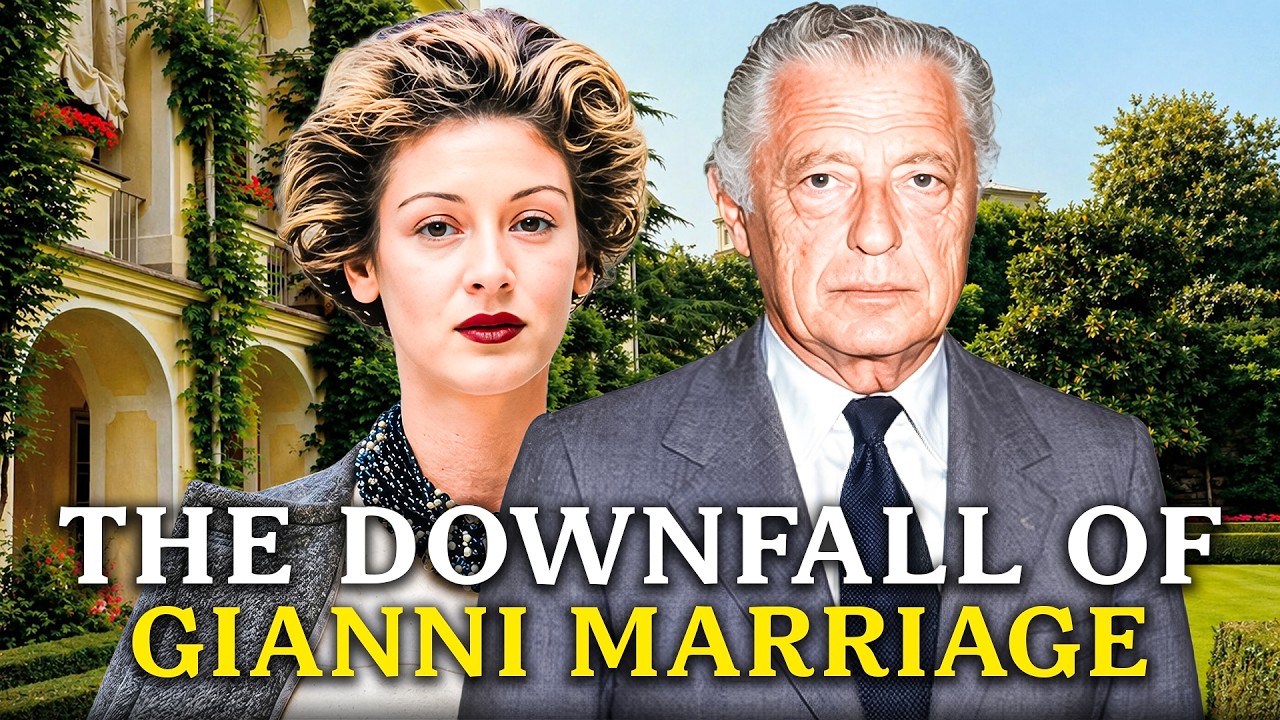
These were not casual encounters with admirers but meetings of equals, drawn from the same world of wealth and influence. In 1953, at age 32, Agnelli married Marella Caracciolo di Castagneto, a 24-year-old from an old Neapolitan aristocratic family. She was beautiful, intelligent, and deeply cultured, with a serious talent for interior design and garden architecture. She had worked with American Vogue editor Diana Vreeland and had been photographed by Irving Penn.
She brought her own foundation into the Agnelli world, entirely separate from his name and money. The wedding took place quietly at the town hall of Astiglia in northern Italy, with no grand cathedral ceremony. The couple had two children: Edoardo Agnelli, born in 1954, and Margherita Agnelli, born in 1955. On the surface, the marriage appeared successful by the standards of their world.
Their circle included Truman Capote, Henry Kissinger, and Jacqueline Kennedy. But Agnelli’s affairs were constant and not a secret. In the circles they moved in, his infidelity was treated as simply a fact of his nature. Marella said almost nothing publicly about it for decades.
She maintained the household, raised the children, continued her work, and stood beside her husband at every official occasion. The public marriage of Gianni and Marella Agnelli was in many ways a masterpiece of Italian upper-class performance. One relationship, however, was considerably more serious than the tabloid affairs. Pamela Churchill re-entered Agnelli’s world during the early years of his marriage in a way that was genuinely threatening to his stability with Marella.
She understood power deeply and knew Agnelli in ways rooted in their earlier intimacy. Their renewed connection in the mid-1950s was, according to several biographers, not casual. Marella was aware of it. But Agnelli did not leave his wife for Pamela, a decision that shaped the rest of all three of their lives.
Pamela Churchill eventually married American diplomat Averell Harriman in 1971, becoming one of the most influential political hostesses in Washington. She and Agnelli remained connected socially at a careful distance. A serious car accident in 1952, the year before his marriage, had left Agnelli with a permanent limp. People who knew him said that after the accident, he was even less cautious than before, more drawn to speed and risk.
This was a key to understanding the decades that followed. A man who had come close to death at 31 does not experience time the way other people do. Agnelli’s relationships with women like Jackie Kennedy and actress Anita Ekberg revealed something real about him. He was documented spending time with Kennedy in the 1960s, and they were photographed together on the water off Ravello in the summer of 1962 while she was still first lady.
Whether the relationship was ever more than profound mutual admiration was never settled publicly. Both connections were, at some level, encounters between equals. Agnelli was not drawn to women he could manage but to women who were formidable in their own right. The heaviest weight of the Agnelli story was what happened to the children.
Edoardo Agnelli, Gianni’s son, was born in 1954 and was clearly not his father’s double. Where Gianni was commanding and socially magnetic, Edoardo was sensitive, intellectual, and increasingly inward. He developed a deep interest in Eastern philosophy, particularly Sufism, and converted to Islam in the 1990s. The relationship between father and son was deeply painful, with Gianni ill-equipped to meet his son where his son lived.
By the 1990s, Edoardo had largely withdrawn from the world of Fiat and Italian industry. On November 15, 2000, he was found on the roadway beneath the Fiat-owned Mandria Viaduct near Turin. He was 46 years old. The official conclusion was that he had taken his own life, though his mother, Marella, and others close to him disputed aspects of the official account for years afterward.
The loss was devastating for both parents. Gianni Agnelli, by then elderly and in poor health, never recovered from the blow, according to those who observed him in his final years. He died of prostate cancer in Turin on January 24, 2003, at age 81. Marella was with him at the end.
The Italian president declared national mourning, and factory workers at Fiat held a moment of silence. Margherita Agnelli, the couple’s daughter, built a life somewhat independent of the Agnelli orbit. She married French writer Alain Elkann in 1975 and had three sons: John, Lapo, and Ginevra. The marriage later ended, and she married Serge de Pahlen in 1995.
After Gianni’s death, her relationship with her mother became very public. In the mid-2000s, Margherita filed a legal claim against her mother’s handling of Gianni Agnelli’s estate. Her position was essentially that she had not received the inheritance that was rightfully hers. What followed was one of the most extraordinary public family disputes in Italian history, with a mother and daughter at war in the press and in court.
The specifics of the dispute involved trusts, foundations, and governance structures that controlled the Agnelli family’s financial assets. The dispute cast harsh light on the private arrangements that had governed the family’s financial life, suggesting that behind the perfectly curated image, structures had been put in place to concentrate power in ways that did not simply trickle down to the next generation. Marella Agnelli died in Lausanne, Switzerland, in February 2019 at age 91. The legal disputes between her estate and Margherita continued even after her death.
But perhaps the most striking thing about the inheritance dispute was what it revealed about the marriage that produced it. Gianni Agnelli built a life of extraordinary outward unity, yet within that structure, the relationships were anything but simple. His son had died estranged from his father’s world, and his daughter would spend years in legal battle with his widow. Marella Agnelli was remarkable in her own right.
Born in 1927 to a Neapolitan prince and an American mother of Cherokee descent, she spoke multiple languages fluently and was seriously interested in the visual arts. The gardens at Villa Perosa, the Agnelli country estate in Piedmont, are recognized as one of the great private gardens in Italy. She worked on them over decades, creating something that stood as a testament to her vision. Truman Capote described her in effusive terms, seeing in her an aesthetic sensibility that was genuine, not performed.
During the long middle decades of the marriage, she appears to have developed a serious romantic friendship of her own, though the name most consistently mentioned has been disputed by those close to her. What is less disputed is that Marella was not simply waiting patiently for her husband to return from his adventures. She was living her own interior life, shaping her own world. By the time Marella died, the world she and Gianni had inhabited had changed fundamentally.
Fiat had merged with Chrysler in 2009 to form Fiat Chrysler Automobiles, which in turn merged with PSA Group in 2021 to form Stellantis, one of the largest automotive groups in the world. The family’s direct control remained significant through their holding company Exor, but it was no longer the singular dominance of the Agnelli era. John Elkann, Margherita’s son and Gianni’s grandson, took the reins of Exor and became a respected figure in European business. But he was not Gianni Agnelli, and the name, while still attached to enormous wealth and influence, no longer carried quite the mythological quality it had when Gianni was alive.
At its peak in the post-war decades, Fiat employed close to 200,000 people in Turin alone. The city’s identity was inseparable from the company’s fortunes. That level of dominance over a city’s daily life was the foundation on which Gianni Agnelli’s authority rested, not just as a businessman but as a kind of unofficial sovereign of northern Italy. In his final years, Agnelli returned to a closeness with Marella that the middle decades of their marriage had occasionally interrupted.
They were seen together more frequently, and he spent time at Villa Perosa in the gardens she had spent decades building. Those who were present said he found something there that the boats and the Riviera had not given him. There is no simple summary for a life like this. The story of Gianni Agnelli’s marriages contains a man of genuine greatness who was also, in the most intimate dimensions of his life, incapable of sustained fidelity.
It contains a woman of remarkable strength who made choices across 50 years that preserved a marriage, a family, and an image at costs she never fully disclosed. It contains children marked by their father’s greatness in ways that were, in at least one case, devastating. The marriages of Gianni Agnelli did not end in public catastrophe or scandalous collapse. They ended the way most things end in the world of old European money: quietly, with lawyers, over a long time, with the image more or less intact.
But in their private reality, they were genuinely difficult, genuinely costly, and genuinely human.