In the late 1990s, a researcher working in a historical society archive made a discovery that had been misfiled for decades as agricultural records. The contents were a set of notebooks and ledgers belonging to the Vellacott family, who had farmed a remote hollow in the Appalachian range beginning in 1851. The documents, kept over several decades, described something unusual on the property’s northern boundary—something the family had managed for generations through careful, deliberate maintenance. Silas Vellacott settled the land in 1851, building his home, barn, and a stone wall along the northern edge where the ground climbed toward the ridge.
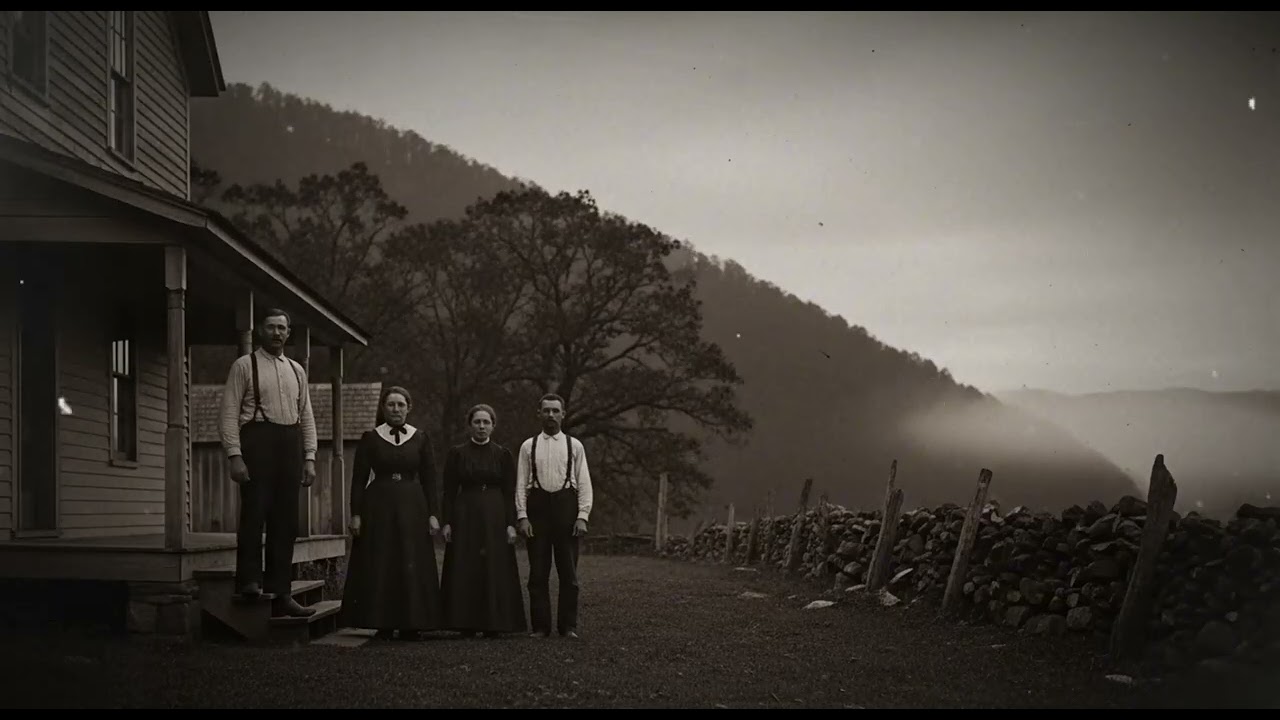
At the time, he told his wife Martha that the ground up there “felt like it needed a line. ” A practical farmer, Silas kept detailed notes about timber, soil, and weather, but gradually his records shifted. Beginning in the mid-1860s, he documented objects appearing on the wall—stones arranged in unnatural configurations, lengths of material folded with purpose, and marks carved into the mortar that he could not identify. He removed each item but recorded it first with unusual precision.
By the early 1870s, Silas noted low, rhythmic sounds from the upper ridge at night. He described them as occurring on no regular schedule, writing, “Not regular, but not random, either. There is a pattern I cannot yet find. ” Entries from the late 1870s grew shorter and more compressed.
One line from the summer of 1877 read: “The wall is a record of what comes and tries to cross. I keep removing what it leaves. I do not know if removing is helping. ” His final entry, from October 1878, was three words: “It knows me now.
”
Silas died in the spring of 1879 in a logging accident at age 53. Three weeks after his funeral, Martha found a locked iron box beneath the floorboards of his study. It contained cash, a land deed, and the notebook. She read it twice, then locked the box away.
She did not mention it to anyone for four years. The property was managed after Silas’s death by his nephew, Arvid Brecht, who arrived at the farm at age 34. Arvid was a practical, observant man who had spent his career working other men’s land. He and Martha established a businesslike arrangement: he ran the farm, she ran the house and finances.
For four years, Arvid said nothing about the odd occurrences he noticed near the wall, though he had begun hearing sounds at night and observing something moving slowly along the stone boundary when it was dark. In the autumn of one year, Arvid told Martha that something was moving along the north wall at night. He was specific that it was not an animal—it moved deliberately, stopped at the same section of wall every time, near an old oak cluster. After going to investigate twice and finding nothing, he stayed at the barn door in the dark on the third occasion and listened.
When the movement stopped, the silence that followed was different, fuller, as if something had entered the space and settled. That evening, Martha brought out the iron box. Arvid read Silas’s notebook twice. The two agreed to continue documenting what happened on the upper property.
Arvid began his own record-keeping in the winter of 1883, approaching the problem more systematically than Silas had. He structured entries around specific questions—what happened, when, under what conditions, what he did in response, and what changed afterward. The careful logging only made one thing clearer. The phenomena did not follow logical rules for which he had language.
He wrote in March 1884: “Every system I have worked with in my life has had a logic I could find if I looked carefully enough. … The logic here is not absent. It is present, but it is oriented toward something I cannot identify. And the more I try to understand the orientation, the more it seems to turn toward me.
” Beneath that, he added: “Yes, Silas wrote, ‘It knows me now. ’ I understand what he meant now. I did not understand it before. ”
In the spring of 1885, a surveyor named Rutherford Crane arrived in the valley looking for work.
He was hired after demonstrating competence with instruments and a manner suggesting he was comfortable working alone in difficult terrain. What Arvid did not know initially was that Crane had spent years surveying land parcels in eastern counties with a reputation for being difficult in ways beyond rough terrain or disputed boundaries. His predecessor on one job had retired abruptly after six weeks on a particular ridge without explanation, and Crane had spent those six weeks trying to understand what the man had fled. Crane noticed the Vellacott property’s northeast wall section within his first week but said nothing for three weeks.
Finally, he asked Arvid how long that section of wall had stood without mortar repairs. The question led to a long evening conversation during which Martha produced the iron box and Crane read Silas’s notebook. He then told them what he had learned through his career: he had surveyed four properties with similar characteristics. The specifics varied, but the core quality was the same—a section of land where something had been present for a very long time, something with orientation, something that did things.
In three of those cases, the families had left. In the fourth, they had stayed and managed the boundary. Managing, he explained, did not mean eliminating the problem. It meant regular attention, physical maintenance, and never crossing the line between managing and engaging.
Crane identified a mistake in Silas’s approach. Silas had been removing objects from the wall without replacing them, leaving gaps. In Crane’s observation, a gap read as an invitation. What the entity that came to the wall did when it found a gap was to come further in.
Under Crane’s direction, the maintenance work on the wall was corrected. He performed specific work at the oak cluster on three mornings in early April. Martha privately noted in the margins of her household accounts that the quality of the upper property gradually changed—the reluctance she had felt about walking toward the wall lifted, and the stillness of the pool near the oaks felt different, less like something waiting beneath the surface. Crane stayed two seasons and left without drama in the autumn of 1886.
He left Arvid a set of written notes, enough to maintain what had been established and to know what to watch for. Arvid and Martha continued the work between them. Over the following years, the objects on the wall came less frequently, and the sounds from the ridge faded to the point where Arvid stopped noting them. In the spring of 1891, a man named Lemuel Pace arrived in the valley asking about land use history and property transfers in the county.
He worked for no institution that anyone could identify. He told the county recorder he was compiling a historical documentation effort. When he came to the Vellacott farm, Arvid met him at the gate. Pace asked two questions: how long the current management of the property had been in place, and whether the north wall was original to the property or had been rebuilt.
Arvid answered both, then asked who had sent him. Pace said nobody had. He was working through a private ledger compiled by an eastern-counties surveyor in the 1860s, a man who kept records of properties that shared specific characteristics. The Vellacott farm was on the list.
Arvid named the surveyor: Rutherford Crane. Pace stayed for four days. He was clear that he was not there to alter the property, and Arvid believed him. Pace explained that he had been working through a list that had grown to 43 properties.
Of the 30 he had completed before this one, 18 had been brought under some form of management. Eight had been abandoned. Four had experienced what Pace described with deliberate care as “uncontrolled escalation. ” He did not elaborate further, except to note that in each of those cases, the county records from the relevant periods contained unexplained gaps.
He described the Vellacott property as one of the better-managed cases on the list. Pace asked to walk the wall. He walked its full length slowly, stopping for a long time at the oak cluster. He touched nothing, only looked.
Then he told them what Rutherford had documented on a property three ranges over: a pattern suggesting that the properties on the list were not independent. They were connected through a common origin or quality. Each property had a specific section, a “point of contact,” where the condition was most active—here, the northeast wall near the oaks; elsewhere, a spring, a rock outcropping, a clearing. Rutherford had written in the final pages of his ledger: “I have been working on the assumption that each site is its own problem.
I’m no longer sure that assumption is correct. I think the sites know about each other, and I think some of what they know is about us. ”
Pace left on the fifth morning, leaving Arvid copies of the relevant sections of Rutherford’s ledger and his own notes from other sites. He asked Arvid to continue the documentation and said he would return without a timeline, because he had learned that timelines in this work were mostly fiction.
The years between 1891 and 1898 were quiet. Arvid maintained the documentation and the wall work. Pace returned twice, in 1893 and 1895. On the second visit, he told them the map had grown to 61 properties, with 17 additional sites not in the original ledger.
He also mentioned three properties on the original list he could not account for—the families were gone, the land had changed hands, whatever management had existed had ended, and the record of what followed had unexplained gaps. Martha Vellacott died in the autumn of 1898 at age 71, in the same bedroom she had woken in for 47 years. On her last fully lucid night, she asked Arvid to bring the iron box. She held Silas’s notebook and spoke about the fact that he had built the wall first, before the house, before the barn.
“The wall was the first thing,” she said. Arvid replied that it had been the most important thing. She asked him not to stop, and told him to make sure whoever came after him understood what they were inheriting. The farm passed to Arvid formally after her death.
In the spring of 1899, he hired a man named Cass Holloway, recommended by another farmer in the valley. Arvid did not tell Cass about the wall immediately, waiting a season to see whether Cass was the sort of person who could understand what needed to be said. The decision was made in late summer, when Arvid found Cass standing alone at the stone wall, head slightly tilted, listening. Cass looked at the ridge and said, “There’s something up there.
” Arvid confirmed it and told him to come to the barn that night. Teaching Cass took most of the winter of 1899 into 1900. The knowledge resisted being taught quickly, requiring context that required other context, and the whole edifice needed to be built in a particular order or it did not hold together. By March 1900, Cass understood the wall, the northeast section, the oak cluster, the pool, the documentation practice, the maintenance schedule, and the underlying reality of what they were managing.
Pace returned in the autumn of 1902. He was older, carrying the weight of years of work. He walked the wall with Arvid and Cass and told them the property was in the best condition of any on the list. The list had grown to 84 properties, and he had brought in two other people to help with the documentation.
He had been able to read the unexplained gaps in three of the missing properties, and his expression when he referenced it was that of a man who had hoped not to find what he had found. Cass asked whether the work done at this property mattered to the others on the list. Pace said he believed so—that when a line held in one place, there was some effect on adjacent sites, and the cumulative effect of consistent management across the whole map mattered. Cass nodded and said nothing more.
The documentation after 1902 has gaps. Pace appears to have stopped returning to the valley. Arvid’s notebooks continue through 1908, when they stop abruptly, without drama, the way records sometimes simply end. His final entry, written in late autumn of 1908, read: “The work is not finished.
The work is never finished. I used to think that was discouraging. It isn’t. It means the work is real.
Real things don’t end because you decide they should. They continue, and they require people to continue with them. … Walk the wall. Document what you find.
Don’t stop. ”
The Vellacott farm was sold in 1927. The iron box went with the household effects and ended up, through an estate sale in the 1940s, in a historical society archive, where it was cataloged incorrectly as agricultural records. A researcher found the notebooks in the late 1990s and spent four years verifying what she could, which was not everything, and making clear what she could not verify, which was most of it.
Her conclusion was less an answer than an accounting. The line had held for as long as consistent management was maintained, from the mid-1880s through at least the first decade of the 1900s. The specific deterioration documented on other properties did not occur here. The unexplained gaps in county records that marked failing cases elsewhere were absent from the Vellacott property’s history.
Whether the line continued to hold after 1927, after the sale, after the careful management simply stopped, she could not say. She noted in her account that she had once driven past the property on her way to the archive, stopped at the roadside, and looked toward the north end of the land, where the old wall was still partially visible through the overgrowth and the oak cluster still stood. She wrote that she did not get out of the vehicle. She closed her account with a thought about the people who build walls before they know why, who walk the line without being asked, who keep the record and pass it on, trusting that whoever receives it will understand its weight.
“Those people are the reason some lines hold as long as they do,” she wrote. “I don’t know if anyone is walking this one. I hope someone is.
”