Australian military authorities never prosecuted Hatazo Adachi for anything he personally did. On July 12, 1947, a military court in Rabaul sentenced him to life imprisonment for actions committed by others while he was elsewhere. The indictment was explicit on this point: he was charged with neglecting his duty as a commander and failing to perform it unlawfully—an accusation rooted in absence, not in direct acts. No witness placed him at the scene of any killing, and no document in his handwriting ordered one.
The Rabaul trials ran from December 1945 to August 1947, bringing 188 cases before military courts. Of the 390 men who stood trial, 266 were convicted and 84 were sentenced to death by hanging. Adachi’s case carried the number R73, and the trial transcript is held in the Australian National Archives under item 81652. Among the evidence were the general’s own handwritten statements, numbered three and five, in which he explained to an investigating officer what his army was doing in New Guinea and under what authority.
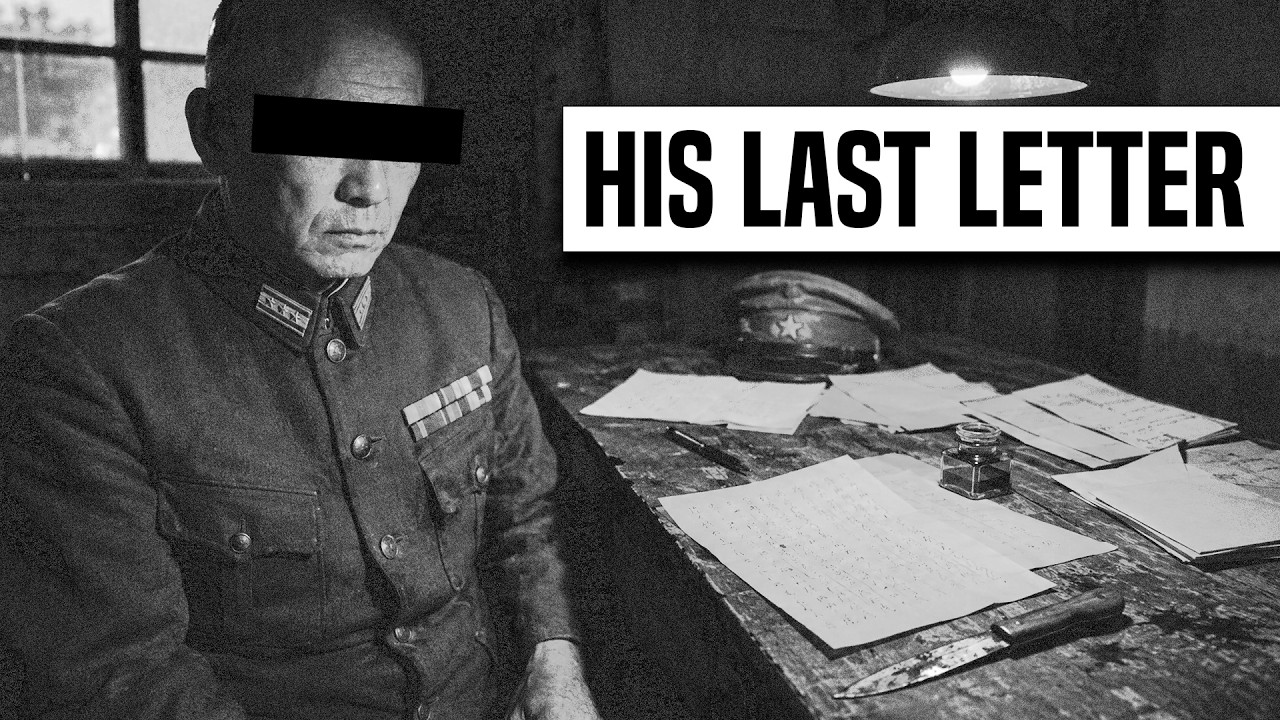
He wrote them himself for the men building the case against him. Adachi never saw a prison in Japan. Two months after sentencing, on the morning of September 10, 1947, guards at the Rabaul prisoner compound found he had died by suicide in his cell using a peeling knife. He had spent the night writing letters.
One of those letters took responsibility for the starvation of his army. In his own words, he demanded “endurance beyond the limits of human capacity. ” His officers and men, he wrote, followed him in silence and without complaint until they collapsed. More than one hundred thousand of them died, most from hunger rather than Australian fire.
A second letter went further, accepting responsibility for the cannibalism that had occurred among his divisions. He was 57 years old. The knife, according to more than one account of that morning, was rusty. Before all of that, he had done something the court did not expect.
Each of his accused subordinates stood trial while the commander of their army appeared in the defense case, testifying on behalf of his men one by one and then returning to the compound. The case against Adachi came together in stages, and slowly. No one charged the general in 1945, nor in the first half of 1946. Investigators worked upward from the level of ordinary soldiers, and the adjutant general only authorized the prosecution of senior officers on September 4, 1946, where a reasonable chance of conviction appeared.
By December, lawyers had prepared three leadership cases. Imamura had commanded the entire army group. Adachi commanded the Eighteenth Army in New Guinea. Kanda commanded the Seventeenth Army on Bougainville.
Each was to be tried along with his two principal staff officers. In all three cases, the victims were Indian, Chinese, or Indonesian prisoners brought in as laborers. In January 1947, the Director of Legal Services dropped the staff officers. There was no case against any of them.
Kanda also fell away because the crimes in question occurred within days of his taking command, in a location his headquarters could not reach by signal or road. That left two army commanders and Major General Hirota, who had run the supply depots at Rabaul. There was also an order. Adachi issued it at the end of October 1944.
It was called the emergency punishment order. Everything in the case revolved around it, and the prosecution never saw its text. What the court saw instead was an argument about its own authority—and a strong one. The War Crimes Act defined a war crime partly by reference to a list of 35 offenses attached to a commission established on September 3, 1945.
Japanese defense lawyers reviewed that list and found it was not new. Thirty-two of the items came directly from the Commission on Responsibilities at the 1919 Paris Peace Conference. Three items had been added: waging aggressive war, mutilating the dead, and cannibalism. Earlier Australian investigations, from June 1943 and June 1944, contained only the original 32 items without any additions.
So the objection was precise and pointed: a parliament in Canberra could not invent a crime in international law simply by listing it in a schedule. Either cannibalism was already a crime among nations, or this court had no authority over it. Lieutenant Colonel J. T.
Brock, the military judge, summarized the case before the members withdrew to deliberate and agreed with half of the submission. The Commonwealth could not create an international crime. That was sound law, and he said so. Then he ruled that the crime existed anyway, because Article 3 of the 1929 Red Cross Convention bound belligerents to protect the bodies of enemy dead from pillage and mistreatment—and eating them constituted mistreatment.
The ruling rested on the burial clause. No one appealed the judgment because there was no body to appeal to. Most of this story remained in numbered files in Canberra for nearly 30 years before the Attorney-General opened the trial proceedings to the public. The machinery that produced the judgment had been assembled hastily from parts that already existed.
The form of that machinery was written into law. Both houses of parliament passed the War Crimes Act on the same day, October 4, 1945, and it received assent a week later. Under it, Australia conducted 296 trials in eight places: Labuan, Wewak, Morotai, Rabaul, Darwin, Singapore, Hong Kong, and Manus Island. The courts heard charges against 804 individuals, some more than once, and acquitted 280 of all charges.
They issued 225 death sentences, later reduced to 148 by the confirmation process. Each court was a copy of the general court-martial, a frontline discipline tool of the British and Commonwealth forces, never designed for this purpose. The minimum membership was three. The president was not required to outrank a captain, and members could be lower in rank than the person they tried.
One protection normally covering a Commonwealth soldier was excluded for this purpose. Section 9 of the Act allowed the court to admit any oral statement or any document that appeared on its face to be genuine, which meant the rule against hearsay—and with it the right to cross-examine whoever wrote the paper—was not available to the accused in the dock. The justice of that machinery depended, more than anything else, on the timing of the man who came before it. Wewak saw Australia’s second war crimes trial in the world.
On November 30 and December 1, 1945, a court there tried Lieutenant Tazaki on two charges arising from a night the previous July: mutilating the body of an Australian soldier at a place called Sorin and eating part of it. The dead man’s name appeared in the indictment with his service number. He was Private John Crowe, from Queensland. Major General Robertson selected that court himself.
By any ordinary military standard, he chose well. Three of the four members had commanded battalions overseas for years and understood fully the nature of fighting in the Torricelli Mountains. The fourth was a major attached to divisional headquarters as a staff trainee. Tazaki confessed.
He had also been starving when it happened. The members convicted him on both charges and sentenced him to death by hanging, three votes to one. The Sydney Sun’s correspondent for the trial, Noel Ottaway, filed a straightforward report on the verdict, then wrote privately to the news editor describing it as intolerable cruelty, noting that someone had interfered with the court. He observed that one lieutenant colonel was known in Wewak as “Jap-happy Jack,” and that another court member had said in front of witnesses he had no intention of letting the accused get off.
The letter went to Foreign Affairs, then to the Attorney-General, then to the Army, and things moved quickly. Newspapers in Melbourne and Sydney were at that moment running front-page complaints that the hangings had not started. None of that was necessary. The officer commanding the 6th Division had already recommended, on his own initiative, that the sentence be commuted for three reasons: the act was isolated with no indication of practice behind it; cannibalism was not a crime under English criminal law; and the circumstances the man had lived in were a form of mitigation.
On December 19, 1945, Sturdee reduced the sentence to five years. The same judicial calculations ran in the opposite direction for men caught by the constraints of the calendar. In April 1946, a court in Rabaul sentenced a Japanese sergeant, a soldier, and seven Formosan guards to death for shooting 36 Chinese prisoners. Four of them were hanged that July.
The other five survived because the prosecution wanted them as witnesses against Teruta, whose command-responsibility trial did not end until April 1947. When it ended, the president of that court wrote to headquarters asking for mercy for the five men who had waited a year in death cells, and they received it. Their sentences were commuted to life imprisonment. Eighteen months after the Tazaki case, another court in Rabaul sentenced a Japanese naval captain to 20 years for ordering the killing of all prisoners at Aitape.
A legal officer at army headquarters, reviewing the file of two men who had by then spent 19 months in death cells, wrote that sentences from early 1946 seemed harsh by the standards of 1947, and that there should be a uniform standard of punishment proportionate to the degree of guilt. His submission never reached the civil council that reviewed every death sentence, and a firing squad executed the two men at Rabaul on October 23, 1947. The mood behind all of this kept shifting under the weight of the courts. By March 1950, when the whole matter was raised in the House of Representatives, the new Menzies government had released 71 suspects against whom no one had completed gathering evidence, and members from both sides of the chamber argued openly that the affair had gone on long enough.
What Adachi actually did was write the order, and the order was addressed to his own troops. Cannibalism within the Eighteenth Army had become so widespread by the autumn of 1944 that it was a disciplinary problem, and in October he made it a capital offense. In the five months that followed, 70 Japanese soldiers were executed after summary investigations by their formation commanders. Forty cases were for desertion or insubordination; the remaining 30 were for cannibalism.
On December 31, 1944, Australian troops fighting on the Danmap River near Aitape captured a disciplinary directive issued by a commander within the 41st Division. The directive imposed the death penalty on anyone who knowingly ate human flesh, then added four words in parentheses: “other than the enemy. ” That parenthetical phrase is the closest anyone ever came to the wording of the emergency punishment order. The defense never put the actual text of that order before the court.
The most plausible explanation for that silence, as a later researcher concluded, is that the text would have revealed the same exception. What the prosecution had, then, was a subordinate’s restatement of a document that never appeared. No one disputes the condition of the army by that point, on either side of the courtroom or in any account written since. Adachi had entered New Guinea with just over 100,000 men.
Only about 20,000 of them remained alive at the end, and nearly every survivor had walked the 2,000 kilometers from Buna to Aitape. The American landings at Aitape and Hollandia in April 1944 had cut the supply line from the rear. What the army had at that moment was enough for four months at one-third rations. After September 1944, nothing arrived.
Seventy percent of the men who survived entered hospital immediately upon reaching home in Japan. Their commander shared that fate: he lost about 80 pounds and all his teeth, and he advanced to his forward positions carrying an untreated hernia. Between the surrender parade at Wewak and his trial, Adachi waited for nearly two years, first in detention in New Guinea and then at Rabaul, while investigators interrogated the men who had served under him. Most of his surviving army crossed to Mushu Island off Wewak from mid-September 1945.
Men who were already sick continued to die there through the wet season. About 10,000 of them managed to board ships home during 1946. Seven out of ten entered hospital wards on arrival. David Sissons studied these papers more closely than anyone else.
He served as a young soldier and interpreter at three of the Morotai trials, and spent four decades studying the texts. He was honest enough to examine what his own side had done, including a forced march of sick Japanese prisoners at Torokina in September 1945 that killed about 50 men through heat. When offered a Japanese monument describing the trials as nothing more than victors’ revenge, he refused to accept it. He also did not deny that an arbitrary element existed, and he said so in writing in a Sydney newspaper 40 years after the events.
Instead, he pointed to Australia’s first war crimes verdict at Morotai in November 1945, where the president of that court broke with military custom and announced his reasons aloud in open session. Colonel J. L. McKinley had served in the ranks during the First World War and held a Military Medal.
He told the courtroom: “We are not taking revenge, we are protecting society from the scourges of cruelty. ”
The Navy had moved before everyone. On September 10, 1945, Admiral Sato boarded a small Australian motor boat in Kairoiru Strait and surrendered his sword on behalf of Japanese naval forces at Mushu and Kairoiru, three days before the Army moved. The Army’s surrender, two years before the trial, was a military parade.
On September 13, 1945, at the airstrip at Cape Wom near Wewak, Major General Horace Robertson sat at a table before 3,000 men of the 6th Division. The Japanese commander came from the southern end of the runway in a jeep and walked forward until he was within 20 yards of the table. His interpreter, Captain Fred Kazuo Iwao, read the surrender document line by line. He signed it and handed over his sword.
The next morning, they put him on a plane. A single-engine Tiger Moth trainer, serial A17-489, carried him inland to the Kaiarivo airstrip so he could explain the terms of surrender to his own troops face to face—something the 6th Division needed from him that week, and which he did. The law under which they would try him had not yet been passed.
It went through both houses of parliament three weeks after that flight.