In May 1987, Slice held 3. 2% of the entire American soft drink market. In a category measured in billions of cases annually and dominated by Coca-Cola and PepsiCo, that number was a significant breakthrough for a brand only three years old. Slice had no decades of brand equity, no celebrity spokesperson, and no iconic jingle.
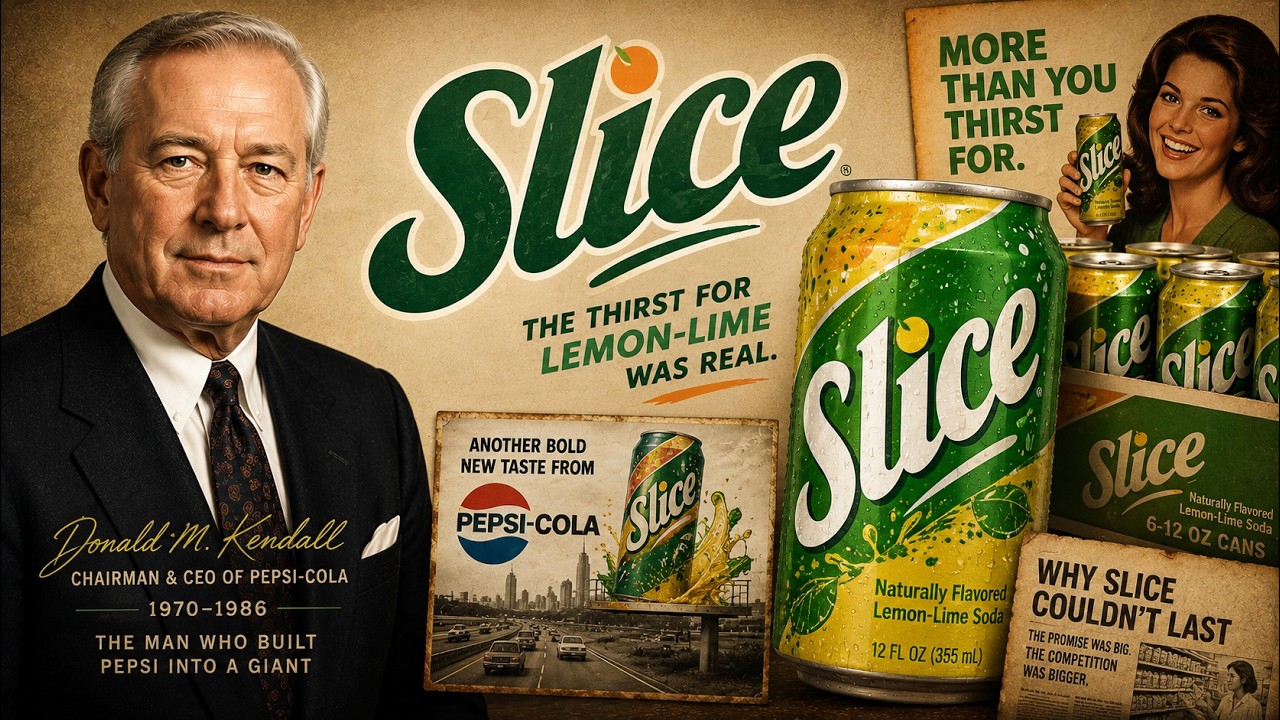
It had a green can and a single sentence printed on the front: “10% real fruit juice. ”
No other mass-market soda in America could print that sentence in 1984. Sprite couldn’t, 7Up couldn’t, and no other product in the refrigerated case from Maine to California could either. That one claim had carved a new subcategory out of a market that was not supposed to have room for anything new.
Then, within 12 months, the market share dropped to 2. 1%. By 1990, the juice was gone entirely—not reduced, not reformulated, but removed. The can still said Slice.
The label still showed citrus colors. But the formula inside no longer contained a single percentage point of real fruit juice. The brand that built its identity on “We Got the Juice” had quietly removed the juice, without a press release, without an announcement, without a name change. The story of Slice is not just the collapse of a soda.
It is the story of a corporation that proved consumers wanted real ingredients in mass-market beverages, then dismantled the product that proved it. The story begins with a problem PepsiCo had failed to solve since 1959. That year, the company introduced a lemon-lime soda called Team, intended as a response to Sprite and 7Up. Team was carbonated, sweet, and almost entirely indistinguishable from the drinks it was meant to challenge.
It had no real identity, and for two and a half decades it finished third in a three-brand race. By the early 1980s, Team existed largely as a placeholder, filling shelf space without ever offering a reason to be chosen. In 1983, Pepsi’s internal research team asked a different question: what do lemon-lime drinkers actually want that no one is giving them? Blind taste tests in cities across the Midwest produced a specific answer.
75% of regular lemon-lime drinkers said they would choose a carbonated beverage containing real fruit juice, if one existed. At the time, no mass-market soda in America contained real fruit juice. The entire category was built on the simulation of citrus, not its presence. Pepsi’s R&D team went to work on a formulation that could be both genuine and stable.
They landed on 10% real fruit juice—a number high enough to be credible, round enough to communicate, and legally defensible as a meaningful ingredient claim. The brand was named Slice, with a logo placing a small lemon wedge above the “i” in the word. In 1984, Pepsi tested the concept in Rochester, New York, and Tulsa, Oklahoma, and both markets confirmed the research. Consumers responded immediately and returned for repeat purchases.
On June 28, 1984, Slice entered national distribution. On the same day, Team was discontinued without a farewell campaign. Slice moved through PepsiCo’s existing bottler network, which meant it did not have to fight for shelf space. It arrived with the credibility and distribution muscle of a corporation that had spent decades building reach other new brands could only dream of.
The original can was solid green, and the front panel carried the claim in type large enough to read from across the aisle. The launch slogan was four words: “We got the juice. ” No celebrity, no jingle, just a declarative sentence. By the close of 1984, Slice had cleared every benchmark Pepsi had set for it.
The national launch outperformed the test market projections. Repeat purchase data showed that consumers were coming back because the product had delivered on its promise, and Slice was pulling drinkers away from Sprite and 7Up rather than cannibalizing Pepsi-Cola. In 1985, Pepsi introduced Diet Slice, extending the juice claim into the fast-growing low-calorie segment. In 1986, the company expanded the line with Mandarin Orange, Apple, and Cherry Cola flavors, each with solid color packaging that matched the flavor.
The Mandarin Orange became a surprise hit, outselling the original lemon-lime in some regional markets. The line expansion suggested Slice was not just a product but a platform, with the juice-and-soda concept extending as far as the fruit category itself. By May 1987, that argument had won 3. 2% of the American soft drink market.
In practical terms, with the market moving roughly 8 billion cases per year, one in every 31 sodas sold in America was a Slice. That number was the apex. It is also the last good number in the history of the brand. The problem with proving a concept is that proof belongs to everyone.
By 1987, Coca-Cola and Cadbury Schweppes had seen the number in trade reports and both moved quickly. Coca-Cola launched Minute Maid orange soda as a direct response to Slice’s Mandarin Orange expansion, carrying one of the most recognized juice brand names in American history. Cadbury Schweppes introduced Sun-Kissed soda. These competitors deployed established brand equity that American consumers already associated with real fruit.
Slice’s advantage in 1984 had been the claim itself. By 1987, the claim no longer functioned as a differentiator because the market around it had changed. The consumer education Slice had funded was being harvested by brands that had not paid for it. In July 1988, The New York Times published a story titled “Slice: A Case Study of a Setback.
” The article described how a product that had seized 3. 2% of the market in May 1987 had lost more than a third of that share in 13 months. The most damaging truth, however, was not in the framing: Slice was not losing because the concept had failed. Slice was losing because PepsiCo had started quietly dismantling the concept while the brand was still on the shelf.
Competing for internal marketing resources against Pepsi-Cola, Diet Pepsi, and Mountain Dew, Slice was finishing third again. The question inside the company by 1987 was no longer how to grow Slice, but how much it was worth defending. The answer came in 1988 in the form of a change so quiet most consumers never registered it consciously. The juice content was reduced.
The front panel no longer said “10% real fruit juice. ” The new language read “with fruit juices”—no percentage, no number. The word “real” disappeared. No press release accompanied the change.
The reformulation moved gradually through the supply chain, market by market, as old stock cleared. The slogan changed too. “We got the juice” was retired and replaced with “Either you got it or you don’t. ” The original claim had been verifiable—you could read the percentage on the can and confirm it.
The replacement was purely subjective, and the brand that had been built on a specific, printable, legally defensible claim was now asking consumers to trust a vibe. The Apple and Cherry Cola flavors were discontinued around the same time. Two of the line extensions that had performed below expectations were removed, narrowing the brand back toward lemon-lime and orange. By the summer of 1988, Slice’s market share was below 2% and falling.
By 1990, the transformation was complete. The juice content was eliminated entirely. The 1990 Slice contained no fruit juice of any kind. It was a fruit-flavored soda, chemically indistinguishable from the category it had been built to disrupt.
Pepsi responded to the identity vacuum by expanding the flavor line sideways toward the crowded mid-market territory occupied by Crush and its regional competitors. Strawberry, pineapple, fruit punch, and grape did not extend the Slice concept. They replaced the concept with volume, an attempt to hold shelf space through variety rather than through the single differentiating claim that had earned the shelf space in the first place. The solid-color can design from 1984 was also replaced.
In the early 1990s, Slice’s advertising adopted a cartoon character called Fido Dido as its brand mascot. The character had been created in 1985 by New York artists, licensed to 7Up for international markets, and redirected to Slice in the United States through a corporate rights arrangement. A brand that had launched on the credibility of a specific ingredient claim was now represented by a cartoon character created for a competitor. By 1994, the cans went black.
By 1997, they turned blue with swirling abstract patterns. Each redesign arrived with the quiet desperation of a brand that had stopped knowing what it was. A new flavor called Dr. Slice, positioned as an answer to Dr Pepper, did not last.
The brand that had once created a subcategory was now chasing subcategories that belonged to other brands. In 1999, PepsiCo began testing a new lemon-lime soda called Sierra Mist. It was built from scratch with a single competitive purpose: to take market share from Sprite. It had no juice content and made no ingredient claims.
It competed on taste and marketing spend. By 2000, Sierra Mist entered national distribution, and Lemon-Lime Slice was discontinued to make room for it. Slice had not been defeated by Sprite or outcompeted by Minute Maid or Sun-Kissed. It had been replaced by its own parent company.
The remaining Slice flavors continued in diminished distribution through 2005, when most were silently transferred to the Tropicana Twister soda line. In 2006, a diet-only version called Slice 1 launched exclusively at Walmart locations. It did not last the year. By 2009, Slice had disappeared from PepsiCo’s product locator entirely, with no closure and no final campaign.
The name did not stay gone. In 2018, New Slice Ventures LLC acquired the Slice trademark portfolio from PepsiCo for the United States and Canada. The company worked with smaller beverage partners to relaunch Slice as a sparkling water line containing organic fruit juice. The flavors were raspberry, grapefruit, blackberry, mango, and pineapple—a modern palette for a market that had moved far beyond the lemon-lime aisle.
The founding premise of 1984 had returned. In May 2024, the brand changed hands once more. PepsiCo sold its remaining trademark rights to Suna Life, a California company focused on organic ingredients and functional health benefits. The 2024 Slice launched at Costco and Target with prebiotics, probiotics, and postbiotics, five grams of sugar per can, and the words “healthy soda” printed directly on the label.
The packaging used a retro-style redesign with an updated version of the original 1984 logo, deliberately invoking the visual memory of the brand at its peak. Vintage Slice cans from the 1984-to-1993 solid-color era still circulate on eBay and through collector communities. An original lemon-lime green can in excellent condition sells for $15 to $40 depending on variant and provenance. The Mandarin Orange flavor is among the most sought-after items in the 1980s soda memorabilia market.
Drinkers who remember the original consistently report the same timeline: sometime in 1988, the thing that made it different became harder to identify, and by 1990 it was gone. The market Slice invented is now worth billions. Poppi, Olipop, and every sparkling water with a juice claim on the shelf at Whole Foods and Target is selling the same fundamental idea Slice sold in 1984: juice in a carbonated drink, real ingredients stated plainly, offered as a reason to feel differently about a choice you were already making.
The idea has been absorbed into the culture so completely that it no longer has an origin.