The United States Army investigated the December 1945 collision outside Mannheim, Germany, and concluded it was a routine traffic mishap. Low speed, poor visibility, no criminal negligence, and no fault attributed to the driver. General George Patton, paralyzed in the 130th Station Hospital in Heidelberg, stated from his bed that the driver should not be blamed. He said so before he died.
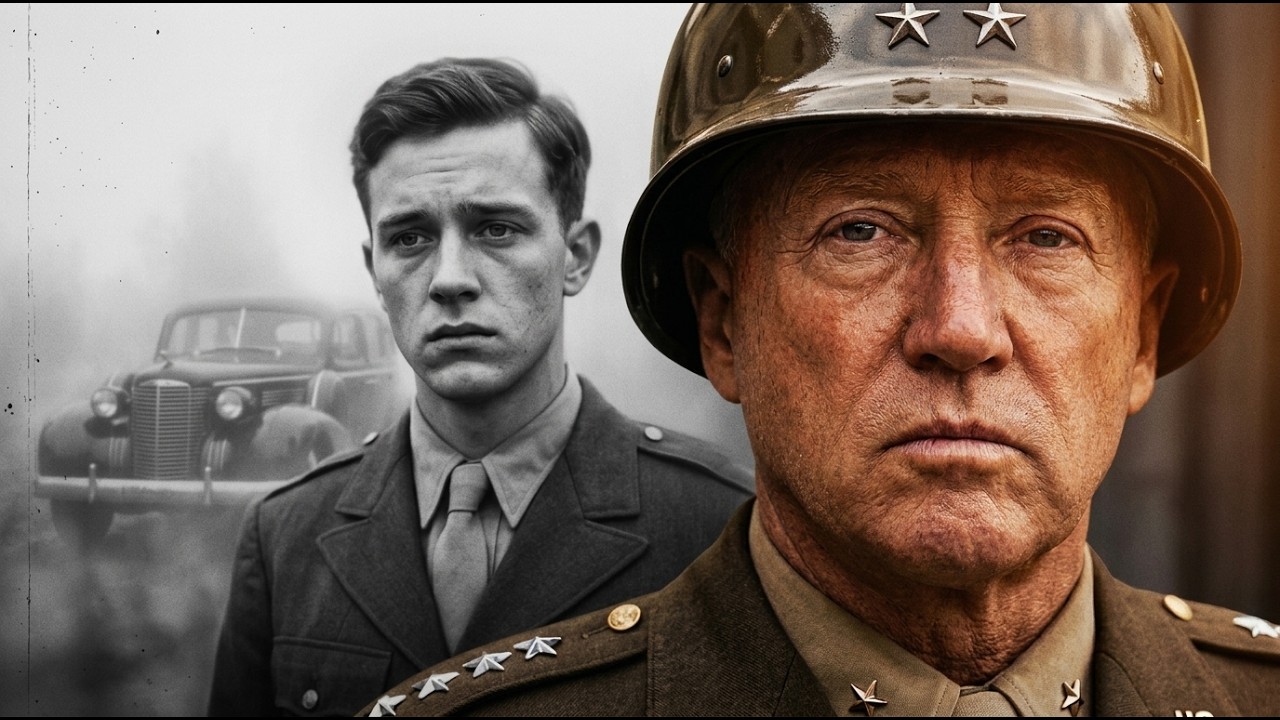
The discharge papers issued to Private First Class Horace Lynn Woodring in 1946 showed a clean record. No disciplinary action. Woodring returned to Kentucky, married a woman named Margaret, moved to Michigan, and spent the rest of his working life selling cars. He named his son John Patton Woodring.
He died of heart failure in November 2003 in a Detroit hospital. His New York Times obituary headline read, “Was driver in Patton crash. ” Fifty-eight years of his life reduced to one morning. Woodring was born September 30, 1926, in Morganfield, Kentucky.
He left home at 15, adding years to his age to obtain a driver’s license. He worked defense industry jobs and drove trucks before enlisting in August 1944. After completing basic training at Fort McClellan, Alabama, he attended the Army Chauffeurs Training School there. Shipped overseas as an infantry replacement, he developed frostbite before seeing sustained action, was declared unfit for infantry, and transferred to transportation.
He fought at the Battle of the Bulge from a vehicle, not a foxhole. From transportation, he entered the motor pool system moving senior officers through occupied Germany. Originally assigned to General Leonard Gerow, he came with the post when Patton assumed command of the 15th Army in the fall of 1945. Woodring was 19 years old.
He had been demoted three times. But here is the detail the official investigation never addressed. Patton’s previous driver had been Master Sergeant John Mims, who served five years across North Africa, Sicily, France, and Germany. When Mims went home in May 1945, Patton wrote to him personally, “At no time during these years of danger and difficulty have you so much as bumped a fender.
”
The replacement was a teenager from Kentucky who drove at 70 mph and had been demoted three times. Patton took to him immediately. Biographer Ladislas Farago described the dynamic in a single phrase: both men loved to dare the odds. Woodring had the nerve Patton recognized—speed, the willingness to push past what the road technically allowed.
Historians would later note this was an ominous combination. On the morning of December 9, 1945, Patton and General Hobart Gay were in the rear of the 1938 Cadillac Model 75 limousine. Their destination was a hunting ground outside the city. The war had been over for seven months.
Patton was scheduled to leave Germany for good in three days. Woodring was behind the wheel when a 2. 5-ton army truck began turning left across their path into a depot driveway. The Cadillac struck it at approximately 15 mph.
Gay and Woodring sustained minor injuries. Patton was thrown forward into the steel partition between the compartments, striking it headfirst. He said immediately, in a voice witnesses described as calm, “I think I’m paralyzed. ” He asked Gay to rub his fingers.
When Gay did, Patton said, “Go ahead, Hap. Work my fingers. ” He could not feel them. He was rushed to Heidelberg, 12 miles away.
X-rays confirmed two crushed cervical vertebrae. Patton had broken his neck. From Heidelberg, as investigators reviewed the accident, Patton stated clearly, more than once, that the driver should not be blamed. The Army’s formal investigation reached the same conclusion.
Routine mishap, poor visibility, the truck driver turned without adequate warning, no fault attributed to Woodring. The general cleared him. The Army cleared him. The paperwork was signed and filed.
On December 21, 12 days after the crash, a blood clot reached Patton’s heart while he lay paralyzed in his hospital bed. He had shown minor signs of recovery earlier that day. He died in his sleep at 5:55 in the evening. He was 60 years old.
Woodring was 19. The discharge came in 1946. Clean record. No notation connected to the accident.
Woodring left the Army with the American Campaign Medal, the European-African-Middle Eastern Campaign Medal, the World War II Victory Medal, and the Combat Infantryman Badge. He went back to Kentucky, married Margaret Geraldeen Adamson, and they had a son. He named him John Patton Woodring. The family relocated to Michigan, where Woodring entered automotive sales and sold cars professionally for decades.
The record does not preserve what he said about December 9th when customers came in to test drive something on a Michigan lot. It does not record whether he kept a photograph, returned to Germany, or attended any Patton memorial. It does not capture what he told his son about the middle name or when. What it preserves is the occupation, the city, and the name of the child.
He named his son after the man who died in the back seat. That is the most legible private record he left behind. The 1938 Cadillac from the crash was preserved by the United States Army. It is currently displayed at the First Division Museum at Cantigny in Wheaton, Illinois.
The middle window was rolled down at the time of the accident and remains in original condition. Museum documentation identifies it as the vehicle driven by Private First Class Horace L. Woodring on December 9, 1945. The car has a museum.
Woodring had a car lot. He died November 2, 2003, at a hospital in Detroit. Heart failure. Age 77.
His daughter, Ginger Dement, confirmed the cause of death to the press. The Los Angeles Times ran his obituary November 6th. The New York Times ran theirs November 9th. Both papers led with the crash, treating December 9, 1945, as the central event of his 77 years.
Patton’s original driver, Sergeant John Mims, served five years, drove through combat and enemy fire across three continents, and left with a personal letter praising his perfect record. Mims went home in the spring of 1945. Woodring served three months. The investigation said it wasn’t his fault.
Patton said it wasn’t his fault. The discharge papers said it wasn’t his fault. Woodring named his son after the man who died in the backseat. That is the private arithmetic of the aftermath—the kind that doesn’t appear in army files or discharge records or museum placards.
The kind that surfaces in the middle name of a child born in Kentucky the year after the war ended, and in the occupation of a man who spent 58 years selling the same category of machine that made his name. The Cadillac is behind glass in Illinois, maintained, documented, visited. Horace Lynn Woodring sold cars in Michigan until his heart stopped. The army cleared him.
He named his son Patton.