In April 2024, a gold pocket watch sold at auction for over one million British pounds. The initials engraved on its case were simple: JJA. Three letters that once belonged to the richest man aboard the most famous shipwreck in history. That watch stopped ticking in the early hours of April 15th, 1912.
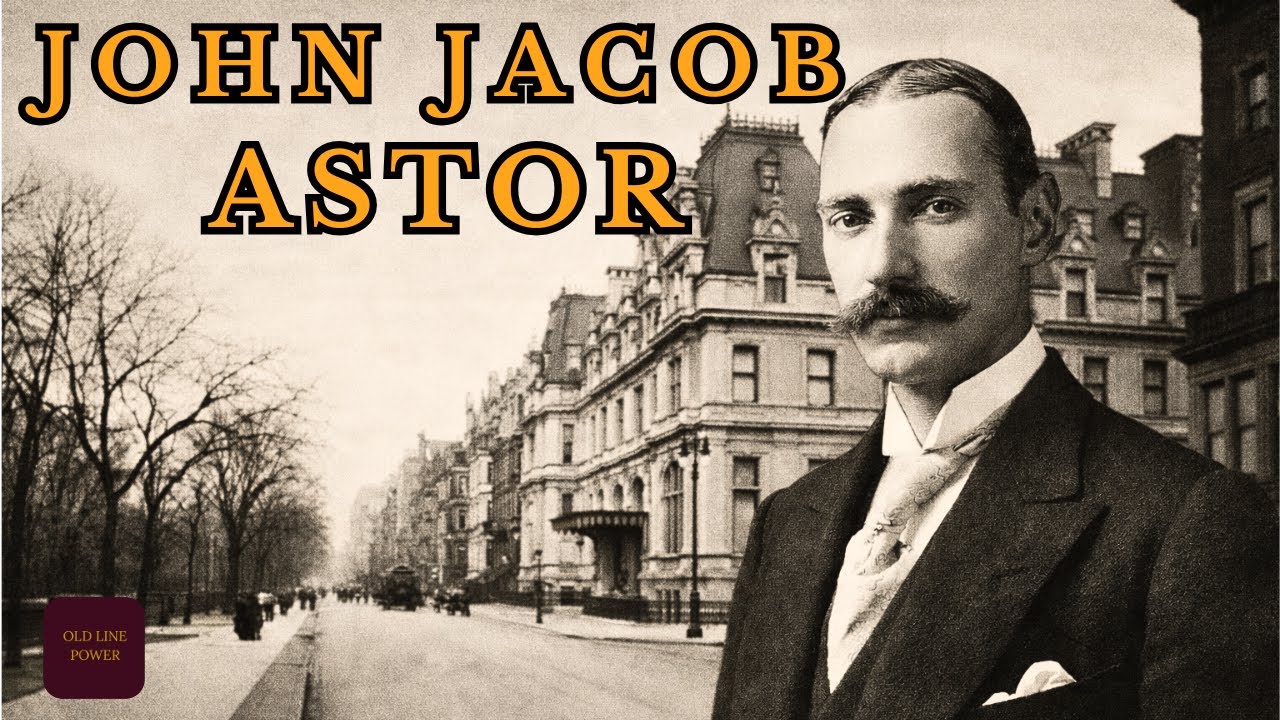
Its owner had just placed his pregnant teenage bride into a lifeboat. He asked if he could join her. The answer was no. John Jacob Astor IV possessed a fortune estimated at $87 million.
In today’s currency, that approaches three billion. He could have purchased the entire White Star Line and still had money left over. He owned hotels that defined luxury. He had invented machines and written novels about the future.
None of it mattered in the North Atlantic that night. This is not simply a story about the Titanic. The ship appears only at the end. Before that cold April night, there was a dynasty built from nothing by a German immigrant.
There was a mother who decided who belonged in New York society and who did not. There was a son caught between expectations and his own unconventional mind. There was a scandalous divorce, a teenage bride, and a wedding that respectable clergy refused to perform. The Astors were American royalty.
Their name adorned hotels, streets, and libraries across New York. Their wealth shaped the skyline of Manhattan. And in 1912, the heir to all of it stood on a tilting deck and watched his wife disappear into the darkness. This is the story of how the Astor fortune began, how it shaped New York, and how the family’s heir met his end.
The first John Jacob Astor arrived in America with almost nothing, a few coins, some flutes to sell, and an ambition that would reshape New York City forever. He was born Johann Jakob Astor in 1763 in the small village of Waldorf near Heidelberg. His father butchered meat for a living. The family was respectable but poor.
Young Johann showed little interest in following his father’s trade. At 16, he left for London to join his brother in manufacturing musical instruments. Four years later, he boarded a ship for the newly independent United States. During the voyage, Astor met a fellow passenger who traded in furs.
The man explained how beaver pelts commanded high prices in Europe, as fashion demanded them for hats. By the time he reached New York in 1784, he had already decided to abandon the flute business. He started small, working for a fur dealer and learning the trade. Within a few years, he opened his own shop.
Astor possessed two qualities that separated him from other merchants. First, he understood that controlling the entire supply chain meant controlling the profits. He established trading posts, hired his own agents, and eventually owned the ships that carried his goods to Europe and China. Second, he recognized opportunity before others did.
The Treaty of 1794 opened British-controlled territory around the Great Lakes to American traders. Astor moved immediately. Within a decade, his American Fur Company dominated the industry from the Great Lakes to the Pacific Northwest. The town of Astoria in Oregon still bears his name.
He founded it in 1811 as a trading outpost at the mouth of the Columbia River, and it became the first permanent American settlement on the Pacific coast. Astor was not sentimental about fur. When beaver populations declined and European fashion shifted toward silk hats in the 1830s, he saw the change coming. He sold his fur interests and redirected his capital toward something more permanent: land, specifically Manhattan.
He bought his first parcel of Manhattan property in 1799. Over the following decades, he accumulated more, purchasing the Richmond Hill estate from Aaron Burr after Burr’s finances collapsed following the duel with Alexander Hamilton. Astor rarely developed his properties himself. Instead, he leased the land to others who built homes and businesses on it.
When the leases expired, typically after 21 years, everything on the land belonged to him. The buildings, the improvements, all of it. New York grew exactly as he had predicted. Immigration surged, and land that had been considered too far from the city center became prime real estate.
By the 1840s, he was the wealthiest person in the United States. Some estimates placed his holdings at around $20 million, representing roughly one percent of the entire American economy at the time. No individual before him had accumulated such a proportion of national wealth. Adjusted for economic scale, his fortune dwarfs those of modern billionaires.
When he died in March 1848, newspapers struggled to quantify his estate. He left $400,000 to establish what became the Astor Library, later merged into the New York Public Library. He sent $50,000 back to his hometown of Waldorf for a poorhouse and orphanage. The bulk of his estate, however, passed to his children.
His son, William Backhouse Astor, expanded the real estate empire further, constructing hundreds of buildings across New York. The family’s grip on Manhattan tightened with each generation. They became landlords to tens of thousands. Their name appeared on hotels, theaters, and apartment buildings throughout the city.
Money alone did not guarantee social acceptance in the rigid hierarchies of 19th-century New York. Old Knickerbocker families descended from the original Dutch settlers looked down upon mere wealth. To stand at the apex of New York society would require something more. It would require a queen.
And in 1853, William Backhouse Astor Jr. married a woman who intended to become exactly that. Caroline Schermerhorn understood something that mere millionaires did not. Money could buy mansions and jewels and carriages, but it could not buy social acceptance.
That required bloodlines, manners, and above all, the right arbiter to decide who belonged. She intended to become that arbiter. Born in 1830 to one of New York’s oldest Dutch families, Caroline possessed what the Astors lacked. The Schermerhorns traced their American roots to the original settlers of New Amsterdam.
They were Knickerbocker, part of the quiet aristocracy that had governed New York society for generations. When Caroline married William Backhouse Astor Jr. in 1853, she brought respectability to the Astor name. The marriage was practical rather than passionate.
William proved more interested in horses, yachts, and time away from home than in social climbing. He eventually owned the largest private yacht in America and spent months aboard it each year, often in the company of guests his wife preferred not to acknowledge. Caroline smiled and remarked that sea air was beneficial for dear William’s health. If she could not control her husband, she would control everything else.
Throughout the 1860s and 1870s, Caroline assembled the machinery of social power. She cultivated relationships with the right families. She hosted dinners of precise formality. Her key ally was Ward McAllister, a southern-born lawyer who had reinvented himself as a professional social organizer.
Together, they developed the concept that would define Gilded Age New York: the Four Hundred. The name supposedly derived from the capacity of Caroline’s ballroom at her mansion on Fifth Avenue and 34th Street. Whether this origin is accurate or simply a convenient legend remains unclear. What mattered was the principle.
New York contained thousands of prosperous families by the 1880s. Industrialists and railroad magnates flooded into the city, building enormous houses and throwing extravagant parties. Caroline’s response was to draw a line. Only 400 people, she and McAllister declared, truly constituted New York society.
Her annual ball became the most anticipated event of the social calendar. Held on the third Monday of January each year, an invitation confirmed your place among the chosen. The press called her simply “the Mrs. Astor.
” Other women held the name through marriage. She held it through sheer force of will. When her nephew William Waldorf Astor attempted to position his own wife as the true Mrs. Astor, arguing that as the eldest son’s eldest son, he held seniority, Caroline simply ignored him.
William Waldorf eventually gave up and moved to England. She had outlasted him without raising her voice. Her methods could be brutal. Families who violated her standards found themselves excluded not just from her ballroom, but from every drawing room that mattered.
A single misstep, a marriage to the wrong person, an association with someone unacceptable, could end a social career permanently. For the better part of 40 years, nothing significant happened in the city’s upper circles without her approval. Caroline and William had five children together, four daughters and one son. The son, born in 1864, was named John Jacob Astor IV after his great-grandfather.
As the only male heir, he would eventually inherit not just the family business, but the weight of the Astor name itself. Caroline doted on her boy. She called him Jack. She expected him to take his place at the head of New York society when the time came.
But Jack Astor was not like his mother. Where she was controlled and commanding, he was awkward and introspective. Where she mastered social ritual, he preferred tinkering with mechanical devices and imagining futures that did not yet exist. The heir to America’s most prominent social dynasty would prove to be profoundly uncomfortable in the world his mother had created.
John Jacob Astor IV was born on July 13th, 1864, at Ferncliff, the family’s country estate in Rhinebeck, New York. He arrived as the fifth child and only son. His education followed the expected path: St. Paul’s School in Concord, New Hampshire, then Harvard.
He moved through these institutions without distinction, a tall and ungainly young man who struggled with the easy social confidence that wealth usually provided. Classmates remembered him as quiet, somewhat odd, more interested in how things worked than in who knew whom. In 1891, at the age of 26, Jack married Ava Lowle Willing of Philadelphia. She was beautiful, cultured, and socially accomplished.
Caroline approved. Three years after his wedding, he published a novel. This alone would have raised eyebrows. Astors managed property.
They did not write fiction. But the book itself proved even more surprising. “A Journey in Other Worlds” imagined the year 2000. Spacecraft powered by a force called “Apergy” traveled between planets.
Characters explored Jupiter and Saturn. Critics were puzzled. The prose was serviceable, the science fanciful, the philosophy muddled with spiritualism. But scattered throughout were predictions that would later seem prescient: airships crossing the Atlantic, screens displaying moving images, a planet warming from human industry.
He followed the book with patents: a bicycle brake in 1898, a pneumatic device for improving road surfaces, a vibratory disintegrator that could produce gas from peat moss. He contributed to the development of turbine engines. None of these inventions made him famous. None of them needed to.
He had more money than he could ever spend. What he lacked was purpose. The Spanish-American War provided it. When war broke out in 1898, Jack did not simply write a check or attend patriotic rallies.
He financed and equipped an entire volunteer artillery battery, known as the Astor Battery. He outfitted them with the finest equipment his money could buy and arranged for their deployment to the Philippines. Then he went further. He applied for a military commission himself.
The army appointed him lieutenant colonel in the United States Volunteers. He served on the staff of Major General William Shafter during the Santiago campaign in Cuba. He placed his yacht at the disposal of the federal government. After the war ended, the army brevetted him to the rank of colonel in recognition of his service.
For the rest of his life, he preferred to be called Colonel Astor. The feud between the Astor cousins played out in brick and mortar. William Waldorf Astor, Jack’s older cousin, had long resented his position in the family. As the son of the eldest son, he believed himself the rightful head of the American Astors.
Caroline disagreed. William Waldorf’s response was architectural spite. In 1893, he demolished his father’s mansion on Fifth Avenue and 33rd Street and erected a massive hotel on the site. He named it the Waldorf after the German village where the dynasty had begun.
The structure rose directly beside Caroline’s home, casting shadows across her windows, flooding her street with commercial traffic. It was an insult disguised as an investment. Caroline refused to be outdone. She abandoned her brownstone and moved uptown to a new mansion at 65th Street.
Jack, meanwhile, saw opportunity where his mother saw a fence. In 1897, he raised Caroline’s former home and constructed his own hotel adjoining his cousin’s. He called it the Astoria. The two buildings connected through a corridor that journalists dubbed Peacock Alley, 300 feet of marble and mirrors where the fashionable paraded each afternoon.
The combined Waldorf-Astoria became the largest and most celebrated hotel in New York, with 1,000 rooms and a ballroom that seated 1,500. The cousins never reconciled personally. William Waldorf eventually renounced his American citizenship and moved to England, where he purchased a title and became Viscount Astor. The St.
Regis Hotel opened on September 4th, 1904, at Fifth Avenue and 55th Street. Jack had spent $5. 5 million on construction and furnishings. He intended to create something unprecedented: not merely a hotel, but a private residence for travelers who expected the comforts of a well-appointed home.
Every detail reflected his engineering mind. Each room contained a telephone, still a novelty in most buildings. A fire alarm system connected every floor. Most remarkably, Jack designed an air cooling system that allowed guests to adjust the temperature of their own rooms.
Modern air conditioning did not yet exist. His solution used fans, ice, and ductwork to circulate cooled air throughout the structure. It worked. He installed mail chutes on every floor, a convenience that made headlines at the time.
He created a central vacuum system. He specified French marble throughout the corridors and stairways because he considered Italian marble too common for his purposes. The hotel attracted precisely the clientele Jack had envisioned. Families who spent entire seasons in residence, foreign visitors who expected European standards of service, guests who appreciated innovation as much as elegance.
Salvador Dalí would later live there for years. So would Marlene Dietrich. The King Cole Bar with its famous Maxfield Parrish mural became a gathering place for those who shaped opinion and policy. Jack raised one more hotel, the Knickerbocker, which opened in 1906 at Broadway and 42nd Street.
It catered to the theater district. The tenor Enrico Caruso kept a permanent suite there and reportedly stored his personal collection of signed photographs in its walls. Three major hotels in less than a decade, each profitable, each bearing the Astor imprint of practical innovation wrapped in understated elegance. By the time the Knickerbocker opened, his marriage had collapsed entirely.
Ava had moved to Europe years earlier. Newspapers speculated about the reasons. The couple had lived separate lives for so long that the legal dissolution seemed almost redundant. In 1909, Ava returned to New York and filed for divorce.
The scandal would have destroyed a lesser family. For the Astors, it was merely the beginning. Ava Lowle Willing came from old Philadelphia money, the kind that traced back to colonial times. She was 22 when she married Jack in February of 1891.
She was considered a great beauty of her generation. Jack was 26, awkward, and so nervous at social gatherings that he struggled to make conversation. The mismatch became apparent almost immediately. Where Jack preferred solitary evenings and mechanical drawings, Ava craved attention and admiration.
Acquaintances would later recall that she mocked her husband openly. She gave him two children. Vincent arrived in November of 1891, just nine months after the wedding. A daughter, Ava Alice Muriel, followed more than a decade later in July of 1902.
The long gap between children suggested what everyone already suspected. The union existed in name only. By 1896, Ava had established herself in London. Rumors linked her to Winthrop Rutherfurd, a New York bachelor known for his looks.
Jack remained in New York, building hotels and filing patents and raising Vincent largely on his own. In November of 1909, Ava returned to America and filed for divorce in White Plains, New York. The legal grounds were abandonment, though everyone understood the reality was far more complicated. Four months later, in March of 1910, the state of New York granted the final decree.
The financial settlement became a matter of confusion. Some reports claimed Ava received $10 million. Contemporary newspaper accounts indicated she accepted annual alimony of approximately $50,000. The precise figure remains uncertain.
Vincent, now 18, chose to remain with his father. Young Ava Alice, only seven, went with her mother to England. Jack emerged from the divorce embarrassed publicly but unburdened privately. At 45, he found himself single for the first time in nearly two decades.
His mother had died the previous year. His son would soon leave for college. He had no one to share his wealth with. Ava flourished in England.
She remarried in 1919, wedding Thomas Lister, fourth Baron Ribblesdale. The title she had always craved was finally hers. She died in 1958 at the age of 89. In the spring of 1910, Jack Astor was a divorced man approaching 50, richer than almost anyone on earth, and entirely without companionship.
He would not remain so for long. That summer, he went to Bar Harbor, Maine, where the prosperous retreated each August to escape the heat of eastern cities. There, at the age of 46, he met Madeleine Force. She was 17.
Madeleine Talmage Force was newer to these circles. Her family had money, but not the kind that drew notice. Her father, William, owned a successful shipping company. Madeleine had graduated from Miss Spence’s school in Manhattan just that spring.
Tall and graceful with clear features and an easy manner, she drew people to her without apparent effort. Friends described her as unusually capable. She rode horses well, handled sailboats with confidence, and spoke passable French. By December, she would make her formal debut into society.
No one recorded the precise circumstances of their first meeting. What mattered was what followed. Jack began inviting Madeleine on automobile drives and afternoon cruises aboard his yacht. The press noticed.
By winter, the two were appearing together at dinners he hosted at the St. Regis. On the 1st of August 1911, her father, William Force, confirmed to reporters that his daughter and Colonel John Jacob Astor IV were engaged. No date had been set for the ceremony.
The announcement ignited a firestorm. Religious leaders across the country condemned the match. Episcopal doctrine at the time prohibited remarriage after divorce. Catholic priests denounced it from their pulpits.
Letters arrived at the Force home threatening Madeleine with violence. The pressure made her physically ill. The Four Hundred closed ranks against her. At gatherings where she appeared, women turned away.
No one acknowledged her as a future Mrs. Astor. Jack responded with money. He reportedly purchased a $30,000 engagement ring worth nearly a million in today’s currency.
He arranged a settlement said to be worth $5 million should anything happen to him. But wealth could not buy acceptance, and wealth could not find them a minister willing to perform the ceremony. They tried the Episcopalians first. The Astors had worshiped in Episcopal churches for generations.
But Episcopal doctrine in 1911 did not permit clergy to marry divorced persons whose former spouses still lived. Ava was very much alive. The church doors closed. They approached ministers of other denominations: Presbyterian, Methodist, Baptist, Lutheran.
One by one, each declined. Some cited religious objections to remarriage. Others simply did not want the attention. Weeks passed.
The engagement had been announced in August. September arrived with no wedding date set and no minister secured. Finally, a name emerged: Reverend Joseph Lambert, pastor of Elmwood Temple Congregational Church in Providence, Rhode Island. Lambert was willing.
Some accounts suggested Jack offered him a substantial sum, reportedly around $2,000, for his services. Lambert himself declined to discuss any financial arrangements, saying only that it was nobody’s business. The wedding took place on September 9th, 1911, at Beechwood, Jack’s oceanside estate in Newport. The ceremony began in the morning in the ballroom that had hosted countless gatherings during Jack’s mother’s reign.
Madeleine’s sister, Katherine, served as maid of honor. On Jack’s side stood his son, Vincent, 19 years old, acting as best man. Vincent was barely older than his new stepmother. The ceremony itself was brief.
Within minutes, Madeleine Talmage Force had become Mrs. John Jacob Astor IV. There was no elaborate reception. Within hours of becoming husband and wife, the Astors were aboard Jack’s steam yacht and heading out to sea.
The minister did not fare as well. Within weeks, Lambert found himself at the center of a storm he had perhaps underestimated. Fellow clergy criticized his decision publicly, and his congregation divided. In November, less than two months after joining the Astors, Reverend Joseph Lambert resigned his position at Elmwood Temple.
Back in New York, society continued to treat the new Mrs. Astor as an outsider. The women who had snubbed Madeleine before the wedding showed no signs of welcoming her afterward. There was only one solution: leave.
In November, word reached the press that Colonel and Mrs. Astor intended to winter abroad. In January 1912, they boarded the Olympic, the largest ocean liner in the world and sister ship to one still under construction. Egypt offered everything America could not: distance, anonymity, ancient wonders.
They sailed up the Nile. They visited Cairo. They stood before the pyramids at Giza. For the first time since their engagement had been announced, no one cared who they were or what respectable people thought of their marriage.
One American did seek them out: Margaret Brown, a Denver millionaire whose fortune came from mining rather than old money. She had recently separated from her own husband and understood something about being unwelcome in polite circles. Jack relaxed in ways Madeleine had never seen. He pointed out engineering details in ancient structures.
He sketched mechanisms. He took photographs. From Egypt, they moved to Paris. The city welcomed wealthy Americans without asking questions about divorce or age differences.
Then Madeleine realized she was pregnant. The news changed everything. Jack wanted his child born in the United States on American soil as an American citizen. They began making plans to return.
Madeleine’s condition required careful travel. She would need a nurse. The crossing would have to be comfortable, the accommodations superb. Jack started inquiring about passage.
A new ship was preparing for her maiden voyage. The Royal Mail Steamer Titanic would depart Southampton on April 10th, 1912, bound for New York. She was the largest vessel ever built, even larger than her sister Olympic. The newspapers called her unsinkable.
Her first-class suites were said to be the most luxurious afloat. Jack booked a parlor suite, cabins C62 through 64 on the starboard side. They would board at Cherbourg, France, where the Titanic would stop to collect passengers before heading into the Atlantic. Accompanying them would be Jack’s valet, Victor Robbins; Madeleine’s maid, Rosalie Bidois; a private nurse named Caroline Endres; and of course, Kitty, Jack’s Airedale terrier.
Madeleine was five months along by then. On April 10th, 1912, Colonel and Mrs. John Jacob Astor boarded the Titanic at Cherbourg. The ship was everything the newspapers had promised.
Their suite contained a private promenade deck where Madeleine could take fresh air without encountering other passengers. For the Astors, those days passed without incident. The pregnancy had left Madeleine with little stamina. She spent much of her time in their suite, resting on the enclosed deck adjoining their rooms.
Jack brought her books and sat with her. When she felt strong enough, they ventured into the public spaces. Jack appreciated the engineering. He examined the fittings, asked questions of the officers, studied the mechanisms that kept such a vast vessel moving through the water.
On the evening of April 14th, Captain Smith attended a dinner party hosted by the Wideners in the à la carte restaurant on B deck. According to a steward who served them, the captain talked and joked with Mr. Astor during the meal. Jack appeared content that evening.
The crossing had been smooth. In three more days, they would reach New York. The night was calm, unusually calm. The sea lay flat as glass.
The air had turned cold, noticeably colder than previous nights. The ship had received ice warnings throughout the day. Other vessels in the area reported bergs drifting south from the Arctic. Some of these messages reached the bridge.
Others apparently did not. At 20 minutes before midnight, most first-class passengers had retired to their cabins. Madeleine had gone to bed early. Jack stayed up reading in their sitting room.
At 11:40, lookout Frederick Fleet spotted something in the darkness directly ahead. He rang the warning bell three times and telephoned the bridge. “Iceberg right ahead. ”
The impact woke some passengers and went unnoticed by others.
A grinding shudder ran through the ship. Jack had been in the sitting room when he felt it. He went to investigate. He found Captain Smith on the bridge.
The captain’s expression told him more than words could. Jack asked directly. His wife was unwell. She had gone to bed.
Did he need to wake her? Smith advised him to do so. They might have to take to the boats. Jack returned to their suite and woke Madeleine as gently as he could.
He told her the ship had struck ice, but that the damage did not appear serious. They should dress warmly and put on their life belts just as a precaution. There was no need to panic. Madeleine’s maid, Rosalie, and her nurse, Caroline, were summoned.
The women helped Madeleine into warm clothing while Jack dressed himself. He found extra life belts and helped fasten them. The scene above was strange. Officers moved with purpose, uncovering lifeboats and preparing davits, but most passengers milled about in confusion.
A few laughed nervously. The night air bit through their clothing. Madeleine shivered. Jack suggested they wait inside the gymnasium where at least they would be out of the wind.
They sat there in their life belts waiting. Jack remained composed. According to witnesses who saw him that night, he never raised his voice or showed fear. At one point, he found a spare life belt and used his penknife to cut it open.
He wanted to show Madeleine what was inside: cork. The belt was filled with cork. Time passed. The ship had taken on a noticeable tilt toward the bow.
The officers were loading lifeboats now, calling for women and children. On the boat deck, Madeleine noticed a young woman holding an infant. The woman was traveling in third class and had somehow made her way up to the first-class areas. She looked cold.
Madeleine removed her own shawl and wrapped it around the baby. Eventually, word came that lifeboat 4 was being loaded from a deck one level below. Jack led Madeleine down. Second Officer Charles Lightoller had been struggling with the windows, which had been designed to open but were stuck from disuse or the cold.
Finally they gave way. The lifeboat swung just outside. Lightoller called for women and children. Madeleine’s maid and nurse climbed through first.
Then it was her turn. Once Madeleine was seated in the lifeboat, Jack leaned through the window. He asked Lightoller if he might join his wife. She was in a delicate condition, he explained.
Surely an exception could be made. Lightoller refused. No men until all the women and children were loaded. Those were the orders.
Jack did not argue. He did not demand special treatment or invoke his name or his money. He simply nodded, leaned through the window, and kissed Madeleine goodbye. He told her not to worry.
He would find another boat. They would meet in New York. Then he stepped back from the window and watched as the lifeboat began its descent toward the dark water below. It was almost 2:00 in the morning.
Jack walked back toward the boat deck. He was last seen standing with John Thayer, Harry Widener, and Arthur Ryerson near the starboard rail. Some accounts say he lit a cigarette. Others say he helped with the collapsible boats that the crew was struggling to free.
Madeleine’s lifeboat reached the water at five minutes to two. She looked back at the ship, searching for her husband among the figures still visible on deck. She could not find him. Twenty-five minutes after the last lifeboat pulled away, the Titanic disappeared.
The stern rose until the ship stood nearly vertical against the stars. The lights flickered and went dark. The hull split. The forward section dropped away.
The stern hung suspended, then slid beneath the surface. At 2:20 on April 15th, more than 1,500 people went into the water. The temperature was below freezing. Madeleine survived.
Her maid and nurse survived. Jack did not. The Carpathia arrived at dawn and pulled the living from the lifeboats. A week later, the cable vessel Mackay-Bennett reached the debris field.
Her crew found hundreds of bodies floating in their life belts. Jack was recovered on April 22nd, designated number 124. Blue serge suit with JJA on the collar, brown boots, a gold pocket watch, diamond cufflinks, $2,400 in American currency. The watch had stopped at 3:20.
Most others had stopped at 2:10 when the ship went down. Jack’s had continued for another hour. Vincent traveled to Halifax to claim the remains. He was 20 years old and had just become one of the richest men in America.
The funeral was held May 4th at the Church of the Messiah in Rhinebeck. Madeleine attended in deep mourning. So did Vincent and Jack’s daughter, Ava Alice. At Trinity Church Cemetery on Washington Heights, Jack was laid to rest beside his mother.
The newspapers transformed him into something he had never been in life: a man beyond criticism. The same voices that had condemned his marriage now praised his courage. The will had been signed shortly after the wedding. Jack had known what people would say about his young bride.
He had tried to protect her. The document divided an estate valued at approximately $85 million. Vincent, as the only son from the first marriage, received the bulk of it, $69 million. The yacht, the Ferncliff estate in Rhinebeck, the business interests, the hotels, the real estate holdings that stretched across Manhattan.
At 20 years old, he became one of the richest men in America. Ava Alice, Jack’s daughter, received a trust fund of $10 million. For the unborn child, Jack had included a clause providing $3 million in trust to be released when the child came of age. Madeleine’s portion was more complicated.
She received $100,000 outright. She received the income from a $5 million trust fund. She received the use of the house at 840 Fifth Avenue and all its furnishings. She received the use of Beechwood in Newport and all its furnishings.
She received her choice of automobile from Jack’s collection. She received five of his horses. All of this came with a condition. If she remarried, she would lose everything except the initial $100,000.
The trust income would stop. The houses would revert to Vincent. Jack had written the clause to ensure his widow would remain his widow. On August 14th, 1912, four months after the sinking, Madeleine gave birth to a son in the Fifth Avenue house.
She named him John Jacob Astor VI, the boy they would call Jakey. For four years, Madeleine lived as the Astor widow. She raised her son. She was 23 years old with her entire life ahead of her and a choice that would define it.
In 1916, she chose William Dick. He had known her since childhood. He came from a respectable Brooklyn family. He was not rich by Astor standards, but he loved her, and he asked her to marry him.
She said yes. The newspapers calculated what she was giving up: the trust income, the houses, the automobiles and horses, approximately $3. 5 million in total. She walked away from it anyway.
Vincent watched his stepmother surrender the provisions that had bound her to the family. Madeleine married Dick quietly and moved to a more modest life. She had two sons with him. The marriage lasted 17 years before ending in divorce.
She married once more after that, to an Italian boxer named Enzo Fiermonte. That marriage also ended. When Madeleine died in 1940 at the age of 46, she was buried at Trinity Church Cemetery in a plot separate from the Astors. Her son Jakey inherited what little she had left.
From his half-brother Vincent, who died childless in 1959, he inherited nothing. Vincent claimed his father’s effects when the body arrived in New York. The cash, the jewelry, the gold pencil, and the watch. It was a 14-karat Waltham with his father’s initials engraved on the case.
The movement had stopped in the Atlantic, frozen at the moment the cold finally reached it. Vincent had the mechanism restored. Then he wore the watch himself. For more than two decades, Vincent carried his father’s timepiece.
He became head of the Astor holdings at 20, managed the hotels, the real estate, the investments. He married three times. He gave away much of his fortune to philanthropic causes, uncomfortable with wealth built on tenements and slums. He never reconciled with his stepmother or his half-brother.
In 1935, Vincent stood as godfather to the infant son of William Dobbin, his father’s former secretary. As a christening gift, he gave the child his father’s watch. The Dobbin family kept the watch for six decades. In the late 1990s, they sent it to auction.
A collector purchased it. The watch traveled to museums, displayed behind glass, a relic from the most famous shipwreck in history. On April 27th, 2024, the watch returned to the auction block. Henry Aldridge and Son in Wiltshire had estimated it might bring £150,000.
Instead, an American collector paid nearly £1. 5 million. It became the most expensive piece of Titanic memorabilia ever sold. The buyer’s name was not disclosed.
The watch disappeared again into private hands, carrying with it a story that had begun in a German village in 1763 and ended in the North Atlantic 149 years later. John Jacob Astor IV had been born into wealth he did not create and died in circumstances he did not choose. He became a symbol of an age that was already passing, the Gilded Age. The Titanic herself became a metaphor for that hubris, the unsinkable ship that sank.
But Jack Astor was more than a symbol. He was a man who built hotels and wrote science fiction novels and patented inventions that never quite worked. He was a man who helped his pregnant wife into a lifeboat, asked politely if he might join her, accepted the refusal without complaint, and then stepped back to wait for the end. What remains is a gold watch that once kept time for a man who ran out of it.
The hands stopped at 3:20 on the morning of April 15th, 1912, an hour after the ship went down.