The cannons fell silent over Appomattox Court House on the afternoon of April 9, 1865, but the silence that followed was heavier than any artillery barrage. Inside a modest brick home owned by Wilmer McLean, two men who had defined the most violent conflict in American history sat across from one another, their armies spent, their nations broken or reborn. One wore a mud-spattered uniform with no sword, the other appeared in full dress regalia with gold spurs and a ceremonial weapon of exquisite craftsmanship.
The meeting was brief, the terms were generous, and the war was effectively over. But the judgment Ulysses S. Grant rendered on Robert E.
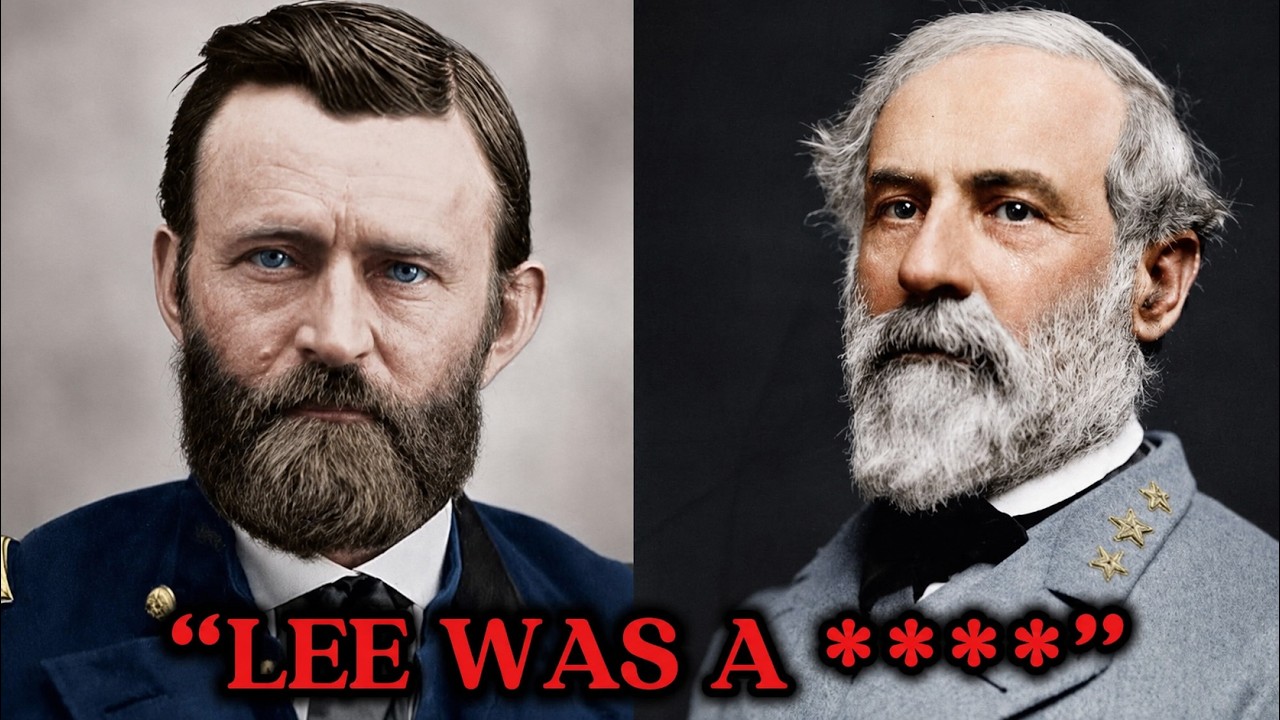 Lee in that room, and in the years that followed, was far more complex than the simple surrender documents suggested. It was a verdict delivered with cold, professional clarity, stripped of romance and free of vindication, a final assessment from a man who had spent four years learning exactly who his adversary was, and who he was not.
For nearly four years, the name Robert Edward Lee had been spoken in the North with a mixture of terror and morbid fascination. He had humiliated George McClellan on the Peninsula, baffled John Pope at Second Manassas, and mocked Joseph Hooker at Chancellorsville with half the men and in half the time, defying every principle of military logic. Lee had become something more than a general.
He was a specter, a diagnosis, a prophecy of doom that haunted the Union high command. Each defeat in the Eastern Theater reinforced the myth of his invincibility, and each new commander sent against him seemed to arrive with a preemptive excuse already prepared. The newspapers in Richmond celebrated him as a modern Napoleon, and the soldiers of the Army of Northern Virginia followed him with a devotion that bordered on religious fervor.
But Grant had been watching from the West, from the muddy banks of the Tennessee River, from the bloody peach orchard at Shiloh, from the slow, strangling siege of Vicksburg. And what he saw was not a sorcerer. He saw a problem, and problems have solutions.
When Abraham Lincoln promoted Grant to command all Union armies in March 1864, the briefings were filled with talk of Lee. Lee’s genius, Lee’s audacity, Lee’s supernatural ability to read a battlefield like a living document. Grant listened patiently as the staff officers recited the litany of Eastern Theater disasters, each one attributed to Lee’s tactical brilliance.
Then he spoke, and the room fell silent. He said he was tired of hearing about what Lee was going to do, and that they should go back to their commands and think about what they, the Union forces, were going to do to Lee. It was not bravado.
Grant was not the type for theatrical displays of confidence. It was a diagnosis of reality, a fundamental reframing of the strategic question that had paralyzed the Army of the Potomac for three years. The war was not about matching Lee’s brilliance move for move.
It was about applying overwhelming force with relentless consistency until the Confederate military machine simply ceased to function.
On May 4, 1864, 120,000 Union soldiers crossed the Rapidan River and entered the Wilderness, a tangled, smoke-choked forest in central Virginia where visibility collapsed to a few yards and artillery became useless. Lee struck immediately, a classic Lee maneuver, attacking a superior force before it could deploy, turning the enemy’s numbers into a burden. In two days of savage fighting, Grant lost 17,000 men.
Every commander before him had done the same thing after such a blow. They had retreated northward, returned to their camps, and told Lincoln they needed more time. But Grant ordered the army south.
A soldier who witnessed the moment wrote that when the men realized they were not retreating, that Grant was continuing the advance, they erupted in cheers. They threw their hats into the air. Something broke inside them, and they understood that this was a different kind of war.
Lee felt it too. He wrote to Jefferson Davis that Grant would not retreat. Those words carried enormous weight because Lee had always counted on retreat, on the psychological exhaustion of his opponents, on the political pressure that would force Union commanders to withdraw and regroup.
What followed was six weeks of nearly continuous combat, the likes of which the American continent had never seen. The Wilderness, Spotsylvania Court House, twelve hours of hand-to-hand fighting at a salient that history would remember as the Bloody Angle, the North Anna River, and finally Cold Harbor. Cold Harbor was Grant’s worst hour.
Seven thousand casualties in less than sixty minutes on June 3, a frontal assault against entrenched positions that Grant would later describe as the decision he regretted more than any other in the war. The newspapers called him a butcher. The word spread like wildfire through the North, and even some of his own officers began to question whether this quiet, unassuming man from Illinois was capable of defeating Lee.
 But Grant continued his advance, and it was during those six weeks of blood, forests, and mud that the real psychological calculation began. Grant had learned something essential about Lee. He had learned the truth of his adversary.
Lee was a genius of reaction, a master of defensive positions, counterattacks, and making the enemy pay a terrible price for every yard gained. His instincts were Napoleonic, his courage was genuine, and his men would follow him into the mouth of a cannon. But Grant had also learned what Lee was not.
Lee was not capable of replacing what he lost. The Confederacy was bleeding to death. Every brilliant defensive stand, every devastating counterattack, cost the South men who could not be replaced, artillery that Richmond could not recast, horses that would never be found again.
Grant understood with cold and terrible clarity that he was not fighting a battle. He was fighting an equation. For nine months, from June 1864 to March 1865, the two armies faced each other across the trenches of Petersburg, Virginia.
It was the future of warfare, and the end of Lee’s era. Lee’s army shrank, and desertions increased. In the winter of 1864, Confederate soldiers were subsisting on a handful of cornmeal per day.
Meanwhile, Grant’s army grew, received supplies via railroad and river, was reinforced with fresh troops, fed, rested in rotation, and equipped. The siege was not glamorous, and it was not heroic in the traditional sense. It was industrial, methodical, and utterly remorseless.
In his private correspondence during that period, Grant’s assessment of Lee underwent a subtle but telling transformation. At the beginning of the campaign, he wrote about Lee’s movements with professional respect tinged with caution. By Petersburg, the tone had changed.
He began to see Lee not as an unpredictable force of nature, but as a man operating within a box. A very skillful man, an austere man, as Grant would later describe him. A man of defiance and dignity combined.
But a man constrained. Lee was a commander from the eighteenth-century tradition, the brilliant general seeking the decisive battle, the climactic clash, the Napoleonic moment of transformation. He had adapted that tradition to serve his defensive genius, but he could not escape it.
Grant was something newer, something the military academies had not yet named. He was an industrial commander. He thought in systems, logistics, and the long, grinding, relentless pressure of resources applied without emotion.
He did not need to defeat Lee in a single glorious afternoon. He only needed to never stop.
On April 2, 1865, the Confederate lines at Petersburg finally collapsed. Jefferson Davis received the news during a Sunday morning service and fled Richmond that night. The Confederate capital burned.
Lee marched west with approximately 35,000 men, attempting to reach North Carolina to join Johnston’s army and continue the fight somehow. Grant closed the trap with methodical precision. Sheridan’s cavalry raced ahead.
 Infantry cut the road at Appomattox Station. By the morning of April 9, Lee’s army was surrounded. A Confederate officer asked Lee what he intended to do.
Lee said he had no choice but to go and see General Grant, and that he would rather die a thousand deaths. He sent a flag of truce. The house belonged to Wilmer McLean, who had moved his family here from Manassas, from the very farm where the first major battle of the war had been fought in 1861, fleeing the conflict.
But the war had caught up with him anyway.
Grant arrived first. He wore a private’s coat with his general’s rank insignia on the shoulders. His boots were covered in mud.
He carried no sword. Lee arrived in full dress uniform, with tall boots, gold spurs, and his sword at his side, a ceremonial weapon of extraordinary beauty. Those who witnessed the meeting left nearly identical descriptions.
Grant, stout, unkempt, and direct. Lee, erect, elegant, carrying himself with a dignity that seemed to impose itself, as if his mere posture could stop what was happening. Grant wrote about that moment with the precision of a man choosing every word carefully.
He noted that Lee wore a full and completely new uniform, and that he carried a sword of considerable value. In his rough travel suit, in a private’s coat with lieutenant general’s insignia, Grant acknowledged that he must have appeared strangely contrasted with a man of such elegance, six feet tall and of perfect build. There is no sarcasm in that text, no triumph.
There is something closer to awe.
They spoke briefly about Mexico, about the old army, about men they had both known. Grant later admitted that he almost forgot why they were there, that the conversation seemed for a moment like two soldiers reminiscing about a shared life. Lee brought them back to reality.
The terms were written, and they were generous. Officers would keep their personal weapons, and men would keep their horses. Lee’s composure faltered slightly at the horse provision.
He said it would have a very happy effect on his army. Grant later wrote that Lee’s relief was evident, and that behind that perfect posture and elegant uniform, there was a man who had feared his soldiers would find nothing to return to. When Lee walked out of the McLean house, Grant stepped onto the porch and watched him mount his horse.
He did not cheer. He did not raise his hat in triumph. He quietly removed it, without any ceremony, and held it at his side.
His staff followed suit. There were no Union cheers, no artillery salutes, no celebrations within earshot of the defeated army.
 Grant would explain why in his memoirs, written twenty years later, in a race against throat cancer, memoirs that Mark Twain described as among the finest military writing in the English language. He wrote that he felt anything but joy at the fall of a foe who had fought so long and valiantly and suffered so much for a cause, though that cause was, in his belief, one of the worst for which a people ever fought. Read that sentence carefully.
Consider its structure. He describes Lee as a foe who fought valiantly. He acknowledges real suffering.
He grants Lee and the Confederate soldier the dignity of endurance. Then, without hesitation or softening, he describes their cause as one of the worst for which a people ever fought. Both things at once, without contradiction.
This is not a simple man writing.
So what did Ulysses Grant truly think of Robert E. Lee? He thought Lee was brave, not the manufactured bravery of a man seeking reputation, but the deep structural courage of someone who had reconciled himself with his own mortality long before the war demanded it.
He thought Lee was a first-rate tactician, perhaps the finest the American continent had produced. Interior lines, use of terrain, audacity of flanking attacks. Grant never diminished any of that.
But Grant also believed that Lee’s greatness was inseparable from its limitations. Lee thought in battles. Grant thought in wars.
Lee understood Virginia with an intimacy approaching spirituality, but he never fully grasped, or perhaps never allowed himself to grasp, that Virginia was not the entire war. The Confederacy was dying in Tennessee, Georgia, and Missouri while he was achieving brilliant tactical victories that consumed men he could not replace.
Grant was formed by the same traditions as Lee, West Point, the Mexican War, the old regular army, where honor and personal glory were intertwined, and where the decisive battle was the supreme military achievement. But somewhere, perhaps at Shiloh, or in the filth of the Vicksburg trenches, he shed that. He learned to think as a manager of terrible industrial violence rather than as a nineteenth-century general.
And that contrast, not in courage or intelligence, but in vision, is what Grant saw with complete clarity when he looked at Lee across that room. A brilliant man fighting brilliantly within a framework doomed to defeat. Grant did not attend the formal surrender ceremony the next day.
He had already begun his journey north, thinking about what would come next. Lee went to Lexington, Virginia, to preside over a small college, and died in 1870 without ever applying for restoration of his citizenship, a request Gerald Ford granted symbolically in 1975, 105 years after his death.
Grant became president, struggled, was betrayed by men he trusted, and finished his memoirs five days before dying of throat cancer in July 1885. The book provided financial security for his family. It remains one of the most honest documents ever written by a military commander about war, and about the men who were on the other side of it.
Grant ultimately described Lee as a man of great dignity, someone who gave everything to a cause he believed in, even though Grant believed that cause was a catastrophic mistake. There is a word for what Grant felt in that room, for what he offered Lee on that porch, for what he ordered his men not to celebrate. The word is not forgiveness.
The word is not pardon. The word is respect, cold and clear respect from one professional to another, untainted by emotion, unmixed with endorsement. Grant spent four years learning what Lee was and what he was not.
On April 9, 1865, he knew both answers perfectly. He felt nothing but sadness for the fall of a foe who had fought so long and valiantly and suffered so much for a cause, though that cause was, in his belief, one of the worst for which a people ever fought.