Six torpedoes struck the USS Indianapolis, and the ship was doomed. The sinking of the cruiser in the final weeks of World War II remains one of the most devastating naval disasters in American history, killing hundreds of sailors through the sinking itself, exposure, dehydration, and relentless shark attacks. But for decades, questions have lingered about why the crew was left stranded for days and why the ship’s commanding officer became the sole figure held responsible. On July 26, 1945, the USS Indianapolis completed a highly classified mission, delivering vital components for the first operational atomic bomb to the island of Tinian.
Those parts would be assembled into the weapon known as Little Boy, which was dropped on Hiroshima days later, killing an estimated 80,000 people. After the delivery, the Indianapolis received orders to proceed to the Philippines to prepare for the planned invasion of the Japanese mainland. The ship sailed alone at about 17 knots. Shortly after midnight on July 30, 1945, a Japanese submarine fired torpedoes into the side of the Indianapolis.
The impact was catastrophic, breaking the ship in two. The order to abandon ship came quickly, but many did not make it out in time. The cruiser sank in roughly 12 minutes, and around 300 sailors were trapped inside as it went down. They were never seen again.
Approximately 900 others made it into the water, unaware that their ordeal was only beginning. An estimated 879 men survived the initial sinking. Many had not secured life preservers and were forced to struggle continuously to stay afloat. Those with life vests could do little more than drift helplessly in the open ocean.
Many were wounded, suffering deep cuts or broken bones from the explosions. There were no life rafts and no reliable way to treat injuries. Nearly every man was covered in fuel oil leaking from the wreckage, and some were already dying in their comrades’ arms within the first hours. During the 12 minutes it took the ship to go down, the crew sent distress signals until it was no longer possible to continue.
Those SOS calls were received by the Navy. For reasons that remain unclear, they were dismissed. Even when the Indianapolis failed to arrive at its destination on schedule, no concern was raised. No rescue mission was launched to search for the vessel or its crew.
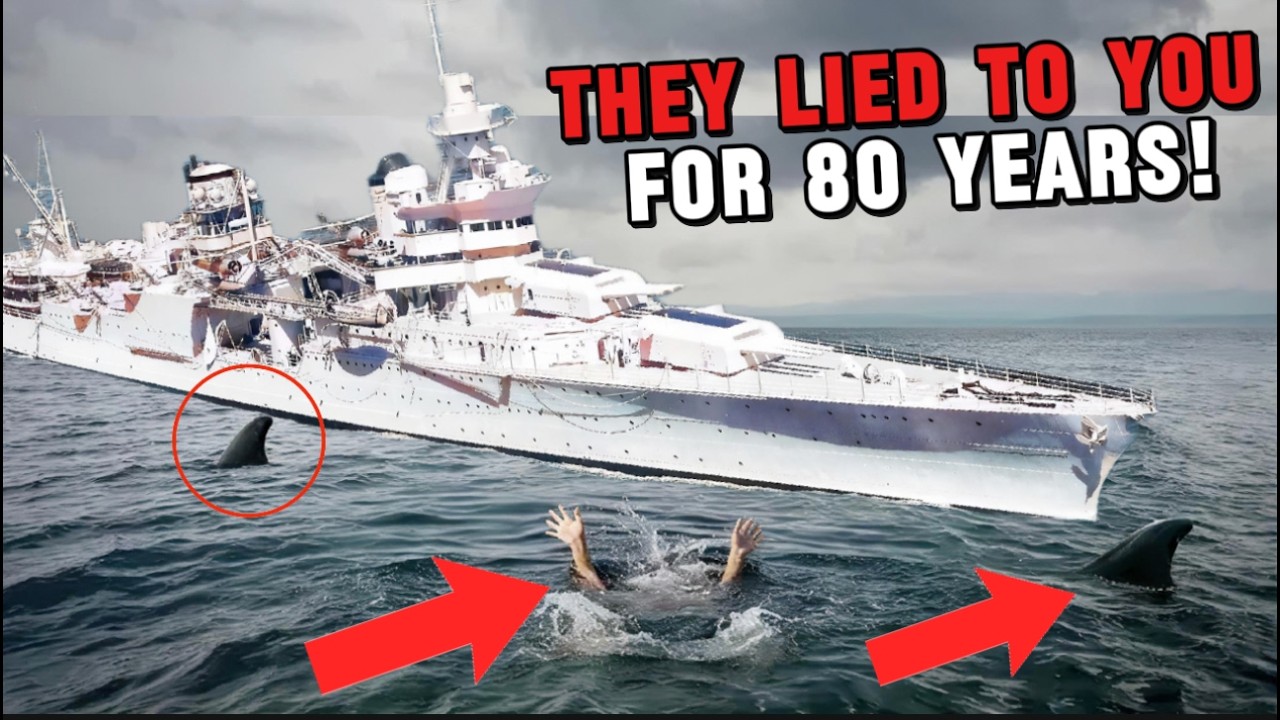
By dawn, blood was in the water, and sharks began gathering. Survivors tried to stay in clusters, but men would drift apart. Once a man was separated, sharks would strike quickly. Those who lived through it recalled hearing screams before a sailor was pulled beneath the surface, after which only his life preserver would resurface.
The attacks continued for days. The sharks were not the only threat. The men had no fresh water, and after days of exposure, many died from dehydration. Sailors who drank seawater soon suffered from hallucinations and confusion.
Their life preservers became waterlogged, making it harder to stay buoyant, and numerous men drowned long before the sharks could reach them. On the third day, some sailors found floating crates and lashed them together into a makeshift platform. Though too unstable to serve as a real raft, it was useful for drying out the waterlogged life preservers. The men would wring them out, place them on the platform, and put them back on once dry.
One crate contained partially decayed potatoes, which were carefully rationed to help the survivors hold on. At 11:00 a. m. on the fourth day, the group was spotted by Lieutenant Wilbur C.
Gwynn, flying a routine patrol mission in a bomber. He radioed for help. The USS Cecil J. Doyle, a destroyer operating nearby, was alerted, and its captain made the decision on his own authority to alter course and recover the survivors.
Lieutenant Adrian Marks, piloting a seaplane sent to drop rafts and supplies, saw sharks menacing the men and landed his aircraft to pull the most exposed sailors from the water. The plane became so crowded that survivors had to be secured to the wings with parachute cord. By nightfall, Marks had rescued 56 men. When the Doyle’s commander reached the scene, he ignored caution and aimed a powerful searchlight into the sky to signal other rescue ships.
Since the war was still ongoing, this placed his vessel in serious danger, but he understood that time was critical. Despite the rescue effort, only 317 of the original 879 survivors were brought back alive. The ship’s full complement had been 1,196 sailors. The Navy was stunned and angered that such a tragedy had been allowed to happen.
But because the Indianapolis had been carrying components for an atomic weapon, the full details of the mission could not be made public. The U. S. government kept the disaster secret for a full two weeks.
During that time, Hiroshima and Nagasaki were both bombed, the former with a weapon built from the parts the Indianapolis had delivered. The sinking was finally announced on August 15, 1945, the very day Japan declared its surrender. The timing meant the story was almost entirely overshadowed by headlines of victory. Months after the tragedy, Commander Charles McVay, the commanding officer of the Indianapolis, faced a court-martial.
The charge was that he had failed to steer the ship in an evasive pattern, a maneuver that might have confused a pursuing Japanese submarine. McVay was the only captain in the entire U. S. Navy to be court-martialed for losing a ship during World War II.
Many observers have argued that he was made a scapegoat to deflect attention from Navy failures. In 2001, the U. S. Congress formally exonerated McVay of any misconduct, but the vindication came decades too late.
He died by suicide in 1968. The legacy of the Indianapolis remains clouded by unanswered questions. Was the tragedy preventable? Why was no rescue sent despite the distress calls?
Why was the captain singled out while the truth stayed buried until after the war ended? Some answers may never fully surface, but the story continues to demand attention, not just for the horror of what happened, but for the failures that made it worse.