By the afternoon of July 2, 1863, the Army of the Potomac had made nearly every mistake an army could make and still be standing.
Its commander, George Meade, had only been in charge for three days. He inherited a force of roughly 93,000 men who had marched hard through Pennsylvania heat, slept poorly, and eaten worse. They were stretched across unfamiliar ground outside a small college town that none of them had heard of before the day before yesterday.
To the west and north, Robert E. Lee’s Army of Northern Virginia was already pressing on multiple fronts. What was about to happen on a rocky, tree-covered hillside at the southern end of the Union line would not just decide the day. It would decide whether the Army of the Potomac survived the summer.
The man at the center of it, a former rhetoric professor from Maine who had never commanded men in combat before the previous year, would have less than 20 minutes to make the most consequential tactical decision of the entire war.
This is the story of Little Round Top.
To understand why the hills at the southern end of Gettysburg mattered so much, you have to understand what the battlefield looked like on a map. The Union line ran roughly north to south along a series of ridges, curling at the northern end into what military historians call a fishhook shape.
At the very bottom of that fishhook sat two hills. Big Round Top and, just north of it and slightly lower but far more tactically significant, Little Round Top.
These two elevations commanded the entire surrounding landscape. Artillery placed on Little Round Top could fire down the length of the Union line. Every regiment, every battery, every supply wagon in the Union position would be exposed.
If the Confederates took that hill, they didn’t need to break through the Union center. They could simply make the entire position untenable from above and force a retreat or a rout.
The problem was that Little Round Top was nearly empty.
The Union’s Third Corps commander, Daniel Sickles, had made what was possibly the single worst unilateral decision by a corps commander in the entire war. Without orders, without consulting Meade, he had advanced his entire corps forward from the high ground it was supposed to hold.
He planted it in a salient, a forward-jutting line centered around a peach orchard that left his flanks completely hanging in the air. It looked aggressive. It was actually suicidal.
By moving his corps forward, he had left Little Round Top exposed and undefended at almost exactly the moment Confederate General James Longstreet was preparing to launch the largest assault of the battle directly at the Union left.
The man who caught this was not Meade. It was his chief engineer, Gouverneur Warren.
Warren rode up Little Round Top to get a look at the battle’s southern end and found, to his horror, that the hill was empty except for a small signal station. He looked south and west. He could see Confederate infantry massing in the woods below.
He understood immediately what was about to happen. He rode hard to find someone, anyone, to plug the gap.
He found Fifth Corps commander George Sykes, who found a brigade commander named Strong Vincent. And Vincent, without waiting for formal orders to be written and passed down, made the decision on his own authority to take his entire brigade up that hill.
Strong Vincent was 26 years old. He would be dead within two days, mortally wounded on the very ground he was riding to defend. But in that moment, he made the right call, and he made it fast.
Vincent’s brigade arrived on Little Round Top at roughly 4:30 in the afternoon and fanned out along the southern and western slopes. He placed his regiments in order from right to left.
The 16th Michigan. The 44th New York. The 83rd Pennsylvania.
And finally, at the very end of the line, on the extreme left flank of the entire Army of the Potomac, the 20th Maine Volunteer Infantry Regiment.
Their commander was Colonel Joshua Lawrence Chamberlain.
Chamberlain was 34 years old, a Bowdoin College professor who had spoken to the administration about taking a sabbatical to study in Europe, then turned around and volunteered for the Union Army instead. He had taught rhetoric, oratory, and modern languages. He had read Homer in the original Greek and could recite long passages of it from memory.
He had no formal military training before the war. What he had was an unusual combination of qualities. A systematic intellect. A capacity for calm under pressure. And a willingness to absorb information from the men around him who knew things he didn’t.
In his first year of service, he had watched and listened and learned. He was not yet a great commander, but he was becoming one, and he was becoming one faster than almost anyone around him realized.
He also inherited, at the start of this campaign, a complication that would have broken a lesser officer’s spirit before a single shot was fired.
Two weeks before Gettysburg, the army had sent the 20th Maine a batch of mutineers. Not deserters. Mutineers.
These were 120 men from the Second Maine Regiment who had signed up for a two-year enlistment, served it out faithfully, and then been told, incorrectly, through an administrative error, that they had actually signed three-year terms. When they refused to accept this and refused to fight further, they were placed under armed guard and transferred to Chamberlain’s command with written orders that he could shoot any man who refused to comply.
Chamberlain read those orders, folded them, put them in his pocket, and went to talk to the mutineers personally.
He didn’t threaten them. He didn’t lecture them about patriotism. He sat with them, acknowledged that they had been wronged, told them he had no power to fix the administrative error, but that he did have the power to treat them with decency.
He asked them to fight.
Not all of them came around, but most did. And on July 2nd at Little Round Top, those men, former mutineers, fought as hard as anyone on that hill.
That detail matters because it tells you something about who Chamberlain was before the shooting started. He led by drawing people toward something rather than pushing them away from something else.
Strong Vincent placed the 20th Maine on the far left with a very specific instruction. He told Chamberlain that this was the left flank of the Union Army, that there was nothing beyond him, and that he must hold that position at all costs.
He added a phrase that Chamberlain would remember for the rest of his life.
“You are to hold that ground at all costs. Not hold it if you can. Not hold it unless it becomes untenable. Hold it at all costs. Period.”
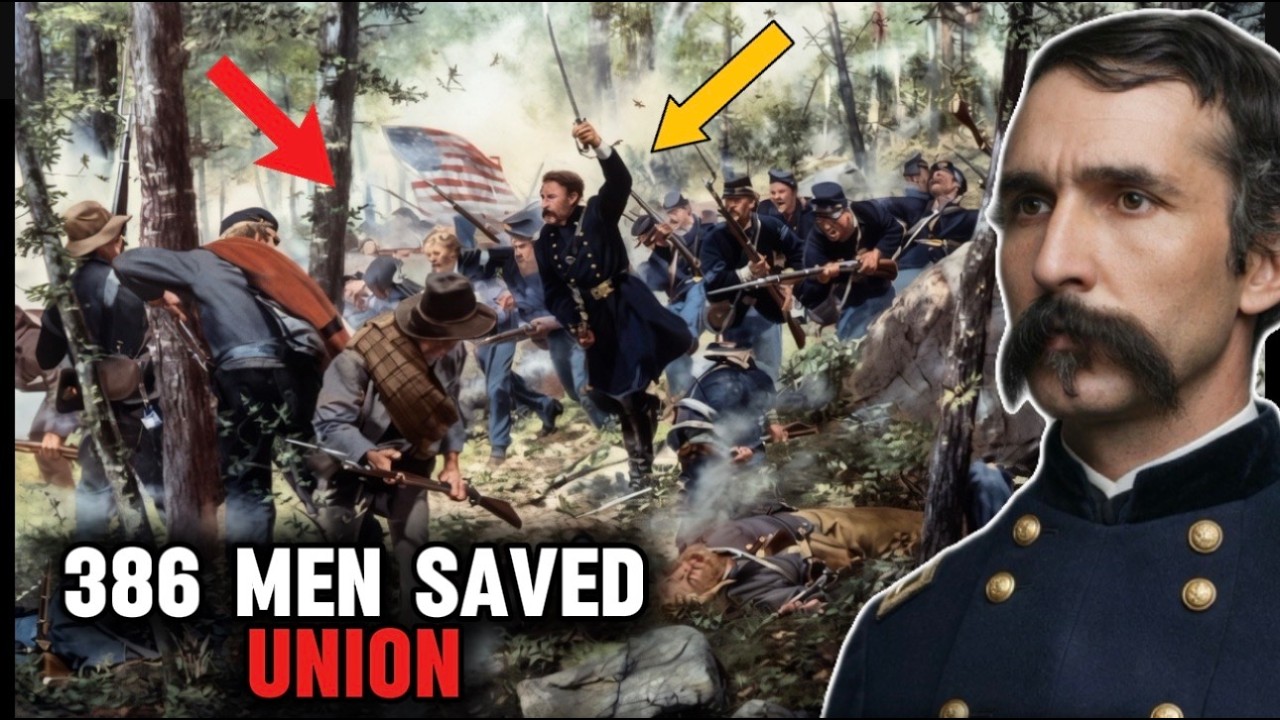
Chamberlain deployed his roughly 386 men along the slope and then did something smart. He sent his brother, Tom, who was serving as a company commander, to scout the ground to the left.
Tom came back and reported what nobody wanted to hear. The ground extended further than they had thought. If the Confederates came around the end of the line, they could flank it entirely.
Chamberlain responded by bending his left flank backward, swinging it like a door hinge, so that it formed a right angle with the main line. It was a standard military maneuver, but executing it quickly on steep, unfamiliar, boulder-strewn ground with tired men required someone who understood both the mechanics of the move and the terrain simultaneously.
Chamberlain pulled it off. His men barely had time to catch their breath when the Confederate attack began.
The men coming up that hill were the 15th and 47th Alabama Infantry, commanded by Colonel William C. Oates.
Oates was 30 years old, a self-made lawyer from Alabama. He was aggressive, experienced, and, in the hours before this assault, deeply frustrated.
His men had spent the morning of July 2nd on a forced march that had covered nearly 30 miles in brutal heat. They had arrived at their jump-off position parched and exhausted. Oates had sent two companies to find water. They hadn’t returned by the time the order to advance came, so he went without them, fighting with roughly 500 men instead of the 640 he should have had.
He had also, earlier in the day, climbed to the top of Big Round Top and seen clearly that placing artillery there would give the Confederates a devastating position. He had sent word up the chain of command suggesting exactly this. The suggestion was ignored.
So he descended and prepared to assault Little Round Top from the southwest, climbing uphill through trees and boulders toward men he couldn’t fully see.
The first assault hit the 20th Maine like a wave. The Confederates came up through the rocks yelling, firing as they advanced, and the Maine men held their ground and fired back.
The hillside was steep, the boulders offered cover to both sides, and the smoke from black powder rifles hung in the air between the trees and turned the afternoon light a dirty gray. Men on both sides went down.
The Confederates reached the Union line in places, were thrown back, reformed in the trees below, and came again.
The second assault was harder. Oates shifted his approach, trying to find the left end of the Union line and curl around it. Chamberlain had anticipated this, or rather had prepared for it by bending that left flank back.
So when the Alabamians tried to swing around the edge, they ran into men who were already facing them. The fighting became close, loud, and savage. Men fired at targets 10 yards away. Officers drew pistols.
The 20th Maine’s line bent, but did not break.
The third assault very nearly finished them.

By this point, Chamberlain’s men had been fighting for somewhere between 15 and 20 minutes. A duration that sounds almost trivially short until you consider that they had been firing as fast as they could load, that the smoke was nearly blinding, that the noise was continuous and deafening, and that men all around them were screaming or going silent in ways that were worse than screaming.
The regiment’s line had contracted. Men had been pulled from the right side of the line to reinforce the left, thinning the right to almost nothing.
And the ammunition was nearly gone. Not running low. Nearly gone.
The officers were going up and down the line asking men how many rounds they had left. The answer was coming back in ones and zeros. Some men had already resorted to picking up the rifles of the dead and wounded around them and using those until those ran dry, too.
When Chamberlain understood that his regiment had, at best, one more volley in it, if that, he faced a set of options that all looked like different versions of the same catastrophe.
He could order a retreat. But retreating from this position meant abandoning the flank, and abandoning the flank meant the Confederates would come around and roll up the entire Union line from below.
He could hold the position and fight with whatever was left. Rifle butts. Bayonets. Bare hands. But with hundreds of Confederates still coming, a static defense with no ammunition was a slow way to lose the same ground a retreat would surrender faster.
Or he could attack.
Chamberlain would later write about this moment with a characteristic precision. He didn’t describe it as inspiration. He didn’t describe it as desperation. He described it as calculation. A cold inventory of options in which attack was the only one that didn’t end in certain defeat.
The left flank was bent back at a right angle to the main line. If he ordered both halves of his line to advance simultaneously, the left swinging outward and the right sweeping forward like a closing barn door, the movement would be geometrically analogous to a wheel with the rightmost end covering the most ground at speed.
It would be disorienting. It would be unexpected. And it would close the distance so quickly that the Confederates, who were themselves in the process of reforming for what they intended to be a final push, would have no time to react.
He gave the order to fix bayonets.
What happened next is one of those events in American military history that gets described as legendary so often that the word has been drained of its meaning. So let’s try to say it plainly instead.
Roughly 350 men who had been fighting uphill for 20 minutes with no ammunition drew bayonets and charged downhill into roughly 500 Confederate soldiers who were preparing to attack them.
The noise was enormous and sudden. The psychological impact was instant and total.
The Confederates who had expected to come up the hill into defenders who were nearly finished found instead that the hill itself seemed to be coming down at them.
Oates’s line collapsed. Not slowly. All at once.
Men turned and ran, or threw their hands up, or were caught in the sweep. The 20th Maine captured over 100 Confederate prisoners, including several officers, in a matter of minutes.
Oates himself barely escaped. He would spend the rest of his long life, he lived until 1910, arguing that Confederate command failures earlier in the day had cost them a victory that would have changed the war.
He was probably right. But what broke his assault on July 2nd, specifically, was not Confederate failure. It was the charge of a man with no ammunition and nowhere to retreat.
The 20th Maine held the left flank of the Army of the Potomac for the rest of that day and into the third day of the battle.
The broader fighting of July 2nd raged on. Sickles’s Third Corps was effectively destroyed in the Peach Orchard and the Wheatfield. The fighting at the Trostle farm turned brutal. Devil’s Den became a killing ground for sharpshooters.
But the Union line held. And it held in part because the anchor at its southern end had not given way.
The following day, July 3rd, is the day most people know. Pickett’s Charge. 15,000 Confederate soldiers walking across an open mile of ground into concentrated Union artillery and rifle fire.
Lee’s great gamble on the Union center, launched after two days of fighting on the flanks, had failed to break the line. It, too, failed catastrophically. And the Army of Northern Virginia began its long retreat back to Virginia in the rain.
Lee would never invade the North again.

The connection between Little Round Top on the second day and Pickett’s Charge on the third is not incidental. Had the Confederate Army taken Little Round Top on the afternoon of July 2nd, the question of the third day would have been moot.
There would have been no Pickett’s Charge because there would have been no intact Union line to charge. Meade would have had to abandon the field, and he would have done it with a battered, demoralized army that had just suffered its second catastrophic defeat in Pennsylvania.
The political consequences of that are almost impossible to overstate.
Lincoln’s government was already under enormous pressure from peace Democrats who called themselves Copperheads, and who were gaining traction with a northern public exhausted by two years of war and staggering casualty lists.
A decisive Confederate victory at Gettysburg, not just a battle won, but an army crippled, would have given the peace movement exactly the argument it needed. Lincoln might not have survived the 1864 election. The war might have ended on Confederate terms before the year was out.
This is not speculation dressed up as history. These were real political forces operating in real time. And military historians, including ones who are deeply skeptical of counterfactual arguments, have consistently pointed to the Union’s hold on Little Round Top as one of the genuine hinge moments of the entire conflict.
What Chamberlain and his men did in those 20 minutes was not merely brave. It was load-bearing.
The whole structure of the Union war effort rested, for those 20 minutes, on a rocky hillside in Pennsylvania with a professor and 386 men who had run out of bullets.
Joshua Chamberlain went on to fight through nearly every major engagement of the Army of the Potomac for the rest of the war. He was wounded six times, once so severely at Petersburg in 1864, that Ulysses Grant promoted him to Brigadier General on the spot, believing he was dying.
He didn’t die.
At Appomattox in April 1865, Grant selected him to command the Union forces that formally received the Confederate surrender. Chamberlain, without orders and entirely on his own initiative, commanded his men to present arms as the Confederate soldiers marched past. A military salute to men who had fought honorably.
Confederate General John Gordon, who was leading the marching troops, saw the gesture and ordered his own men to return it.
It remains one of the most quietly extraordinary moments in American history, and it was characteristic of the man. The same instinct that had gone and talked to the mutineers rather than threatening to shoot them. The same instinct that had looked for what could hold people together rather than what could be used to break them down.
After the war, Chamberlain went back to Maine. He became governor four times. He became president of Bowdoin College, his alma mater, for 12 years.
He wrote extensively about the war, giving testimony and speeches, and eventually a memoir that historians still use as a primary source.
He remained physically marked by the war for the rest of his life. The Petersburg wound never fully healed, and he underwent more than a dozen surgeries over the following decades.
He died in 1914 at the age of 85, reportedly still suffering from that wound 50 years later. He was one of the last surviving general officers of the Civil War when he died.
The monument to the 20th Maine still stands on Little Round Top. It sits near the spot where Chamberlain bent his left flank back, above the ground where his men fixed their bayonets and ran downhill.
The boulders are still there. The slope is still steep. If you stand where the regiment stood and look down through the trees toward the southwest, you can see roughly how far the Alabamians had to climb, and roughly how fast Chamberlain’s men must have come at them.
But what the monument can’t quite show you is the interior of that decision. The moment when a man with no ammunition, responsible for holding the flank of an entire army, looked at his options and chose the one that looked like madness, but was actually the only geometry that worked.
That required not just courage, though it required that, too. It required clarity. It required someone who had trained himself, over years of studying how arguments are made and how minds under pressure reason through problems, to find the logic inside a crisis that had no obvious solution.
There are moments in history that feel retrospectively inevitable. The winner was always going to win. The tide was always going to turn.
Little Round Top is not one of those moments. It was genuinely contingent. It hung on specific men making specific decisions under conditions that gave them almost no margin for error.
If Warren hadn’t ridden up that hill to check the ground. If Vincent hadn’t moved without waiting for orders. If Chamberlain had decided the only rational response to running out of ammunition was to fall back and save his men.
If any one of those things had gone differently, the hill falls. And if the hill falls, the question of what comes next for the battle, for the campaign, for Lincoln’s government, for the war, opens up into something genuinely dark.
Instead, a former rhetoric professor from Maine looked down a rocky Pennsylvania hillside at an enemy force larger than his own, turned to his officers, and ordered the charge.
The Army of the Potomac held. Gettysburg held. The Union held.
20 minutes. 386 men. One decision made by a man who had never heard of Little Round Top before the day he was ordered to die on it.
That is how close it was.