In the summer of 1884, Ulysses Grant was dying. Throat cancer, almost certainly from decades of cigar smoking, was closing off his ability to speak and eventually to swallow. He had lost his money in a fraudulent investment scheme that left his family nearly destitute.
He was racing against a clock he could hear ticking, writing his memoirs in a desperate sprint to leave something for his wife Julia after he was gone. He wrote anyway, sometimes dictating when his voice still worked, sometimes writing in longhand while the cancer advanced.
The Personal Memoirs of Ulysses Grant were finished just days before he died in July of 1885. Mark Twain, who published them, later called them one of the finest works of prose the English language had produced. The book sold hundreds of thousands of copies and rescued Julia Grant from financial ruin.
But the sales figures are not what made those memoirs consequential to the history of how Americans understood the Civil War. What mattered was what Grant chose to write with full knowledge that these were his final words on the subject about the two Confederate commanders whose reputations had by then already begun hardening into myth: Robert E. Lee and James Longstreet.
One was being transformed into a marble saint by the very men who had served under him. The other was being systematically destroyed by those same men for reasons that had more to do with post-war politics than anything that happened on a battlefield.
What Grant said about both of them cut against the prevailing narrative in ways the Lost Cause movement spent the next century attempting to muffle. What emerges when you read that testimony carefully, without the filter of mythology, is a portrait that inverts almost everything popular memory insisted was true.
By the mid-1880s, the Lost Cause had established itself as the dominant Southern interpretation of the war. Its central architects were men like Jubal Early, who had served under Lee and who spent the post-war decades constructing a mythology in which the Confederacy had been a noble civilization brought down by weight of numbers.
Lee had been a military genius without peer in American history, and Confederate defeat had been inevitable from the start. The myth was self-exonerating in ways Early and his associates preferred not to examine. It absolved the Confederate leadership of meaningful failures, while simultaneously making those failures irrelevant.
Lee existed in this framework as something close to a secular saint. The mythology required that everything be his victory and nothing be his fault.
Gettysburg created a problem for that framework because Gettysburg needed explaining. The Lost Cause answer was James Longstreet.
He had commanded the Confederate forces on the second and third days of the battle. He had argued against the assaults Lee ordered. By Lost Cause accounting, he had been too slow, too reluctant, too wedded to defensive thinking to execute Lee's plan with the urgency the moment required.
The charges accumulated across the 1870s and 1880s in southern newspapers, veterans memoirs, and the publications of the Southern Historical Society. Longstreet had failed at Gettysburg. Longstreet had cost Lee the battle. Longstreet had, in some versions of the argument, cost the Confederacy the war.
None of the men advancing this case acknowledged the more obvious explanation for their animus. James Longstreet had done something unforgivable in the eyes of the Lost Cause establishment. After Appomattox, he had cooperated with Reconstruction, aligned himself with the Republican Party, supported black citizens' participation in the political process, and worked openly with Grant's administration.
Making him the villain of Gettysburg was not a neutral military analysis. It was a verdict delivered by men whose quarrel with Longstreet was primarily political and who had both the platform and the motivation to dress it up as history.
Grant understood this perfectly, and he had known Longstreet far too long to pretend otherwise. The friendship between Ulysses Grant and James Longstreet went back to their time at West Point in the early 1840s. Grant graduated in 1843, Longstreet a year ahead of him.
They had served together during the Mexican-American War, navigating the same brutal campaigns across foreign terrain that would later shape how each of them thought about supply lines, terrain, and the limits of what infantry could achieve without proper support. When Grant married Julia Dent in August of 1848, Longstreet stood in the wedding party.
After Appomattox, when Longstreet became a target for the Confederate veterans who viewed his post-war choices as apostasy, Grant's support was not symbolic. He helped Longstreet secure an appointment as surveyor of customs in New Orleans. When Grant held the presidency, he found Longstreet further positions within the federal government.
What Grant said about Longstreet as a soldier was not the careful praise of someone doing a favor for a political ally. It was a professional military assessment delivered by a man who had fought on the same side as Longstreet in Mexico, who understood what effective generalship looked like from the inside, and who had spent four years fighting against the army Longstreet had helped build.
Grant called Longstreet one of the finest soldiers he had ever known. He described him as steady, analytically clear under pressure, tactically sound, and possessed of the quality Grant valued most in a senior commander: the ability to take an honest reading of actual conditions and act on what was there, rather than what theory or ego suggested should be there.
That assessment directly contradicts the picture the Lost Cause had been painting for two decades by the time Grant's memoirs were published. Longstreet was not the Confederate Army's soft spot. In Grant's estimation, Longstreet was among its two or three most capable officers.
The credibility Grant brought to that assessment was not transferable. He was the general who had ultimately defeated Lee's army, which meant he had defeated the whole of it, Longstreet included. His reading of which Confederate commanders were genuinely dangerous was calibrated against direct operational experience rather than regimental reunions and partisan memoirs.
The more delicate piece of Grant's testimony, the piece the mythology found harder to absorb, concerned Lee. Grant refused with clear deliberateness to place Lee in the category of military immortal that the Lost Cause had constructed.
His treatment of Lee in the personal memoirs was measured, analytical, and deliberately stripped of the reverence that had settled over Lee's legacy by 1885. Grant's core argument was operational and specific.
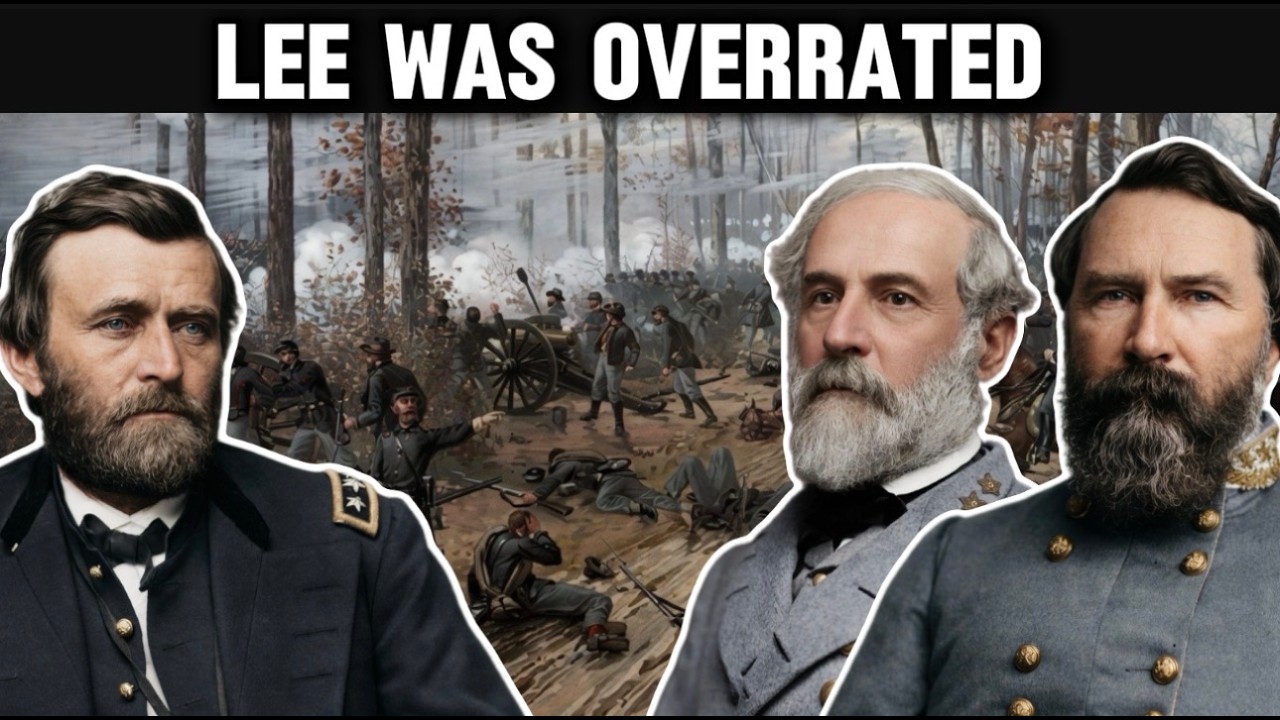
He observed that Lee had spent the war's most celebrated campaigns fighting against a succession of Union commanders who were substantially inferior to him. McClellan, who consistently believed himself outnumbered and rarely committed his full strength at the decisive moment. Pope, aggressive in temperament but tactically reckless. Burnside, whose physical courage was genuine but whose grasp of independent command was badly overmatched. Hooker, who planned the Chancellorsville campaign well and then withdrew psychologically at the moment his plan was working.
Against this particular rotation of opponents, Lee's record had come to look close to supernatural. The victories were real, but the opposition had frequently been an active contributor to its own defeat.
Grant wrote in the plain language that defines the Memoirs throughout that he had known Lee personally before the war and knew him to be mortal. In context, it was a pointed correction to something the culture had begun treating as settled.
What Grant's own conduct in 1864 had proved was that the rebuke was accurate. After the Battle of the Wilderness in early May of that year, in which the Army of the Potomac and the Army of Northern Virginia had fought each other to a brutal tactical draw, the men expected Grant to pull back.
They had watched it happen under Hooker, under Burnside, under Pope. Each time Lee fought a federal force to exhaustion, the federal force retreated.
Grant refused to retreat. He moved south around Lee's flank, pressing toward Richmond. He kept moving south after Spotsylvania. He kept moving after Cold Harbor, even after absorbing severe casualties in a frontal assault he later acknowledged openly as his worst tactical decision of the campaign.
The result was that Lee faced, for the first time, a commander who had stripped away the psychological leverage that the accumulated mythology of Confederate invincibility had always provided. Grant had analyzed what had gone wrong against Lee repeatedly and had identified the mistake each previous Union commander had made. They had believed in Lee more than they believed in their own arithmetic. Grant chose the arithmetic.
The Lost Cause answer to Grant's defense of Longstreet and his measured assessment of Lee was a particular kind of silence. For a long time, it worked. The mythology was more emotionally satisfying than the correction, more widely distributed, and more aggressively promoted.
What gradually shifted the professional historical consensus was not any single counter-revelation, but an accumulation of scholarship across the latter half of the 20th century. Historians went back to the primary sources, traced the actual operational timeline at Gettysburg, examined what Longstreet had argued before the battle, and what Lee had ordered, and what the terrain and logistics actually permitted.
They concluded that the Lost Cause case against Longstreet was built on convenient omissions and motivated reasoning. What they found was what Grant had essentially said from the beginning: that Longstreet's critics had more to gain from his destruction than from honest military analysis.
Grant's relationship with Longstreet survived everything the post-war decades threw at it. When Longstreet published his memoirs in 1896, they were partly a defense of his own record against 30 years of sustained attack. Grant didn't live to read them.
The irony at the center of this entire story is almost too precise to be accidental. The man who defeated Lee and Longstreet ended his life insisting that the most admired of the two had been somewhat overrated, and the most attacked of the two had been genuinely exceptional.
Grant had no mythology to protect. He had no Lost Cause to prop up, no veterans organization whose feelings he needed to manage, no regional identity bound up in the reputations of Confederate commanders.
He had known Longstreet since they were young men learning military discipline at the same institution. He had studied Lee's campaigns the way a professional studies a rival before a high-stakes engagement. Then he had spent eight months maneuvering against Lee across Virginia and drawn his own conclusions about what Lee was and was not.
What those conclusions add up to is not a simple inversion of the mythology. Lee was a capable commander whose real gifts operated most powerfully within a particular set of conditions: fighting defensively on familiar terrain against opponents whose willingness to absorb punishment and keep coming was lower than their physical resources should have allowed.
When those conditions changed and the opponent in front of him was Grant, Lee's results were different. Not because Lee had changed, but because the conditions that had amplified his strengths and concealed his limitations had finally changed.
Longstreet was a general of the first rank who had his reputation deliberately dismantled by political enemies inside his own former cause using Gettysburg as the vehicle. Gettysburg needed a villain, and Longstreet had made himself available for the role by refusing to participate in the mythology that required one.
Grant knew both of these things because his relationship with the original material was closer than almost anyone else's. He had stood in Longstreet's wedding. He had spent the better part of a year trying to force Lee into a decisive engagement and had been forced to adapt his tactics to what he found.
The man who won the war spent the last weeks of his life writing the truth about it in a chair on a porch in upstate New York, working against a cancer that was going to kill him before most of the country was willing to hear what he had to say.
He finished the book. He died four days later. The book came out, sold enormously, made Julia Grant financially secure, and was praised on every literary front.
The specific claims it made about Lee and Longstreet settled quietly into the professional historical record while the Lost Cause mythology continued to dominate the popular one. That gap between what Grant actually wrote and what American popular memory chose to absorb is one of the stranger features of Civil War historiography.
The primary authority, the man with the most direct knowledge and the least reason to distort it, had told the story plainly. The story that spread instead was the one that felt better to the people who needed it to feel a certain way.
History does not always travel toward clarity at the speed truth deserves, but the testimony is there in Grant's own words, finished in the last light of his life with the specificity and directness of a man who had earned the right to say exactly what he thought and chose to use it.