On July 3, 1863, Robert E. Lee made a decision that would define his legacy and cost thousands of men their lives in under an hour. The Confederate commander had spent two days trying to break the Union Army along the ridges south of Gettysburg, Pennsylvania. The first day brought a tactical victory, pushing Union troops back through the town. The second day, marked by brutal fighting at Little Round Top, the Wheat Field, and the Peach Orchard, failed to dislodge the Union line from the high ground.
The Army of the Potomac, under George Meade, was bent but not broken. Dug in along a ridge shaped like a fishhook, the Union forces held terrain that favored the defender in almost every way. Lee had a choice to make, and he made it in defiance of his most experienced subordinate.
James Longstreet, Lee’s senior corps commander, argued forcefully against attacking the Union center. He wanted to maneuver around the Union left, forcing Meade into a position where the Confederates could fight defensively. Lee rejected the plan. He believed the Union center had been weakened to reinforce the flanks and that a concentrated assault could split Meade’s army in two.
Longstreet pushed back harder than most officers ever pushed against Lee. He walked the ground himself that morning and told Lee plainly that no 15,000 men could take that position. Lee listened, considered it, and gave the order anyway.
The man chosen to lead the main assault was George Pickett, a Virginia-born major general whose division had missed the first two days of fighting entirely. Pickett’s men were fresh but untested in this specific fight. Pickett himself had a complicated resume, having graduated last in his class at West Point, though he had built a reputation for personal bravery during the Mexican-American War.
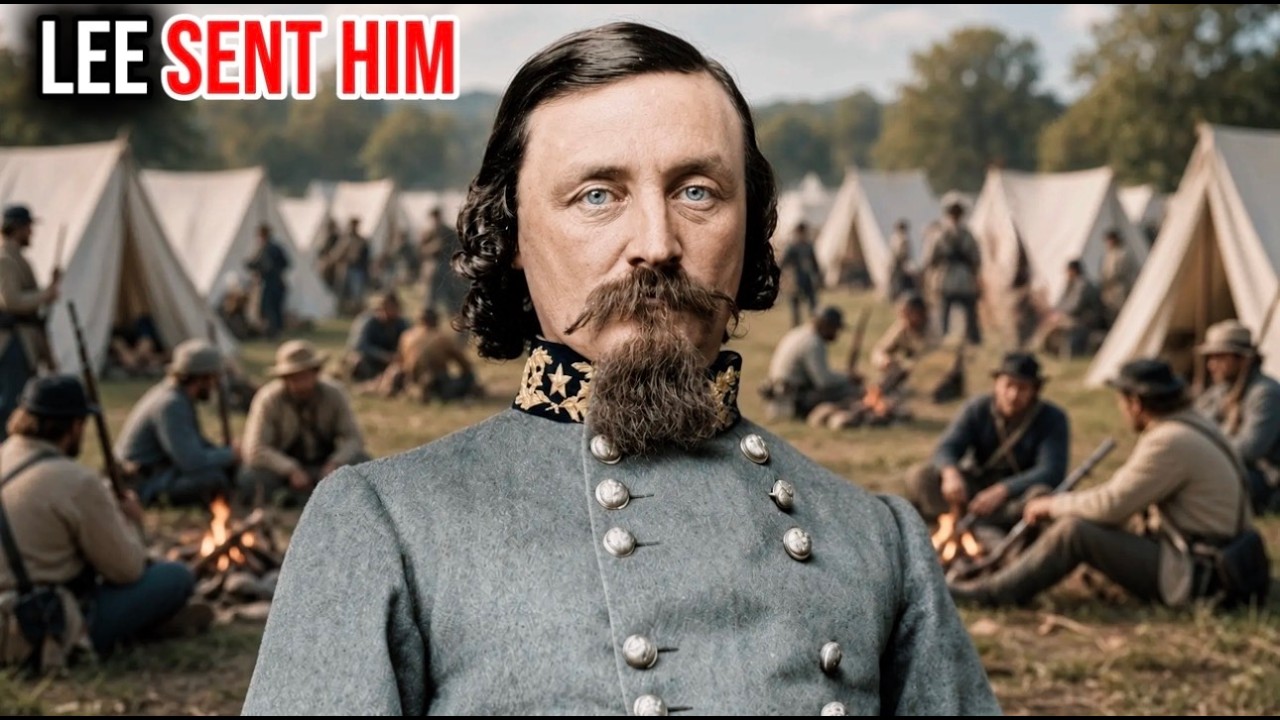
Pickett had spent much of the war slightly outside Lee’s inner circle. By the summer of 1863, he wanted a chance to prove his division belonged at the center of a decisive fight. He would get exactly that, though not in the way he wanted.
The plan called for a massive artillery bombardment first, roughly 150 Confederate cannons opening fire on the Union center. The bombardment began around 1:00 in the afternoon and lasted close to two hours. But Confederate gunners overshot much of their target, and many shells landed in rear areas instead of destroying Union artillery.
The Union artillery deliberately slowed and eventually stopped its return fire, conserving ammunition and tricking the Confederates into believing the bombardment had succeeded. Around 3:00 in the afternoon, the order came down. Pickett, along with divisions under Johnston Pettigrew and Isaac Trimble, moved roughly 12,500 Confederate soldiers into the open.
The distance to the Union line was close to three-quarters of a mile of entirely open field. A rail fence partway across forced the advancing lines to slow down and bunch together in full view of Union guns that had never been destroyed. Union artillery opened fire with devastating effect, first with solid shot and shell, then with canister rounds that tore gaps through entire companies.
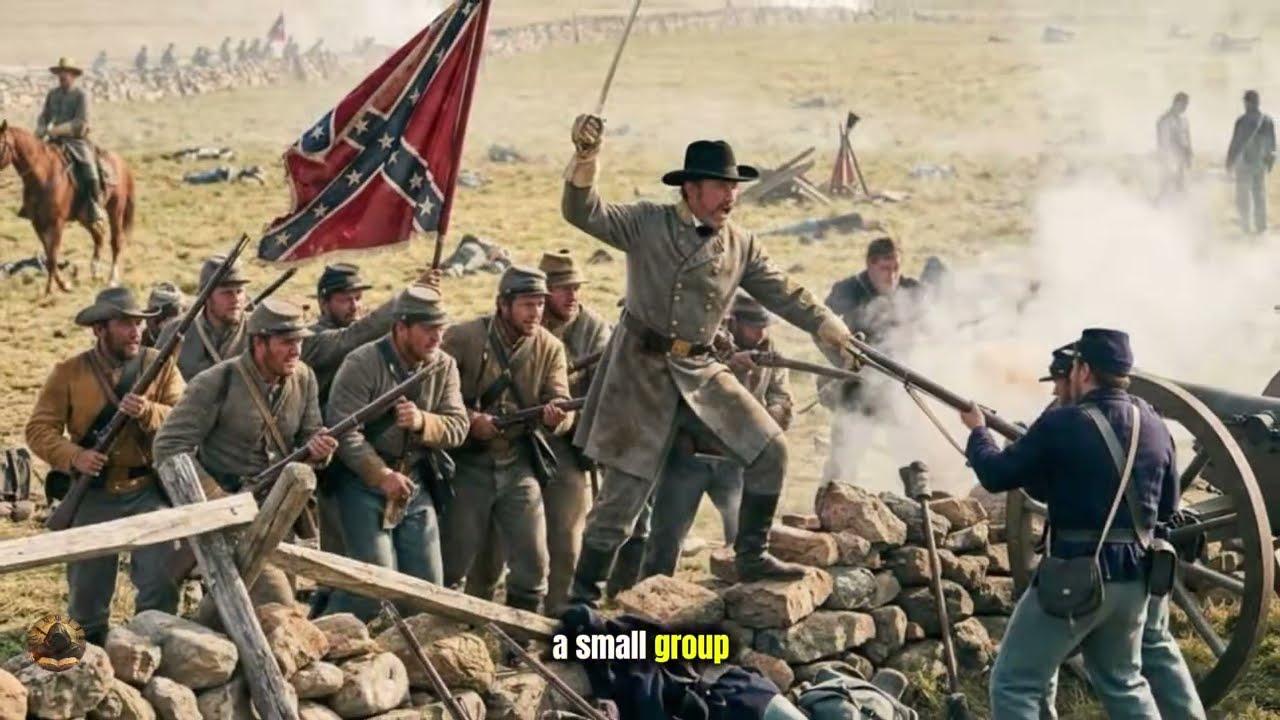
Union soldiers behind the stone wall watched the Confederate line come on with disbelief. Officers ordered their men to hold fire until the attackers closed to within a few hundred yards, then unleashed volleys that staggered whole brigades. Some Union regiments fired directly into the flanks of the advancing line, creating a devastating crossfire.
Confederate officers on horseback were shot down in disproportionate numbers, leaving disorganized units without leadership. By the time the survivors reached the low stone wall near a cluster of trees, the formation was a fraction of its original size and badly fragmented.
A small group led by Brigadier General Lewis Armistead actually broke through the Union line for a few minutes, reaching what has since been called the high water mark of the Confederacy. It didn’t last. Union reinforcements closed in, and the breakthrough collapsed within minutes. Armistead was mortally wounded near the wall.
The retreat back across the open field was almost as costly as the advance. Confederate casualties totaled somewhere between 5,000 and 6,000 men out of the roughly 12,500 who started the attack, a casualty rate of over 50 percent in less than an hour. Pickett’s own division lost every one of its regimental commanders.
Lee rode out to meet the survivors as they streamed back across the field. By most accounts, he took full responsibility on the spot, telling retreating soldiers the failure was his fault alone. Pickett did not share Lee’s instinct for graceful accountability. When Lee reportedly told him to rally his division, Pickett is said to have replied that he had no division left to rally.
Pickett spent the rest of his life bitter about the charge that made him famous. He reportedly refused to attend certain post-war reunions where Lee would be present. When asked late in life why the charge failed, he is said to have responded that he always believed the Union Army had something to do with it.
The failure of the charge effectively ended the Battle of Gettysburg. Lee, having lost roughly a third of his army over three days, began a retreat back toward Virginia the following day in heavy rain. Meade was criticized afterward for not pursuing aggressively enough to destroy Lee’s weakened army.
President Lincoln was reportedly furious when he learned Meade had let Lee’s army slip away. He drafted a sharply worded letter expressing his frustration, though he ultimately never sent it. The war would continue for nearly two more years, but Gettysburg, combined with the fall of Vicksburg the very next day, marked a turning point the Confederacy never recovered from.
Lee would never again mount a major offensive campaign onto northern soil. Across the full three days of fighting at Gettysburg, combined casualties on both sides topped 50,000 men, making it the costliest battle ever fought in North America. Pickett’s charge alone accounted for a disproportionate share of the Confederate total from that final day.
What makes the story of Pickett’s charge more than just a military footnote is the question it leaves behind about command, trust, and blame. Lee made the decision. Longstreet warned against it and was overruled. Pickett carried it out knowing the odds and lost the division that had made his career.
It was Pickett’s name, not Lee’s or Longstreet’s, that history attached most firmly to the disaster. Lee’s own writings after the war reflect a man who never fully resolved his feelings about that afternoon. He took public blame in the moment, but in later years, some of his statements shifted responsibility toward subordinates.
That pattern fed directly into the broader post-war mythology known as the Lost Cause, which worked to preserve Lee’s reputation as a flawless commander undone only by bad luck or the failures of the men around him. The mythology needed a villain who wasn’t Lee, and for decades, popular retellings quietly shifted blame toward Longstreet or Pickett’s division.
Pickett never got the chance to build a legacy beyond July 3, 1863. He continued serving through the remainder of the war, but nothing he did afterward competed with the shadow of Gettysburg. He died in 1875, still known first and foremost as the general whose name got attached to the moment the Confederacy’s fortunes turned, a moment he neither planned nor wanted, and one he never stopped resenting the men who sent him into.