On October 12, 1870, Robert E. Lee lay dying in a narrow bed in Lexington, Virginia. Outside, a cold rain fell. His wife, Mary, sat beside him. His children filled the room. In the gray hours of the morning, he spoke his last coherent words. Different accounts give different versions, but the one that survived was this: "Strike the tent." A soldier’s final order. The march was over.
Within hours, telegraph lines carried the news across the country. Former Confederate officers issued statements of grief. Churches in Richmond tolled their bells. The entire South entered a kind of public mourning.
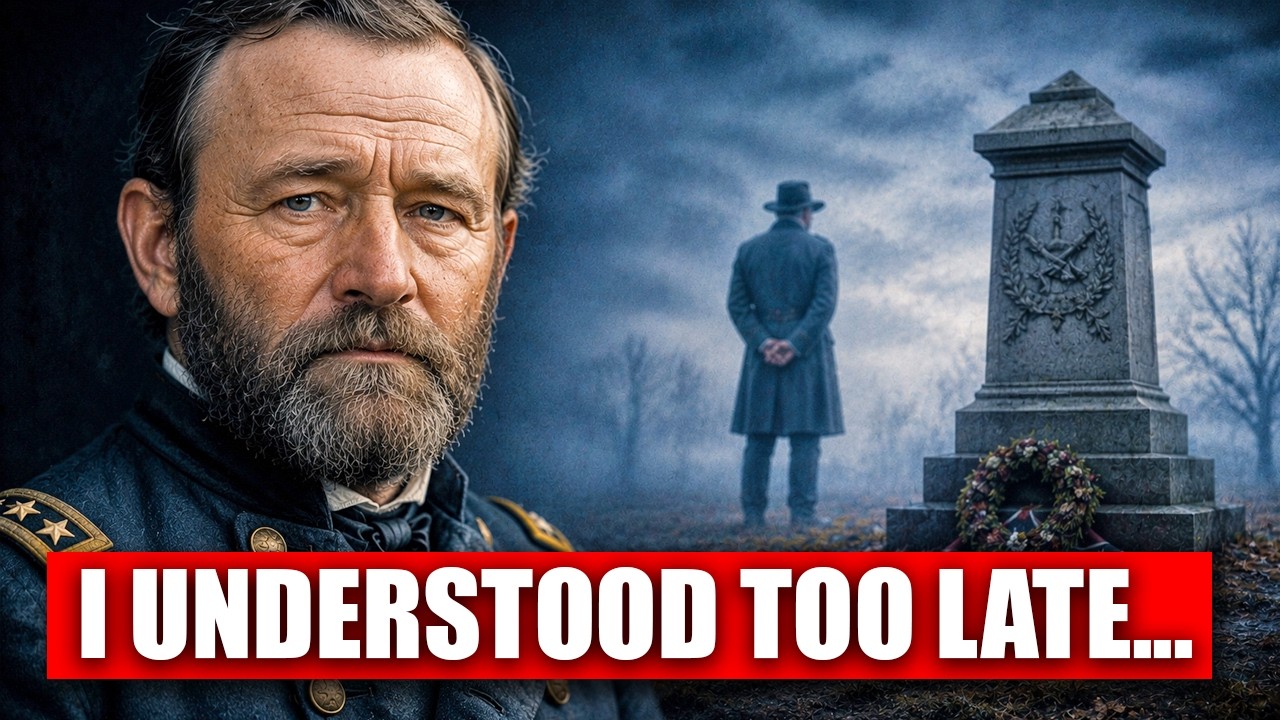
In Washington, D.C., inside the White House, the man who defeated Robert E. Lee said nothing. Not a word. Not a line. Ulysses S. Grant, the 18th president of the United States, issued no proclamation, sent no letter of condolence, offered no public tribute. The White House was silent.
Why? What was Grant thinking? And why, 15 years later, did he finally put something on paper about Lee that was more honest and more devastating than any eulogy could have been? Because what Grant eventually wrote was not a tribute. It was not an insult. It was a single sentence that respected the soldier and condemned the cause, and refused to let history separate the two.
To understand that sentence, you have to go back to the last week of the Civil War and into the room where it ended.
By the first days of April 1865, the Confederacy was collapsing. Richmond had fallen. Jefferson Davis had fled south. The Army of Northern Virginia, the last real Confederate fighting force, was running west. Grant was right behind it.
Grant was 46 years old. Twelve years earlier, he had resigned from the army in disgrace, drinking too much, missing his family, stuck at a fogbound posting in California. He tried farming. He failed. He tried selling firewood on street corners in St. Louis. He failed at that, too. By 1860, he was working as a clerk in his father's leather goods store in Galena, Illinois. Now he commanded a million men.
The man he was chasing was in many ways his opposite. Lee was 63, the son of Revolutionary War hero Light-Horse Harry Lee, a man who died disgraced and bankrupt when Robert was a child. Lee married into the family of George Washington himself. He was the most promising officer in the United States Army. Winfield Scott offered him command of the Union forces in 1861. Lee said no. He chose Virginia. He chose the Confederacy.
Now, four years and hundreds of thousands of dead Americans later, that choice had led him to a muddy road with a starving army and nowhere left to go. The men stumbling along behind Lee were not an army anymore. Many were barefoot. Some had not eaten in days. They were farmers' sons, conscripts, boys who were 15 when the war started and were not yet 20.
Grant, riding behind them with 80,000 men, was thinking about something no one expected. Not vengeance. Not punishment. He was thinking about what happens after. He had a headache that had lasted three days, and he had a decision to make that would define the next century of American life.
Lee's army had roughly 28,000 men left. Of those, fewer than 10,000 were armed infantry in any condition to fight. A year earlier, this army had numbered more than 75,000. Now it was bleeding out on the roads of central Virginia. Converging on Lee were approximately 80,000 Union soldiers. Grant did not need to fight a battle. He needed to close a door.
Lee knew the arithmetic. There were only three options: fight through, scatter, or surrender. His officers were divided. Some wanted one last charge. Others were already talking about terms. But there was a fourth option, the one Jefferson Davis wanted. Disperse the army. Send the men into the mountains. Wage a guerrilla war. Bleed the Union for years.
On the night of April 8th, Lee was in a field near Appomattox Courthouse. His senior officers were around him. The conversation turned to the guerrilla option directly. Someone raised it. Scatter the men. They know the land. They could fight for years.
Lee listened. He considered it. Then he said no. His reasoning was both military and moral. The men who scattered would become bandits. The federal army would have to occupy the South indefinitely. Farms would burn. Civilians would suffer. He told his officers plainly, "We would bring on a state of affairs it would take the country years to recover from." Then he said something quieter. He said he would rather surrender his army and die a thousand deaths.
The decision itself is beyond dispute. Lee chose to end it cleanly. No mountains. No guerrilla columns. No decade of blood. One meeting. One document. One signature. Lee's refusal to wage guerrilla war may have saved more American lives than any single battlefield victory in the entire conflict.
But before Lee could surrender, the army had to survive long enough to reach the meeting. The last week of the Army of Northern Virginia's existence was one of the most harrowing retreats in military history.
On April 2, 1865, Grant's forces finally broke through the Petersburg line. The Confederate government evacuated Richmond. That night, Jefferson Davis boarded a train south. Behind him, Confederate soldiers set fire to warehouses and bridges. By morning, whole blocks of Richmond were burning.
Lee turned his army west, aiming for Amelia Courthouse, 35 miles away. There were supposed to be supply trains waiting there. Food. Ammunition. Shoes. He reached Amelia Courthouse on April 4th. The supply trains were not there. An administrative error had sent the wrong trains. Instead of food, Lee found boxcars full of ammunition and harness. His men could not eat ammunition. The army waited a full day, a day it did not have, while Grant's forces closed the distance behind them.
The army staggered west again on April 5th. Men were eating anything they could find. Parched corn. Raw sweet potatoes pulled from abandoned fields. Horses were collapsing and being butchered on the roadside. Union cavalry struck at the flanks, picking off wagons, capturing stragglers. Every mile, the army got smaller.
On April 6th, disaster struck at Sailor's Creek. Union forces caught a large portion of Lee's army strung out and separated. Nearly 8,000 Confederate soldiers were captured in a single afternoon, including six generals. Among them was Lee's own son, Major General Custis Lee. Lee rode to a hilltop overlooking the carnage. Watching his shattered units stream back in disorder, he said the words every historian of the Civil War knows: "My God, has the army been dissolved?"
That evening, Grant sent a note to Lee. The language was restrained, almost gentle. "The results of the last week must convince you of the hopelessness of further resistance." He asked Lee to surrender. Lee, not yet ready, responded. He asked what terms Grant would offer.
Over the next two days, the noose tightened. Sheridan's cavalry raced ahead of Lee's column and blocked the road west at Appomattox Station. When Confederate cavalry and Gordon's infantry attacked at dawn on April 9th, they pushed the Union cavalry back. Then they saw behind the horsemen, rank after rank of Union infantry. The road was closed. The last door had shut.
Lee dressed carefully. He put on his finest gray uniform, his red silk sash, the jeweled sword presented to him by an admirer in England. His aide, Charles Marshall, asked why he was dressing in his best. "I have probably to be General Grant's prisoner today," Lee said, "and I thought I must make my best appearance."
Grant had been suffering from a migraine for three days. On the morning of April 9th, he received Lee's note agreeing to meet. As he later wrote, "The headache vanished instantly. I was cured the moment I got Lee's letter."
Marshall rode ahead to find a suitable location. He encountered Wilmer McLean, a local resident, who offered his parlor. It was a modest brick house in a tiny hamlet of fewer than 100 people. McLean had a reason to be weary of the war. In July 1861, the war's first major battle, Bull Run, was fought literally on his previous property. A cannonball came through his kitchen. He moved to Appomattox to get away from the fighting. The war followed him. It began in his front yard and ended in his parlor.
Lee arrived first. He waited in the parlor, seated at a small marble-topped table. Outside, Confederate soldiers waited in the road, sensing what was happening inside. Some wept openly. Some stood in rigid silence.
Grant walked in. The contrast was almost absurd. Lee was in full dress uniform, immaculate gray coat, red silk sash, polished boots, the jeweled sword at his side. He looked like a painting. Grant was wearing a mud-spattered private's coat with only his shoulder straps to indicate his rank. His boots were caked with Virginia clay. He carried no sword.
Grant, perhaps nervous, began making conversation. He brought up the Mexican-American War, where both men had served almost 20 years earlier. "I met you once before, General Lee, while we were serving in Mexico," Grant said. "I have always remembered your appearance, and I think I should have recognized you anywhere."
Lee responded politely. He said he remembered the occasion but could not recall what Grant looked like.
Lee brought the conversation back to the business at hand. He asked Grant to put his terms in writing. Grant nodded, called for his order book, and sat down at a small oval table. He began writing in pencil.
The terms were astonishing in their generosity. Officers could keep their sidearms, their horses, and their personal property. Enlisted men could keep their horses and mules as well. Grant added this provision specifically, knowing that most Confederate soldiers were farmers. They would need them for spring plowing. No one would be taken prisoner. Every man would be paroled and allowed to go home.
Understand what Grant was not doing. He was not demanding unconditional surrender. He was not confiscating weapons beyond the army's formal arms. He was not arresting Lee. He could have done all of these things. He chose something else.

Years later, Grant explained his reasoning with characteristic simplicity. "I did not want to exalt over them or humiliate them. I wanted to get them home and back to work." Home and back to work. Not justice. Not punishment. Just home. Spring plowing.
Lee read the terms. His face betrayed almost nothing. But at the provision about the horses, Lee's composure shifted. "This will have the best possible effect upon the men," he said. "It will be very gratifying and will do much toward conciliating our people."
Grant's terms, written in pencil, needed to be copied in ink for the official record. The task fell to Ely S. Parker, Grant's military secretary, a trained lawyer, an engineer, and a member of the Seneca Nation. Parker, whose Seneca name was Donehogawa, Keeper of the Western Door, picked up a pen and began writing the document that would end the war.
Under the laws of the United States, Parker could not vote. He could not testify in most courts. He was not legally a citizen. He was writing the peace.
When Lee was introduced to Parker, the general looked at the Seneca officer's dark complexion and said, "I am glad to see one real American here." Parker's reply was unambiguous. "We are all Americans."
The documents were signed. Lee stood. Grant stood. They shook hands. Lee walked to the door of the McLean house and paused on the porch. He struck his fist into his palm three times, the gesture of a man controlling himself with enormous effort, and called for his horse, Traveller. He mounted and rode slowly back toward his own lines.
Grant, watching from the porch, removed his hat. His staff officers did the same. There was no cheering. Grant later ordered that there be none. The war was over. The rebels were countrymen again.
Grant's next act was to send 25,000 rations to Lee's starving army. Hardtack, salted pork, coffee. The food arrived within hours. Confederate soldiers who had not eaten in days sat in the Virginia fields and ate Union rations. Some of them wept, not from grief, from relief.
Three days later, on April 12th, the formal surrender took place. Commanding the Union force that received the surrender was Joshua Lawrence Chamberlain, the hero of Little Round Top, a college professor from Maine who had been wounded six times. Chamberlain gave an order that Grant did not instruct. He ordered his men to shift from order arms to carry arms. The marching salute. A soldier's gesture of respect to a fellow soldier.
Gordon heard it. He understood instantly. He wheeled his horse, dropped the point of his sword to his boot toe, the reciprocal salute, and ordered his own men to return the honor. The Confederate column marched past in silence. Not a word was spoken. Not a cheer. Not a jeer.
Lee issued General Order Number Nine, his farewell to the Army of Northern Virginia. "After four years of arduous service marked by unsurpassed courage and fortitude, the Army of Northern Virginia has been compelled to yield to overwhelming numbers and resources." He told them, "You will take with you the satisfaction that proceeds from the consciousness of duty faithfully performed." Then the line that would endure: "Go to your homes and resume your occupations. Obey the laws and become as good citizens as you were soldiers."
Five days after Appomattox, Abraham Lincoln was shot at Ford's Theater. He died the next morning. The man who supported Grant's generous vision of peace was gone. Andrew Johnson took office. The political ground shifted under Grant's feet.
Lee returned to a South in ruins. His family's estate, Arlington, had been seized by the federal government. Union soldiers were buried on his front lawn. It would become Arlington National Cemetery. Lee, now without income or property, accepted the presidency of a small, struggling college in Lexington, Virginia, Washington College. He told his students to be good Americans. He urged former Confederates to accept the result and look forward.
He applied for a pardon and the restoration of his citizenship. The application was lost, misplaced in a government office. It would not be found until 1970.
Lee's health deteriorated steadily. He suffered from what modern physicians believe was cardiovascular disease. He was 63 but looked much older. On September 28, 1870, Lee suffered what appeared to be a stroke. He was carried to his bed and did not leave it. On October 12th, he died.
The South mourned extravagantly. Former Confederate states lowered flags. Churches held services. Newspapers printed eulogies that transformed Lee into a secular saint. The mythmaking began before the body was cold.

In the North, the reaction was more complicated. Some papers were generous. Others were blunt. He was a traitor who led an armed rebellion that killed hundreds of thousands of Americans.
And the president of the United States said absolutely nothing. The silence was deafening, and it was deliberate.
Grant was in his second year as president. He was fighting the Ku Klux Klan, which was terrorizing black citizens across the South. He was enforcing the 14th and 15th Amendments, which gave black Americans citizenship and the right to vote. Rights that the cause Lee fought for was specifically designed to prevent. A presidential tribute to Lee would have handed his political enemies a weapon. It would have said the cause was noble. Grant was not willing to say any of those things. So he said nothing.
Grant's silence in 1870 was not hatred. It was not pettiness. It was strategy, and it was also restraint. Because 15 years later, with no political consequences left to worry about, with death staring him in the face, Grant finally wrote what he actually thought about Robert E. Lee.
In 1884, Grant was diagnosed with throat cancer caused by a lifetime of cigars, sometimes 20 a day. He was bankrupt, having been swindled in a financial fraud. He was dying and he was broke. His friend Mark Twain offered to publish his memoirs. Grant began writing with a ferocity that astonished everyone around him. He was racing the cancer, writing sometimes 10,000 words a day.
In the Personal Memoirs of U.S. Grant, reflecting on the moment he watched Lee ride away from Appomattox, Grant wrote these words: "I felt like anything rather than rejoicing at the downfall of a foe who had fought so long and valiantly and had suffered so much for a cause, though that cause was, I believe, one of the worst for which a people ever fought."
Read that sentence again. A foe who had fought so long and valiantly for a cause, though that cause was, I believe, one of the worst for which a people ever fought. This is not a man choosing sides. This is a man refusing to choose between two truths. In 1885, dying of cancer, writing against the clock, he finally put both truths on the same page.
That single sentence contains the entire contradiction. Respect for the man. Condemnation of the cause. Grant never wavered on either half. He did not soften the condemnation to make the respect easier. He did not withdraw the respect to make the condemnation cleaner. He held both truths in the same fist and refused to let either one go.
This is what Grant admitted about Lee. Not that Lee was great, and not that Lee was wrong, but that he was both, and that both mattered.
Grant finished his memoirs on July 16, 1885. He died seven days later on July 23rd. The book became one of the best-selling works of the 19th century and earned Grant's widow nearly $450,000, a fortune at the time. It is still considered one of the finest military memoirs ever written in the English language.
In the memoirs, Grant wrote one more thing about Lee that deserves to be remembered. Reflecting on whether Lee was a traitor, Grant put it this way: "I knew he was morally wrong in the rebellion against the government of the United States. I also understood that every man does not see right and wrong in the same light."
Grant, in the end, refused to simplify. He gave Lee exactly what Lee deserved: honest respect, no more and no less. And he denied Lee what the mythmakers wanted to give him: innocence.
The version of Lee that most Americans carry in their heads, the noble warrior, the reluctant rebel, the marble man on the horse, was largely constructed after his death, not by historians, but by former Confederates who needed a saint. Grant in his memoirs refused to participate in that construction.
Lee's citizenship was never restored during his lifetime. He applied for a pardon in 1865. The application required him to sign an oath of allegiance to the United States. He signed it. But Secretary of State William Seward gave the oath to a friend as a souvenir, and it was lost for over a century. It was not found until 1970 in the National Archives. Congress posthumously restored Lee's citizenship in 1975, 110 years after he asked for it.
October 12, 1870. A gray-haired man lay dead in Lexington, Virginia. In Washington, the White House was silent. And somewhere in the years ahead, a dying general picked up a pen and wrote the truest thing anyone ever said about Robert E. Lee. Not that he was a hero. Not that he was a villain. But that he was both simultaneously, and that America would have to learn to hold that contradiction or be broken by it.
Grant held it. The question is whether we can.