On August 18, 1862, a 14-year-old German girl named Mary Schwandt was walking back toward her family’s farm on Beaver Creek in Renville County, Minnesota. She did not yet know her father was dead. She did not know her mother was dead. She did not know her pregnant older sister, married just months earlier, was lying in the yard with her brother-in-law. Her younger brothers, Frederick and Christian, would never open their eyes again.
The late summer heat rested heavy on the prairie. The grass was gold and dry. The wind carried a smell of smoke that should not have been there. Somewhere ahead of her, in the direction of the house, were the men who had done it. She kept walking.
Within hours, a Dakota warrior seized her, tied her hands, and dragged her into a nightmare that lasted 39 days.
The version of this story taught in school for generations was simple. A brave frontier family. A savage attack. A miracle rescue by a good Indian woman. That is not what happened to Mary Schwandt.
For 39 days, a 14-year-old girl was held in a Dakota camp. She was moved between lodges, threatened with knives, and marched across prairie in worn shoes. On the fourth day of her captivity, a Dakota woman named Snana walked up to the warrior who owned Mary and did something that history has spent 160 years trying to soften. She purchased her.
Not adopted her. Not rescued her. Bought her, the way you buy a horse.
The family memorial does not tell you what her 1894 narrative only hinted at, and what her 1929 recollections said more openly. There were four days before Snana arrived. Four days in which a 14-year-old girl was in the hands of men who had just killed her family. What happened in those days is the part of the story that was quietly buried when her family’s names were carved into stone.
The morning of August 18th began on a farm at Beaver Creek. Johan Schwandt was a German immigrant who had crossed an ocean for the promise every immigrant is sold, that land in America is cheap and the future is wide. He and his wife Christina had raised their children in a farmhouse built on ground that had belonged less than a decade earlier to the Dakota.
Their daughter Karolina had just married a man named John Walls. She was pregnant. The little boys, Frederick and Christian, were young enough that their names would fit on the same line of a monument someday. Mary was 14, literate, the kind of frontier girl who could write a letter and read a Bible passage aloud in German.
On the morning of August 18th, she was not at the house. She was working nearby. A small mercy of geography that would keep her alive for another five hours, and then in a sense cost her everything.
To understand what walked up to the Schwandt farm that morning, you have to understand what had walked the Dakota to that morning. The annuity payments, the money the United States government had promised the Dakota in exchange for their land, had not arrived. The money that was supposed to buy flour and salt pork for families that were now starving had not come.
A trader named Andrew Myrick, when told the Dakota were hungry, had reportedly said that if they were hungry, they could eat grass. When the uprising began that morning, Myrick was one of the first killed. His mouth was stuffed with grass.
The men who came up the trail toward the Schwandt farm were not faceless. Many were young. Some were in their teens, the same age as Mary. They had watched their own younger brothers grow thin. They had watched their fathers argue in council houses about whether patience or violence was more likely to keep the children alive. They had chosen.
The attack on the Schwandt farm was not a battle. It lasted minutes. When it was over, seven people were dead. Johan, Christina, Frederick, Christian, Karolina, John Walls, and a hired man named John Frerichs.
In 1915, the state of Minnesota carved their names into a granite monument. But no monument mentions the small detail that mattered most. Mary was not there. She was somewhere else on the property, and she was walking back.
In her 1894 narrative, Mary described herself as a little maiden of 14, held captive amid suffering, torture, and peril. She chose those three words carefully, 32 years after the fact. Modern historians reading her later 1929 manuscript noticed that she said more each time she was allowed to.
The war between the United States and the Dakota was not a war between armies. It was an uprising erupting simultaneously across a 100-mile stretch of the Minnesota River Valley. On August 18th alone, dozens of farms were hit. It was not one coordinated force. It was a fracture.
Little Crow, whose Dakota name was Taoyateduta, was somewhere in his 40s. He was a Mdewakanton chief who had been to Washington and shaken the hand of a president. He sometimes wore European suits. He sometimes wore Dakota clothing. He had spent his adult life trying to keep his people alive by cooperating with the very government that was starving them, and it had earned him nothing.
The night before the attacks, a council of warriors gathered. They were demanding war. Little Crow stood among them and tried to stop them. The uprising was not his plan. He was pulled into it, then chose to lead it because leadership was the only thing he had left to give.
At the council, Little Crow reportedly turned to the young men demanding war and said something no chief wants to say to his own warriors. Braves, he told them, you are little children. You are fools. You do not know what you are doing. You are killing yourselves.
Then he agreed to lead them anyway. A man who has been overruled by his own people has two choices. Watch them die alone, or die with them.
The man leading the attack that killed Mary Schwandt’s family did not want the attack to happen. He predicted out loud in front of witnesses that it would destroy his own people. He was right. That is one of the first things white historians left out when they wrote the story of the Sioux outbreak. A savage does not warn against savagery.
The raiding parties moving through Renville County were small, typically six to thirty warriors. They traveled on horseback and on foot. They were not uniformed. They were not a coordinated army. They were individual bands, individual decisions, individual grudges attached to individual farms.
They carried rifles, many of them old trade guns of limited range and reliability, along with knives and tomahawks. The rifles are a load-bearing detail. They explain why the attacks were close quarters and personal, not distant.
Beaver Creek was a mix of open prairie and creek bottom timber. Farms were scattered. There was no fort. There was no garrison. The nearest United States military presence, Fort Ridgely, was hours away. The Schwandt farm sat on ground that in living memory was Dakota hunting territory. The men walking up the trail that morning may have known this land longer than the Schwandts had lived on it.
Four days into the uprising, in a Dakota camp somewhere along the Minnesota River, a 23-year-old woman named Snana looked at a white girl sitting in the dirt beside a warrior’s lodge. The girl’s face was streaked with tears. Her hands were bound or bruised. She was too tired to cry anymore.
Snana knew what the next four days would look like for her if nothing changed. Snana had an English name too. Maggie. She had spent time around missionaries. She was married to a man called Brass. Her people were at war with the whites, and her own family had reasons to hate the government that was starving them.
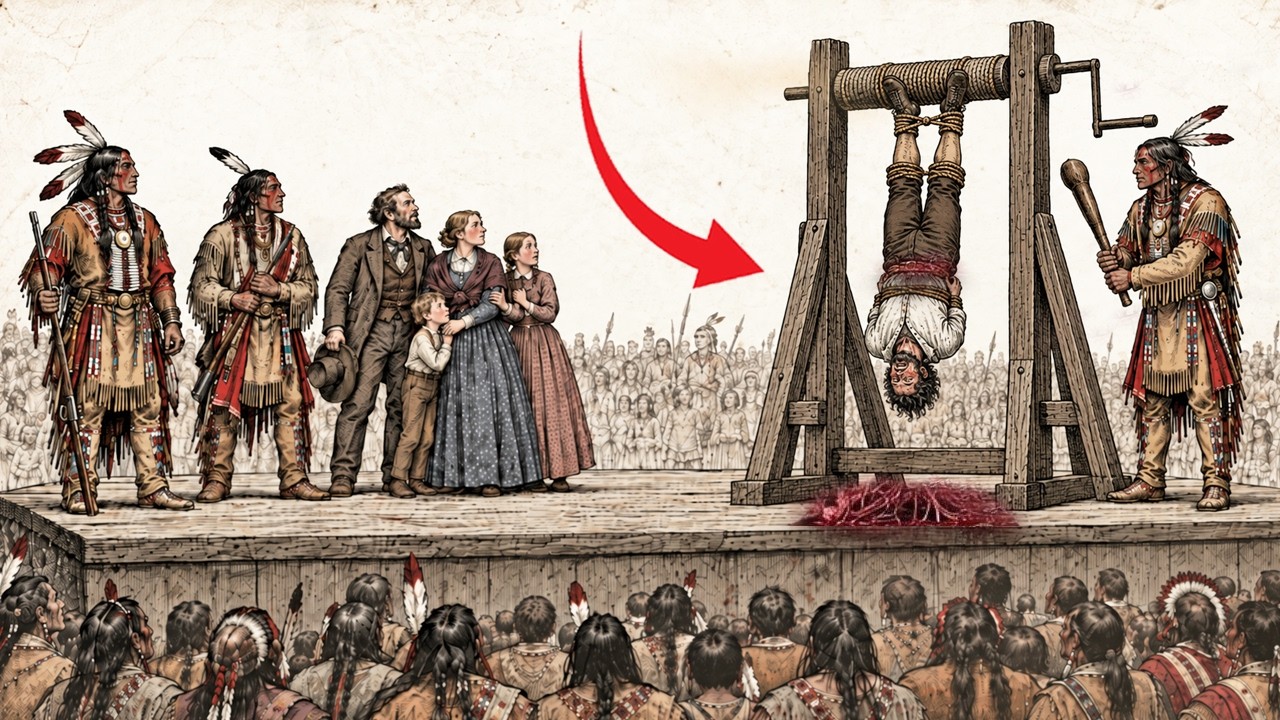
And yet, she looked at this specific 14-year-old and made a decision that would be misremembered for the next 150 years. She walked over to the warrior who held Mary and offered to buy her.
Whether this happened with a horse, with blankets, with a promise, or with a threat, historians cannot say with certainty. The Dakota woman’s own account, later filtered through translators and white editors, says only that on the fourth day of the outbreak, she purchased the white girl.
Purchased. That is the word she used. Not rescued. Not saved. Not adopted. Because in that camp, in those four days, a 14-year-old girl had been chattel. The only way to lift her out of that condition was to buy her, and then decide personally, individually, at the risk of your own life, that she was a person again.
Snana did not save Mary from the Dakota. She saved Mary from four specific days and from what those four days meant. And she saved her by participating in the same economy of ownership that had caused Mary to need saving in the first place.
Nothing about this story is clean. That is why they cleaned it.
What Snana had bought was not safety. It was a chance. And the men who would spend the next 35 days walking into that lodge with knives in their hands did not consider a purchase permanent.
When Mary was seized, her hands were bound. She was put on a horse or marched on foot with other captives. In the space of one afternoon, she had lost her father, her mother, her older sister, her sister’s unborn child, her brother-in-law, her two younger brothers, and the family friend who was probably like an uncle to her. Seven people.
Everyone she loved, except one brother she did not yet know was alive. She had not eaten. She had not slept. And now she was walking toward a camp full of strangers, some of whom had killed her family that morning.
The first camp was a rough circle of tipis. Cooking fires burned low. Other captives were there. Women, children, a few older girls like her. Some she recognized from neighboring farms. They did not speak. They could not afford to be heard speaking.
The first four nights are the four nights nobody writes about in the commemorative books. She was inside a lodge. She was a piece of property. The men who owned her had not decided yet what they intended to do with her.
Some Dakota accounts insist the captives were not systematically abused. Some captive narratives insist the opposite. Mary in 1894 gestured at torture and peril and moved on. Mary in 1929 said more.
What is undisputed is this. She was 14. She was terrified. And she was under the control of men who had lost everything and had every reason to unmake her the way their own children were being unmade.
On the fourth day, Snana walked into the camp. She was around 23, not much older than Mary in the arithmetic of years, enormously older in every other way. She was married to a man called Brass. She had connections to missionary circles, which meant she had grown up hearing both the ceremonies of her ancestors and the sermons of white men who claimed to be there to save souls.
Her people were at war. Her family was hungry. And she had that morning decided to take a specific personal risk that she had no obligation to take.
The record of that day is preserved in what historians call a narration of a friendly Sioux, transcribed after the war. The line is short. It was on the fourth day of the outbreak when Snana purchased Mary Schwandt from her captor. Mary Schwandt was then 14 years old.
There is no adornment in that sentence. There is no drama. Just the fact of a transaction that saved a life.
What purchase meant on the ground was goods, horses, a negotiation the historical record does not fully preserve. And then the practical consequence. Mary was walked out of one lodge and into another. Snana’s lodge. Snana’s husband. Snana’s rules. Snana’s protection, for whatever it turned out to be worth.
The annuity money is the invisible engine of this entire catastrophe. A starving Dakota family in the summer of 1862 looked like this. Children whose ribs were visible. Councils that argued for weeks. Traders who refused credit and mocked the pleas.
The United States government owed the Dakota approximately $71,000 in annuity payments that summer. That money was sitting physically in kegs in a strong room in a nearby town, waiting for a bureaucratic signature. The signature that would have prevented the war did not arrive in time.
Mary Schwandt’s family was killed for a piece of paperwork.
The generational grievance ran deeper than one summer. Land treaties made under duress. A reservation shrinking. Children raised on stories of a bigger world their fathers had lost. The Dakota were fighting for a future that looked like the past. The settlers were fighting for a future that looked like the East. Neither side recognized the other’s claim.
The next weeks established a brutal rhythm. Camps moved to avoid United States troop columns. Mary walked miles a day across prairie, sometimes barefoot. Food was scarce. The taste of muddy river water became familiar.
The sounds of the war reached her indirectly. Gunshots from a distance as warriors fought at New Ulm, at Fort Ridgely, at Birch Coulee. Mary did not see these battles. She heard them the way you hear a thunderstorm a valley over.
The smell of camp was constant. Smoke, wet hide, horses, human bodies pressed too close together. Other captives became her only anchor.
A young woman named Mary Anderson, older than her, engaged to be married, walked with her. They talked when they dared. And then sometime in September, Mary Anderson stopped being able to walk.
Forget the war. Forget the columns of soldiers hours away. Forget the political grievances and the annuity money. It was a night in early September 1862. Inside one hide lodge on the prairie, four people were sleeping. Snana, her husband Brass, a Dakota child of theirs, and a 14-year-old white girl who still could not quite believe she was alive.
The fire was low. The lodge smelled of smoke and skin and dried grass. Somewhere out on the prairie, a man was on horseback who had decided that the presence of a white girl in a Dakota lodge was an insult he would fix tonight.

Then came the knock. The voice. The door flap was thrown open. A warrior, drunk or grieving or both, stepped inside the lodge with a knife.
Snana put her body between him and Mary. What she said was in Dakota. Some of it was recorded by translators. Some of it is lost. The core of it is this. This girl is under my protection. If you take her, you take me first.
The warrior left, or was talked down, or was threatened by Brass. The record varies. What does not vary is that this happened more than once, and that every time, Snana said something like, I would rather die.
The extraordinary thing is not that Snana said it once. The extraordinary thing is that she said it every time.
In her later recollections, decades after the war, Mary remembered it this way. Maggie, as she then called Snana, placed herself between Mary and the warriors and told them she would rather die herself than see the girl killed.
That was the language Mary reached for when she tried, as an old woman, to describe what a 23-year-old Dakota woman had spent 39 days doing on her behalf.
What this cost Snana was not just risk. It was social cost. Family cost. Some of the men threatening Mary were kin. Some were relatives of the very warriors who had been killed at New Ulm and Fort Ridgely. To defend Mary was to defend, in their eyes, the daughter of the enemy.
Snana’s own position was precarious. She was Dakota. Her people were losing. Her people’s children were also dying from bullets, from hunger, from the coming winter without annuities. And she had chosen to spend her energy keeping a white girl alive.
The sentimentalists later called this the Minnesota Pocahontas. The phrase does damage. It flattens Snana into a folk figure, a Dakota woman who existed to make white audiences feel good about Dakota women in general. It erases the fact that she was a person before Mary arrived and a person after Mary left.
Mary Anderson was older than Mary Schwandt, late teens or early 20s. She was engaged. She carried a small photograph of the young man she was supposed to marry. She had that photograph on her person when she was taken.
The onset of her illness came with the camp conditions. Not enough food. The exhaustion of forced marches. Some accounts suggest a wound. Some suggest illness. What is certain is that she stopped being able to walk, and the camp did not stop moving.
The two Marys were together through it. Mary Schwandt cared for her, bringing water, talking to her when she could still speak, watching her die by inches over days.
The moment of her death was quiet. What Mary Schwandt saw was the stillness, the silence, and the Dakota women who came into the lodge to help with the body.
Years later, 30 years later, Mary wrote about what happened to Mary Anderson’s body and Mary Anderson’s belongings. She wrote that Anderson was subsequently disinterred and buried at the Lower Agency. A likeness of the young man she was to have married was kept and returned to him.
Read that carefully. In one sentence, a 14-year-old girl catalogues the reburial of her friend’s body and the return of her friend’s engagement photograph to a young man who was about to learn from a piece of paper that he was a widower before he was a husband.
In the last two weeks of September, everything the Dakota fighters had won turned to dust. New Ulm did not fall. Fort Ridgely did not fall. Birch Coulee bloodied Sibley’s troops but did not stop them. The column of blue-uniformed soldiers grinding up the Minnesota River Valley was day by day closer.
Little Crow could count. He knew what was coming. The split in the Dakota camp was inevitable.
Little Crow and the core war party began to move northwest, away from the columns, away from Sibley, toward the plains. The peace-minded Santee leaders, older men with kin networks, with connections to missionaries, with a longer memory of what a defeated tribe looks like, refused to go with him. They kept the captives.
The man they were negotiating with was Colonel Henry Hastings Sibley. Around 50 years old. First governor of Minnesota. A former fur trader who had known Little Crow personally for years. Sibley built his fortune in the same trading system that helped starve the Dakota. Now he was leading the army sent to punish them.
The peace-minded leaders knew who Sibley was. They knew what they were dealing with. They chose to deal with him anyway, because the alternative was watching their women and children starve on the northern plains through winter.
Little Crow and his warriors left the captives behind. The elders decided to give them up to Sibley, not because they trusted him, but as one narrator said, to save our women and children from the soldiers. The captives were the price of survival.
Mary Schwandt was, in that moment, currency.
September 26th, 1862. A prairie meadow near what is now Montevideo, Minnesota. Approximately 200 to 300 captives were gathered in one place, the largest concentration of white women and children in Dakota hands since the war began.
Mary was among them. Weak. Thin. Wearing clothes she had worn for 39 days. Standing in a crowd of women and children she mostly did not know.
Sibley’s column arrived. The visual contrast was stark. The ordered geometry of a military encampment, rows of tents, blue uniforms, flags, pressed against the organic clusters of Dakota tipis. The sound of bugles, boots, orders shouted in English, which many of the captives had not heard in weeks.
The moment of transfer was not a rescue in the movie sense. It was a formal negotiated handover. Names were recorded. Conditions were noted. Dakota men were separated from Dakota families. The captives, including Mary, were moved to the United States side of the meadow.
Snana stayed on the other side. She did not walk Mary into Camp Release like a mother walking a daughter to school. She stayed with her own people on the Dakota side of the divide, watching the girl she had spent 39 days keeping alive walk into a military camp that was about to become a courtroom for her friends and relatives.

Mary’s own memory of the moment was relief beyond words. Weak, worn, almost unable to believe she was safe. But she was not safe. She was released. Those are two different things.
Roughly 200 to 300 captives were freed at Camp Release. Between 400 and 800 settlers were killed across the six-week war. Dakota casualties are uncertain, always undercounted in the historical record.
The captives arrived at safety. Names were taken. Ages were recorded. Families were searched for. Many, like Mary, found that nobody was left. Others learned that a brother or a cousin had, by miracle or geography, survived.
Mary’s specific accounting was brutal. Her surviving younger brother, she would learn months later, was alive and eventually living in Vancouver, British Columbia. Of the family that ate breakfast together on August 18th, two children remained. Everyone else was in the ground at Beaver Creek.
What happened to the Dakota men was swift. Military tribunals. Hasty. Often minutes per case. 303 men were initially sentenced to death.
Sibley in his official reports described Camp Release as the deliverance of women and children long held in barbarous bondage. He described the Dakota as savages who had committed horrid massacres.
Read those words carefully. They are not descriptions. They are legal preparation. The words savage and barbarous were the vocabulary of a man building a case for executions.
President Abraham Lincoln reviewed the sentences and reduced them. On December 26th, 1862, 38 Dakota men were hanged simultaneously at Mankato, Minnesota. It remains the largest mass execution in United States history.
It happened four months after Mary’s rescue. It happened while she was still recovering somewhere in a Minnesota settlement, learning to eat regular meals again, learning to sleep through a night.
38 men, some of whom were not proven to have participated in any killing, dropped through the scaffold in one coordinated fall.
The Dakota as a people were expelled from Minnesota. Reservations were dissolved. Families were broken up. Snana’s people, the peace-minded Santee who had negotiated the release of the captives, were punished alongside the warriors who had fought Sibley.
Here is what the 1915 monument does not carry. Here is what Mary’s 1894 narrative gestured at with the words torture and peril, and what her 1929 recollections spelled out more openly. In the four days before Snana arrived, and in some of the encounters afterward, the young female captives, Mary among them, were treated as spoils. Not adopted daughters. Not honored guests. Spoils.
The threats were not only threats of death. Modern historians reading the full arc of the captive narratives, Mary’s and those of the other women taken with her, describe a pattern that the sentimental Pocahontas version of this story exists specifically to soften.
The historical dispute should be noted honestly. Some Dakota accounts insist the systematic abuse of captives did not happen or was rare. Some captive narratives insist otherwise. The truth is likely uneven. Camp by camp. Warrior by warrior. But it is not clean. It never was.
The monument made it look clean.
Mary Schwandt survived. She married. She became Mary Schwandt Schmidt. She lived into the early 20th century.
Snana, Maggie Brass, also survived, though her people did not, in the political sense. Her family joined the diaspora of Dakota people scattered across the northern plains and Canada.
The two women met again years later. There are photographs. There are letters. There is a genuine, complicated, decades-long relationship between them that white newspapers of the time reduced to a folk story about a friendly Indian and a rescued girl.
A short vignette of one of their reunions remains. Mary, now middle-aged, receives Snana. The two of them speak about a night in a lodge in September 1862 that no one else living remembers.
The 1915 monument at the Schwandt farm site carries names carved into granite. The phrase reads murdered by Sioux Indians August 18th, 1862.
Read the phrase for what it does and what it omits. It omits Mary. It omits Snana. It omits the $71,000 in undelivered annuities. It omits Andrew Myrick and the grass in his mouth. It omits the 38 men who dropped on the scaffold at Mankato. It omits the Dakota children who died the same winter on the plains with no monument.
For more than a century, the relationship between Mary Schwandt and Snana was packaged and sold to the American public as a Minnesota Pocahontas story. A Dakota woman heroically saving a white girl. A moral fable that led readers to admire one good Indian while continuing to demonize an entire people.
Modern scholarship, reading Mary’s own 1929 manuscript against her earlier 1894 narrative, has shown something else. Mary’s account of the Dakota grew more nuanced over time, not less. As she aged, she remembered Snana as a person, not a symbol.
It was the newspapers, the lecture circuit, and the monument culture around her that flattened Snana into folklore. The two women in their private correspondence always saw each other as more.
Return for a moment to that afternoon in August. A 14-year-old girl walking back toward a farmhouse she does not yet know is destroyed. The smoke in the sky she cannot yet interpret. Somewhere in the distance ahead of her, although she will not meet her for four more days, is a 23-year-old Dakota woman who has not yet decided to save her.
And somewhere on the plains to the northwest, warriors are riding away from a war they were told by their own chief they could not win.
None of these three people, Mary, Snana, Little Crow, got the story they were promised. All three got a version of history that reduced them. Mary to a victim. Snana to a saint. Little Crow to a savage.
They were all of them more. That is the part the monument leaves out.