On May 6, 1960, an estimated 300 million people watched Princess Margaret marry photographer Anthony Armstrong-Jones. The royal yacht Britannia carried them off on a six-week honeymoon. But three weeks into that honeymoon, a baby girl was born to Camila Fry, the wife of one of the groom’s close friends. A DNA test more than 40 years later would show that the child’s father was the groom himself.
The child had been conceived while Armstrong-Jones was engaged to the queen’s sister. It was only the first thing the fairy tale was hiding.
Princess Margaret Rose was born on August 21, 1930, at Glamis Castle in Scotland. She was the younger daughter of the Duke and Duchess of York. For the first six years of her life, she was expected to be nothing more than a second son’s second daughter. Then her uncle gave the throne away.
On December 11, 1936, King Edward VIII abdicated, and her shy father became King George VI. Margaret, aged six, became the king’s second daughter and the sister of the future queen. Her father died on February 6, 1952, and her sister Elizabeth took the crown. From that morning, Margaret was the unmarried younger sister of a reigning monarch.
In the gray years after the war, she was the most photographed young woman in the country. She was about 5’1", with vivid blue eyes, quick, musical, witty, and imperious by turns. The press adored her. The court was less sure.
The man she loved was Group Captain Peter Townsend, a war hero who had become an equerry to her father. He was 16 years older than she was. He was also divorced, and in the Britain of the 1950s, that single fact outweighed everything else about him.
The first public hint came at her sister’s coronation in 1953. In the crowd of dignitaries, Margaret reached up and brushed a piece of fluff from Townsend’s uniform. It was a tiny, unthinking gesture, and the newspapers noticed it at once.
What followed was a slow separation arranged by the people around her. Townsend was posted abroad to Brussels as air attaché. Margaret was sent away on an overseas tour. The distance was meant to cool what the gesture had revealed.
Behind it all sat the Royal Marriages Act of 1772, which required members of the royal family to have the sovereign’s consent to marry. Once Margaret turned 25, she could in principle go ahead without it by giving notice to Parliament. But the price was her royal rights, her income, and her place.
On October 31, 1955, Margaret issued her statement. Its most famous lines ran: “Mindful of the church’s teachings that Christian marriage is indissoluble, and conscious of my duty to the Commonwealth, I have resolved to put these considerations before others.” She put those words over her own name at 25 and gave up the man she loved.
Anthony Armstrong-Jones was a photographer. He was talented, charming, restless, and crucially not an aristocrat at all. He moved through the same fashionable circle as Margaret’s friends Colin and Anne Tennant. By 1958, they had grown close.
Colin Tennant matters to this story more than anyone could have guessed at the time. He owned a private island in the Caribbean called Mustique, and he would soon give the couple a piece of it. The land would become the one place on earth the princess could call her own.
In October of 1959, Armstrong-Jones proposed with a ruby surrounded by diamonds in the shape of a rose bud. The engagement was announced on February 26, 1960. It surprised the press completely. To the public, it looked like the perfect answer to 1955.
The country was delighted. The palace was relieved. Almost nobody had asked the obvious question about the man she was marrying, which was what kind of childhood had made him.
Anthony Charles Robert Armstrong-Jones was born on March 7, 1930, in Belgravia, London. His parents divorced in early 1935, before his fifth birthday. His mother remarried almost at once, becoming the Countess of Ross. Two more sons followed. The small boy from the first marriage now belonged to a mother with a new title, a new husband, and a new family.
The worst of that childhood came when he was 16. He was on holiday in North Wales when he contracted polio. He was taken to the Liverpool Royal Infirmary and stayed there for six months. In all that time, only one member of his family came to see him. It was his sister, Susan.
His mother did not come. His father did not come. For half a year, a teenage boy lay in an infirmary ward, and the only familiar face at the end of the bed belonged to his sister.
The illness left him with a withered left leg, an inch shorter than the right, and a slight limp he would carry for the rest of his life.
He rebuilt himself. At Cambridge, he became the cox of the University boat. In 1950, he coxed Cambridge to victory in the Boat Race against Oxford, on a leg that polio had shortened. He left Cambridge without a degree, but he had already found the thing he was good at.
He took up photography and rose fast. By 25, he was a renowned photographer. He had a temper, too. One portrait of him in those years lists his bad language, practical jokes, fiery temper, and cavalier style, all in a single breath. Friends of later years would describe the pattern in a phrase: charming in public, corrosive in private.
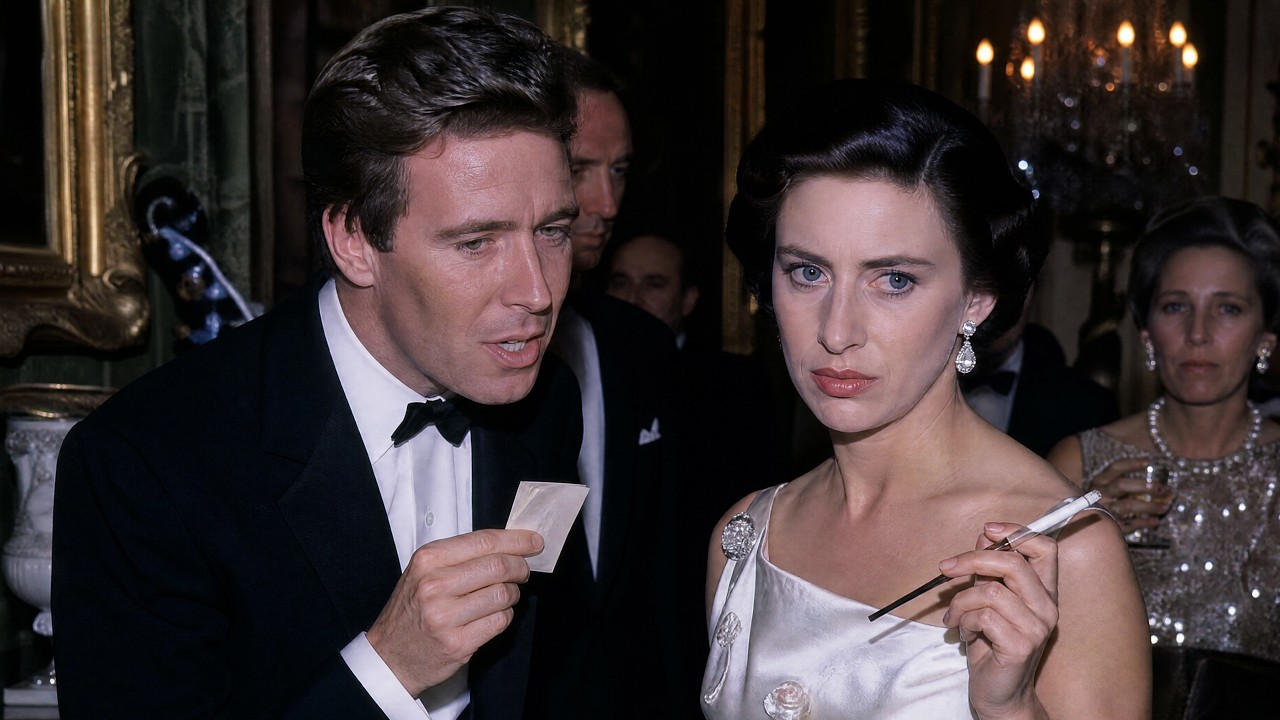
His private life was crowded. Before the engagement, his relationships included the dancer and actress Jackie Chan. He was also bound up closely with a married couple named Jeremy and Camila Fry. Jeremy Fry was an engineer and one of Armstrong-Jones’s closest friends, close enough that when the photographer became engaged to the queen’s sister, Fry was his intended best man.
The wedding took place on May 6, 1960. It was the first royal wedding ever broadcast on television. The bride wore a gown by Norman Hartnell. Eight bridesmaids followed her, led by her niece, the young Princess Anne. The groom was 30. The bride was 29.
More than 2,000 guests filled the abbey. Some 20 million people watched in Britain and an estimated 300 million around the world.
One man was missing from his expected place. Jeremy Fry, the groom’s close friend, had been his intended best man, and he withdrew before the day. The reason given in later accounts reportedly was an old conviction in his past.
After the abbey, the couple sailed away on the royal yacht Britannia for a six-week honeymoon in the Caribbean. Colin Tennant had given Margaret a plot of about 10 acres on his island of Mustique. She would call it “the only square inch in the world I own.”
While the yacht was still at sea, the first secret of the marriage was born. On May 28, 1960, three weeks after the wedding, Camila Fry gave birth to a daughter. The baby was named Polly.
For most of her life, Polly Fry believed that Jeremy Fry was her father. The truth came decades later. In 2004, a DNA test showed that her biological father was Anthony Armstrong-Jones. In 2008, he acknowledged his paternity.
Polly Fry spoke about the discovery with restraint. “Finding out at the age of 45 that the man I had idolized and put on a pedestal higher than Nelson’s column since I was a small child was not in fact my father was a hard burden to bear,” she said.
Of Camila Fry’s own feelings, then or later, the record is almost silent. Whatever she knew in May of 1960, she kept.
The newlyweds moved into Kensington Palace, where an apartment was being renovated for them at public expense. They began their married life as the most watched couple in the kingdom.
On October 6, 1961, the queen created her brother-in-law the Earl of Snowdon and Viscount Linley. Their first child, David, was born on November 3, 1961. A daughter, Lady Sarah, followed on May 1, 1964.
Their home was Apartment 1A at Kensington Palace. It was large and grand. The two children were raised there among the antiques in the rooms where the marriage would later come apart.
Snowden’s own career flourished. He worked for the Sunday Times magazine and helped design a great aviary for London Zoo. He was appointed Constable of Caernarfon Castle, a ceremonial office in the same corner of Wales where polio had found him as a boy.
For a time, the Snowdens were the most glamorous couple in Britain. They filled their rooms with actors, dancers, designers, and musicians. They looked modern. They looked happy.
From the middle of the 1960s, the marriage began to curdle. Snowden worked in a studio in the basement of the apartment. His wife lived in the rooms above, and he began to leave her notes.
He hid them where only she would find them: in the books she was reading, slipped among her handkerchiefs, tucked into her glove drawer. The notes were written to wound, and they were written to be found alone. One of them, by the standard account, read, “You look like a Jewish manicurist, and I hate you.”
He also made lists. Lady Anne Glenconner, Margaret’s lady-in-waiting and lifelong friend, recalled a list headed “20 Reasons Why I Hate You.” The writer Craig Brown put the number at 24.
When she found one of those lists, Margaret’s answer was dry and devastating. “I can’t think of 24 reasons to hate anybody,” she is said to have remarked.
The most telling detail comes from Glenconner. In time, Margaret stopped opening her own chest of drawers. She had her maid open them for her instead, so that she would not be ambushed by whatever her husband had left inside.
Snowden’s obituarist described what the household was eventually reduced to: the marriage had sunk to the level of exchanged grunts when passing in the hallway.

His infidelity was serial. The names that appear in the record include Lady Jacqueline Rufus Isaacs, Gina Ward, and the journalist Anne Hills, described as his long-term mistress. Near the end there was his assistant Lucy Lindsay-Hogg, the woman he would marry within months of the divorce.
Anne Hills stands apart because of how long she lasted. One account describes her as his mistress for 20 years. That is longer than the marriage to Margaret itself, which ran for 18 years.
None of this showed in his public life. In 1969, the investiture of the Prince of Wales at Caernarfon Castle was designed and organized by its constable, Lord Snowdon. He turned to television and made documentaries that won awards.
There was also a side to him that fits none of the rest of the picture. The boy who had spent six months in the Liverpool Royal Infirmary grew into a man who worked for decades for disabled people. He sat on the council of the Polio Research Fund. In 1971, he patented an electric wheelchair. In 1981, he led the International Year of Disabled Persons in England.
The same man, in the same years, was hiding notes in his wife’s handkerchief drawer.
Margaret was not sitting at home waiting. The record of the marriage is mutual. In or around 1966, she began an affair with Anthony Barton, a friend of her husband’s and her own daughter’s godfather.
In 1967 came Robin Douglas-Hume. His uncle was Sir Alec Douglas-Hume, who had been prime minister. Robin had married the fashion model Sandra Paul and divorced her in 1965. He had also been suffering from depression for several years.
Margaret always maintained that their relationship was platonic. Her letters to him, by the standard account, were intimate. The affair, whatever its nature, did not last long. It ended in 1967.
On October 15, 1968, about 18 months after the relationship ended, Robin Douglas-Hume took his own life at his country home in West Sussex. He was 36 years old.
No honest account can draw a straight line from the princess to that death. He had been ill for years before he met her. What the record allows is only the sequence.
In September of 1973, at a house party in Scotland, Colin Tennant introduced a princess of 43 to a young man of 25. His name was Rody Llewellyn. He was the youngest son of Sir Harry Llewellyn, the show jumper who had won Olympic gold in 1952. He was studying landscape gardening.
Margaret herself had a phrase for the relationship. She called it a “loving friendship.”
Its home was Mustique. The house on Colin Tennant’s plot had been completed in February of 1972. It was a villa called Les Jolies Eaux, the pretty waters. Its designer was Oliver Messel, Lord Snowdon’s own uncle.
The house where the princess would escape her husband had been drawn by her husband’s family. It had five bedrooms, two guest lodges, and a pool. Margaret called the place “the only square inch in the world I own.”
In 1974, she invited Rody to stay there, and he planted its gardens.
In 1974, Rody left abruptly for Turkey. Margaret was left behind distraught, and she took an overdose of sleeping tablets. Her own explanation, as it has come down in the standard account, was: “I was so exhausted because of everything that all I wanted to do was sleep.”
Her ladies-in-waiting kept her husband away from her while she recovered. They feared that his presence would only distress her further.
Rody came back. The relationship went on into 1976. Then in February of 1976, a photographer from the News of the World flew to Mustique on a tip.
What he photographed was ordinary, and it was enough. Margaret and Rody on the beach in their swimwear, at ease with each other. The woman on the beach was the queen’s sister, and the man beside her was 17 years younger and not her husband.
The News of the World ran the pictures on its front page on February 22, 1976. The papers cast her as a predatory older woman and him as her toy boy. The tabloids called her a cradle robber.

Every one of her husband’s affairs had stayed private. His child with Camila Fry was still a secret. His mistress of many years was still unknown to the public. Hers was the relationship that got photographed.
On March 19, 1976, Kensington Palace announced that the marriage had irretrievably broken down. The statement said that Princess Margaret and the Earl of Snowdon had agreed to separate.
In the apartment at Kensington Palace, there were two children. David was 14. Sarah was 11. They had grown up in the rooms where the notes were left and the grunts exchanged. Sarah, one account notes, was reportedly quite shaken by her parents’ split.
The public reaction fell almost entirely on their mother. Some Labour members of Parliament denounced her as a royal parasite and a floozie. Some suggested that she should be removed from the civil list altogether.
Her husband’s side of the ledger drew almost none of it.
The legal ending took two more years. The decree nisi, the provisional order of divorce, came on May 24, 1978. The decree absolute, the final order, came on July 11, 1978. Eighteen years from the abbey to the end.
That same month, Margaret was diagnosed with gastroenteritis and alcoholic hepatitis. Her authorized biographer, Christopher Warwick, has always denied that she was ever an alcoholic. The diagnosis and the denial both stand in the record.
It was the first divorce of a senior member of the royal family since 1901, when a granddaughter of Queen Victoria had ended her own marriage. Within her own adult life, the same institution had told her she could not marry a divorced man and keep her place. Twenty-three years earlier, she had written that Christian marriage is indissoluble. In the summer of 1978, a court dissolved hers.
Her former husband did not wait long. On December 15, 1978, five months after the decree absolute, Lord Snowdon married Lucy Lindsay-Hogg. Their daughter Frances was born in July of 1979.
Margaret never remarried. Rody Llewellyn stayed in her life for a few more years until the relationship faded around 1980 or 81. In 1981, he married Tatiana Soskin, and Margaret remained close friends with both of them.
She also remained on good terms with Snowden. By the standard account, the two of them stayed friends after the divorce.
In 1998, 20 years after his second wedding, a son was born to a woman who was not Lord Snowdon’s wife. Her name was Melanie Cable-Alexander, and she was an editor at Country Life magazine. The boy was named Jasper. When the birth came to light, it ended Snowden’s second marriage. He and Lucy divorced in 2000.
Anne Hills, the mistress of some 20 years, had died on New Year’s Eve 1996 of an overdose, as later accounts report it.
Decades of heavy smoking had taken their toll on Margaret. In January of 1985, part of her lung was removed. In 1996, she gave Les Jolies Eaux to her son. On February 23, 1998, she suffered a stroke there. Further strokes followed in 2001.
On the morning of February 9, 2002, at King Edward VII’s Hospital in London, Princess Margaret died in her sleep, aged 71. Both her children were at her bedside.
Lord Snowden lived for another 15 years. He died at home in Kensington on January 13, 2017, aged 86, and was buried in Wales. It was in Wales, 70 years before, that polio had found him. He left nothing in his will, it is reported, to Polly Fry.
The two children did what they could with their inheritance. Sarah trained as a painter at Camberwell School of Art and then at the Royal Academy Schools, where she won the Windsor and Newton Prize in 1988 and the Creswick landscape prize in 1990. She has exhibited with the Redfern Gallery in London since 1995, always under her maiden name, Sarah Armstrong-Jones.
On July 14, 1994, she married the actor turned painter Daniel Chatto. They raised two sons. She undertakes no public duties and gives no interviews.
David became a furniture maker and later chairman of Christie’s in Britain. In 2017, he succeeded his father as the second Earl of Snowdon.
In February of 2019, he spoke publicly about the way his mother was remembered. “My mother is often portrayed as being a socialite who was only interested in parties,” he said. “She was so much more than that.” Of the mother he grew up with, he said: “She never pressured us to do things. She was always enthusiastic and made everyone feel included.”
Rody Llewellyn built a long career as a garden designer, writer, and broadcaster. In 2009, he became Sir Rody, the fifth baronet.
Polly Fry, the child born during the honeymoon, chose her words with care when she spoke about the discovery. “I still believe in the sanctity of family life,” she said. “Even if, in my own case, it has proved to be a tad more complicated than I had previously thought.”
On May 6, 1960, 300 million people watched a princess walk up the aisle of Westminster Abbey toward a photographer with a slight limp, and then watched the royal yacht Britannia carry them away. It was the most glamorous wedding of its age, and every frame of it was real. It was simply never the whole picture.