For nearly two decades, one man controlled what Soviet scientists were allowed to believe. His methods, applied on collective farms across the Soviet Union, led to failed harvests. His promises collapsed one after another. None of it cost him anything.
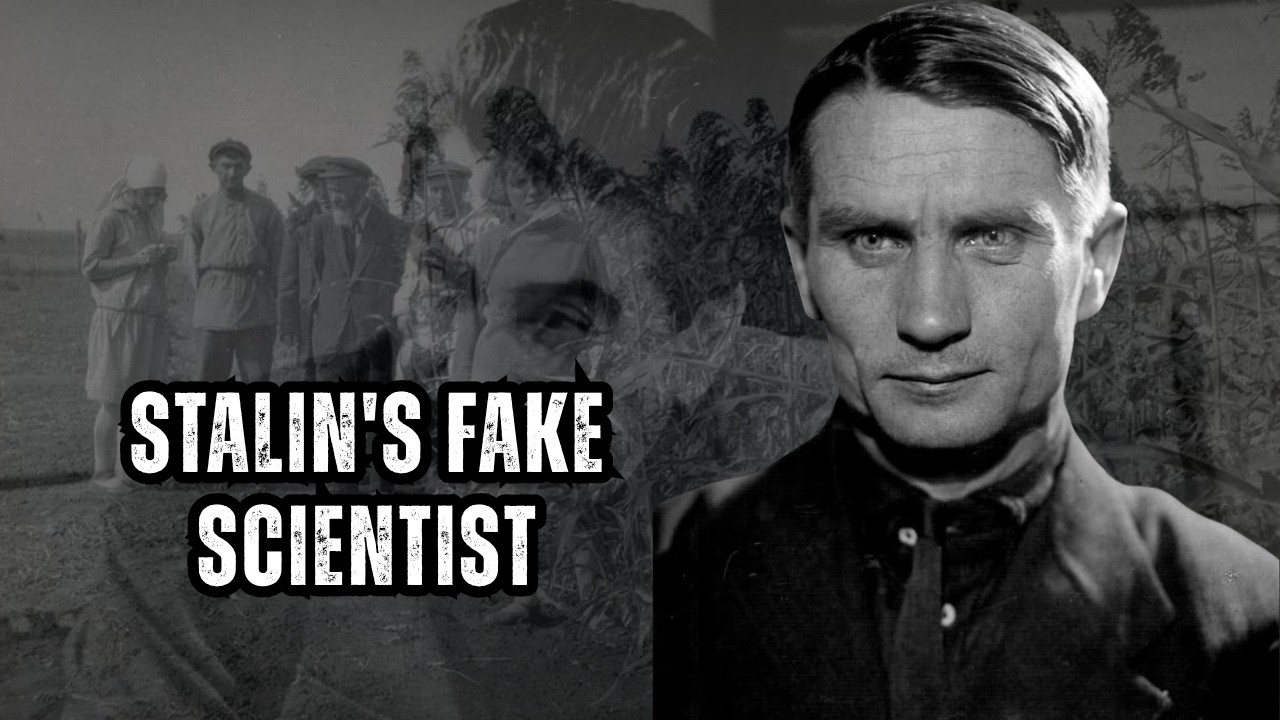
He directed the country’s most powerful scientific institution. He collected Stalin Prizes. Scientists who told the truth about his work paid the price. His name was Trofim Lysenko.
He was wrong about nearly everything, and still he won. Lysenko was born in 1898 in a Ukrainian village. His father was a simple farmer. He did not learn to read until he was about thirteen.
He worked his way through an agricultural school and eventually landed in Soviet agricultural research. He never studied genetics, could not run a controlled experiment, and had no place anywhere near a laboratory. Under normal circumstances, the story might have ended there. But circumstances were far from normal.
In the late 1920s, Stalin began his forced collectivization campaign. Private farms were confiscated. Millions of farmers, the people who actually knew how to work the land, were executed, imprisoned, or exiled. What followed was entirely predictable.
In 1932 and 1933, famine swept the Soviet Union and killed millions. Stalin needed someone to blame and someone to fix the problem without admitting that his own policies had caused it. A peasant agronomist from Ukraine, promising bigger harvests through simple techniques any farm worker could follow, was exactly what the moment demanded. Lysenko’s central idea was called vernalization.
The claim was simple. Expose wheat seeds to cold and moisture before planting, and you could push winter wheat to grow like spring wheat. More growing cycles meant more food. The technique itself was not new.
Farmers had cold-treated seeds for generations. Scientists had taken it seriously long before Lysenko came along. The results were modest at best, some practical value in specific conditions, nothing revolutionary, and no lasting effect on the plant itself. That last part is where Lysenko broke from everything real science had proven.
He said cold treatment did not just affect that generation of plants. He said it rewrote what the plant passed on to the next generation. In other words, you could train wheat the way you train a dog, and the offspring would remember what the parents had experienced. He went further.
He claimed wheat grown under the wrong conditions would eventually produce rye seeds instead of wheat. A completely different crop from a completely different family. Biologically, this was equivalent to claiming that dogs raised in the wild would give birth to foxes. Lysenko rejected Mendelian genetics entirely, the foundational science that biology had relied on for decades, and dismissed it as a bourgeois lie.
He denied the existence of genes altogether. When collective farms actually applied his methods, crops failed. He continued anyway. The science was a fraud.
What needs explaining is how this fraud held an entire country’s scientific establishment hostage for nearly twenty years. Timing was the beginning. The state was in agricultural collapse and needed a solution that did not blame the state. Lysenko offered one.
Cheap, fast, and requiring no admission of failure. His actual success did not matter. The Soviet government needed a promise, and he had one. But timing alone does not explain two decades.
What kept him in power was ideology. Mendelian genetics holds that heredity is fixed. The environment shapes your life, but it does not rewrite what you pass on to your children. For a government betting everything on the idea that socialism could radically transform human nature, this was an existential problem.
If biology placed limits on what circumstances could achieve, the philosophical foundation of the entire Soviet project was threatened. Lysenko’s theory, borrowed from the long-discredited nineteenth-century naturalist Jean-Baptiste Lamarck, said the opposite. The environment rewrites heredity. Nature is malleable.
This was not just agriculturally convenient for the Soviet state. It was ideologically necessary. Lysenko understood this and used it as a weapon. He recast every scientific disagreement as a political one.
Plants growing in dense clusters were practicing socialist solidarity. Mendelian genetics was a Western import designed to make class hierarchy seem permanent and natural. His critics were not merely wrong. They were enemies.
In 1935, he stood before Stalin and compared the scientists who rejected his theories to the kulaks who had resisted collectivization. Stalin stood and applauded. He shouted, “Bravo, Comrade Lysenko. Bravo.
” That moment settled everything. Opposing Lysenko now meant opposing something the Party had publicly endorsed. His propagandist, Isaac Prezent, made sure scientists understood what that meant. Critics were denounced in newspapers as foreign agents and saboteurs.
They lost their positions. Some were arrested. Some were executed. The most prominent scientist to challenge Lysenko was Nikolai Vavilov, one of the most respected biologists in the world, a Lenin Prize winner, who had spent his career building the largest seed collection in history.
He told the truth about Lysenko’s work publicly and repeatedly. Lysenko had him removed from the directorship of his own institute in 1936. In August 1940, the NKVD arrested Vavilov on charges of spying for the British and deliberately sabotaging Soviet agriculture. He died of malnutrition in a Gulag camp in January 1943.
That was the price of disagreeing with Trofim Lysenko. The scientific community learned the cost. They chose silence. Under a censored press, silence was understood as approval.
What kept the cycle going was promises. Every time Lysenko’s claims collapsed visibly, with failed crops and dead plantings, he was already announcing the next breakthrough. New grain varieties, a method for growing potatoes, developments in livestock breeding. The propaganda machine moved to the next announcement before anyone could formally hold him accountable for the last failure.
He kept this cycle going from 1927 to 1964. But there was one moment that made his dominance permanent. Not just political, but official. A moment when the last door of opposition was closed and sealed shut.
That moment came in 1948. By the late 1940s, Lysenko had effectively suppressed his opponents. But genetics as a field still technically existed. Individual scientists, despite grave personal risk, could defend the other viewpoint.
That ended in the summer of 1948. In July, the Eighth International Congress of Genetics convened in Stockholm. It was the first time the global genetics community had met since World War II. Geneticist Hermann Muller used his speech to name “Lysenkoism” directly as one of the greatest threats facing science.
Seventeen days later, on July 31, the Lenin Academy of Agricultural Sciences met in Moscow. Seven hundred people filled the hall. Lysenko delivered the keynote address. Stalin had personally read and edited it in advance.
The session lasted eight days. Lysenko and his allies stood on the platform and declared classical genetics bourgeois, idealist, and reactionary. Scientists who tried to object found the proceedings controlled and the hall hostile. Any small resistance that appeared was immediately isolated.
Everyone sitting there knew what had happened to people who resisted. On the final day, Lysenko closed the session with one announcement. He told the seven hundred people present that the Central Committee of the Communist Party had reviewed his report and approved it. Silence filled the hall.
There was nothing left to say. Lysenko’s speech was printed in a booklet, with 300,000 copies distributed. The full proceedings were distributed in 200,000 copies. Within weeks, scientists across the country began to be dismissed.
Genetics textbooks were pulled from universities. References to heredity were removed from curricula at every level of Soviet education. Orders were given to destroy all laboratory stocks of Drosophila fruit flies, the standard research organism for genetics work at the time. Without the specimens, research could not exist.
Soviet biology was officially severed from the rest of the scientific world. Repairing the damage would take a generation. For the next five years, nothing changed. Lysenko remained untouchable.
Then, in March 1953, Stalin died. The question became whether the system that made Lysenko would survive without the man who built it. Most people assume this is the end of the story. It is not.
Khrushchev came to power, denounced Stalin’s cult of personality, released Gulag prisoners, and opened Soviet society in ways that would have been unthinkable five years earlier. He also personally protected Lysenko. Khrushchev admired the story of the peasant genius. He was staking his political reputation on improving Soviet agriculture.
Lysenko kept coming up with new promises. Khrushchev restored him to his position after an early loss of the academy presidency and defended him against critics within the Party. Stalin gets most of the blame for Lysenkoism. Khrushchev deserves more than history usually gives him.
In 1953, Watson and Crick published the structure of DNA. The rest of the world moved into molecular biology. Soviet scientists watched from the outside. Lysenko only fell when Khrushchev fell.
In October 1964, Brezhnev ousted Khrushchev in a Party coup. Within weeks, the head of the Academy of Sciences announced that the protection of Lysenko was over. A committee went to his experimental farm to examine his actual results. What they found confirmed everything his critics had said for thirty years.
His data was fabricated. His results could not be replicated. The crops he promised never materialized. In 1965, he was stripped of his directorship of the Institute of Genetics.
The institute was dissolved. He spent his remaining years on a farm in the Lenin Hills in Moscow, stripped of power and largely ignored. Even then, the Soviet Union kept its distance from the full truth. An implicit ban on criticizing Lysenko lasted into the mid-1980s.
Researchers who tried to document what really happened at the 1948 session were persecuted or forced to leave the country. The cover-up outlived the man. But the numbers do not lie. More than 3,000 biologists were dismissed, imprisoned, or executed.
Seventeen years of Soviet genetics research, years that coincided with the discovery of DNA and the birth of molecular medicine, were simply lost. Trofim Lysenko died in 1976, never tried, never held accountable for any of it. The Soviet Union is gone.
But the word Lysenkoism remains, a name for what happens when power decides what is true, and the price of disagreement becomes too high for anyone to pay.