Five hundred million people watched her marry him. November 1973, Westminster Abbey, the first royal wedding broadcast in color, her mother's tiara on her head. Britain called it a love match.
Six months earlier, asked on camera whether the marriage could survive the pressure, Anne answered, "Can? It's got to, hasn't it?"
Twelve years later, a child was born in New Zealand, and her husband's accounts recorded the payments to the mother as equestrian consultancy. Then someone stole letters from Anne's briefcase inside Buckingham Palace. She never explained. She kept the house.
It began at a party in Mexico City. That was 1968, and neither of them was there for romance.
Anne was 18 and had just left school. Mark Phillips was 19, a cadet at Sandhurst, already good enough on a horse that people in the eventing world knew his name. The Olympics were in Mexico that year, and British equestrian circles orbited around it.
They met the way two people in the same small, obsessive sport meet, through horses, at an event about horses, surrounded by other people who talked mostly about horses.
Everything the public later projected onto this marriage, devotion, partnership, a princess who married for love instead of rank, was built on top of a single, shared interest. Not a shared world, not a shared temperament, one interest.
The girl at that party was already unusual inside her own family. Anne had gone away to Benenden, a boarding school in Kent, which was itself a break from how royal daughters had been educated.
She came out of it at 18 and went straight into public work, meeting Welsh soldiers on her first official engagement in 1969. At 20, she became president of the Save the Children Fund, a post she would still hold half a century later.
She wrote her own speeches. She did not enjoy being looked at, and she was extremely bad at pretending otherwise. The British press picked up on that immediately and never forgave her for it.
Through the early '70s, she was written up as sullen, sharp, spoiled, a princess who couldn't manage a smile on cue. Fleet Street eventually settled on a nickname, Her Royal Rudeness.
What saved her publicly was the riding. In September 1971, at Burghley, she won the individual European three-day eventing title on a horse called Doublet. That December, she was voted BBC Sports Personality of the Year.
She would go on to ride for Britain at the Montreal Olympics in 1976, the first member of the family ever to compete at a games.
Mark Phillips came from that world and almost nowhere else. Born in September 1948 in Tetbury, Gloucestershire, son of an army major who'd won a Military Cross, educated at Marlborough and then Sandhurst, commissioned into the First the Queen's Dragoon Guards.
Comfortable English gentry, not aristocracy, no title, no great estate, no political weight. What he had was talent on a horse. He rode with the British team that took gold at the Munich Olympics in 1972, and he won Badminton, the sport's most punishing event, more than once.
He offered her the only subject on which she was fluent and relaxed, plus a way out of the marriage market she was theoretically supposed to shop in. She had been linked in the papers to Andrew Parker Bowles, who would later marry Camilla, and to the Olympic rider Richard Meade.
He offered something those men didn't. He was, from the palace's point of view, uncomplicated. A serving officer, Church of England, no divorce, no scandal, no foreign complications. And she offered him the largest promotion available to any Englishman alive.
They kept it quiet for years, and they were good at it. Through 1972 and into 1973, the palace flatly denied any romance every time Fleet Street asked, which was constantly.
The engagement, when it finally came on the 29th of May, 1973, genuinely surprised the press pack that had been chasing it. Then came the photo call on the palace lawn.
She showed the ring, a sapphire flanked by diamonds from Garrard, noticeably modest by royal standards. Britain was in a bad economic stretch that year, and the restraint was read as tact.
Someone in the press asked whether a marriage could withstand the pressure of public duty and publicity. Philips answered first, and pleasantly. They'd already withstood a great deal that year. Anne cut in, "Can it's got to, hasn't it?"
It plays on film as brisk, funny, very her. It is also read cold. A 22-year-old announcing that the option of failure has been removed. Not that the marriage would work, that it had to.
Nobody at the time treated it as a warning, because nobody was looking for one.
The wedding was already in motion, and the wedding was not really theirs. The Lord Chamberlain's office ran it. Roughly 2,000 guests filled Westminster Abbey on the 14th of November, 1973.
The Archbishop of Canterbury officiating, foreign royalty and heads of state arranged in order of precedence. The government declared the day a public holiday. The BBC put it out live in color, a first for a royal wedding, and the audience estimate that stuck was 500 million.
The couple's own fingerprints on the day are small and revealing. Anne's dress was designed by Maureen Baker, chief designer for Susan Small, a ready-to-wear label. Not a couture house, a high street brand essentially, which had dressed her before and which she liked.
The tiara was the Queen Mary fringe, borrowed, the same one her mother had worn in 1947. Philips wore the full-dress uniform of his regiment. His best man was a fellow officer, Captain Eric Grounds.
There was one more decision, and it is the one with the longest half-life. Philips did not become an earl.
The precedent was fresh and obvious. When Princess Margaret married the photographer Anthony Armstrong Jones, he was created Earl of Snowdon shortly before their first child arrived, which meant their children carried courtesy titles.
The expectation in 1973 was that something similar would happen for Phillips. It didn't. Accounts of why have never agreed. Some say he declined a peerage, some say Anne wanted no part of it. Some say nothing was ever formally offered. The palace has never confirmed any version.
Anne did not refuse royal titles for her children. She couldn't have. The rules of the day granted prince and princess styles through the male line, and her children were never going to be royal highnesses regardless.
What the earldom would have given them was a courtesy title. Peter as a viscount, Zara as a lady. That's what evaporated.
Anne has defended the outcome ever since. "Titles have downsides," she said years later. "It was probably easier for them this way, and probably the right thing to do. Maybe."
It also meant that from birth, her children carried their father's plain surname and nothing else in a family where names were currency. And it meant Mark Phillips stayed exactly what he had been on his wedding day, a captain in the Queen's Dragoon Guards who happened to be married to the Queen's daughter.
The court noticed. At some point in the years that followed, someone inside the family started calling him Foggy, on the reasoning that he was thick and wet.
The nickname is usually attributed to the Prince of Wales, though that attribution has never been confirmed, and it may simply be the kind of joke that circulates until it acquires an author.
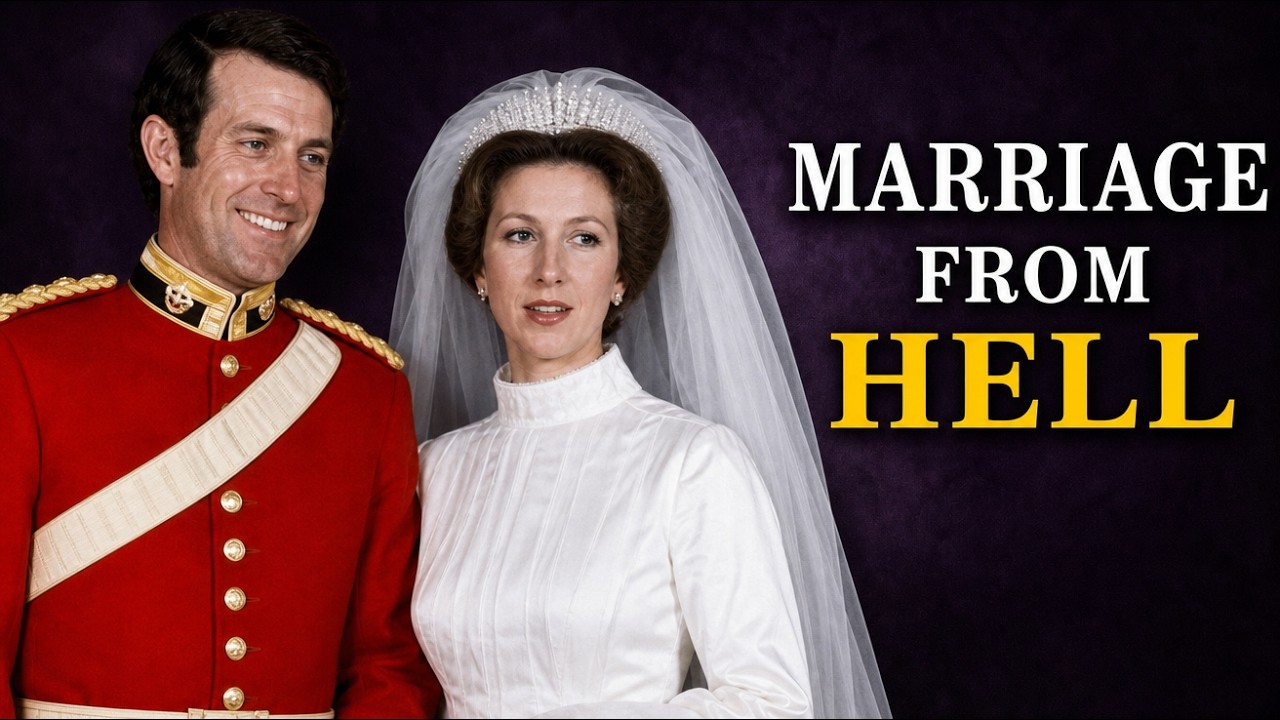
What matters is that it circulated at all, and that it stuck, and that it tells you precisely how the man in the Dragoon Guards uniform was regarded by the people he had married into. He was decorative. He was athletic. He was, in the family's private accounting, not quite serious.
None of that was visible from the Abbey, or from the balcony afterward, or on any of the 500 million screens. What the public saw on that November morning was a princess who had picked a soldier over a duke and appeared to have gotten away with it.
Four months later, on a badly lit stretch of the Mall at 8:00 in the evening, a man in a white Ford Escort blocked their car and started shooting. The date was the 20th of March, 1974.
Anne and Phillips were being driven back to Buckingham Palace from a charity film screening for Riding for the Disabled, with her lady-in-waiting Rowena Brassey in the car. The man was Ian Ball, 26, armed with two revolvers, and he had a plan that involved 2 million pounds and a ransom note.
Four men were shot in the next few minutes. Her personal protection officer, Inspector James Beaton, took a round in the shoulder, tried to return fire, and found his pistol jammed. He got back to the car anyway, put himself between Ball and the princess, and was shot again through the hand, and then in the abdomen.
Anne's chauffeur, Alexander Callender, was shot. A police constable, Michael Hills, was shot. A passing journalist named Brian McConnell walked toward the gunman to talk him down and was shot for it. All of them lived.
Ball leaned in and told Anne he wanted her to come with him for a day or two because he wanted 2 million pounds. Would you get out of the car?
The account released later through the National Archives records her reply. "Not bloody likely," and "I haven't got 2 million pounds."
It became one of the most famous sentences ever spoken by a member of the royal family and it did more for her reputation than a decade of engagements. Her father's comment afterward was that if the man had actually succeeded in abducting her, she'd have given him hell in captivity.
Here is the part that matters for this story. Mark Phillips was in that car.
Ronnie Russell, the former boxer who happened to be walking past and who knocked Ball flat with one punch, later described what he saw. Ball trying to drag Anne out of one side of the vehicle and her husband holding on to her, pulling her back in.
Russell got the George Medal. Beaton got the George Cross. Phillips got nothing because there was nothing to give him. He'd done what any husband would do and it happened in front of the entire world which somehow made it smaller rather than larger.
He is a supporting figure in the most dramatic night of his own marriage. Look at that scene once more though because it's the last unambiguous image of the two of them on the same side of anything.
What came after was property.
In 1976, the Queen bought Gatcombe Park, a Grade II listed house of about 730 acres in Gloucestershire from the former Conservative Minister R. A. Butler. The price was never disclosed. Estimates at the time ran between 500 and 750,000 pounds.
The Crown paid for the renovation and the redecoration on top of that. Anne and Phillips moved in during November 1977 within days of the birth of their first child, Peter Mark Andrew Phillips, born the 15th of November at St. Mary's Paddington.
In 1978, the estate was enlarged by the purchase of the neighboring Aston Farm.
So, by the time she was 28, Anne had a husband, a son, a working farm, and a stable yard with an airstrip attached. She also had a house that her mother had bought.
That detail sits quietly for another 14 years and then decides everything. Whatever happened inside this marriage, the exit was always going to be his because the address was always going to be hers.
The couple settled into what looked, from outside, like an enviable arrangement. Phillips left the army in 1978 and became a full-time horseman, competing, teaching, running clinics, eventually designing cross-country courses, work he was genuinely gifted at and still does.
Anne rode Goodwill at Montreal in 1976, fell at the same fence as half the field, remounted, and finished. Zara Anne Elizabeth Phillips arrived on the 15th of May 1981 at the same hospital as her brother.
Two children, two riders, one estate. The public read it as a private, rural, sporting marriage, the antidote to whatever was going on elsewhere in that family.
The private version was already diverging, and the first documented crack has a name and a rank.
In 1979, Scotland Yard assigned Detective Sergeant Peter Cross to the Royal Protection Squad, and he began guarding Anne that autumn. He was married, based in Southwest London, and by his own later account, he and the princess got on immediately.
Long conversations, coffee running into the small hours, the easy candor of two people who both preferred plain speech. Within about a year, he was off the detail and back in uniform. Reassigned amid suggestions that he had become, in the delicate phrasing that reached the papers, too close.
This is where the evidence has to be handled carefully, because almost all of it comes from one interested man.
Harry Arnold, then the royal reporter at The Sun, broke the story in the early '80s. He told a Channel 4 documentary in 2002 that a source he considered unimpeachable had told him Cross was having an affair with Princess Anne, and that since he couldn't print the word affair, he invented a phrase instead. He wrote that Cross had become overfamiliar with the princess.
Arnold also claimed Anne used the alias Mrs. Wallace when she wanted to reach Cross, a detail that, if true, indicates a woman with a sense of humor about her own family's history and no illusions about what she was doing.
Cross himself sold the story to the News of the World in the mid-'80s, after he'd left the police, for a sum reported at the time in the hundreds of thousands. He signed affidavits swearing his account was true.
His then girlfriend swore that Anne had telephoned his home repeatedly late at night. Years later, his ex-wife told interviewers that of all his infidelities, this was the one that never left the room, that the princess was always somehow present in the background of their own marriage.
Anne has never commented, not once, in more than 40 years.
Treat the affair as a credible report rather than an established fact, because that's what it is, a paid account from a man with a book to sell and a career to salvage, partially corroborated by people close to him, and never contradicted by the only other person who knows.
What is documented beyond dispute is the reassignment. A serving officer was quietly moved off the daughter of the sovereign's protection detail, and Fleet Street had a reason to start watching this marriage that was not about horses.
By then, Anne had also stopped performing for the cameras altogether. On the 1st of May, 1982, she fell from her horse, Stevie B, at the water jump at Badminton, in front of the massed photographers, and told them loudly what she thought of them.
The papers printed it as "Naff off", and it entered the language. Except that isn't what she said.
In that same 2002 documentary, two of the photographers who were standing there admitted the fix. Steve Wood of the Daily Express called it the "Naff off" picture. His colleague, Ashley Walton, explained that they'd made the word up to cover another word.

The press corps sanitized their own front page, because the real quote was unprintable in 1982, and more to the point, because a princess telling photographers to "Naff off" is charming, and a princess telling them something else is not.
That is a small correction with a large implication. The most famous line ever attributed to her was written by the people she was insulting. Her actual words never made it into public memory.
Nobody's did from inside this marriage unless she permitted it. A pattern that becomes the entire point of the ending.
Through the mid-80s, the two of them lived increasingly separate working lives, and made increasingly infrequent joint appearances. In a 1983 interview, they were asked directly about the rumors and both dismissed them.
Speculation had really taken hold after Zara's birth, driven by nothing more exotic than arithmetic. The amount of time Anne spent away on engagements and the amount of time her husband spent on the international eventing circuit, why not simply end it?
Because in that decade, in that family, it could not be done. Princess Margaret's separation in 1976 and divorce in 1978 had cost the institution real damage and generated years of unpleasant coverage.
A second royal divorce, this one involving the Queen's own daughter, was not a private matter. It was a constitutional embarrassment with a church attached. The Church of England did not remarry divorced people. Her mother was its supreme governor.
So, Anne did the thing she had been trained to do since she was 18. She worked.
The engagement count climbed. Save the Children took her repeatedly into famine and refugee zones where the photographs were of other people's suffering, not hers. Gatcombe began hosting the Festival of British Eventing every August, turning the marriage's one genuine common interest into an annual public institution with tents and sponsors.
She wrote her own speeches and refused interviews about anything personal. The press that had called her Her Royal Rudeness began slowly to run a different story. The hardest working royal. The one who did the unglamorous countries and never complained.
On the 13th of June, 1987, the Queen gave her the title of Princess Royal, traditionally reserved for the sovereign's eldest daughter. It was the highest recognition available to her and it arrived while she and her husband were, by every credible account, effectively living parallel lives on the same estate.
That is the shape of the false repair. Not a reconciliation, a promotion.
From the outside, it looked like a marriage that had settled, matured, found its footing in duty and farming, and a family sporting event. Rural, sensible, enviable even, compared to the operatic disaster unfolding around her elder brother.
The distance between that picture and the facts was, at that moment, about 11,000 miles.
In 1983, a New Zealand art teacher named Heather Tonkin attended a riding clinic that Mark Phillips was giving in Auckland. According to her account, they met again the following year at a party for a local Olympic rider.
He asked for her telephone number, and they spent a night together in November 1984. Her daughter was born in August 1985, 4 years younger than Zara. Her name was Felicity. Her mother called her Bunny.
For 6 years, nobody outside a very small circle knew she existed.
What happened in that gap is the reason the word nasty belongs in this story, and it has nothing to do with the affair itself. Affairs are ordinary. The bookkeeping is not.
Take Heather Tonkin's account carefully, because on the private details, it is largely a single source, given to newspapers in 1991 by a woman who was at that point suing.
She said that when she told Phillips she was pregnant, he pressed her to end the pregnancy. She refused. She said she was advised by one of his aides to raise the child believing her father was dead.
And she did exactly that for 8 years, until Felicity came home with a school project on family history and the lie became impossible. She showed her daughter a biography of Mark Phillips written by the news reader Angela Rippon, which is how a child in Auckland learned who her father was.
What is not a single source is the money. From 1986, Phillips paid Tonkin roughly 6,000 pounds a year, routed through an associate and recorded in his accounts as fees for equestrian consultancy.
She was not an equestrian consultant. She was the mother of his child.
That is the artifact at the center of this story. Not a love letter, not a photograph, a line item. A man protecting a marriage that had already stopped functioning by describing his daughter's upkeep as a professional expense.
The payments became erratic. He refused to be named on the birth certificate. In 1991, Tonkin engaged lawyers and filed a paternity claim in a New Zealand court.
And when the Daily Express broke the story that March, Phillips said he would contest it. He was still contesting it when the DNA results came back. They confirmed him as Felicity's father.
A settlement followed, reported at around 350,000 pounds, a figure that comes from press accounts, not court documents, and should be treated as such.
Her explanation for going public was short. She was doing it for her child. She wanted the record put straight and she said that nothing could compensate for the night she'd spent trying to plan her daughter's future while facing the possibility of being left with nothing.
By the time any of that reached print, the marriage had already been declared over, but only just and not in the order most people remember.
Rewind to the spring of 1989. Someone opened the Princess Royal's briefcase inside Buckingham Palace and removed a bundle of private letters.
They had been written to her over roughly 18 months by Commander Timothy Laurence, a Royal Navy officer who had served as the Queen's equerry since 1986 and whom Anne had appointed in September 1988 as one of just three advisers to her charities trust.
The letters had been hand-delivered to the palace, not posted to Gatcombe where her husband lived. The thief took them to the Sun.
The paper could not safely publish them, so it ran a headline announcing that a palace thief had stolen Anne's letters and that the Sun had come to the rescue, then handed the letters to Scotland Yard.
Buckingham Palace then did something it almost never does. It confirmed the story.
The statement said the stolen letters had been addressed to the Princess Royal by Commander Timothy Laurence, the Queen's equerry, that the palace had nothing to say about the contents of personal letters sent to Her Royal Highness by a friend, and that the matter was subject to a police investigation.
Read that again. The palace named him. It could have said nothing or said the letters were of no significance. Instead, it put the officer's name in the public record and declined to characterize the relationship.

Detectives fingerprinted more than 500 people inside the palace. They never found the thief. The case remains unsolved to this day, which means that in a building full of staff, secretaries, and protection officers, somebody stole from the sovereign's daughter and got away with it.
A source who had read the letters described them to People magazine with magnificent unkindness, that Laurence was clearly potty about her. But that the letters were boring and rambling, the sort of thing 18 or 19-year-olds write to one another, thoughts about life, rather philosophical.
Another account insisted the contents suggested no intimacy at all, only affection.
Anne said nothing. She has still said nothing.
On the 31st of August, 1989, Buckingham Palace announced that the Princess Royal and Captain Mark Phillips had decided to separate on terms agreed between them. The statement added one more sentence. There were no plans for divorce proceedings.
That line was not sentiment. It was law. Under English divorce law, an uncontested divorce required 2 years of separation. The Palace had just started a clock and told the country it hadn't.
Then it waited. 2 years and 8 months of nothing. No comment, no interview, no briefing war of the kind that was by then consuming her brother's marriage.
Anne kept working. The engagement totals kept climbing. Phillips kept working on the estate. The paternity suit broke in March 1991. The DNA result followed.
And the moment the 2-year requirement matured, the machinery moved with almost indecent efficiency. Anne filed on the 13th of April, 1992. 10 days later, on the 23rd, a judge named Gerald Angel granted the uncontested divorce in a London court.
She was represented by a lawyer and did not attend. No financial settlement was announced.
The terms tell you who had been holding the cards. Peter and Zara remained with their mother at Gatcombe. Phillips retained unlimited access to his children and moved to Aston Farm, the property added to the estate in 1978, immediately next door.
He had, in effect, been relocated to the far end of the land his mother-in-law bought.
Then came the part almost nobody saw coming and nobody saw at all.
The Church of England would not remarry divorced people. It would not do so for another decade. The Church of Scotland would.
On the 12th of December, 1992, Anne married Timothy Laurence at Crathie Kirk, the small granite parish church near Balmoral, in front of about 30 guests.
Her mother, her father, her grandmother, her sister-in-law, her brother Edward, and her two children were among them. She wore a white knee-length dress. He wore naval uniform. There was no tiara, no Abbey, no Lord Chamberlain's office, no broadcast.
The date deserves a moment of appreciation. Nine days earlier, the Prime Minister had stood up in the House of Commons and announced the separation of the Prince and Princess of Wales.
The Queen had already, in November, given a speech in which she called 1992 a horrible year.
Into the single worst 12 months in the modern history of that family, Anne inserted a wedding so small and so fast that it was over before the press could organize a narrative about it.
She had been the first of the Queen's four children to marry. She was the first to divorce. And she got remarried in a church her mother's own establishment couldn't reach, roughly seven months after the decree.
Nothing stuck to her. That is the genuinely remarkable outcome here. And it was not luck.
Consider what the record actually contains. A bodyguard sold his version. A gunman published a memoir insisting he was innocent and sane. A mother in Auckland gave interviews because she had no other leverage. Fleet Street invented a quote and admitted it 20 years later. Netflix eventually dramatized the bodyguard's version for a global audience.
Every single account of this marriage that reached the public came from someone outside it. Someone who needed money or recognition or a court order or a drama series.
Anne never gave a memoir. Never gave a confessional interview. Never briefed a friendly journalist. Never corrected anyone. Not about Cross. Not about the letters. Not about her husband's daughter.
When she has spoken about the marriage at all it has been to defend the one decision people criticize, the absence of titles for her children, on the grounds that it was probably easier for them. And there are downsides to titles.
That silence which in 1973 looked like sulkiness and got her called Her Royal Rudeness turned out to be the most effective public relations strategy any member of that family has ever run.
She did not manage her image. She refused to have one. And the refusal did the work.
The marriage itself was never the merger the wedding implied. It was two athletes with one shared subject sharing a farm her mother owned who ran out of the subject and kept the farm going for the children and the eventing calendar and the constitutional inconvenience of the alternative.
It failed as a romance somewhere in the early '80s and continued for another decade as an address.
Both of them, in the end, got the second life they wanted. Phillips married the American dressage rider Sandy Pflueger in 1997 and later moved to the United States where he became chef d'équipe of the American eventing team coaching the country that beat his own.
His daughter Zara won an Olympic silver for Britain in 2012, riding, as her mother had, for a team rather than a title, and stayed at Gatcombe with Laurence, and by 2023 and 2024 was still recording more than 400 official engagements a year, decades after Fleet Street had written her off as the one who couldn't manage a smile.
Now, go back to that morning in November 1973. 500 million people, the first color broadcast, the borrowed Queen Mary fringe tiara, the off-the-peg dress, the young officer in Dragoon Guards scarlet, the whole apparatus of an institution demonstrating that it could still stage a love story on demand.
It was not evidence of a love match. It was the last time the British public was permitted to see this marriage without her permission.
Every image after it, the separation notice, the unattended divorce, the 30 guests in a Scottish parish church, was released on her terms, at her pace, in her chosen quantity, which was as little as possible.
She said it herself on the palace lawn 6 months before the Abbey, and everyone laughed because it sounded like a joke.
Can it survive? It's got to, hasn't it?
It didn't. She did.