In 1969, a 24-year-old woman sat among the nominees at the Academy Awards, nominated for Best Supporting Actress for her very first film. No one in that room knew her real age—she had told everyone she was 18. Her name was Sondra Locke. She came from Shelbyville, Tennessee, with talent and a carefully constructed lie about her age.
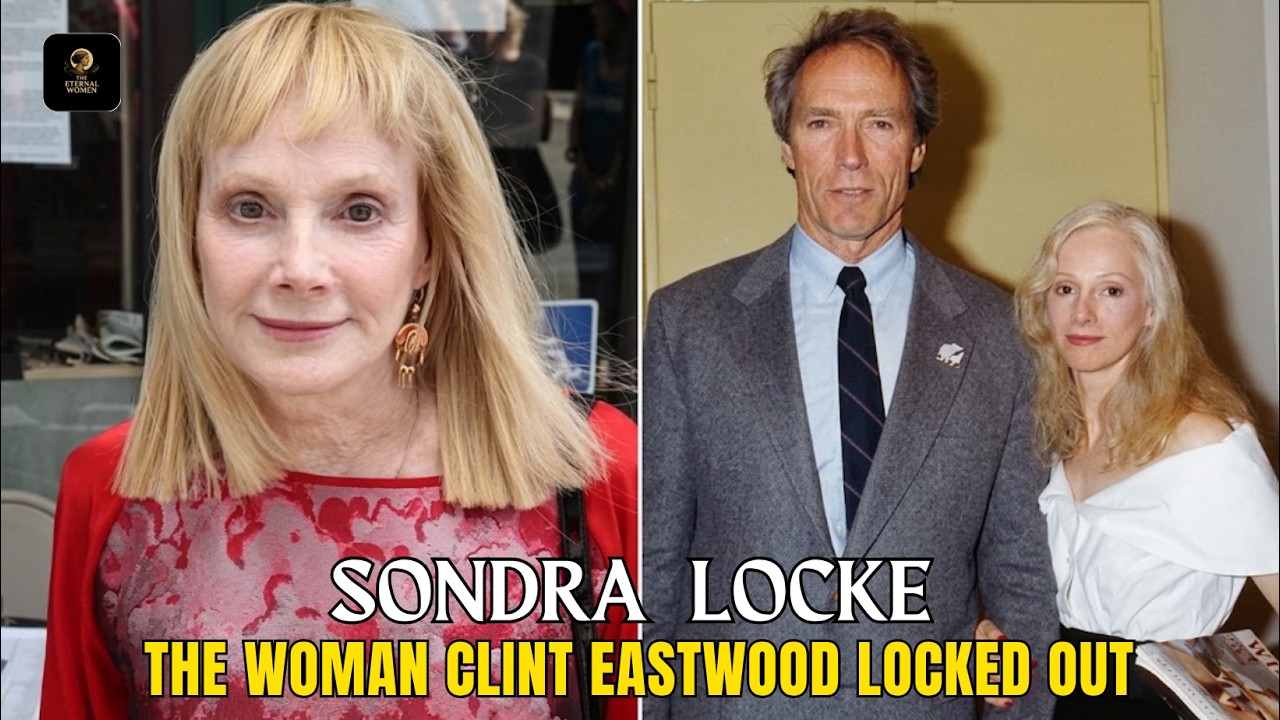
She had beaten out more than 500 other women for the role that earned her the nomination. She bound her chest, lightened her eyebrows, and subtracted six years from her birth date to play a teenager convincingly. It worked. Twenty years later, she returned home from a film set to find the locks on her front door changed.
Her belongings were packed in boxes. A letter was waiting—not addressed to her, but to her husband. The man who did it was Clint Eastwood, the man she had spent 14 years loving, working beside, and building a life with. She fainted when she heard the words.
Locke was born on May 28, 1944, in Shelbyville, Tennessee, a small town about 50 miles southeast of Nashville. She came from circumstances with no connection to the entertainment industry. She was not discovered at a Hollywood party. She chose the field deliberately and pursued it patiently.
She married Gordon Anderson in 1967. Anderson was gay; the marriage was an arrangement based on mutual understanding and genuine affection. It gave both of them cover in an era that was not accepting of their truths. They remained legally married throughout her life.
Twenty-two years later, this marriage became the central legal complication in her palimony suit. Eastwood’s lawyers argued she had a husband and was never Eastwood’s wife in any legal sense. In 1968, Locke made her film debut in “The Heart Is a Lonely Hunter,” Robert Ellis Miller’s adaptation of Carson McCullers’ novel about loneliness and the pain of being misunderstood. Locke played Mick Kelly, a musically ambitious teenager living next to a deaf-mute man portrayed by Alan Arkin.
The Academy nominated her for Best Supporting Actress. She did not win—the award went to Ruth Gordon for “Rosemary’s Baby”—but the nomination stood as a credential that should have opened doors. By 1975, Eastwood was one of the most commercially powerful figures in Hollywood. The “Dirty Harry” films had made him a box-office institution.
His Westerns with Sergio Leone had given him international fame. He ran his own production company, Malpaso Productions, giving him a degree of control few in Hollywood history had possessed. He was still legally married to his first wife, Maggie Johnson; their divorce was not finalized until 1984. Locke first met Eastwood in 1972 when she auditioned for his directorial project “Breezy,” a film about a relationship between a middle-aged man and a younger woman.
She was 27 at that audition. He decided she was too old for the younger role, which went to actress Kay Lenz. Three years later, she auditioned for “The Outlaw Josey Wales. ” She was 30.
He was 45. She got the part, and the chemistry on set was, by multiple accounts, real. She moved into a home he provided. They lived together while he remained legally married.
She later said in her memoir that the love was genuine, that the relationship was sincere. Between 1976 and 1983, Locke appeared in six films directed or produced by Eastwood: “The Outlaw Josey Wales,” “The Gauntlet,” “Every Which Way but Loose,” “Bronco Billy,” “Any Which Way You Can,” and “Sudden Impact,” in which she played a rape victim seeking justice—her most complete performance in his world. In a 1996 Los Angeles Times interview, she explained why she stayed in his films. “I did not want to be there with the orangutan.
I was there because I was in love and Eastwood wanted me there. I loved working with him and we were together, but I didn’t want to be there. ”
The industry drew the conclusion it always draws: she was cast because she was his girlfriend, not because she was talented. This perception followed her throughout the 14 years.
Meanwhile, she directed “Rat Boy” in 1986 under Malpaso. She directed “Impulse” in 1990 for Warner Bros. , a project genuinely her own. During production of “Impulse,” he changed the locks.
She fainted on set. On April 26, 1989, 16 days after the locks were changed, she filed suit for palimony. During the relationship, Locke became pregnant twice. Both pregnancies ended in abortion.
She said in her memoir that Eastwood pressured her to terminate both pregnancies, that he did not want children with her, and that his existing family obligations made adding a child logistically unacceptable from his perspective. While the relationship was ongoing, Eastwood had children with other women: a son, Scott, born in 1986, and a daughter, Kathryn, born in 1988, both with flight attendant Jacelyn Reeves. Locke discovered their existence—with the shock of someone who had made irreversible decisions based on an incomplete picture. The palimony suit was settled in April 1990 after 19 months of litigation—a period during which Locke was also diagnosed with breast cancer, underwent a double mastectomy, and received chemotherapy.
The settlement included the Bel Air home, $450,000 for work done at Malpaso, and a three-year development deal at Warner Bros. worth $350,000 annually to develop and direct films. The development deal was supposed to give her the professional foundation to rebuild her directing career. It turned out to be a fraud.
She submitted more than 30 projects to Warner Bros. over three years. All 30 were rejected—every single one, without substantive feedback. When she investigated through her lawyer and new agent, she found evidence of what she suspected: Eastwood had secretly arranged through Malpaso to reimburse Warner Bros.
for the cost of her deal. He was paying the studio to maintain the appearance of a real development contract while ensuring it produced nothing. Among the projects she submitted was what later became “Junior,” the 1994 comedy starring Arnold Schwarzenegger as a pregnant man, and what became “Addicted to Love,” the 1997 romantic comedy with Matthew Broderick and Meg Ryan. Both were rejected under her deal.
Both were later made by other people after her opportunity to produce them had vanished. Her lawyer called what Eastwood did “treason. ” On June 5, 1995, Locke filed a second lawsuit alleging fraud and breach of fiduciary duty against Eastwood and Warner Bros. The Warner Bros.
case was initially dismissed on procedural grounds. She appealed. An appellate court revived the case on August 26, 1997. A jury sided with her by a vote of 10 to 2 on liability.
The jury moved to the damages phase. A settlement was reached on May 24, 1999, minutes before jury selection for the damages phase was scheduled to begin. Eastwood was listed as a key witness. He chose to settle rather than testify under oath.
Locke kept her cancer diagnosis largely private. The cancer later spread to her bones. In 1997, she published her memoir, “The Good, the Bad and the Very Ugly. ” The title carried the full weight of the Leone reference—a world where good and evil coexist in the same person, where love was real and exploitation was real, and neither truth canceled the other.
In the memoir, she described the abortions, the discovery of Scott and Kathryn Eastwood, the changed locks, the letter delivered to Gordon’s address, the Warner Bros. deal, the 30 rejected projects, and her breast cancer. She put her name on all of it in a culture that would have been far more comfortable if she had accepted her settlement money and remained quietly silent. She did not remain silent.
She kept a documented record. On November 3, 2018, Locke died at her home in Los Angeles. The cause was cardiac arrest resulting from breast and bone cancer. She was 74 years old.
The Associated Press obtained her death certificate from the coroner’s office. The news became public five weeks after her death. Eastwood, according to multiple published reports, was not informed of her death until days after it was announced publicly. The man she had spent 14 years with learned of her death from a news report.
Locke left an estate estimated at around $20 million—the accumulated result of the palimony settlement, the fraud suit settlement against Warner Bros. , and careful management of those resources over nearly three decades. She was one of the most financially successful litigants in the history of Hollywood palimony and fraud cases. Eastwood received the AFI Life Achievement Award, the Academy Award for Best Picture and Best Director for “Unforgiven,” and the Presidential Medal of Freedom in 2024.
He has been honored across the full range of what American cultural institutions offer their most prominent figures. Locke learned of the death of a man she had lived with for 14 years weeks after it happened. The career her talent promised—the career her Oscar nomination should have launched—was never built because the years that should have been spent on it were spent on his films, building his filmography instead of hers. She deserved honest evaluations of the 30 projects she submitted.
She deserved a real development deal instead of a mechanism for silencing her. She deserved a public conversation proportional to the documented evidence of what was done to her. What she got instead was her memoir, the truth she told under her own name, two lawsuits she won, the home she kept, the $20 million, and the private satisfaction of completing the record while still alive. She named all three truths—the good, the bad, and the very ugly—and put her name on the cover of a book that can still be read today.
Hollywood forgot her. She never forgot herself.