In 2017, a locksmith was called to a country house in Wales. He was there to cut open two red boxes. They were British government dispatch boxes, the kind a minister carries, and nobody could find the keys. They had not been opened since their owner died in 1985.
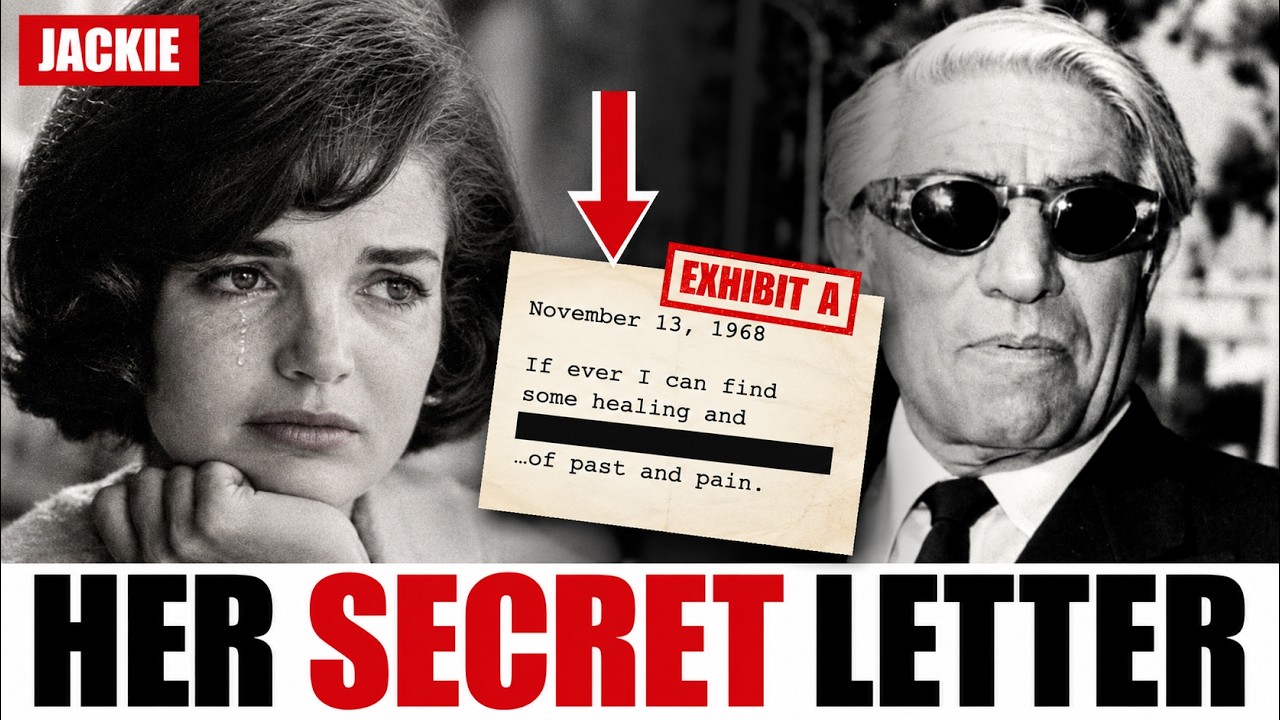
Inside were 18 handwritten letters from Jacqueline Kennedy. One of them is dated November 13th, 1968. That is 24 days after she married Aristotle Onassis. 24 days after newspapers around the world decided that the most admired widow in America had sold herself to one of the richest men on earth.
In that letter, she explains why she did it in her own handwriting. It stayed secret for almost 50 years. "If ever I can find some healing and some comfort," she wrote, "it has to be with somebody who is not part of all my world of past and pain."
She was writing to a man who loved her, a man who had asked her to marry him that same year. She had told him no. So this is a file about a choice. Who she turned down, who she picked, and what she got for it. Because the man she picked answered her too. Seven years later and in writing.
Start with him. Aristotle Onassis was born in Smyrna on the coast of what is now Turkey in 1906. In September 1922, the Turkish army took the city and the Greek quarter burned. He was a teenager. His family's business was gone and his father was in prison.
Years later, he told his biographer, Peter Evans, how he got his father out. He said that at 16, he started a relationship with an older Turkish officer and used it to buy his father's freedom. We only have his word for that, but it is the story he chose to tell about himself in it. A person is something you spend to get what you need.
He sailed for Argentina as a refugee and was rich by his mid-20s. He bought ships when nobody wanted them. By the 1950s, he controlled one of the largest private fleets in the world. The United States government accused him of getting hold of American surplus ships through front companies. Four days before Christmas in 1955, he settled. He paid $7 million. The FBI kept a file on him, and you can read it today.
Then he bought an old Canadian warship and turned it into a yacht, the Christina. The bar stools were covered in the skin of whales, a very particular part of the whale. The story goes that he liked to tell his female guests exactly what they were sitting on.
The guests were the point. Churchill, Garbo, princes and presidents. Onassis collected famous people the way other rich men collected paintings. The most famous of them was Maria Callas, the greatest opera singer of her time. She was married. So was he.
His wife Tina was 17 when she married him. He was 40. In July 1959, he invited Callas and her husband on a cruise. Winston Churchill was on board. So was Tina. By the time the yacht came home, two marriages were finished.
Callas wanted to marry him. She wanted his child. She let her career slide to be near him. And there is a darker claim. The writer Arianna Stassinopoulos reported that Callas became pregnant in 1966 and that Onassis told her he would leave if she kept the baby. Another biographer, Nicholas Gage, says there was a son born too early in 1960 who lived only a few hours. The two versions can't both be right. What they agree on is this. She ended up with neither the child nor the ring. For nine years, she waited.
And in those nine years, Onassis was looking at two other women. They were sisters. In the early 1960s, while Jacqueline Kennedy was first lady, Aristotle Onassis was already involved with a woman from her family. It was her younger sister. Lee Radziwill was married to a Polish prince and lived in London. Several biographers described the affair. By their accounts, Lee hoped to become Mrs. Onassis.
Think about what that meant in Washington. The president's sister-in-law was involved with a man the Justice Department had gone after only a few years before. According to Peter Evans, Bobby Kennedy wanted him kept far away from the White House until after the next election. That comes from Evans alone, but nobody disputes the feeling behind it. Bobby could not stand Aristotle Onassis.
Then in August 1963, Jackie gave birth to a son five and a half weeks early. They named him Patrick. He died two days later. Her sister had an idea. Come to Greece, rest. Onassis has offered his yacht.
The president's advisers hated it. The first lady was going sailing with a man who had paid the government $7 million to make a case go away. The photographs ran everywhere, and there were protests in Congress.
At the end of the cruise, Onassis handed out presents for Jackie. There was a necklace of rubies and diamonds said to be worth £50,000. Lee noticed. She wrote to her brother-in-law, the president, to complain. Next to her sister's rubies, she said she had been given dinky little bracelets that Caroline wouldn't wear to her own birthday party. The woman who was sleeping with Onassis was jealous of what he had given her sister. She saw where his attention was going five years before the rest of us.
Jackie came home on October 17th and agreed to go with her husband on a political trip to Texas. Five weeks later, she was in Dallas.
And when the family gathered in Washington to bury the president, Onassis was there. According to Nicholas Gage, it was Lee who telephoned him. He was one of only about half a dozen people outside the family who stayed in the White House that weekend. He did not go to the funeral. He stayed at the house and he waited.
Peter Evans goes further. He writes that in the years that followed, Onassis was quietly giving Jackie money. There is no document for that and no second source. A rich man who asks for nothing is a useful friend to have. Onassis never did anything for nothing.
But he was not the only man who wanted to take care of her. There was another one, and this one the Kennedys loved. His name was David Ormsby-Gore. Later, he became Lord Harlech. He is the man the red boxes belong to.
He was British, an aristocrat, and one of Jack Kennedy's oldest friends. They met in London before the war. When Kennedy became president, Britain sent him to Washington as its ambassador. During the Cuban Missile Crisis, he was in and out of the White House. He was almost family.
He was also married. His wife Sylvia was a friend of Jackie's. Then both of them lost the person they had married. Jack in 1963. Sylvia in May 1967 in a car accident.
Jackie wrote to him afterwards. That letter was in the boxes too. "Your last letter was such a creature of loneliness," she told him. "I would do anything to take that anguish from you."
That November she traveled to Cambodia to see the temples of Angkor. And he went with her. The press followed them through the ruins, the widow and the widower. To a lot of people, it looked like the perfect ending.
In February 1968, he asked her to marry him. She said no. We know how hard he took it because he kept a draft of what he wrote to her afterwards. He had gone to New York, he says, full of plans, all kinds of answers to what he calls "our marriage problem." And then the line nobody knew about until 2017, including one for a secret marriage this summer. All of it, he writes, had become "irrelevant trash to be thrown away within a few hours of my landing in New York."
He tells her he has her photograph. "I weep when I look at it," he writes. "Why do such agonizing things have to happen?"
So, here is a man from her own world, a man her husband trusted, a man with a title and estate and no scandal attached to his name. And she chose the Greek with the whale skin bar stools.
To understand that, look at what happened four months after she said no. First, a rumor. It says that after Dallas, Jackie and Bobby Kennedy became lovers. It comes mostly from one writer, C. David Heymann. In 2014, Newsweek went through his books and found sources who did not exist. So, we are not going to hand you his stories as facts.
Here is what is solid. After 1963, Bobby was the person Jackie leaned on. He helped raise her children, and he was the one Kennedy with the power to say no to Onassis.
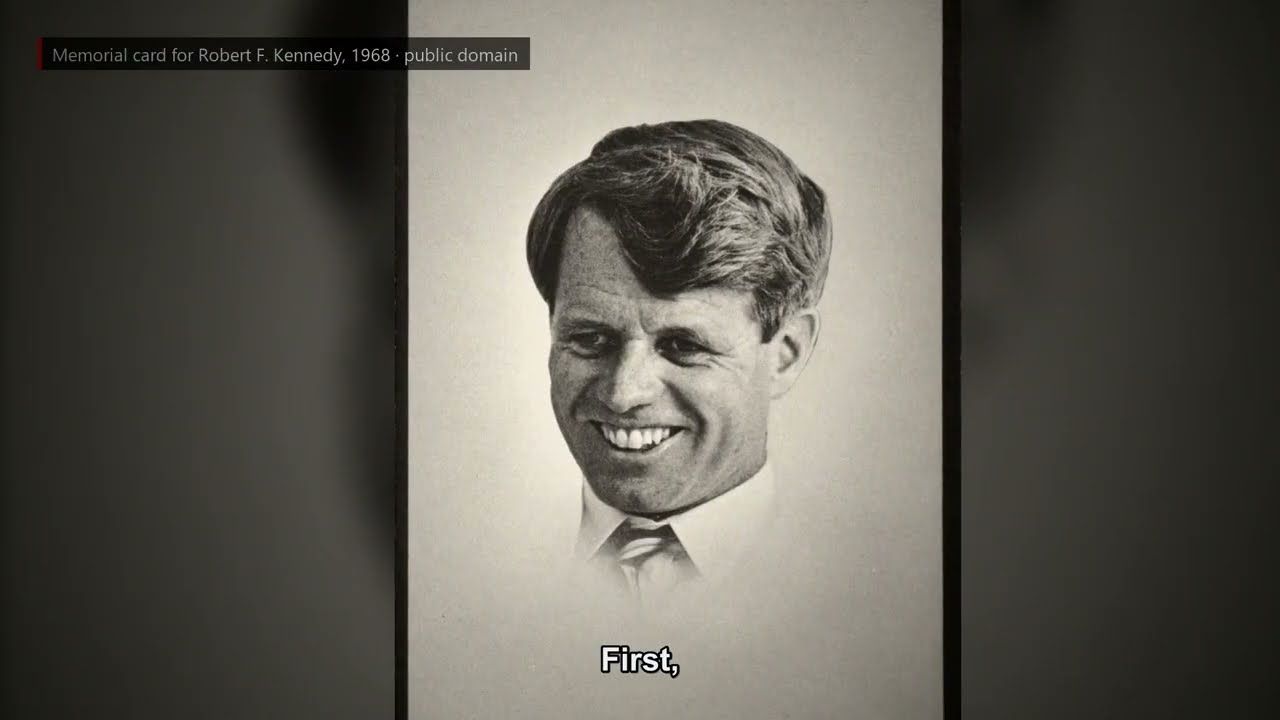
On June 5th, 1968, just after midnight, Bobby Kennedy won the California primary. He left the hotel ballroom through the kitchen. He was shot there. He died the next day. He was 42.
David Ormsby-Gore flew in and helped carry the coffin. There is a line her biographers have repeated ever since. They say that in those days she told a friend, "If they're killing Kennedys, then my children are targets." Whether she used those exact words or not, look at where she stood. Her husband had been murdered in front of her. Now her brother-in-law had been murdered, too. She had a daughter of 10 and a son of seven with the most famous last name in the country. And she knew a man who owned an island.
Four and a half months after Bobby died, she married him. It happened on October 20th, 1968 on Skorpios, the island Onassis owned. The chapel was tiny. It was raining. Caroline and John stood beside their mother holding candles. She was 39. He was 62 or close to it. The engagement ring held a diamond of just over 40 carats. She is said to have worn it twice. Then it went into a bank vault.
Her sister Lee was there. And here is how she found out. By most accounts, Jackie never told her. The call came from the groom. Lee told one person how jealous she was of her sister. That person was Truman Capote. Years later, after they fell out, he went on television and told everyone.
Then the headlines came. In New York, the reaction here is anger, shock, and dismay. In Germany, America has lost a saint. In Sweden, across a front page, Jackie, how could you? A paper in Rome wrote that John Kennedy had died a second time. A paper in London called it Jackie Wed's blank check.
The church joined in. Onassis was divorced. The Vatican's press officer said she had knowingly violated the law of the church. The Vatican's weekly paper called her a public sinner. She could no longer receive communion.
One man defended her. Cardinal Cushing of Boston, the priest who had married her to Jack and buried him. "Why can't she marry whomever she wants?" he asked. The hate mail was so vicious that within days he announced he would offer the pope his resignation.
And in Paris, Maria Callas had been told nothing. Time magazine reported the one remark she made. "She did well, Jacqueline, to give a grandfather to her children."
So that was the verdict of the world. She did it for money. Nobody asked her.
24 days later, she sat down and wrote to the man she had refused. The letter is dated November 13th, 1968. She is answering a letter from David, and clearly a painful one. He had told her what he thought of Aristotle Onassis. She does not argue. She tells him he has the man wrong.
"You know me," she writes, "and you must know that the man you write of in your letter is not a man that I could marry."
Then she describes Onassis. She says she knows he is, in her words, lonely and wants to protect me from being lonely. And he is wise and kind. Wise and kind. Hold on to those two words. We are going to test them.
And then the line we started with. The reason she could not marry David or any man like him. "If ever I can find some healing and some comfort, it has to be with somebody who is not part of all my world of past and pain."
Think about who David Ormsby-Gore was. He was Jack's friend. He had been in the White House through the best years. He had carried Bobby's coffin. Every time she looked at him, she would see both of them. Onassis had nothing to do with any of it. He was foreign. He was loud. He was not respectable. And he was not a Kennedy. That was the attraction.
"I can find that now," she writes, "if the world will let us." She does not let David go coldly. "We have known so much and shared and lost so much together. Even if it isn't the way you wish now, I hope that bond of love and pain will never be cut." She calls him "my beloved beloved brother."
He kept that letter. He put it in a red box with the others and he locked it. So that is her answer in writing. She did not say she loved him. She did not say he was rich. She said he was outside the story that was killing her.
Now the harder question. Did she get what she wrote that she wanted?

Here is what the next seven years held. The man she called wise and kind would go back to another woman. He would be accused of selling photographs of his own wife. He would hire one of the most feared lawyers in America to get rid of her. And then he would put his answer in writing.
Start with the paperwork. You have probably heard that Jackie and Onassis signed a marriage contract with 170 clauses, separate bedrooms, a fixed number of nights together each year, so many millions if he ever left her. So where does it come from? You would expect a lawyer or a court file. It comes from the man who ran the dining room.
His name was Christian Kafarakis and he said he had been chief steward on the Christina for 10 years. In 1971, he sold his story to a London tabloid and the next year it came out as a book. "I am one of the few people," he announced, "to learn the contents of this remarkable document." Newspapers around the world repeated his numbers. One American headline read, "Jackie guaranteed $625,000 a year."
That is the source. A former employee with a story to sell. In more than 50 years, nobody has produced the document. No page, no clause, no signature.
What is real is less exotic. There was a financial agreement before the wedding negotiated for her by Ted Kennedy and a New York banker named Andre Meyer. The figure most often reported is $3 million for her and a million for each child. The papers have never been published, so every number you hear is somebody's estimate.
And here is what the people who said she sold herself usually leave out. Marrying him cost her money. She had an income from a Kennedy family trust reported at around $150,000 a year. It stopped when she remarried. So did her Secret Service protection. She gave up a guaranteed Kennedy income for an Onassis promise. And the promise depended on one thing, him.
For the first couple of years, people who visited them say it worked. Skorpios gave her what she had asked for. No crowds and no cameras. Onassis was good with the children. She redecorated his houses. He grumbled about the bills and he paid them.
But she lived in New York for most of the year because that was where her children went to school. He lived wherever his deals took him. And a husband who lives alone in Paris has time on his hands.
Onassis kept an apartment on the Avenue Foch. Maria Callas lived on the Avenue Georges Mandel. You could walk from one to the other. His private secretary, Kiki Moutsatsos, wrote a memoir in 1998. She says he never stopped seeing Callas and that the staff all knew.
A secretary is not a neutral witness. She adored her boss, but she was in the office every day. She also says Jackie knew. Jackie complained to his sister Artemis and got the advice of an older Greek wife. Don't fight, ignore it. Here in Greece, that's what usually happens.
For a while, she did. And then it was her turn to be embarrassed. His name was Roswell Gilpatric. He was a Wall Street lawyer who had been number two at the Pentagon under President Kennedy. He was married and a good deal older than Jackie. After Dallas, they had been close enough for the gossip columns to link their names.
In February 1970, four letters from Jackie to Gilpatric turned up for sale at a New York autograph dealer. Gilpatric said they had been taken from his files. Before the lawyers could get them back, a Washington Post columnist had copies and then everybody did.
Look at where she wrote one of them. On the Christina on her honeymoon. "Dearest Roz," it begins. "I would have told you before I left, but then everything happened so much more quickly than I'd planned." And it ends, "Dear Roz, I hope you know all you were and are and will ever be to me with my love, Jackie."
So, a new bride, a few days married, was writing those words to another man from her husband's yacht. Time magazine ran the story under the headline, "Dear Roz." The same week, Gilpatric's wife started proceedings for a separation.
People around Onassis say he was humiliated. He had married the most famous woman in the world to be envied. Now the world was reading her letters and laughing at him. He answered in the way he knew best, in public. Soon afterwards, he took Maria Callas to dinner at Maxim's, the most famous restaurant in Paris. He did not hide. The photographers got their picture and it went around the world.
Jackie saw it in New York. She got on a plane. Within a day or two, she was sitting at Maxim's with her husband. She had asked for the same table. That is what the marriage had become by its second year. Two people sending each other messages through photographers.
And at home, his children were waiting for it to fail. His son Alexander put it in one line. "My father loved the names and Jackie loved the money." His daughter Christina called her "my father's unfortunate obsession."
Then somebody found a way to hurt her where she felt safe. Skorpios was the one place she believed nobody could reach her. On the beach there, she swam and sunbathed without a swimsuit. At the end of 1972, an Italian magazine called Playmen published pages of color photographs of her doing exactly that. The photographers had used boats and diving gear to get close enough.
The pictures were sold around the world. In 1975, the American publisher Larry Flynt bought them for $18,000 and put them in his new magazine, Hustler. That issue sold a million copies in a few days. It made him rich. She had beaten photographers in court before. This time there was nothing a court could do. The pictures were already on newsstands.
Now the controversy. Who told the photographers where she would be? In 2014, the biographer Christopher Anderson gave an answer and it was the last name anyone expected. He wrote that it was Onassis, that he was sick of paying for his wife's lawsuits against the press, and that he supplied a map of the island and her schedule himself to teach her a lesson.
You should know that it is disputed. The family of one of the photographers says he worked alone on a tip from an airline employee. No document proves that Onassis gave the order. But look at what that argument tells you about this marriage. Four years in, serious people found it believable that the husband would sell his wife's privacy to punish her.
Wise and kind, she had written.
Within weeks of those photographs, the Onassis family was hit by something far worse. On January 22nd, 1973, Alexander Onassis was at Athens airport checking out a new pilot in a small amphibious plane. It lifted off and came down seconds later. He died the next day. He was 24.
His father never recovered. He buried his son on Skorpios beside the little chapel where he had married Jackie. He would not accept that it was an accident. He offered a million dollars to anyone who could prove sabotage. And he looked for someone to blame.
According to Peter Evans and others who were around him, he found her at his own table. He started calling Jackie "the witch." His reasoning went like this. Her first husband was murdered. Her brother-in-law was murdered. Now she had married into his family and his only son was dead. She carried death with her.
Go back to the letter. She had married him to get away from what she called her world of past and pain. Four years later, he was telling people that she was the pain.
The next year, the family story got darker still. His first wife, Tina, had married again. Her new husband was Stavros Niarchos, Onassis's great rival, and Niarchos had been married before to Tina's own sister, Eugenia. In 1970, Eugenia was found dead on his private island with barbiturates in her blood and bruises on her body. He said the bruises came from trying to revive her, and an inquiry cleared him. The next year, he married her sister.
In October 1974, Tina was found dead in the Niarchos mansion in Paris. She was 45. Christina demanded an autopsy on her own mother. It pointed to barbiturates.
So, in under two years, Onassis had lost his son and the mother of his children. His own body was failing. He had a disease that weakens the muscles. In his last photographs, his eyelids are held up with strips of tape.
And in that condition, he went to see a lawyer. The lawyer most often named is Roy Cohn. The same Roy Cohn who had worked for Senator McCarthy and who would later teach a young Donald Trump how to fight. Onassis wanted to know how he could divorce Jacqueline Kennedy.
The writer Arianna Stassinopoulos reported what came next. She says Onassis hired a private detective to follow his wife and find proof of adultery. And she says he had decided to divorce her. In her words, only after he had made it as humiliating as possible for her.
He ran out of time. In February 1975, Onassis was flown to Paris for surgery. He died five weeks later on March 15th at the American Hospital outside Paris. By most accounts, his daughter was with him. His wife was in New York.
She landed the next day in black with photographers running beside her and she gave the press a statement. It is short and every word has been weighed. "Aristotle Onassis rescued me at a moment when my life was engulfed with shadows. He brought me into a world where one could find both happiness and love. We lived through many beautiful experiences together which cannot be forgotten and for which I will be eternally grateful."
Rescued. Shadows. Grateful. Put that next to the letter from 1968 and they match. Seven years apart in public and in private, she gave the same reason.
Then the will was read. His biographers say he wrote it by hand on his private jet in January 1974 flying home from Acapulco. He and Jackie had just had an argument there about a house she wanted to build.
Close to half of his fortune went to a foundation in his dead son's name. The rest went to Christina. For his wife, there was an income. The reports run from $150,000 to $250,000 a year. For a man said to be worth hundreds of millions, it was pocket change. And he added a warning. If she went to court to get more, she would lose even that.
So, there are two documents in this story and they answer each other. In 1968, she wrote that he was wise and kind and that with him she could heal. In 1974, he wrote her out. A letter can say what a marriage is for. A will says how it ended.
She did not accept the will. Her lawyers let Christina know that she was ready to challenge it. That would have meant years in court with every private detail of the Onassis family read into the record. Christina had just lost her brother, her mother, and her father in a little over two years. She was 24 and one of the richest women on Earth. What she wanted most was to never see her stepmother again.
So, she paid. The number depends on who was counting. The New York Times at the time said $20 million. The figure you will read most often is $26 million. Peter Evans put it best. Christina, he said, couldn't stand her to the tune of $26 million.
So, did she marry for money? You can make the case. She walked away with millions. But here is the part that does not fit. That same year, with a fortune on the way, she took a job. She went to work as a book editor in New York four days a week for $200 a week. She stayed in publishing for the rest of her life. She never wrote her memoirs.
The others did not get a second act. Maria Callas died in her apartment on the Avenue Georges Mandel in 1977. She was 53. Christina Onassis married four times. She died in Argentina in 1988 at 37.
Lee Radziwill, the sister who got there first, was never close to Jackie again. When Jackie's own will was read, it had one sentence for her. "I have made no provision in this my will for my sister Lee B. Radziwill, for whom I have great affection, because I have already done so during my lifetime." Lee got nothing.
Remember the ruby necklace and the dinky little bracelets? 31 years later, Jackie had the last word.
And David Ormsby-Gore, Lord Harlech, went home to Wales. He married again. He never sold his story. In January 1985, he was badly hurt in a car crash and he died the next day. Jackie flew to his funeral. The red boxes stayed in the house. Nobody had the keys.
Jacqueline Kennedy Onassis died in New York on May 19th, 1994. She was 64. In her last weeks, she invited old friends to her apartment one at a time. She handed each of them a bundle of letters tied with yarn, and together they fed them to the fire. Letters from her children, from Jack, from Onassis.
She could not burn the ones she had sent. 18 of them were in Wales in a locked box in the house of a man who had loved her. That is the only reason we can read her side.
So on one side we have the headlines, the rumors, the will, and the money. And on the other we have one sheet of paper in her handwriting written when she had no idea anyone else would ever read it. It says she married him to heal.
Both things can be true. She could have gone to him for shelter and left with his money and felt she had earned it. She saw this argument coming. It is in the same letter. One line written to a man who thought he knew exactly why she had done it.
"Please know," she wrote, "you of all people must know it. We can never really see into the heart of another."