Rescue teams searching the burning wreckage of a plane near the Belgian coast made a striking discovery. Inside a steel safe, pulled from the debris without a single scratch, lay a diamond tiara. Everyone on board the aircraft had perished, including the last woman to wear it: Princess Cecilie of Greece, the sister Prince Philip was said to love most and the one he never spoke about. The tiara had been designed by Prince Albert, Queen Victoria’s husband.
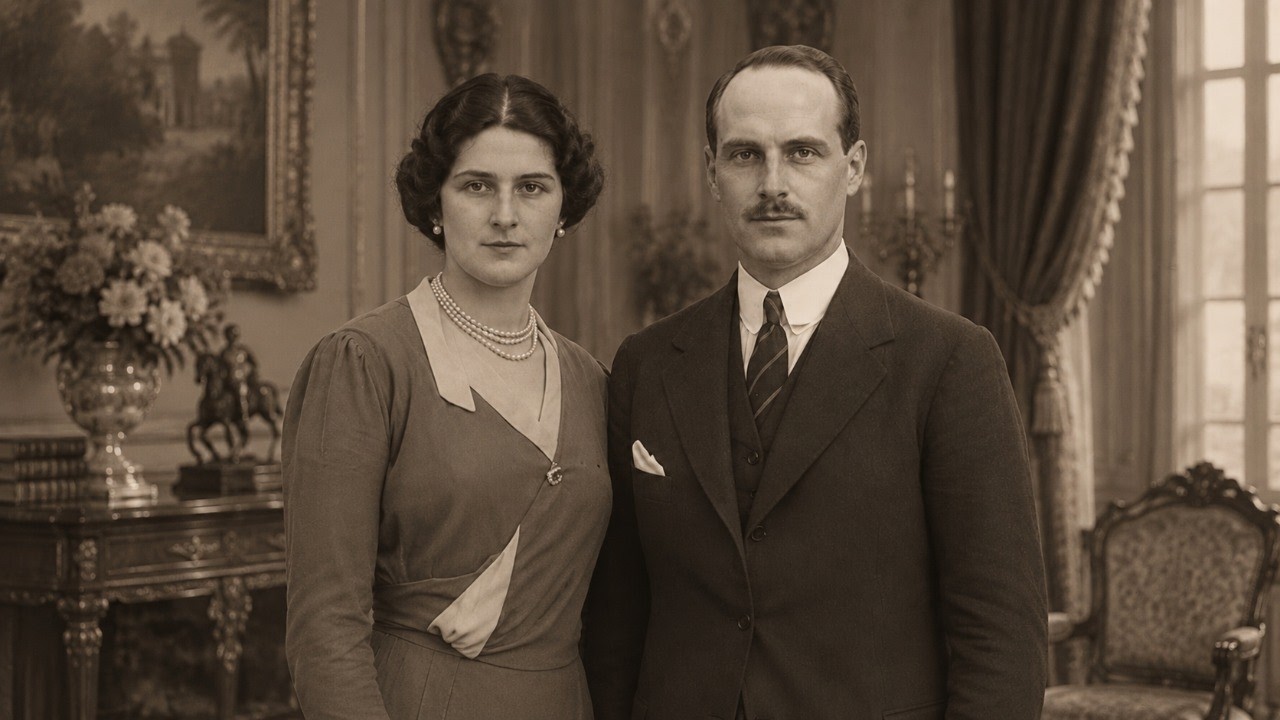
Three women wore it, and all three faced remarkably similar, tragic ends. It became known as the jewel that outlived everyone who touched it. The third woman to wear it was Princess Cecilie of Greece and Denmark, born in 1911 in exile. She was the third of Prince Philip’s four older sisters and considered by many to be his closest sibling.
By the spring of 1937, she had a devoted husband, three healthy children, and a fourth on the way. The story begins long before Cecilie, however, with a grieving father. In the autumn of 1861, Prince Albert was designing jewelry for the wedding of his daughter, Princess Alice. He worked with court jewelers Garrard on a delicate band of diamonds set in the shape of leaves and needles, a design later known as the “Strawberry Leaves” tiara.
Albert never lived to see it completed. He fell ill with what doctors called typhoid fever in December 1861. Alice, just 17, nursed him tirelessly through his final weeks. He died on December 14.
It is a date that would echo through the family for decades. Queen Victoria refused to postpone her daughter’s wedding but also refused to make it a celebration. Alice married Prince Louis of Hesse on July 1, 1862, in a dining room converted into a temporary chapel. Victoria, dressed in black and hidden from view, described the day as being closer to a funeral than a wedding.
Alice took the tiara to Germany. Her life in the small Grand Duchy of Hesse was not the fairy tale a queen’s daughter might have expected. The palace was poor, and she threw herself into hospital work and nursing the wounded. She had seven children, but tragedy soon found her.
She lost a young son who fell from a window, an anguish she carried silently beneath her public dignity. In the autumn of 1878, diphtheria swept through her household. One by one, the children fell ill. Her youngest, four-year-old Marie, died on November 16.
Alice hid the news from her other children as long as she could, but her son Ernest was devastated by his sister’s death. Nursing her son, Alice made a fatal mistake. Throughout the weeks of caring for the sick, she had followed a strict rule: no kisses, no close contact that might spread the infection. But when her grieving son sat up in bed, inconsolable, she forgot her caution for a single moment.
She leaned over and kissed him. She fell ill in early December. On December 14, 1878—exactly 17 years to the day after her father’s death—Princess Alice died. Her final words, spoken to a man who had been gone for 17 years, were simply, “Dear Papa.
” Victoria called the coincidence almost incredible and deeply mysterious. Alice was the first of Victoria’s nine children to die. The tiara remained in Hesse, waiting for the next Grand Duchess. It passed to Victoria Melita, known as “Ducky,” who married Alice’s son Ernest in 1894.
She wore the tiara at the coronation of her cousin, Tsar Nicholas II, in Moscow in 1896, sparkling among the crowned heads of Europe. But the marriage, partly arranged by Queen Victoria, was deeply unhappy. They divorced in 1901, an almost unheard-of scandal among royalty. Ducky kept many of her jewels, but the Strawberry Leaves tiara stayed with the House of Hesse.
Two years after the divorce, their eight-year-old daughter Elizabeth died suddenly of typhoid fever while traveling in Russia. She had been the only bond holding her estranged parents together. Ducky remarried for love but lost everything in the Russian Revolution, spending her final years in exile. Ernest remarried the quieter Princess Eleonore of Solms-Hohensolms-Lich, who became the next Grand Duchess of Hesse and wore the tiara for her official portraits.
Eleonore proved a steady presence through World War I and the fall of the German monarchy in 1918. She raised two sons. The eldest, Georg Donatus, married a Greek princess named Cecilie in 1931. She was clever, gentle, and easy to love, and Eleonore welcomed her as a daughter.
The younger woman was soon lent the family’s greatest jewel for the most important occasions. Cecilie had grown up in exile. Her family was stripped of everything and forced to flee Greece aboard a British warship. Her father drifted to the south of France, living with a mistress.
Her mother, Princess Alice of Battenberg, suffered a severe mental breakdown and was forcibly committed to a Swiss sanatorium. The four sisters raised each other. All four later married German nobles, a fact that would take on terrible significance in the years ahead. In the spring of 1937, Cecilie and Georg Donatus attended the coronation of King George VI in London.
For the occasion, Eleonore lent her daughter-in-law the Strawberry Leaves tiara. A photograph from a coronation concert shows Cecilie standing beside her cousin, Princess Marina, Duchess of Kent, the diamonds sparkling under the lights. She was 25 and radiant. In less than six months, everyone in those photos except one would be dead.
That same month, May 1937, Cecilie and her husband joined the Nazi Party. Historians still debate their reasons. Some point to a German nobility that made uneasy compromises with the new regime to survive. Others are less forgiving.
The records confirm the fact of their membership but not what was in their hearts. In October 1937, Georg Donatus’s father died. He became head of the House of Hesse, and Cecilie became Grand Duchess in name, the third woman to wear the tiara as lady of the house. A final journey was planned.
Georg Donatus’s younger brother Louis was to marry in London in November. The whole family decided to attend, despite Cecilie being eight months pregnant. A biographer of her brother later recorded a haunting detail: Cecilie hated flying. She was afraid of it.
Whenever she had to travel by air, she wore black, as if dressing for her own funeral. On the morning of November 16, 1937—the same date little Marie had died 59 years earlier—Cecilie wore black and went to the airport. The family boarded a Junkers aircraft operated by the Belgian airline Sabina. On board were Cecilie, Georg Donatus, their two young sons Ludwig and Alexander, the widowed Grand Duchess Eleonore, a governess, and a family friend, along with the pilot and crew.
Their daughter Joanna stayed home, deemed too young for the journey. The decision would save her life, for a time. Among the luggage, hidden in a safe, was the jewelry Cecilie would wear to her brother-in-law’s wedding, including the Strawberry Leaves tiara. The plan was simple: stop in Brussels, then continue to London.
But as the plane flew toward the North Sea, the weather turned, thick fog erasing the line between sky and earth. Somewhere over Belgium, another emergency developed. Cecilie went into labor. We know this because the Belgian authorities later reconstructed the sequence of events.
The child was due a month early, at an altitude of about 3,000 feet. The pilot realized the emergency and diverted toward the nearest airport, Ostend. Descending through the fog, unable to see, the plane struck a factory chimney near the airfield. A wing sheared off.
The aircraft fell and burst into flames. No one survived. Not the pilot or crew, not the governess or the family friend, not the two small boys, not Eleonore, not Georg Donatus, not Cecilie. When rescue teams reached the wreckage, they made a discovery that still shocks today.
Among the dead lay the body of a newborn. Cecilie had given birth in those final desperate moments, in a falling plane or at the moment of impact. The infant lived, if it lived at all, for less time than it takes to tell this story. The Belgian investigators concluded that the labor was what prompted the desperate attempt to land in impossible conditions.
In a single morning, the House of Hesse lost its head, his wife, his mother, and his two children. A generation vanished between breakfast and noon. And among the still-smoking, charred wreckage, the rescuers opened the safe. Inside, the diamonds were completely intact.
Not one stone missing, not one leaf bent. The Strawberry Leaves tiara had emerged from the fire entirely unharmed. The jewel survived. None of the women who had worn it as Grand Duchesses did.
The living had to carry on with the wedding. Louis, the groom whose family had died flying to his ceremony, went ahead with the marriage the next day in London. No one could stop the machinery that had been set in motion, the guests had gathered, and the world was watching. Witnesses said it felt more like a funeral than a wedding.
The newlyweds then traveled to Ostend, during what should have been the first days of their marriage, to collect the coffins. Six in total. Two were very small. The bodies were returned to Darmstadt and buried in the family mausoleum at Rosenhöhe on November 23, 1937.
Among the mourners were two people who had not been in the same room for six years. Cecilie’s mother, Princess Alice, emerged from her long institutionalization to attend. Cecilie’s father came from the south of France. The estranged couple met again for the first time in years, united before their daughter’s grave.
The grief achieved what nothing else could. But it did not last; they separated again afterward. By 1937, Germany was under Nazi rule, and the regime understood the value of public spectacle. The Grand Ducal family’s funeral became an occasion filled with uniforms.
Soldiers in Nazi dress formed an honor guard. The streets of Darmstadt filled with crowds, and as the coffins passed, arms rose in the Hitler salute. What should have been a quiet family mourning was draped in the regime’s flags, whether the family wanted it or not. Walking behind his sister’s coffin and his two young nephews’ coffins was a sixteen-year-old boy.
Philip, Cecilie’s youngest brother. He had been at Gordonstoun school in Scotland when the news arrived. The headmaster told him. He stood in a dark coat in a foreign town, surrounded by uniforms and raised arms belonging to a cause that had nothing to do with the sister he had lost.
He walked the entire route on foot. Photographs from that day show his young face revealing absolutely nothing. He was sixteen years old and had already learned what would define his identity for the next eighty years: how to carry what cannot be carried, and to allow none of it to show on his face. For the rest of his very long life, Prince Philip almost never spoke about his sister.
He became the most photographed consort in the world, seventy years standing one step behind the Queen of England, a man known for a brisk manner, an impatience with emotion, and a refusal to offer explanations. People who knew him well understood that the closed door inside him carried a date: November 16, 1937. There is one more detail worth telling, for it shows the reach of that day’s shadow. When Philip married Princess Elizabeth in 1947, his surviving sisters were not invited.
Britain had emerged from the war just two years earlier. It was deemed impossible for German princesses—some married to men who had worn the enemy’s uniform—to appear at the wedding of the future Queen. So they were quietly omitted from the guest list, absent from the most important day of his life, as if that part of his family did not exist. He had already lost Cecilie in the sky.
Now a continent’s politics kept his remaining sisters away on his wedding day too. He said nothing about that either. For decades. And then, after his death in 2021, something small came to light.
From the archives of his old school emerged the reports written by his headmaster during the weeks after the crash. They contained a detail no one had known. According to the writer who chronicled the royal family’s history, the headmaster recorded how devastated the boy was. And he recorded something else.
After the tragedy, the sixteen-year-old kept a small piece of wood. A splinter. It came from the wreckage of the plane that had carried his sister. He kept it.
We do not know for how long, or where, or whether he ever looked at it again in the years that followed. All we know is that a grieving boy, told his favorite sister had died in the fog over Belgium with her children and her unborn child, reached out and picked up a piece of what had killed her and held onto it. So two things emerged from that crash intact. One was a flawless tiara, valuable and dazzling, found unmarked inside its safe, passed down as a treasure of the House of Hesse.
The other was a nameless, worthless splinter of wood, kept in secret by a boy who would one day stand beside a throne. For the next ninety years, the world photographed the diamonds. The world did not learn of the splinter until after the boy died. One surviving thing was shiny, public, and meaningless.
The other remained hidden and worn, carrying everything a person could feel. The deaths were not quite over. Joanna, the little daughter left behind in Darmstadt, too young for the journey, was the only survivor of her immediate family. She was three years old.
Her uncle Louis and his new wife Margaret, the couple who had married in the midst of a funeral, adopted the orphaned child and raised her as their own. It was the single kind turn in all that darkness. She lived only two more years. In the summer of 1939, Joanna contracted meningitis and died.
She was buried at Rosenhöhe beside the mother, father, and brothers she had been too young to remember. With their deaths, the direct line of Georg Donatus and Cecilie vanished completely. Without descendants, an entire branch of one of Europe’s oldest families was erased within two years. Louis and Margaret had no children of their own.
When Louis died in 1968, the male line of the Grand Dukes of Hesse and the Rhine came to an end. The family passed to a distant relative. The castles, paintings, and jewelry—including a certain diamond tiara—remained under the care of a family foundation, the Hessische Hausstiftung, where it still exists today. The Strawberry Leaves tiara still survives.
It survived everyone in this story. It is as beautiful as it was in the autumn of 1861, when a dying father chose its diamonds for a daughter he never lived to see wear it. Everyone is gone, and the diamonds remain. With a story like this, there is a temptation to reach for the word “curse.
” Over the years, that is exactly what people have called it: the cursed Hesse family diamonds. One can understand why. A father died before he could deliver it; a daughter died on the anniversary of that father’s death with his name on her lips; a second duchess buried her only child and lost her world; a third died in the air giving birth, her children beside her. But a tiara cannot carry a curse.
Diamonds do not choose. They do not remember Alice, or Ducky, or Cecilie. What looks like a curse is nothing more than this: the women of this family, like women of any other family, were mortal, and it happened that they were photographed again and again wearing the same beautiful thing, so their misfortunes appear to gather around it like reflections within a jewel. The tiara did not destroy them.
It simply outlived them. That is the harder truth, and the sadder one. Not because the object is cruel, but because the object remains so effortlessly, while the people who loved it and wore it and posed with it do not. In the mausoleum at Rosenhöhe in Darmstadt, Cecilie, Georg Donatus, and the two small boys still lie together, along with the infant who lived only minutes and Joanna, who survived the plane only to join them two years later.
Not far away lies Alice, the first of them, with her small daughter carved sleeping in her arms. The diamonds are in a vault. The people are underground.
And somewhere between them, lighter than either, remains a splinter of wood a boy could not bring himself to throw away.