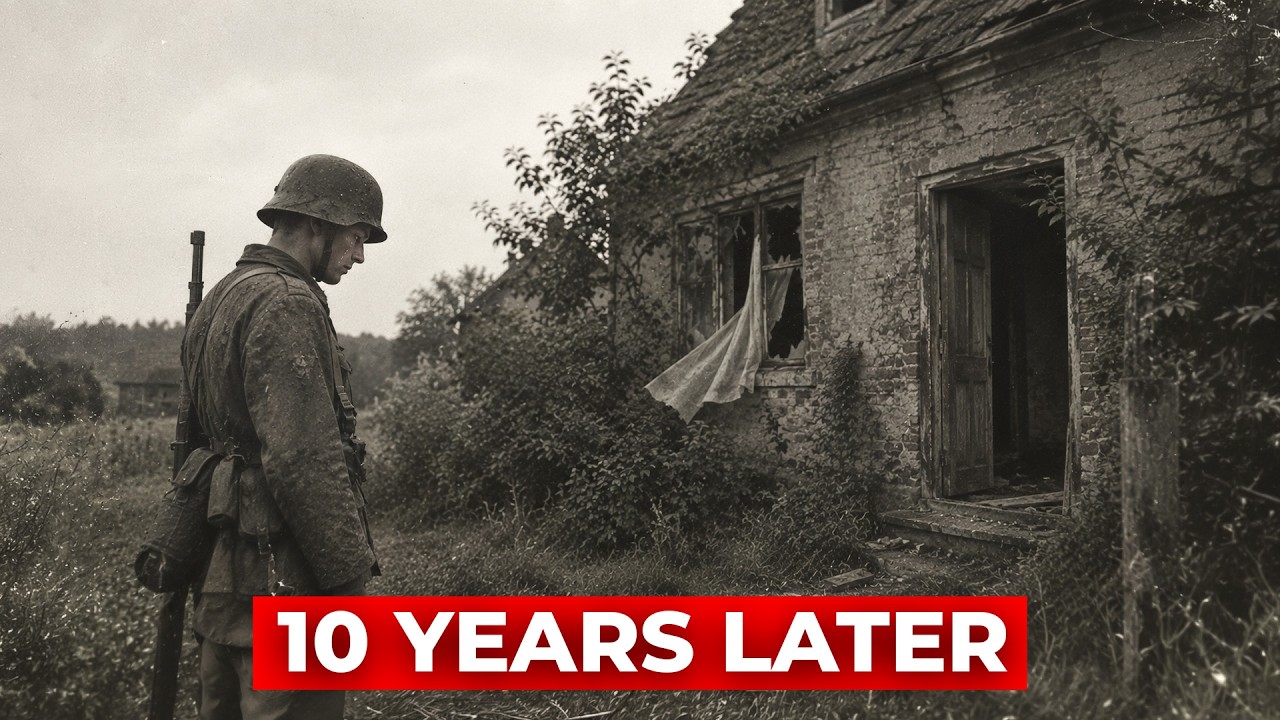
In the winter of 1955, a train pulled into a small camp in Lower Saxony called Friedland, carrying men gone so long that some had already been declared dead. They were German soldiers. The war they had marched into ended more than 10 years earlier, in the spring of 1945. Their wives had waited and then stopped. Their children had grown up with a photograph instead of a father. But the strangest part of their story isn't the 10 years they lost in Soviet camps. It's what was waiting for them when they finally got home.
Start with the scale, because the scale is what makes the rest believable. When Germany surrendered in May 1945, the Soviet Union was holding around 3 million German prisoners of war. That figure comes from the historian Rüdiger Overmans and a West German government commission. And even the lower Soviet count runs past 2 and 1/2 million men. Most of them would eventually come home. Between 1945 and 1950, the Soviets released roughly 2 million, sending them west in long, slow transports.
But not everyone came back. By 1948, Soviet camps still held more than 890,000 Germans, the largest group of prisoners any of the wartime allies had kept. And as the years passed, that number did not empty out the way the families at home kept praying it would. By October 1949, all but about 85,000 had been let go.
Those last men did not come home in 1949. They did not come home in 1950, or 1952, or 1954. For them, the war simply kept going. The releases came in waves, each one smaller than the last. By the early 1950s, the tens of thousands had shrunk to a hard core of around 26,000 men, released, according to the historian Frank Biess, in two final batches. One across 1953 and 1954, and the last in 1955. Every wave that left made the ones still behind more certain they had been forgotten. They watched other men board the westbound trains and then went back to the mine, or the forest, or the barracks, and counted off another year.
One fact has to sit underneath everything that follows. None of these men were innocent in the way that word is usually meant. They had fought for a regime of conquest and mass murder, and some had done far worse than fight. The camps they were sitting in belonged to a country Germany had invaded, burned, and tried to erase. When you set the German prisoner numbers next to the Soviet ones, the comparison is brutal. Of the roughly 5 million Soviet soldiers captured by Germany, an estimated 3.3 million died in German hands, many of them deliberately starved. So, keep that in view, because everything that follows is about what happened to these men anyway, once the shooting stopped and the world moved on
Why did the Soviet Union hold on to them for a decade? Part of the answer is labor. The war had gutted the Soviet economy and killed tens of millions of its people, and German prisoners became a workforce, rebuilding the country their army had wrecked. They dug coal, felled timber, and laid rail across Siberia and Central Asia. Part of the answer was leverage. As the Cold War hardened and Germany split into two states. Those prisoners turned into a bargaining chip, and Moscow knew exactly what they were worth. And part of the answer was paperwork with menace behind it. By the 1950s, many of the men still held had been convicted by Soviet courts as war criminals sentenced to long terms, which gave the Soviet Union a legal reason to keep them long after ordinary soldiers had gone home. Whether every one of those convictions was just is its own question. What matters here is the result. 10 years after the war, tens of thousands of German families were still writing letters to men the rest of the world had stopped counting
For the families back in Germany, the hardest thing was not knowing. A soldier reported missing on the Eastern Front existed in a kind of limbo. He was not confirmed dead, so there was no funeral, no grave, no ending. But he was not confirmed alive, either. Letters through the Red Cross arrived rarely, if at all, and could take a year to cross from a Soviet camp to a German kitchen table. A wife might get a single postcardin 1947, and then nothing for 4 years. Was he alive? Was he coming back? Nobody could tell her
And so, slowly, the living began to treat the missing as dead. German law let a court formally declare a missing person deceased after enough time had passed, which freed a wife to settle an estate, claim a pension, and remarry. Thousands of women did exactly that. They were not being disloyal. They were surviving, raising children alone in a bombed-out country. And at some point, hope becomes a luxury you cannot afford. The man was gone. The calendar said so. The court said so
Meanwhile, the man himself was often very much alive, thousands of miles east, in a camp near the Arctic Circle, or out on the Kazakh steppe. What kept some of them going was the belief that a wife and a child were waiting exactly as they had left them. Prisoners talked about home constantly. They memorized the ages their children would be turning. They planned the first meal. That picture in their heads was, for many, the only thing the guards could not take. But a picture is a fragile thing to build a decade of hope on,and time was quietly rearranging the reality behind it
The camps themselves were scattered across the whole width of the Soviet Union, from the forest near the Arctic to the mines of Kazakhstan and the ruins of Stalingrad itself, where German prisoners were put to work rebuilding the city they had helped destroy. The labor was brutal,and the food was thin, especially in the first years after the war, when the Soviet Union could barely feed its own people. Men died of hunger, of cold, of typhus,and of sheer exhaustion. And they died in the greatest numbers early, before the survivors hardened into the grim routine of staying alive
The ones who made it to 1955 had outlasted more than 10 years of that. The men who lasted that long survived a specific kind of ordeal,and the numbers from one battle tell you what kind. At Stalingrad, around 91,000 Germans went into Soviet captivity in early 1943. About 85,000 of them died in the months and years that followed, from starvation, typhus, cold, and forced labor. Only about 6,000 ever made it home. 91,000 captured, 6,000 returned. That was the arithmetic of Soviet captivity,and the men stepping off the trainsin 1955 were the survivors of the survivors, the small fraction left after the camps had taken everyone else
For years, there had seemed to be no way out. The Soviet Union had no diplomatic relations with West Germany. No embassy, no back channel, nothing. The prisoners were stuck behind a wall of Cold War silence,and no amount of grief in Germany could reach across it. And then, in the autumn of 1955, an old man in a homburg hat got on a plane to Moscow and decided to try
The old man was Konrad Adenauer, the first Chancellor of West Germany, 79 years old,and deeply distrustful of Moscow. In September 1955, he flew to the Soviet capital for four days of talks, from the 9th to the 13th. The official reason was diplomatic. The Soviets wanted formal relations with West Germany, an exchange of ambassadors,a normal line between the two capitals. Adenauer wanted something else,and everyone in the room knew it. He wanted the men
He was not doing it alone. Back in Germany, the missing prisoners had become one of the most emotional public causes of the decade. Returnee associations, churches, and above all, the families of the missing had spent years keeping the issue alive, refusing to let the country quietly write the men off. Mothers and wives wrote letters, held vigils,and pushed every politician who would listen. For Adenauer, bringing these men home was more than a humanitarian gesture. The German public desperately wanted it,and the chancellor who delivered it would bind the country to him for years. The pressure to come back from Moscow with the prisoners was enormous. And so was the humiliation waiting for him if he failed
The negotiations were tense,and by the accounts that survive, genuinely unpleasant. The Soviet side swung between warmth and open hostility, at one point accusing Germany of the very aggression that had filled their camps with prisoners in the first place, which was not a charge Adenauer could easily argue against. He pushed anyway. He tied the prize the Soviets wanted, diplomatic recognition, to the thing he wanted,the release of the prisoners. For days, it was deadlock
There was a real risk in what he was doing. Establishing relations with Moscow meant recognizing the Soviet Union while it occupied East Germany,a bitter concession for a West German leader. Critics at home would say he had legitimized the division of his own country. But Adenauer had made a calculation. The prisoners were aging, dying,and running out of time,and no future deal was guaranteed to be better than the one on the table. So he took it
On the 13th of September,the two governments agreed to establish diplomatic relations. In return,the Soviet leadership gave a promise. Not a signed treaty on the prisoners, but a verbal commitment that the last German prisoners of war and interned civilians would be released. The number attached to that promise was around 10,000 men, roughly 15,000 once civilians were counted. Adenauer flew home, not entirely certain the Soviets would keep their word
They did. For the prisoners,the news arrived like a rumor they were afraid to believe. Men who had learned never to hope because hope in a labor camp is a way to get your heart broken on a schedule. Heard that Adenauer had come to Moscow and that lists were being drawn up. Some did not trust it until the train actually started moving west. They had been promised things before. But this time the trains kept going past the cities where they had worked, across borders they had crossed a decade earlier in the other direction, heading toward a small reception camp in the West German countryside where the whole nation was about to be watching

That camp was Friedland near Göttingenin Lower Saxony. And by the autumn of 1955, it had already been a gateway for the displaced and the returning for a decade. On the 7th of October, 1955,the first transport of these late returnees,the Spätheimkehrer,as Germany called them,reached Friedland. The last of them would not arrive until the 14th of January,1956,when a final train pulled into the border station at Herleshausenin Hesse
What happened on those platforms became a national event. West German radio covered the arrivals live. Crowds gathered in the cold. There were church bells and choirs and a wall of handmade signs held up by people scanning every face that came off the train looking for a son,a husband,a brother they had not seen in 11,12,13 years. Some held photographs of young men in uniform up next to the strangers stepping down onto the platform trying to match the picture to the person
Friedland had a routine for this by now. The men were registered, given medical checks,a hot meal,and often a small sum of money and fresh clothes before being sent on toward home. But,the processing was the easy part. The hard part was the reunion,and not every man on those platforms had someone waiting. Some scanned the crowd and found no familiar face at all because everyone who might have come for them was dead or displaced or had long ago stopped believing they would ever step off a train again
Because that was the first shock before anyone even got home. The men were barely recognizable. They came off the trains thin, weathered,and old before their time. Some still in the rags of the uniforms they had been captured in. A woman who had said goodbye to a man of 22 came to meet a man in his mid-30s who had spent his entire young adulthood behind wire. A child who had been a toddler was now a teenager. Over and over on that platform,the photograph and the person no longer matched
For the country,the return of the Spätheimkehrer was a moment of pure feeling,and West Germany embraced it completely. These were the last men home from the war, living proof that the long nightmare was finally fully over. Adenauer's popularity soared. Newsreels showed weeping reunionsin the Friedland cold. It was,for a few weeks,the happiest story in Germany,and the whole country wanted to stand on that platform and cry with relief
But,the cameras stayed on the platform. They filmed the embrace,the tears,the flags. They did not follow the men home. And it was at home,away from the crowds and the microphones,that the real story of the Spätheimkehrer actually began
For many of the returning men,the reunion they had survived a decade for did not exist anymore. The historian Frank Biess,who studied these homecomingsin detail for his book Homecomings,found a pattern that West Germany did not like to talk about in public. On the platform,the story was joy. Behind the front door,it was often something much harder
Some men came home to find that they had been legally declared dead. Their wives,after years of silence,had gone to a court,obtained a death certificate,and started again. A number of them had remarried. So,a man who had held on through a Siberian winter by picturing his wife found,on reaching his own town,that she was now someone else's wife,sometimes with a new child,living in what had been his house. He was,on paper,deceased. His marriage no longer legally existed. He had come back from the dead into a life that had already closedthe gap where he used to be
And being legally dead created a bureaucratic nightmare on top of the emotional one. A man declared deceased had,in the eyes of the state,no marriage,no property,and,in a sense,no legal existence to return to. His estate might have been settled and divided years earlier. His wife's new marriage was the valid one. To exist again on paper,he had to go to the authorities and,in effect,prove he was not dead and then untangle a decade of decisions that had all been made on the assumption that he never would. Some men reached home to find the practical machinery of their own lives had been dismantled and handed to other people entirely lawfully while they were gone

Even where the marriage had survived,the years had done their quiet damage. A wife had spent a decade as the sole head of the household. She had made every decision,earned the money,raised the children,and rebuilt a life out of the rubble of 1945. Now,a man walked back in expecting to be the head of the house again. And neither of them knew how to be what they had been. Couples who had married as sweethearts before the war met again as two people who had each lived a decade of separate experience the other could not share
And then,there were the children. A man who left when his son was two came back to a boy of 13 or 14 who had no memory of him at all. To that child,the father was a photograph on a shelf and a name in his mother's stories. And now,the photograph was a real,gaunt,silent man sitting at the dinner table,a stranger who expected to be called father. Children reported being frightened of these men. Some fathers tried too hard. Some could not reach their children at all. And many families spent years quietly failing to become whole again
The men themselves had changed in ways their families could not see and did not understand. They had survived the camps by shutting parts of themselves down,and that does not switch back on when the train arrives. Many came home unable to sleep,unable to talk about where they had been,prone to sudden anger or long silences. There was no language yet for for we would now call trauma. And there was very little patience for it. West Germany was busy with its economic miracle,racing toward prosperity. And a gaunt man who woke up shouting in the night did not fit the story the country wanted to tell about itself
So,the returnees learned to be quiet. They did not talk about the camps,and the country did not ask. Their suffering had been celebrated for exactly as long as it made a good newsreel. And then,everyone,including their own families,needed them to simply be normal again. The men who had lost 10 years and come home to find their place in the world already filled in,that was,quietly,a second loss. It was a loss no one had warned them to expect,and no one afterward much wanted to hear about
There was another silence tangled up in all this,and it is the part that keeps the story honest. Some of the men coming home in 1955 were not ordinary conscripts who had gotten unlucky. The last group the Soviets released included men their courts had convicted as war criminals. And when they arrived in West Germany,German prosecutors took a hard look,and some were investigated or put on trial again at home for what they had done in the East. This created a knot that West Germany never fully untied. The country wanted to greet the Spätheimkehrer as pure victims,as martyrs of Soviet cruelty,because that was a comforting story that placed all the villainy on the far side of the Iron Curtain. But some of these men had been perpetrators as well as prisoners. Both things were true at the same time. And holding both at once was more than the public mood of 1955 wanted to do. So,the awkward cases were quietly pushed to the margins,and the simple,heroic version went out on the newsreels
For the ordinary returnee,the politics cut a different way. Both German states used these men. In the West,they became a symbol of Adenauer's success and of Soviet inhumanity. In the East,returnees were pressured to perform gratitude to the socialist systemthat had,in theory,forgiven them. A man who had survived a decadein the camps found,on arrival,that his suffering had already been assigned a meaning by other people before he'd even unpacked
West Germany did try,in concrete ways,to help. There were laws to support returnees,to protect their claims to their old jobs,to give them a financial start again. On paper,the state did a great deal,but no law could give a man back the 10 years,or teach a teenage son to love a stranger,or dissolve a marriage that had legally replaced him. The practical help was real. The deeper wound was mostly left to the men and their families to manage on their own,in private,with no map for how to do it
Over time,the Spätheimkehrer faded from the center of the national story. In the 1950s,they had been front-page news,the living symbol of the war's final chapter. But West Germany was busy reinventing itself as a modern,prosperous,forward-looking country. And a generation of hollowed-out,silent men who reminded everyone of the camps and the war did not fit that image. Their organizations kept the memory alive for a while. Then the men grew old,and the country moved on to brighter things
Many of their own children would only understand,decades later,why their fathers had always been the way they were. Distant. Watchful. Unable to sleep. Unwilling to talk about the years in the East,and so the great homecoming of the 1950s slowly went quiet. The train stopped,the crowds went home,the newsreel cameras found other stories. Across West Germanyin tens of thousands of houses,families settled into the long unglamorous work of living beside someone who had come back from the dead and did not quite fit anymore. For most of them,there would be no reckoningand no recognition beyond those first few weeks on the platform. They went back to work,raised their families as best they could,and carried what they carried in silence for the rest of their lives
But there was one more group in this story whose homecoming never came at all. The last train of late returnees reached Germanyin January 1956,more than 10 years after the guns went silent in Europe. With it,the era of the prisoners of war formally ended. But behind those 10,000 men who came home stood a far larger number who did not. Of the roughly 3 million Germans taken into Soviet captivity,estimates of how many died there range from the Soviet figure of around 380,000 to West German government figures of over a million. The true number is still argued over by historians,and many of the dead have no known grave
Beyond them,well over a million German soldiers from the war remain simply unaccounted for to this day,names on lists,men who marched East and were never confirmed alive or dead. For their families,there was no train,no platform,no reunion. There was only the not knowing,stretched out across the rest of their lives. That is the shadow the celebration of 1955 was standing in front of
The men who came off the trains at Friedland were the lucky ones,and even the lucky ones came home to find that the decade had spent them. The war had taken their youth in a labor camp. Peace,in its own quiet way,took the home they had crossed a continent to reach. They got the one thing they had prayed for,the journey back,and then learned that you cannot really go back because the place you left does not wait for you. It moves on,and then it asks you to move on,too,as if the 10 years in between had simply happened to someone else. The story of the men Germany kept fighting for is really the story of a whole generation the war swallowed and only partly gave back