The face of Elizabeth I is one of the most reproduced images in English history. It appears on coins, in portraits, and in the permanent collections of major galleries around the world. Pale as bone, smooth as poured wax, it seems to exist outside of time.
But that face was a construction. It was built layer by layer, every morning, by a small group of women who knew the truth beneath the paint. They were the ladies of the bedchamber, and their job was not simply to dress the queen. It was to assemble her.
To understand what lay under the makeup, it is necessary to go back to the autumn of 1562. Elizabeth was much younger then, shaking with fever in a bed not unlike the one she would later occupy as an aging monarch. The entire court believed she was dying.
She had contracted smallpox. For days she raved with heat, and her advisors began whispering about who would take the throne after her. But she did not die. She survived, and that is where the true story of her face begins.
Smallpox does not leave a person unchanged. For a time, Elizabeth could not speak. One of the women who nursed her caught the disease herself and was scarred far worse for her loyalty. When the fever finally broke, the queen was left with the disease’s signature written on her skin.
The scars were pitted and deep, carved into a face that had once been described as handsome, even beautiful. The rash peeled and healed, leaving behind its craters. She also lost her hair, not all at once, but enough. The woman who rose from that bed was not the same woman who had lain down in it.
Everything that followed, the powders, the wigs, the disappearance of mirrors, the obsession, all of it grew from that wound. When people say Elizabeth was merely vain, they are telling the end of the story while ignoring the part where she nearly died.
In the grey light of the royal bedchamber, the process of reconstruction began. The first tool was a substance called ceruse. It was a Venetian cosmetic made of finely ground white lead mixed with vinegar to form a smooth, bright paste. Pale skin meant you never worked in the sun, and not working meant you were wealthy. It was the most fashionable face in the Western world.
Modern knowledge tells us it was also a slow poison. Lead seeps into the skin over time, and prolonged use has been linked to skin damage, discoloration, and worse. Popular storytellers often claim the queen layered this poison thickly, that the lead ate her skin, and that she applied more to hide the damage, spiraling into a fatal cycle of vanity.
That story is mostly a myth. Eyewitness descriptions of Elizabeth caked in white lead are surprisingly rare. Many of the details of the poison spiral were invented centuries later, largely by Victorians who loved a cautionary tale about a woman destroyed by her own vanity. Elizabeth likely did use ceruse, especially as her scars deepened with age. Whether it contributed to her death is a legend dressed up as fact.
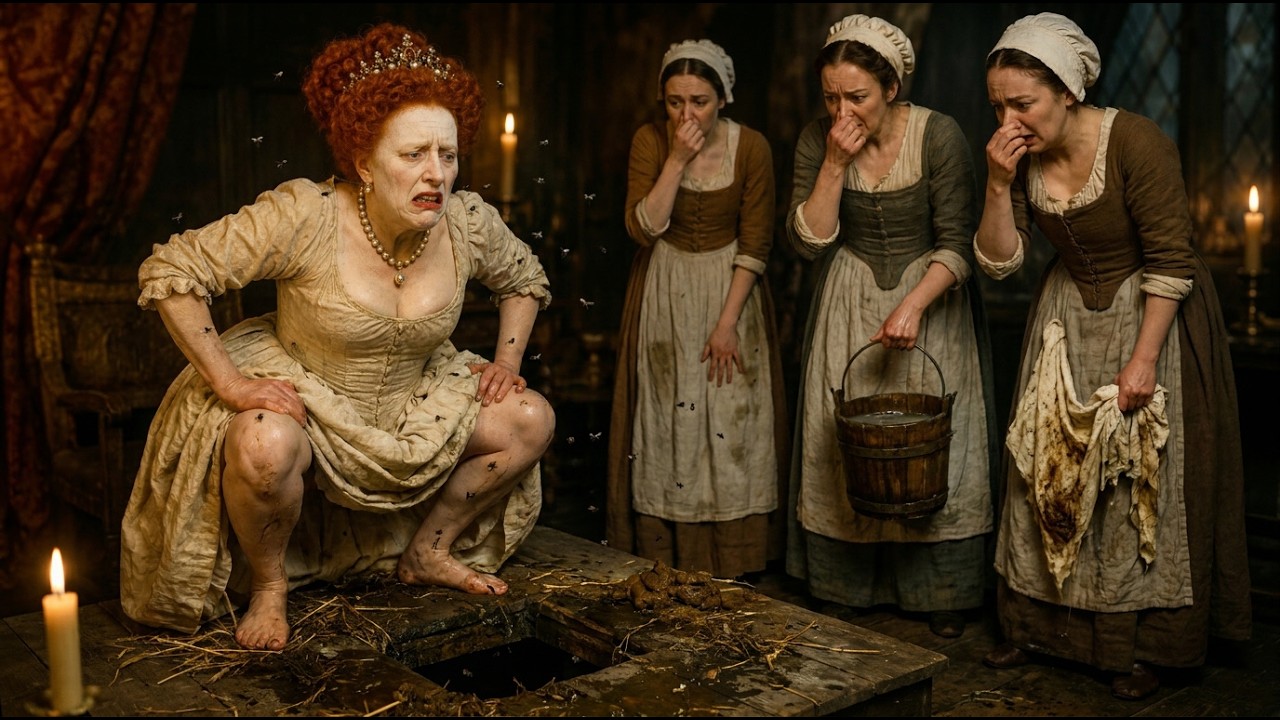
Still, the paint went on. The sharp vinegar in the paste stung the throat while working, a sour scent that clung to the fingers for hours. The pale color was smoothed over the pits and shadows, worked into the gaps where smallpox had dug deepest, until the damaged skin became a flawless, unified mask.
This was done because the queen demanded it, because it worked, and because an unmarried queen’s body was literally a symbol of the kingdom’s stability. There was no husband, no heir, only her. If she appeared mortal, the kingdom would appear fragile. So she was made immortal, one careful stroke at a time.
The face was only the beginning. Over the white went the colors. Red for the lips and the tops of the cheeks, so a little life bloomed amid the deathly pallor. Then the eyes. Then the careful distribution of every shade until the woman disappeared entirely inside the design.
But that was nothing compared to what came next. The queen was not fully dressed until she was armored. Layers of gown were pulled into place and fastened with buttons and laces. The wide wired collar was set around the neck like a halo. The farthingale transformed a frail body into a monument. Jewels, ropes of pearls, earrings, and hundreds of embroidered stones were added until she shone like a window when she moved.
It took a small army to build her. Dressers, wardrobe keepers, jewel experts, each with a single sacred task, all bound by the same silence. By the time she rose to meet the world, almost nothing remained of the woman who had woken trembling in the dark. There was only Gloriana. And everyone in that room knew exactly how she had been made.
At the end of the long day, when the doors were closed and the last courtiers had gone, the entire ritual ran in reverse. The paint had to be removed. Popular accounts often depict this as the darkest moment of all, with the queen scrubbing her mask with a mixture of eggshell, alum, and mercury until her face bled. Such recipes did exist, and some were harsh. But storytellers again exaggerate beyond what the evidence allows, turning an ordinary evening cleanup into a nightly self-mutilation that slowly poisoned her to death.
The truth is simpler and quieter. Night after night, the face that the entire kingdom worshipped was wiped clean in a hidden room, and the woman inside returned to herself. Then she would smile at you to test her reflection in your face.
That is the part the portraits never show. Her teeth were black. This is not a legend. It is a documented fact, recorded by people who had no reason to flatter her and every reason to gossip.
In 1598, a German visitor named Paul Hentzner watched the aging queen walk through her court and noted it plainly. Her face was handsome but wrinkled, her hair was a wig, and her teeth were black, a defect he attributed to the English appetite for sugar. He was not the only one. The French ambassador André Hurault recorded that her teeth were yellow, uneven, and missing in places entirely, so much so that her speech was difficult to understand when she talked.
Two foreign observers, arriving separately, both stopped to note the same thing. The cause was wealth. Sugar in Tudor England was not the cheap white powder of the modern pantry. It was an imported luxury, rare and staggeringly expensive, comparable to jewels and fine spices. Consuming it constantly was a way of announcing with every bite that you were rich enough to rot your teeth.

Imagine the banquets she stood beside. Entire sculptures made of sugar, castles, monsters, and coats of arms shaped from it, set before her to dazzle the eye and then be eaten. Candied fruits. Rich cakes. Sugar sprinkled over dishes no modern cook would think to sweeten. To the Tudor eye, this was not mere indulgence. It was edible power.
Elizabeth loved it. She ate sweets at nearly every meal. In one of history’s crueler jokes, she is said to have cleaned her teeth with a sugar-based paste, polishing them day after day with the very substance dissolving them. The richest woman in the kingdom wore a black smile, and for a time it was the most fashionable smile in the country.
You often hear that courtiers blackened their healthy teeth to imitate her. Be wary of that claim. It is repeated everywhere, but its sources are weak at best. What is certain is stranger and sadder. Her teeth really did rot. And the world called it beauty because the queen made it so.
Now, the smell. Let us address the thing everyone whispers about and correct the greatest slander of all. You have heard that Elizabeth bathed once a year. Perhaps you have heard she bathed once a month, whether she needed it or not. That famous phrase, “whether she needed it or not,” appears in a hundred books and a thousand videos, but it is not based on any reliable source. No one can actually trace where that information came from. It has been passed along by lazy writers until it became accepted as fact.
Even if the monthly bath story is taken seriously, it does not make Elizabeth disgusting. It makes her obsessed with cleanliness by the standards of her century. Her successor, James, is said to have barely bathed at all. Continental monarchs across the Channel are said to have bathed only a few times in their entire lives, because medical wisdom of the time held that immersing the body in hot water opened the pores and allowed disease to enter. Avoiding baths was not filth. It was advanced health advice.
Here is the real secret, the thing the servants knew and the storytellers missed. Hygiene in the Tudor world was not done with water. It was done with cloth. The true hygiene technique of that era was linen. Fine white linen worn against the skin, worn for sleep, worn under every garment, and changed constantly. The theory was that clean linen absorbed sweat and impurities from the body and trapped them in its fibers, so changing a soiled shirt for a fresh one was considered the equivalent of washing.
So you changed her linen again and again. You wiped her face, hands, and body daily with damp cloths scented with rose water and herbs. You perfumed her with musk, civet, orange, and essential oils. Scented gloves were the height of fashion, not just to smell pleasant, but because fragrance itself was believed to protect the body from foul air.
Layer by layer, you wrapped her to protect her from the world. Clean cloth on the skin, oil above the cloth, jewels and silk over everything. By the honest measure of her own time, you kept her immaculate. When history later describes her as a dirty queen, it is judging a civilization of linen by the rules of a civilization of plumbing, and reaching an entirely wrong conclusion.
The wigs came later, a silent tragedy of their own. The strikingly high hairline seen in the portraits was fashion, yes. Foreheads were plucked and shaved to appear tall and noble. But for Elizabeth, it also concealed the scar left by smallpox decades earlier, widened by age since then. Her hair, once a famous Tudor red, had thinned, greyed, and then vanished.
So she wore wigs, dyed that same defiant orange color. Hentzner, watching her in 1598, saw through it immediately, noting that the color was good but the hair was a wig. By the end, she is said to have owned dozens of wigs, a whole wardrobe of borrowed youth, lined up on their stands like a collection of the queen she used to be.

You are the one who fixes them in place. You set each one over the thin grey strands beneath. You pin it securely so no trace of the join shows. You arrange the curled locks away from the forehead and set jewels into them, creating a perfect illusion of a hairline where only scars and thin skin remain. It is delicate work requiring patience, and it must be flawless, because one loose pin in the wrong council chamber could ruin the entire performance.
Every morning you return to her the crown of hair the fever stole in 1562. Every night you remove it again, set it on its stand, and see her without it. That is the essence of your position. You see her without it. You see her entirely. You see her between the mask and the mirror.
About that mirror, there is a dark and distorted story. You will hear that in her final years, Elizabeth banned all mirrors from her presence, unable to bear the sight of her ruined face, and that her ladies, taking advantage of a blind old queen, painted her cheeks and rouged her nose like a drunkard for their own amusement. It is a grotesque and vivid image. It is built almost entirely on rumor, specifically on a story told by the playwright Ben Jonson in 1619, sixteen full years after Elizabeth’s death, relayed in conversation to Scottish acquaintances. A man who was no fan of the late queen, sixteen years later, from a hostile secondary source. That is the only basis for the cruel image of servants mocking her by painting her nose.
The idea that the ladies of the privy chamber, who could be ruined or worse for the slightest offense, would dare to mock their queen as a joke does not survive a moment of honest thought. Remove the rumor, and what remains is quieter, better documented, and far more human. Several separate accounts from the end of her life agree on one thing. She stopped looking at herself. She turned her face away from her reflection, not because her ladies deceived her, but because she could not bear to meet the eyes of the old woman the mirror insisted on showing her, while the whole world outside still bowed to an ageless goddess.
Elizabeth’s vanity was never a personal weakness. It was policy. In the 1590s, while the real woman withered, her government did something unusual. They standardized her face. Official portraits stopped depicting her as she was and began repeating a single approved template that never aged, a pattern historians call the Mask of Youth. The Privy Council worked to suppress unflattering images, tracking down and destroying paintings that showed the truth. The Crown was running the largest image-control operation in England, retouching the image of its queen on every canvas in the country.
The ladies of the bedchamber were the living version of that same operation. Where painters used a template, they used brushes, wigs, and changes of dress. Together, they kept two Elizabeths alive at once. The immortal one the country needed, and the mortal one dying quietly behind the bedchamber door.
She died in March 1603. Even her death is wrapped in a legend that must be uncovered before the end. The tidy story says her cosmetics finally got her, that all those years of white lead poisoned her blood and killed the queen who painted herself to death. It is a story so neat it is hard to resist, and so it is repeated as fact. But the honest answer is that we do not know that, and the evidence does not support it.
The woman who died in those final weeks was old, exhausted, and sunk in deep melancholy. She refused food. She refused her bed. She refused to let her physicians examine her. She stood for hours on her feet, as if sitting down meant surrender. For days she remained standing or propped on cushions on the floor, occasionally putting a finger to her lips, staring into space, refusing the bed as if lying in it was an admission that the performance was over.
What killed her was most likely an ordinary, merciless infection. Blood poisoning or lung disease that carried off countless people in an age without antibiotics. Not a curse of beauty, but a body finally spent after forty years of holding itself together with powders, pins, and the devotion of a handful of women. To attribute her death to vanity is to let the myth write the ending.
When the last breath left her, the ladies were still there, among the few who had known both faces. They had spent a lifetime in that narrow space between the mask and the mirror. They carried out of that room a secret that four hundred years of portraits have tried to erase. Gloriana had scars, black teeth, wigs, and a face she could not bear to look at. And she was, by the honest accounting of her own era, cleaner, more careful, and more disciplined than anyone who has mocked her since.
The painted queen should not be seen as a vain, repellent old woman deceived by her servants. That woman is a Victorian invention and a modern caricature. She was never real. What was real was something far sturdier and braver. A survivor of a disease that should have killed her. A woman who ruled alone in a world that expected her to fail, using every tool her age possessed. Linen, powders, wigs, portraits, and the loyal hands in the bedchamber, all holding together an image that held together a kingdom.
The mask was not weakness. The mask was the job. And the women who built it every morning and dismantled it every night were not the ones who exposed her ugliness. They were the ones who guarded her dignity, kept her secret, and understood more than history itself what it truly meant to be Gloriana. The dark, true history of Elizabeth’s face is not that it was disgusting. It is that maintaining its beauty was one of the loneliest and most brutal performances any monarch ever gave. And she kept performing it, without interruption, until the day she died.