The children of Nazi leaders were born into a world of power and privilege. While their fathers orchestrated chaos across Europe, these children lived surrounded by luxury, shielded from the grim reality of the regime. The Third Reich offered them a unique existence, far removed from the horrors inflicted on millions. But with the collapse of the Reich, their world crumbled. What was once a symbol of greatness transformed into an unbearable burden.
These children were cast into the shadow of a history they never asked for. Some fled, others clung to the legacy, but all were marked by the weight of a surname that could not be forgotten. When the war ended and the myths fell, they were forced to confront the truth about their fathers and the world they built. Some managed to break free from their inheritance, while others were condemned to carry its burden.
A Parallel Universe of Privilege
The childhoods of the Nazi elite’s children unfolded in a parallel universe. It was an artificially created microcosm reflecting the regime’s distorted worldview. This hermetically sealed and privileged bubble created a cognitive dissociation that profoundly affected their psychological development. In the villas and estates of the Nazi hierarchy, a unique generation grew up, the children of the Third Reich’s architects.
These families inhabited strictly controlled environments where Nazi ideology dominated every aspect of daily existence. Children born under these circumstances enjoyed unimaginable privileges while remaining unaware of the atrocities their parents organized. The structure of authority in these families often mirrored the hierarchical principles of the regime. The father held an unshakable position, demanding absolute loyalty in both public and private spheres.
Hilde, the daughter of Albert Speer, described this dynamic. "My father's word was law. Questioning his decisions or judgments was unthinkable," she said. "Not only because he was my father, but because he represented an extension of national authority."
The Goring Household
Hermann Göring’s extravagant estate, Karinhall, represented the pinnacle of this extreme privilege. His daughter Edda, born in 1938, lived in unimaginable luxury within a compound that included thousands of hectares of forest. Bison, deer, and wild horses roamed freely. The rooms overflowed with art looted by her father, who styled himself as the Reich’s art patron.
The property included a private cinema, a gymnasium, a swimming pool, and a hunting hall spanning over 900 square meters. For Edda’s amusement, lion cubs were bred annually and replaced with new ones each year. The girl embodied the ideal of Aryan beauty and was constantly photographed and celebrated in the German press. Hitler himself was her godfather, with the baptism held with great pomp in November 1938.
The Himler Paradox
Gudrun Himler, daughter of Heinrich Himler, was born in 1929 and perfectly embodied the ideal of the Aryan girl. Her father, one of the most terrifying men in Germany as head of the SS, showed her remarkable paternal affection. He lovingly called her "Püppi" and communicated with her by phone daily when home, sending weekly letters when traveling.
This duality, an architect of the Holocaust who simultaneously showed deep fatherly love, created a cognitive dissociation that marked Gudrun’s adult life. For her, family loyalty was inseparable from ideological loyalty. Her intense filial love for Heinrich Himler was tied to her devotion to the ideology he represented. Questioning Nazi principles was implicitly seen as a betrayal of the bond between father and daughter.
Gudrun’s diary, partially preserved after the war, offers disturbing insights into this parallel reality. In one entry from 1941, during a visit to Dachau with her father, the 12-year-old wrote: "Today we visited the camp where Daddy works. It is very large and the men look very neat. Daddy says they work for Germany. On the way to the gate there were many flowers and everything looked very clean."
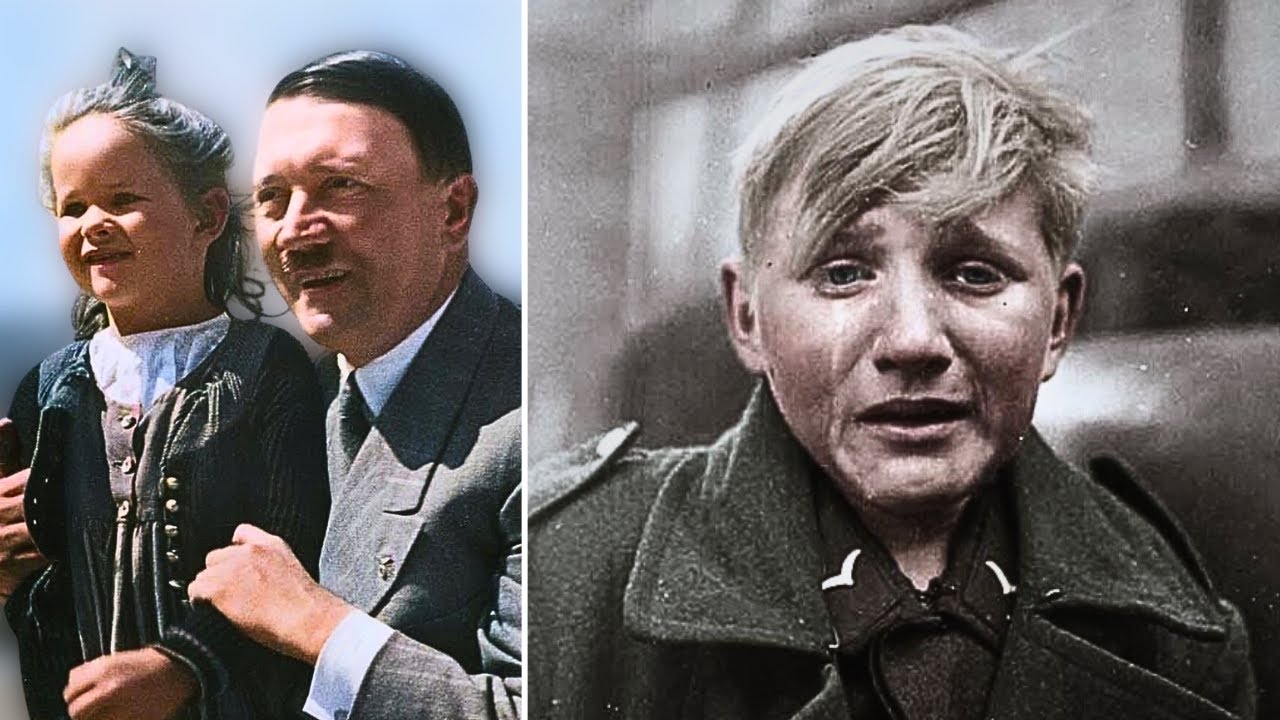
The Goebbels Children
The Goebbels children lived under constant surveillance by the propaganda apparatus, presented as the ideal Aryan family. Helga, Hildegard, Helmut, Holde, Hedwig, and Hidrun, whose names all began with "H" in honor of Hitler, regularly appeared in magazines and newsreels. Their education and social activities were carefully designed to embody Nazi virtues.
Despite his stern public image, Joseph Goebbels was privately a playful father according to household staff. He loved organizing elaborate treasure hunts for his children and reading them fairy tales before bed, often traditional German stories adapted with anti-Semitic messages.
The Höss Family
Rudolf Höss, commandant of Auschwitz, had comfortable living quarters just beyond the extermination camp’s perimeter. He played with his children and tended his garden there. What the children did not know was that their father may have signed death sentences for other children that day or personally overseen the gassing of hundreds of Jews before returning home for dinner.
His daughter Brigitte recalled decades later: "He was the ideal father. He never yelled at us, never punished us. Every evening he sat by my bed and we talked about what happened during the day, my studies, my friends. He sang us songs and told stories." This testimony, from the daughter of the Auschwitz commandant, perfectly illustrates the psychological separation typical of these households, where paternal tenderness coexisted with systematic brutality.
Education as Indoctrination
Key institutions for indoctrinating the children of the Nazi elite included the Napolas, National Political Educational Institutes, and the Ordensburgen, fortified academies designed to train future Reich leaders. These centers represented the most refined educational embodiment of National Socialist ideology.
The admission system reflected the regime’s racial obsessions. Applicants had to undergo thorough physical examinations to verify their racial purity, with everything from skull ratios to the distance between eyes being measured. Horst von Wächter, son of Nazi governor Otto von Wächter, later described the process as a combination of medical examination and initiation ritual.
For teenagers, the Adolf Hitler Schools provided an even more exclusive environment. Helga and Hildegard Goebbels briefly attended these institutions. Their diaries, partially discovered after the war, reveal how these schools systematically shaped their perception of reality. Helga wrote in 1943: "Today we learned why we must keep ourselves pure. Teacher Mayer showed us photographs of less valuable races with defects. I am grateful I was born German."
The Collapse
April 1945 marked the beginning of the end of the Third Reich. As the Red Army advanced from the east and Western Allied forces penetrated from the west, the artificial world protecting the Nazi elite’s children began to violently dissolve.
In Hitler’s underground bunker, the most horrifying tragedy unfolded when Joseph and Magda Goebbels made an unthinkable decision. While Soviet artillery explosions thundered above, their six children spent their final days trapped in the stifling underground complex. Albert Speer offered to evacuate the children to safety, but Magda refused all offers in a disturbing display of ideological fanaticism.

On May 1, 1945, with Soviet troops only blocks away, they carried out their macabre plan. An SS dentist administered morphine injections to put the children to sleep. Once unconscious, Magda Goebbels and Hitler’s personal physician crushed cyanide capsules into their mouths. In a final act of disturbingly twisted maternal care, Magda laid her children’s lifeless bodies in beds, carefully combed their hair, and placed ribbons on the girls.
Different Fates
Other children of the Nazi elite faced different destinies. The Göring family took refuge in their mountain residence at Obersalzberg. After Hermann Göring’s capture, Edda and her mother were interned in a hotel in Luxembourg, a shocking contrast to the luxurious environment they were accustomed to.
After Heinrich Himler’s capture by British troops, Gudrun and her mother Margarete were detained by American soldiers. During interrogations, the 16-year-old Gudrun showed unwavering loyalty to her father, surprising even experienced investigators. One American officer noted: "Himler’s daughter exhibits an exceptional degree of indoctrination, even by Nazi youth standards. She categorically rejects any accusations against her father and insists the atrocities are Allied propaganda."
The Bormann children experienced sudden separation when Martin Bormann, Hitler’s powerful private secretary, disappeared during the fall of Berlin. His children were left abandoned and faced intense scrutiny. The younger Bormann children were initially taken in by Catholic families unaware of their true identity.
Fake Normality
One of the most disturbing aspects of this history is the juxtaposition between the apparent normality of daily family life and the atrocities in which their parents actively participated. Heinrich Himler maintained a carefully crafted family routine. Even during the most intense years of the Holocaust, he reserved time to check his daughter Gudrun’s homework and sent her carefully selected gifts from his inspection trips to concentration camps.
A letter dated September 1943, which Himler sent to Gudrun for her birthday, illustrates this disturbing contradiction: "My dear Püppi, I regret that I cannot be with you on your birthday. I am sending you this brooch I found on my last trip to Warsaw. It is old silver with those Nordic details you like so much. Don’t forget to practice piano as you promised. Daddy is very busy working for Germany, but he always thinks of you." The old silver likely came from the recently liquidated Warsaw Ghetto.
Inherited Guilt
The period immediately after the war was a brutal awakening for the children of Nazi leaders. Germany rising from the rubble of the Third Reich was physically devastated and morally traumatized. Their surnames ceased to be a reason for respect and became synonymous with shame and evil.
For children of prominent figures like Himler, Göring, Frank, or Höss, their identity became an unbearable burden. In schools, these children faced constant bullying, social isolation, and open hostility. Many changed their surnames or adopted their mother’s maiden name.
Brigitte Höss, deeply ashamed of her father’s crimes as Auschwitz commandant, eventually left Germany and settled in the USA under a veil of anonymity. She swore never to speak of her past. For over 60 years she kept her secret, finally giving an interview in 2013 shortly before her death, with the condition that her adopted name and exact location not be published.
Divergent Paths

In the decades after the war, the children of Nazi leaders took markedly different paths. Gudrun Himler represented the most obvious case of unwavering loyalty. She devoted her life to protecting and rehabilitating her father’s memory. She joined Stille Hilfe, a secret organization providing support to arrested, convicted, or escaped SS members. Known in neo-Nazi circles as the "Nazi Princess," she regularly attended secret meetings of former SS officers until her death in 2018.
In stark contrast, Niklas Frank chose open confrontation with his father’s crimes. As a respected journalist, he used his platform to condemn the atrocities of the Nazi regime. In 1987 he published a book in which he called his father a psychopath and expressed that he deserved the death penalty. His own siblings never forgave him for writing the book and cut off all contact.
Martin Bormann Jr., the eldest son of Hitler’s powerful secretary, took a path of spiritual transformation. In 1958 he was ordained as a Catholic priest, representing an unequivocal rejection of his father’s ideology. He served as a missionary in Congo, spreading a message of love and compassion completely opposite to the hateful doctrines of his childhood.
Transforming the Legacy
Some descendants gradually developed a special sensitivity to the ethical and historical dimensions of Holocaust memory. They viewed their unique position not as a burden but as a responsibility. Monika Hertwig, daughter of Amon Göth, the commandant of Plaszow concentration camp immortalized in "Schindler’s List," exemplifies this transformative trajectory.
Born in November 1945, Monika never knew her father, who was executed when she was barely a year old. The turning point in her life came with the release of "Schindler’s List" in 1993. Seeing her father portrayed as a sadistic murderer triggered an existential crisis. This initial shock evolved into a determined search for truth.
In 2008, Monika participated in a documentary recording her meeting with Helen Jonas Rosenzweig, a Jewish survivor forced to serve as a personal maid in Göth’s villa. This extraordinary dialogue between the daughter of a perpetrator and a direct victim of her father created a powerful testimony of reconciliation.
The Weight of Names
In contemporary Germany, where physical remnants of the Third Reich have mostly been removed, the human dimension of this history persists. Individuals carrying emblematic surnames represent biological and cultural links to events that German society has consistently tried to confront and overcome.
Bettina Göring, great-niece of Hermann Göring, grew up with a striking physical resemblance to her infamous great-uncle. In an extreme act of breaking this inevitable biological inheritance, Bettina voluntarily sterilized herself at age 30. "I didn’t want to pass these genes on," she later explained. "I didn’t want some other Hermann Göring to emerge from my blood."
This radical act of genetic rupture illustrates the physical dimension of the Nazi inheritance, the feeling of some descendants that they literally carry the potential for evil in their DNA. Although scientifically unfounded, this idea of contaminated blood influenced the reproductive decisions of several descendants.
The Third Generation
As the generation of biological children ages and gradually passes away, the voice of the third generation, the grandchildren of the Holocaust’s architects, becomes more prominent. Born mostly between the 1960s and 1980s, this cohort has a different but no less complex relationship to their family’s Nazi heritage.
Unlike their parents, the grandchildren grew up in a Germany that had already institutionalized confrontation with the Nazi past. For them, the main challenge was not discovering and processing traumatic revelations about family crimes. This information was generally known from childhood. Instead, they faced the challenge of creating identity strategies to integrate this knowledge into coherent autobiographies.
As Rainer Höss expressed it: "My parents had to discover and accept something unthinkable. We were born with it as part of our heritage. Our task is not so much to discover, but to integrate this history into our lives."
The shadow of the surname persists, but its meaning evolves. For the original generation of children, it represented a catastrophic break between privileged childhood and adult shame. For their children and grandchildren, it became a more distant but enduring connection to a shared historical past. In the memorial landscape of the 21st century, these figures occupy a unique and ambiguous place. They are neither perpetrators nor victims, but hereditary witnesses whose personal lives are inseparably linked to the historical memory of one of humanity’s greatest moral catastrophes.