In February 1962, Julia Child walked into a Boston television studio carrying equipment that did not belong on a quiet book review program—a hot plate, a large copper bowl, a balloon whisk, and eggs. She had come to discuss a new cookbook. Instead, she began to cook. The show, titled “I’ve Been Reading,” was meant to be simple: an author sits down, discusses a book, answers questions, and leaves.
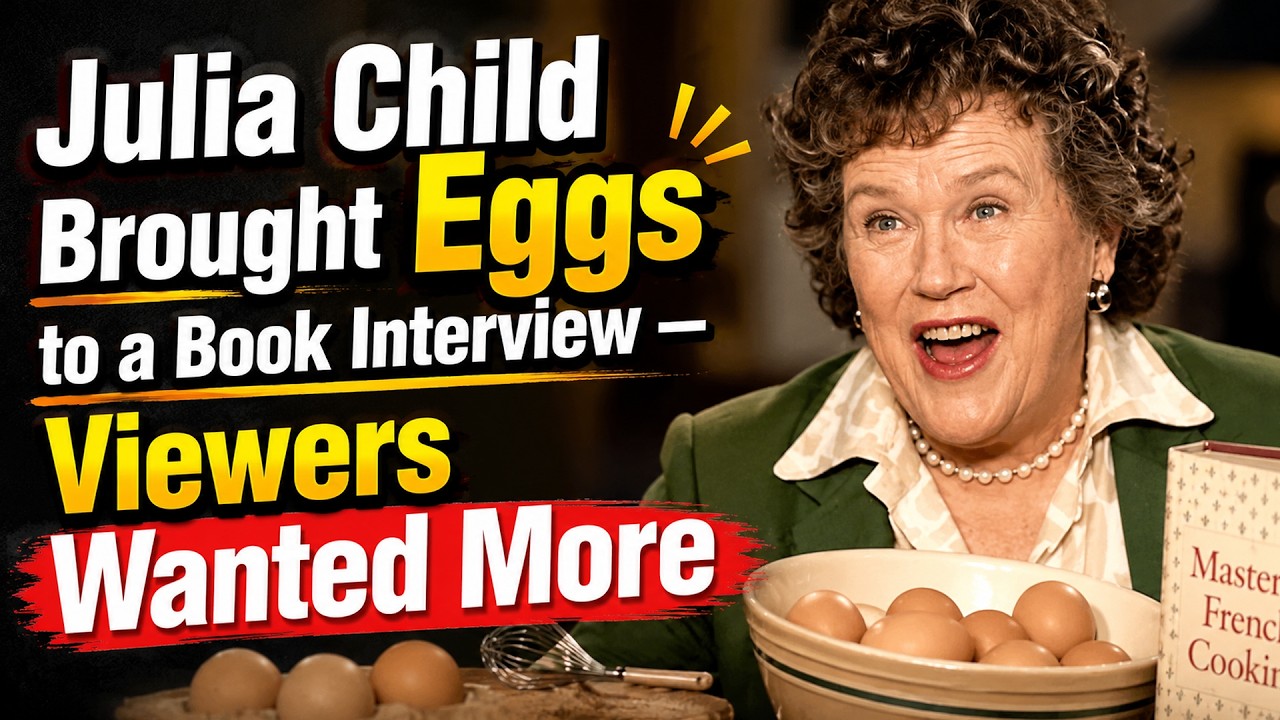
Julia did not fit that arrangement. Talking about an omelet seemed less useful than showing what an omelet did in a pan. She beat egg whites where the camera could see them and turned an interview into a lesson. Viewers wrote to WGBH asking for more.
The moment looked spontaneous. In one sense, it was: no television executive had manufactured Julia Child as a polished personality. She was nearly 50, unusually tall, and equipped with a voice no talent agency would have invented. Yet the knowledge behind that performance was anything but accidental.
Years of apprenticeship, testing, rejection, rewriting, teaching, and collaboration stood behind those minutes. This is the tension at the center of her life—the public remembered a woman who made difficult cooking seem possible; the private record shows how much work was required before difficulty could look inviting. She was born Julia Carolyn McWilliams on August 15, 1912, in Pasadena, California, into a prosperous family. Her father, John McWilliams, was a banker and landowner; her mother, Julia Carolyn Weston McWilliams, came from a successful New England paper manufacturing family.
Julia grew up with advantages, but no clear answer to what she was for. Standing over six feet tall, she was conspicuous in rooms where other girls could disappear. She played basketball and tennis and enjoyed activity, jokes, and company. Food was part of family life, but cooking was not yet her identity.
She did not grow up at the stove with the conviction she would become a chef. The central vocation arrived late. At Smith College, where she entered in 1930, she was energetic rather than academically legendary. She graduated in 1934 with ambition but without a practical route.
After college, she found work in the advertising department of W. and J. Sloane in New York, respectable employment that did not become a calling. She returned to California after her mother’s death, carried family responsibilities, and moved through the unsettled years before World War II without certainty.
A private diary captured her dissatisfaction: she regarded herself as an ordinary person with talents she was not using. The war changed the scale of the search. On November 18, 1942, Julia McWilliams took the federal oath of office in Washington, entering the organization that became the Office of Strategic Services, the wartime intelligence agency that preceded the CIA. The cinematic spy is mostly legend.
She did not move through occupied Europe under false identities. Her work was administrative—handling information, organization, records, and practical problems. One assignment connected her to the emergency rescue equipment section, which worked on military survival problems, including research intended to discourage sharks from attacking men or equipment in the water. She did not invent the chemical herself; the work belonged to a team.
In 1944, the OSS sent her overseas, first to Ceylon, now Sri Lanka, and later to China, where she worked in the registry handling sensitive incoming and outgoing intelligence communications. The war took her far beyond Pasadena, placed her inside an international institution, and proved she could perform demanding work in unfamiliar environments. It also brought Paul Child into her life. Paul was older, shorter, more cosmopolitan, and already formed by experiences Julia had not yet had.
He had traveled, painted, photographed, taught, read widely, learned languages, and developed a deep affection for France. Within the OSS, he worked in visual presentation. Their early relationship was not a love story written backward from marriage. Paul’s letters preserve amusement, criticism, and uncertainty; Julia was exuberant to the point of chaos.
They became companions gradually, sharing meals, travel, talk, and argument. Julia and Paul married in September 1946. Her father disapproved—Paul was older, an artist by temperament, a civil servant, an atheist, and not the conventional husband John McWilliams had imagined. Julia chose him anyway.
Marrying Paul gave her a life in which discovery remained possible. In 1948, his government work took them to France, where he was assigned to the United States Information Service. On the way from the port toward Paris, they stopped in Rouen and ate at La Couronne. Julia later remembered sole meunière, wine, salad, cheese, and coffee.
Biographers returned to that meal because Julia herself returned to it—the point at which appetite began turning into study. What struck her was the coherence: the butter, fish, wine, service, and confidence seemed to belong to a system. Pleasure had structure. She wanted to understand it.
Paris gave her time, markets, language, and a problem. Paul had a profession; Julia still did not. She took French lessons, explored food shops, and discovered that enthusiasm was not the same as competence. She entered serious culinary training around the turn of 1949 and 1950, studying at Le Cordon Bleu and receiving her cuisine diploma in 1951.
She pushed toward professional discipline—sauces, stocks, knife work, roasting, fish, pastry, eggs, meat, heat, timing, repetition. One of her valued teachers, Chef Max Bugnard, represented the kind of authority she respected: craft before celebrity. Julia practiced outside class, repeated preparations, failed, began again, and asked why. Why had a sauce broken?
Why was a pan too cool? Those questions became the engine of a career that did not yet exist. Through the Paris food world, Julia met Simone Beck and Louisette Bertholle. Both French women brought serious culinary knowledge and ambitions of their own.
What Julia brought was a particular kind of ignorance transformed into a professional asset: she knew what an American beginner did not know because she had been that beginner. The three women began teaching small classes under the name L’École des Trois Gourmandes, the school of the three hearty eaters. Teaching changed Julia’s relationship to knowledge. A skilled cook can rely on instinct; a teacher cannot.
When a student’s sauce breaks, saying “you will know when it is right” is not enough. The cookbook project grew out of this world. Beck and Bertholle wanted a book of French cooking for Americans; Julia became the American collaborator who could test not only the recipes but the assumptions underneath them. French recipes assumed equipment, shopping habits, cuts of meat, ovens, and accumulated knowledge many American readers did not share.
Julia tested relentlessly, compared measurements, investigated substitutions, and rewrote instructions until the moment of possible confusion had been anticipated. The manuscript grew because the authors took the beginner seriously. Confusion was not treated as evidence that the reader was stupid but as evidence that an instruction might be incomplete. Paul became part of the project’s hidden infrastructure.
He tasted, photographed, drew, read, criticized, moved equipment, and brought a designer’s eye to problems Julia approached through language and cooking. The Smithsonian later preserved Julia’s affectionate catalog of his unofficial roles: porter, dishwasher, photographer, chopper, editor, illustrator, manager, taster, idea man, poet, husband. She also gave him a simpler credit: “There would be no French chef without him. ” That line did not mean Paul secretly authored her career—Julia’s force, discipline, ambition, and teaching gift were her own.
But fame can create the illusion that the famous person assembled a life alone. Paul’s contribution was more intimate than a formal job title. Another relationship changed the project. The writer and historian Bernard DeVoto had complained in print about the poor quality of American kitchen knives.
Julia, living in France, wrote to him. Bernard’s wife, Avis DeVoto, answered. A correspondence began that became one of the hidden structural beams of Julia Child’s career. Avis became a critic, tester, advocate, publishing guide, and practical American intelligence service for the cookbook.
Julia could ask what ingredients people could actually buy, whether a term sounded natural, or whether a technique seemed impossible in an American kitchen. The letters moved back and forth across the Atlantic before the women knew one another in person. Revision became conversation. A page became authoritative because someone cooked from it, failed, asked why, revised the wording, and tried again.
The manuscript grew very long. That became a publishing problem. Houghton Mifflin had once shown interest, but the book expanded into something the publisher considered too large, too detailed, and too demanding for the American market. The rejection struck at the project’s philosophical center: Julia believed the detail was not excess but the service being offered.
Avis DeVoto helped the manuscript reach Alfred A. Knopf, where it came to editor Judith Jones. Jones had lived in France and missed the food she had learned to love there. She cooked from the manuscript.
Trying the instructions for Boeuf Bourguignon, she discovered that the density other readers had found intimidating gave her the confidence to produce something recognizably French in an American kitchen. Jones became the editor and internal champion the book needed. In the fall of 1961, Mastering the Art of French Cooking appeared. It entered an America in which convenience foods and frozen dinners carried the glamour of modern life.
It would be false to describe the country as a culinary desert; American regional cooking was rich, and immigrant traditions were everywhere. What Mastering offered was narrower and more specific: an unusually complete route into classical French technique for readers who had not been trained inside that tradition. The title made a demanding promise: French cooking could be mastered, not instantly, not without work, but learned. Reviews were strong and sales grew.
Yet print had a physical limit. A paragraph could describe an omelet in exquisite detail and still leave a reader wondering how quickly the pan should move. Television could show time. After the broadcast on “I’ve Been Reading,” viewers wrote to WGBH asking, in Julia’s memory, why they could not have a cooking show.
The station listened. WGBH was an educational broadcaster, not a commercial network searching for a conventional star, and it had been forced into improvisation after a major fire destroyed its facilities in 1961. Producer and director Russ Morash became central to the experiment. The crew had to discover a visual grammar for cooking television: where should the camera go, how could viewers see inside a pan, how could a dish that took hours be taught in half an hour without pretending time did not exist?
The solution required choreography. Intermediate stages of dishes waited off camera so Julia could show what a roast or sauce looked like after the necessary time had passed. Associate producer Ruth Lockwood and other cooks performed enormous amounts of preparation—shopping, chopping, washing, pre-cooking, testing, and resetting whenever an ingredient behaved differently from the plan. A half-hour program could consume most of a day.
The casualness was built on labor. The pilots led to “The French Chef. ” Regular broadcasts began in 1963, when Julia was 50. Her age mattered.
By the time the public met her, she had already been a college graduate without a profession, a wartime administrator, an overseas civil servant, a wife, a late culinary student, a teacher, a collaborator, an obsessive recipe tester, and a rejected author. Her screen presence broke expectations: she was tall, broad in gesture, middle-aged, loud, physically direct with food, and uninterested in pretending that a kitchen was a place where feminine perfection floated above labor. Her voice was high and unmistakable—in another career it might have been an obstacle; on television it became a signature. But personality alone would not have carried the program.
Julia taught technique seriously. If a sauce began to misbehave, she showed viewers how to respond. She did not tell viewers that cooking was always easy; she showed that difficulty could be broken into actions. One famous story claims she dropped a chicken on the floor, picked it up, and carried on.
Researchers who later checked the programs found no evidence for the celebrated incident. The false story survived because it felt like Julia Child. That is precisely why it should not be needed: her real work contains enough failure, improvisation, and humor without a fictional chicken. Confidence was not the absence of mistakes; it was the refusal to stop observing when mistakes appeared.
Julia understood performance. She projected, exaggerated gestures when a camera required it, and learned how to hold attention. But the food still had to work—the camera could not make a bad sauce good. In time, programs connected dishes to places such as Marseille, where a bouillabaisse lesson could begin with fish and technique but lead back to the port, the varieties of fish, and the practical origins of a dish that had become prestigious far from the people who first made it.
Julia’s instinct was increasingly to connect method with place. The camera stopped looking only into a pan; it looked outward toward the world that gave the pan meaning. By the middle of the 1970s, a Julia Child appearance could fill a theater. Long before audiences entered, people were hauling equipment, arranging burners, checking ovens, and preparing intermediate stages.
On a benefit trip to San Francisco, Julia temporarily lost her voice after an encounter with a hot pepper—her voice, one of the most recognizable sounds in American television, failed. She relied on notes and the people around her until she recovered. The episode was minor but revealing: the persona could be interrupted, but the system around the teaching was strong enough to keep moving. Recognition grew.
“The French Chef” received a Peabody Award in 1964; Julia won an Emmy in 1966 for achievement in educational television. The program also participated in early efforts to make television more accessible to deaf and hard-of-hearing viewers through captioning—instruction mattered only if people could reach it. Julia and Paul settled in Cambridge in 1961. Their kitchen became one of the clearest physical records of the marriage.
They arranged a workspace around Julia’s height and habits rather than standard design: counters were higher than usual, pots hung on pegboard, and Paul traced the outlines of tools so each object had a visible place. The kitchen was not a showroom; it was a working room where Julia cooked, tested, entertained, wrote, and eventually filmed. Julia and Paul never had children. The record simply shows a marriage surrounded by relatives, collaborators, students, friends, and guests, with shared meals serving as a powerful form of connection.
Fame changed the original cookbook collaboration. Mastering had been the work of three women; television concentrated public attention on one. Louisette Bertholle moved away from the central collaboration. Simone Beck remained essential to the second volume, but the name Julia Child increasingly carried a public meaning larger than the partnership that produced the first book.
Their arguments could be intense because neither woman was a passive assistant. Julia could dominate a room, repeat a point, and pursue technical clarity long after others might have accepted good enough. The edges were part of the reliability. During the late 1960s, another part of Julia’s life became fragile.
In February 1968, a medical examination led to a biopsy and then a radical mastectomy. Julia recorded the event with striking economy in her datebook. The brevity did not make the experience small. Paul was deeply frightened by the possibility of losing her.
Julia’s public reputation for resilience can tempt readers to imagine she simply turned illness into another practical problem. The surviving accounts are more human: she was frightened. After leaving the hospital, she wept. A broken sauce can be remade; a frightening diagnosis does not obey technique.
Continuing after fear is different from never feeling it. Mastering the Art of French Cooking, Volume Two appeared in 1970, representing continuity, deep technique, and the partnership with Simone Beck. It also arrived when Julia was beginning to move beyond the identity of the American woman who explained France. By the early 1970s, success could look inevitable.
It was not. The original program had been built in improvised spaces. The book behind it had spent years in danger of becoming a manuscript too detailed to publish. Julia could be stubborn about taste and method; at times she spoke as though French technique offered a superior answer to problems belonging to other culinary traditions.
Her early books assumed time, equipment, and access to ingredients that many Americans did not have. She entered a field in which millions of women had long performed complex domestic labor without professional recognition. Julia did not invent patience or home cooking; she became famous partly by bringing professional language and public attention to work women had been doing for generations. What she offered was another vocabulary for that labor—technique, standards, tools, reasons, and permission to take the work seriously.
Over time, Julia’s attitude toward culinary authority became more flexible. She remained opinionated but increasingly separated principle from dogma: know what a method is trying to accomplish, then decide whether another method might accomplish it better. She welcomed tools that worked. Food processors and newer devices entered the kitchen if they saved labor without destroying results.
Her loyalty was not to nostalgia but to usefulness. Meanwhile, Paul’s health began to change their private life. In the 1970s, he underwent coronary bypass surgery, and complications included small strokes that affected abilities Julia had long associated with his quick, cultivated mind. Paul, once fluent in French and precise with words and images, struggled increasingly with language.
The loss was intimate because communication had always been central to their marriage. Julia continued her public career while adapting private life around his needs. The marriage entered a long period in which care replaced some of the old collaboration. Her professional work widened during the 1970s and 80s.
Programs such as “Julia Child & Company” and “Julia Child & More Company” moved beyond the strict identity of “The French Chef,” focusing on menus, entertaining, and American ingredients. Not every reinvention worked equally well. She also began using fame to support institutions. In 1981, she helped found the American Institute of Wine and Food with Robert Mondavi and Richard Graff.
After James Beard died in 1985, Julia became part of the effort to preserve his New York home and create the James Beard Foundation. Her relationship with Harvard’s Schlesinger Library reflected the same instinct: she committed papers and personal culinary materials to the archive, preserving drafts, correspondence, and production papers that document the labor behind the public ease. In 1989, she published The Way to Cook, a title suggesting a mature shift: not the only way, but a way, organized around technique and families of methods. By the late 1980s, Paul’s health had declined enough that he entered nursing care.
Julia visited when she was home and remained connected while traveling. Looking back, Julia described their shared life in simple language: they had had a wonderful life. The sentence did not deny illness or the long narrowing of Paul’s abilities; it placed those years inside a larger marriage. Paul died on May 12, 1994.
They had been married for nearly 48 years. Julia grieved into a life that still contained work. The 1990s opened another phase of television: “Cooking with Master Chefs” and “In Julia’s Kitchen with Master Chefs” placed accomplished cooks from different traditions at the center of the lesson. The structure represented an important evolution.
The early Julia translated masters for beginners; the older Julia could become a beginner again in public. She asked questions, watched another cook’s hands, and interrupted when a home viewer might need an explanation. Her friendship with Jacques Pépin made this visible. Pépin had classical professional training from restaurant and institutional kitchens; Julia had built her authority through home cooking, teaching, writing, and television.
Their differences became material for instruction. They had known one another since around 1960, when Pépin encountered the manuscript that would become Mastering. Decades later, their television collaboration allowed two experts to reach different conclusions in front of the audience. Pépin later remembered that their work together could proceed with surprisingly little conventional scripting.
By then, Julia had earned the spontaneity audiences had imagined she possessed from the beginning. The Cambridge kitchen became increasingly important again during this late television period; several programs were filmed there. The home did not become a glossy set pretending to be domestic; a real domestic room was adapted to production. Lighting equipment entered, cabinets were moved, and preparation spilled beyond the kitchen.
Yet the room remained recognizably Julia and Paul’s—high counters, pegboard outlines, old tools sharing space with newer appliances. In 1995, Julia established the Julia Child Foundation for Gastronomy and the Culinary Arts, designed to support work in food and culinary education beyond the span of her own life. France made her a member of the Legion of Honor; in 2003, President George W. Bush awarded her the Presidential Medal of Freedom.
One of the most revealing decisions of her old age involved not a medal but a room. By 2001, Julia was preparing to leave Cambridge and return permanently to California. She agreed to give the kitchen to the Smithsonian’s National Museum of American History. Museum staff documented the working environment—cabinets, counters, appliances, tools, and patterns of arrangement—so the room could survive as material evidence.
The Smithsonian collected roughly 1,200 objects from the kitchen environment. The decision transformed private space into public record. The kitchen contained the infrastructure behind the personality: high counters suited to Julia’s body, pegboards organized by use, and traces of television production layered into domestic life. It also contained Paul, who had helped plan the room and traced the outlines on the pegboard.
It was not the preserved set of a solo star; it was a physical record of a marriage, a household, and decades of work. Julia moved west to a retirement community in the Santa Barbara area, close to the region where her life had begun. She remained visible, gave interviews, and commented on food. Near the end of her life, she worked with Alex Prud’homme on the memoir that would become My Life in France, returning her to the years before fame.
Julia Child died in Montecito, California, on August 13, 2004, two days before her 92nd birthday. Contemporary accounts identified kidney failure as the cause. She died in her sleep. The response carried affection as much as respect—millions of people had never met Julia, yet television had placed her inside an unusually intimate part of daily life.
After her death, My Life in France was completed and published, returning readers once more to the years when the public Julia did not yet exist. The foundation became fully active. Cooking television expanded into an industry; digital video eventually made almost every technique searchable on demand. In one sense, that world makes Julia’s achievement look ordinary: showing the process is now expected.
That is why it is easy to forget how unusual the expectation once was. Julia did not invent television cooking or French cuisine in America. Her importance becomes clearer when those exaggerations are removed: she helped make expertise transferable. That contribution depended on more than charisma.
The OSS years showed she could function inside systems before cooking defined her. France gave her a subject worthy of concentrated study. Paul gave companionship, criticism, and visual intelligence. Simone Beck and Louisette Bertholle brought French knowledge and collaboration.
Avis DeVoto turned distance into conversation. Judith Jones understood that detail could be the reason to publish rather than the reason to reject. Russ Morash, Ruth Lockwood, and WGBH translated written method into visible action. Julia mattered because she could hold those translations together without disappearing inside them.
To emphasize collaboration too strongly would create another distortion: she was not the passive beneficiary of gifted people. She pushed, tested, wrote, taught, argued, and exhausted herself and others. She entered rooms where she did not know enough and remained until she knew more. Her public warmth did not erase ambition; her humor did not erase standards; her mistakes did not erase preparation.
The preparation made the freedom possible. A musician practices before sounding effortless; an actor rehearses before seeming spontaneous. Julia tested recipes and television sequences until she could respond when the plan failed—and then something unexpected happened, and she dealt with it in real time. That final part could never be fully engineered.
It is why the early programs still feel alive. She did not promise perfect control; she promised attention. A cook who believes perfection is the entry fee may never begin. A cook who believes nothing matters may never improve.
Julia occupied the demanding space between those errors: try, watch, taste, adjust, learn. That sequence describes more than her cooking. She tried government service before she knew her vocation. She watched and learned in France.
She adjusted a cookbook until American readers could use it. She learned television until motion became instruction. She changed again when American food culture outgrew the narrow authority of classical French rules, and in old age she allowed herself to be the student beside younger experts. Years after the fame, after Paul’s death, after the medals and birthdays, the old Cambridge kitchen was dismantled with museum care.
Counters, cabinets, appliances, knives, pots, books, and work surfaces were removed from the house and reconstructed in Washington. The room became still. What remained was arrangement: a tall counter built for work, pegboard holding the shapes of pans and tools, copper, steel, wood, glass, and plastic from different decades sharing one practical space. Behind museum glass, the Cambridge kitchen remains crowded and purposeful.
On the pegboard, each tool still rests inside the outline of the place where Julia’s hands expected to find it.