On December 2, 1936, a 70-year-old man lay dying of pneumonia in a small Manhattan apartment, with just $311 in the bank. His sister Ida, a nurse, and his old friend Frank Hennessey sat by his bedside. In the next room, lawyers worked against the clock, knowing the entire estate was scheduled for auction the following morning. The dying man was John Ringling.
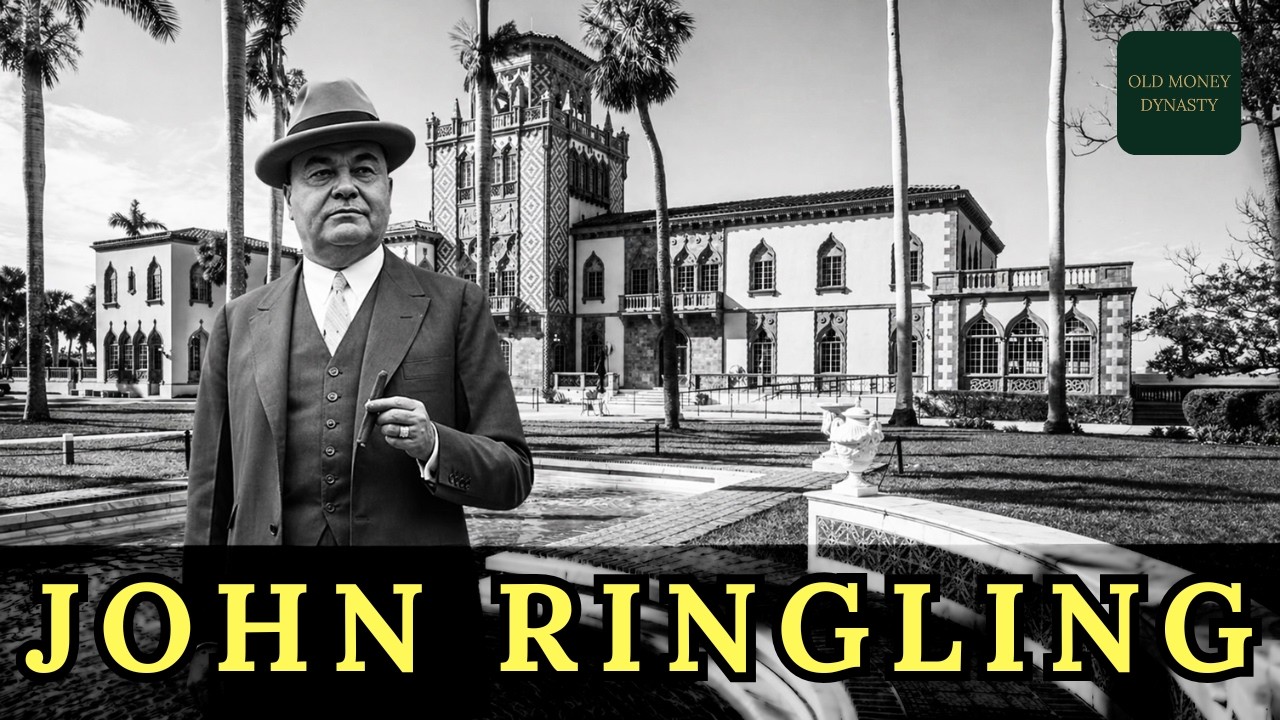
Just 11 years earlier, Time magazine had put his face on its cover and called him the 13th richest man in America. He owned every major circus in the country, railroads in Oklahoma, oil leases, a private rail car, a fleet of Rolls-Royces, and a 36,000-square-foot Venetian palace on Sarasota Bay called Ca’d’Zan. He died just hours before the auctioneers were due to arrive. But in those final hours, Ringling did something almost no fallen tycoon of his era managed to pull off.
He saved the mansion, the museum beside it, and the Rubens paintings, by handing everything to the people of Florida. Not to his nephews, not to his second wife, not to his creditors. The state of Florida would have to wait 10 years to actually take possession. The beginning of the story stretches back about 60 years.
In 1866, a German harness maker named August Ringling lived in McGregor, Iowa, with his French wife and their growing family of sons. The fifth son, John, grew up watching his older brothers improvise, singing and tumbling. By 1884, in Baraboo, Wisconsin, the brothers added a horse, a bear, and a tent, charging 25 cents at the door for what they called a circus. The crucial decision came when the brothers realized horse-drawn wagons could not keep up with their ambition.
They switched to private rail cars, which allowed a circus to play four cities a week. By 1890, the Ringling brothers were running close to 100 rail cars per season. In 1907, after the death of Bailey, they bought out Barnum and Bailey for $400,000. The two biggest circuses in America now belonged to five brothers from Wisconsin.
John, then 39, had become the brother who handled route planning, contracts, and advance work. He was already quietly wealthy. In 1895, he married a woman named Mabel Burton. She was likely born in Ohio, had worked in a factory, and made her way to Chicago, where the most common story has her waitressing in a tony restaurant when John walked in.
She was 30. He was 39. Mabel gave exactly one interview in her entire life. She stayed off the record, refusing to be photographed by the press.
But she had real taste, developed over years of studying architecture and design. She and John traveled to Europe often, and she fell in love with Venice. By 1925, a Sarasota newspaper described her as one of the best-read women in the country on architecture and landscape design. In 1909, John and Mabel spent their first winter in Sarasota, then a small Florida town with a few hundred residents.
Two years later, the Ringlings bought 20 acres of waterfront and moved into an existing wood-frame Victorian house. They stayed there for over a decade, looking at the bay view, thinking about what they would eventually build. By 1923, John was ready to build. They hired architect Dwight James Baum, who spent the next two years on a single project.
Mabel’s reference materials were stacks of photographs, postcards, and torn-out magazine pages. Most of them pointed to Venice. She had studied the Doge’s Palace and the Ca’ d’Oro on the Grand Canal, whose Gothic tracery and waterside facade became the visual spine of what she wanted. Construction began in 1924.
The terracotta came from Pennsylvania, the marble from six countries, the roof tiles from Spain. The window glass was designed to catch the marine light at sunset and throw it back in greens and ambers. Mabel approved every shade. She hired Hungarian-born artist Willy Pogany to paint the ballroom ceiling: 26 panels of dancers from cultures around the world set into a gilded coffered ceiling.
The building had 56 rooms. The first floor was for entertaining, including a great hall built around an Aeolian organ with 2,289 pipes. The second floor was private bedrooms. The third floor was a playroom with another Pogany ceiling showing scenes of Venetian Carnival.
Above all rose the Belvedere tower, five stories modeled after the bell tower of the Cathedral of Seville. Mabel named the house Ca’d’Zan, “House of John” in Venetian dialect. By the autumn of 1926, the building was ready, costing $1. 5 million to build.
The Ringlings moved in and threw parties, hosting people like Will Rogers. But while the builders had been finishing the terraces, John had been doing something else. He had been buying, not just paintings but hotels, land, and an entire second hotel project on the southern tip of Longboat Key. In February 1926, a bridge John had paid for himself opened to the public.
Within days, the Sarasota Herald reported he had sold a million dollars’ worth of property in a single afternoon. Then he made his big bet. On Longboat Key, John signed a deal with the Ritz-Carlton company for a 350-room hotel with three golf courses. Construction started in March, but by late summer, the Florida land boom was deflating.
Then, on September 18, the Great Miami hurricane killed close to 400 people, and northern buyers decided not to winter in Florida that year. John kept building. He had purchased four enormous canvases by Peter Paul Rubens from the Duke of Westminster’s collection, despite warnings that Rubens had fallen out of fashion. He insisted the paintings had to be his, planning to build a museum next door to Ca’d’Zan.
In November 1926, with the Ritz-Carlton bleeding cash, John finally stopped construction on the hotel. He told reporters he would resume when conditions improved. He never did. That same autumn, his older brother Charles died.
Charles had been the man who kept John from making decisions that were too big, too fast, or too expensive. With Charles gone, John was the last Ringling brother, preparing to run everything alone in a Florida market that had just collapsed. Mabel Ringling died on June 8, 1929, in a New York hospital. She had Addison’s disease and diabetes.
The medical advice of the 1920s held that pregnancy could kill a woman with Addison’s, which is why the couple never had children. John was with her when she died. But less than a year before Mabel’s death, John had begun negotiating to buy the American Circus Corporation, the second largest circus operation in America. He did not have the cash.
He went to a financier named William Greve, who agreed to lend him the full $1. 7 million. As collateral, John signed over half of all his circus stock. The deal closed in early 1929.
John now owned every major traveling circus in the United States. It was the worst possible moment to take on debt. Mabel died in June. The stock market crashed in October.
Ticket sales cratered, and John was making interest payments on a loan he could no longer afford. He spent the months after the funeral traveling, leaving Ca’d’Zan mostly empty. In the summer of 1930, John met Emily Haag Buck, a Park Avenue widow in her early 40s. By November, they had decided to marry.
Four days before the wedding, John borrowed $50,000 from Emily. He never repaid it. He also presented her with a document waiving her dower rights to his estate. He said she signed it, then later destroyed it.
She said she destroyed it without ever signing. Emily moved into Ca’d’Zan and ran into the problem any second wife of a recent widower runs into. The house was Mabel’s. Mabel’s monogram was on the pillowcases.
Emily was assigned the bedroom down the hall from John’s. In her later testimony, Emily described the experience as suffocating. John gave a different picture, claiming Emily broke the marriage with constant cocktail parties. In July 1933, John filed for divorce.
Emily was served the papers while shopping at a Sarasota store. According to her testimony, she said, “My husband. There must be some mistake. You must mean Mrs.
Charles Ringling. ” John withdrew the suit within weeks, asking her to stay. He pressed her to extend the original loan and waive her rights to the museum and art collection. She refused.
In February 1934, Emily wrote John a Valentine letter saying, “I love you until my dying day. ” A month later, John refiled the divorce, citing mental cruelty and ungovernable temper. The trial became the most expensive divorce in Florida history up to that point. Each day brought new accusations.
John testified she had struck him hard enough that it felt like being hit by a heavyweight boxer. Emily testified he was paranoid and obsessed with his deceased first wife. The judge granted the divorce on July 6, 1936. John was the legal winner, but both his remaining money and most of Emily’s went to lawyers.
Five months later, John was dead. In his final will, he left Emily a single dollar. It took Florida 10 years after John’s death to actually take possession of the estate. The federal government wanted its tax money first.
The widow Emily filed claims, as did nephews, former business partners, banks, and the trustee for a circus stock voting agreement. Through it all, Ca’d’Zan sat empty, with Florida humidity working on the wood and salt air eating at the terracotta. When the doors finally opened to the public in the spring of 1946, the mansion was already a decade into its decline. It had another 50 years of decline ahead.
By the 1970s, parts of the second floor were closed because the floors could no longer be trusted. By the 1980s, vines had grown over some windows and the original swimming pool had filled with stagnant water. There is another story, the family fight over where to bury him. John and Mabel were placed in temporary receiving vaults in New Jersey in the 1930s, meant to be moved to a permanent crypt in Sarasota.
The crypt was never built. The bodies sat in unmarked storage for 55 years while branches of the family fought over the proper resting place. In 1991, John, Mabel, and his sister Ida were finally buried in the secret garden behind Ca’d’Zan. In 1996, a Hollywood film crew arrived.
Alfonso Cuarón was directing a modern adaptation of Great Expectations and needed a mansion that could play Miss Havisham’s decaying estate. They walked through Ca’d’Zan and decided they did not need to dress the set. The house was already the set. The film, released in 1998, used Ca’d’Zan for both exterior and interior shots.
Fundraising for restoration began that same year. In 1999, the building was closed. Florida State University took over management, launching a six-year, $15 million project. Ca’d’Zan reopened on April 27, 2002, with 95% of the original furniture restored using historical photographs.
In September 2024, Hurricane Helene hit the Florida coast. Two weeks later, Hurricane Milton followed. Eight feet of seawater flooded the basement, and two unmoored boats crashed into the marble terrace, breaking sections of the chevron pattern Mabel had laid out almost a century earlier. By mid-2025, the first floor had reopened for self-guided visits, but the upper floors remained closed.
The circus John built went bankrupt and was sold off. The hotel on Longboat Key was demolished in 1964. The boom-era mansion he renamed after himself was torn down in 1998. Most of the Gilded Age estates of the Florida coast are gone.
But Ca’d’Zan remains. A man with $311 to his name wrote a will that kept the doors open, and the palace he built for the woman he loved has outlasted the Depression, decades of neglect, and two hurricanes.