Caroline Matilda was barely out of her early teenage years when she was sent away to become a queen. Almost immediately, she found herself trapped in a marriage that turned into a nightmare. Then she fell in love with another man, the king’s own physician. Their secret relationship unleashed whispered accusations, political conspiracies, and one of the biggest scandals ever to shake the Danish royal court.
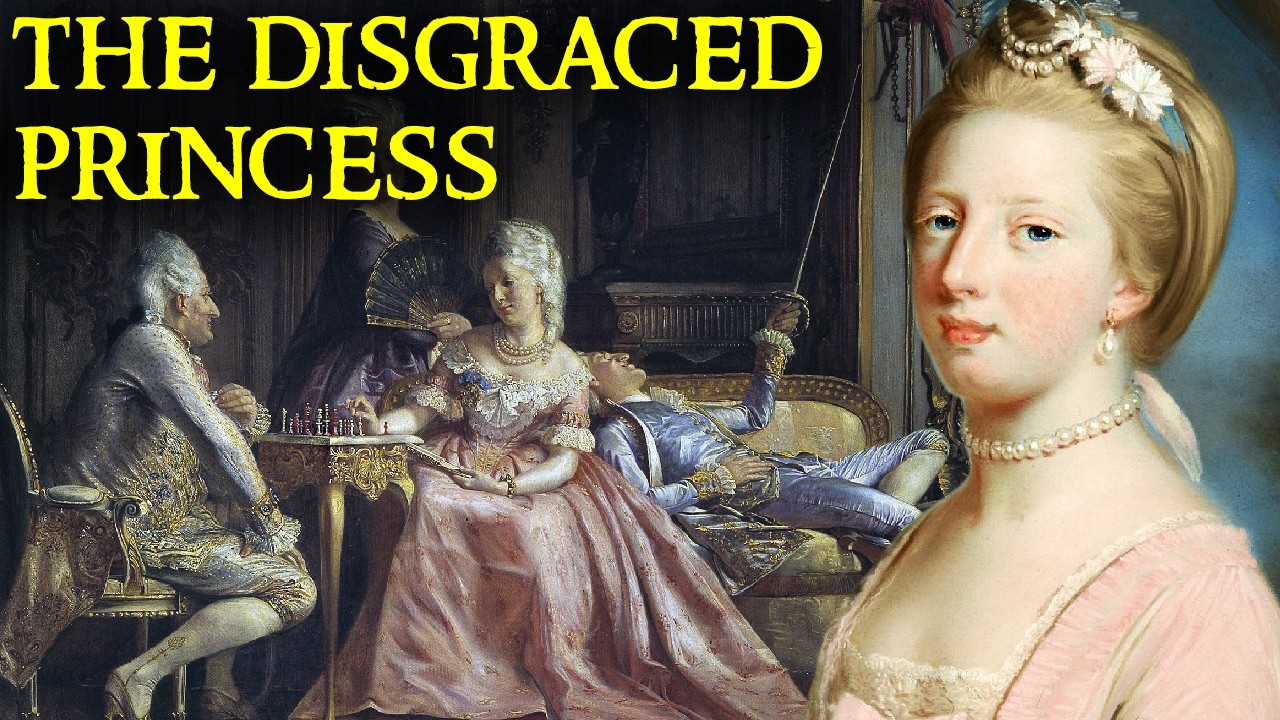
Her enemies turned against her, her marriage collapsed, and the young queen was stripped of her crown and banished. But the darkest part of her story was still to come. The future Queen of Denmark and Norway was born at Leicester House in London on July 22, 1751. She was the ninth and youngest child of Frederick, Prince of Wales, and his wife Augusta of Saxe-Gotha.
Unlike many of her siblings, Caroline never knew her father. Frederick, the eldest son and heir of King George II, died suddenly on March 31, 1751, just months before her birth. He was only 44. For generations, it was said that Frederick died from a lung abscess caused by a blow from a cricket ball.
It is a colorful explanation, though historians are no longer confident in that theory. Her widowed mother raised the large family in seclusion at Leicester House, trying to keep the children away from the intrigues of her father-in-law King George II’s court. As she grew older, Caroline Matilda developed a lively, playful personality. She was described as moody but natural and spontaneous, qualities that set her apart from the rigid expectations of royal life.
Unlike many princesses of her era, she seemed uninterested in politics or the intricate schemes of the court. Instead, she loved riding horses, learned to play the harpsichord, sang, and learned to speak French, German, and Italian alongside her native English. In 1760, Caroline Matilda’s quiet childhood ended abruptly. Her grandfather, King George II, died, and her older brother ascended the throne as George III.
For the nine-year-old Caroline Matilda, everything suddenly changed. She was no longer just a princess raised in seclusion. She was now the sister of a reigning king, which made her a valuable prize in the European marriage market. Discussions soon began about who she might marry.
Caroline had little say in the matter. Her future was decided based on the political interests of her family, and the man eventually chosen for her would lead her into a marriage that became a nightmare. By 1764, plans were underway to secure a husband for Caroline Matilda, and Denmark, whose kings had long ruled Norway as a crown domain, emerged as a likely destination. Crown Prince Christian of Denmark was Caroline’s first cousin, since his mother Louise was the sister of Caroline’s father.
The marriage would strengthen the existing alliance between Britain and Denmark. But Caroline was not the first choice of the Danish court. They initially considered her older sister Louisa Anne until their representative in London warned that her health was too fragile. Attention then turned to the 13-year-old Caroline Matilda.
In January 1765, their engagement was officially announced. Caroline was now destined to become the future Queen of Denmark. Since Caroline was still very young, she did not leave for Denmark immediately. But everything changed in January 1766 when King Frederick V died and her future husband suddenly became King Christian VII.
He was not yet seventeen. Then, on October 1 of that year, the 15-year-old Caroline Matilda married Christian by proxy at St. James’s Palace in London. The very next morning, she left England for a country she had never seen, traveling to meet a husband she had never met.
They finally met face to face at Roskilde in early November. On the eighth, Caroline entered Copenhagen amid great cheers from the crowds. That evening, she and Christian were formally married at Christiansborg Palace. Finally, on May 1, 1767, the young king and queen were crowned together.
Caroline Matilda was now officially Queen of Denmark, but she did not know that her new royal life would soon slide into scandal, betrayal, and disaster. Behind the pageantry of Caroline Matilda’s arrival in Denmark and her wedding, serious problems were already emerging. Christian was mentally ill, and modern writers have generally concluded that he suffered from schizophrenia, which made his behavior increasingly unpredictable. He showed little interest in his young wife and delayed consummating their marriage.
Instead, he spent his nights carousing in the taverns and brothels of Copenhagen with a notorious circle of court intimates. Among them was Anna Cathrine Benthagen, who catered to the king’s fondness for women dressed as men and joined his raucous tours of the city disguised as a naval officer. In fact, Christian did not want this marriage in the first place. He had been pressured by his court, which hoped the marriage might somehow improve his disturbed mental state.
Some at court even whispered that the king preferred the company of men to women. For Caroline, however, the result was the same. She had been sent to Denmark to become queen, only to find herself married to a husband who showed no interest in her existence. To add to her suffering, members of the Danish court showed Caroline no sympathy, and her only ally, her lady-in-waiting Louise von Plessen, was banished in 1768 due to court intrigues.
Eventually, after being persuaded that he needed to secure the succession by producing an heir, Christian performed his royal duty, and on January 28, 1768, Caroline gave birth to a son, Crown Prince Frederick. With the succession secured, Christian quickly returned to his old habits, spending his nights once more in Copenhagen’s brothels and taverns. Shortly afterward, the king left his wife in Copenhagen with their infant son and embarked on a grand tour of Europe that lasted most of the year. During his absence, the young queen was accused of having an affair with La Tour, a handsome French actor and singer.
The claims were probably not true, but the gossip was damaging enough that La Tour was exiled after Christian’s return. Meanwhile, Caroline began forming friendships with ladies of the court known for their romantic affairs, who encouraged her to dance, flirt, and enjoy a more active social life. But the most significant result of Christian’s journey had not yet come. While traveling through Germany, the king’s behavior reportedly became more bizarre, which is why his attendants hired a young physician named Johann Friedrich Struensee.
He would soon become the man at the heart of a scandal that would destroy both himself and Caroline Matilda. Born in Halle in 1737, Struensee became a practicing physician in the city of Altona. He ended up in the service of the Danish crown after being hired during Christian’s travels in Germany, and he proved a rare ability to handle the king’s sharp mood swings, earning his trust. So when the court returned to Copenhagen in January 1769, he went with them and remained at the Danish court as royal physician.
At first, the queen treated the newcomer very coldly. However, she began to warm to him as Struensee seemed to be one of the few at court who urged Christian to show more kindness toward his neglected wife, and the marriage briefly improved. It was not long before Struensee gained a strong position at court. In January 1770, he was given his own rooms at Christiansborg Palace, bringing the young physician into the heart of the royal family.
At the same time, Christian VII became more passive and withdrawn as his mental health deteriorated, leaving more of the day-to-day business of government in Struensee’s hands. Then, in the spring, Struensee earned Caroline Matilda’s gratitude in a way that brought them dangerously close. When smallpox swept through Denmark, he successfully inoculated Crown Prince Frederick, saving the child’s life. Caroline’s trust in the charming physician deepened, and that trust soon turned into something far more intimate.
By the summer of 1770, the queen and the king’s physician were no longer merely close companions. Their relationship had become an open secret. Perhaps the relationship might have been allowed to continue had it not been so politically sensitive. With her husband often incapacitated and Caroline playing an increasing role in running the government, concern grew in the Danish court that Struensee, a foreigner, was becoming a de facto power broker at court.
In September 1770, the veteran foreign minister, Count Johann von Bernstorff, was dismissed, with suspicions that the German physician was behind the decision. Then in July 1771, a royal decree appointed Struensee a minister with the authority to issue orders as if he were acting on Christian’s authority. Thus, for an extraordinary period of about 16 months after the fall of von Bernstorff, a German physician became the de facto ruler of Denmark, issuing more than a thousand decrees in the king’s name. His policies were controversial and would change Danish society.
He abolished prior censorship and attacked many of the privileges enjoyed by the nobility, while attempting to reform the harsh system of forced labor imposed on peasants. Of course, this created powerful enemies for him among the conservative elite. While he was reshaping the kingdom, Caroline Matilda was changing too. The young queen gained new confidence, riding horses and sometimes appearing in masculine riding clothes.
She also surrounded herself with people from outside the traditional aristocratic circle, behavior that only increased the growing scandal around the queen and her controversial lover. But then came the moment that seemed to confirm the worst suspicions of Struensee’s enemies. On July 7, 1771, Caroline Matilda gave birth to a daughter, Louise Augusta. Christian VII acknowledged the child as his own, but people at court soon began whispering that she was actually Struensee’s daughter.
Behind closed doors, she was mockingly nicknamed “la petite Struensee. ” The rumors did not stop there. Shortly after the birth, an even more explosive story began to spread. It was claimed that Caroline and Struensee intended to imprison the king and make Caroline regent of Denmark.
The accusation was certainly absurd, but by then, the truth mattered less than what people were willing to believe. Ironically, the press freedom that Struensee championed helped spread the stories that would destroy him. Copenhagen filled with pamphlets and newspapers mocking his relationship with the queen, while opposition gathered at court around the king’s ambitious stepmother, Queen Juliana Maria, her son Frederick, and their adviser Ove Høegh-Guldberg. Together, they were no longer content merely to conspire against the king’s favorite.
They were preparing to bring down the queen herself. The alliance formed against Caroline and her lover finally struck on the night of January 16, 1772, during a masked ball at Christiansborg Palace. Caroline danced into the early hours, completely unaware that the conspirators had already begun their move. Once the palace had fallen quiet, they entered the terrified king’s bedroom and persuaded him to sign a series of arrest warrants, including one for Struensee.
The physician was seized in his bed and led away to prison. Then, shortly before dawn, armed men entered the queen’s private apartments. Caroline was arrested, and that morning she was sent under heavy guard to Elsinore Castle, accompanied only by her infant daughter. Her young son, the heir to the throne, was left behind with his father.
Interrogations began almost immediately. After three days of intensive questioning, Struensee finally confessed to his sinful relationship with the queen. In March, his signed confession was shown to Caroline. Realizing that denial was pointless, she signed it herself.
Perhaps she hoped that confessing to the affair would save her lover’s life. But if that was her goal, she failed. Struensee stood trial and was executed on April 28, 1772. He was 34 years old.
By that time, Caroline was no longer Queen of Denmark and Norway. Her marriage to Christian had been dissolved on April 6, and the fate of the young queen now lay in the hands of her brother across the sea. George III could do nothing to restore his sister’s marriage or reputation, but the imprisonment of a British princess was considered a grave diplomatic insult that could not be tolerated. The British envoy in Copenhagen, Sir Robert Murray Keith, threatened the Danes with a complete severing of relations and possibly war if Caroline were not released.
The Danish government eventually yielded. Caroline would retain the right to call herself queen and her letters would be returned to her, but there was a heavy price. She had to leave Denmark while her children would remain in Copenhagen. In late May 1772, a small British naval force anchored off Elsinore.
Caroline boarded one of the ships and sailed into exile. She was barely twenty years old, and she was never destined to see her son or daughter again. Caroline did not return to England. Given the circumstances of her downfall in Copenhagen, her brother George III felt that the return of his disgraced sister to the British court would create an embarrassing and potentially damaging situation.
Instead, she was sent to live at the old Celle Castle in Hanover, a territory under the control of the British royal family. There, Caroline established a small court and lived a secluded life, eventually reuniting with her former lady-in-waiting, Mrs. von Plessen. But Caroline was not forgotten in Denmark.
The new regime dominated by Christian’s stepmother, Queen Dowager Juliana Maria, quickly became highly unpopular. By the autumn of 1774, a group of Danish nobles was secretly planning to overthrow the government and bring Caroline back to Copenhagen as regent for her young son, while the incapacitated Christian remained king in name only. Their intermediary was an English adventurer named Nathaniel Wraxall, who arrived to present this extraordinary proposal to Caroline. She was willing to consider it, and Wraxall was sent to London to obtain the approval of King George III.
For a brief moment, the opportunity arose for Caroline Matilda to return to Denmark, not as an exiled queen, but as a ruler. But before her brother could make a final decision, illness and death brought the entire scheme crashing down. In the spring of 1775, an epidemic fever swept through northern Germany, generally believed to have been a wave of scarlet fever. At Celle, the queen became infected, and after a short illness she died on May 10, 1775, at just 23 years old.
A letter attributed to her on her deathbed asserted her innocence to her brother King George one last time. However, there is no doubt about Caroline’s betrayal with Struensee. She was buried in the church crypt at Celle next to her great-grandmother Sophia Dorothea, the former wife of the first Hanoverian king of England, George I, whose own story of betrayal and punishment echoed Caroline’s. In Denmark, Caroline’s son finally took control of the government in 1784 at the age of sixteen, although his father Christian VII remained king in name until his death in 1808.
Caroline’s son then became King Frederick VI and ruled Denmark until 1839. Her daughter, Louise Augusta, remained in the Danish court and lived her entire life as the daughter of Christian VII, despite the widespread belief that Struensee was her real father. In the end, Caroline Matilda never returned to Denmark and never saw either of her children again.
She was queen for barely five years, but her short and controversial reign left behind a story of love, political upheaval, and a disputed princess, one of the most famous chapters in Danish royal history.