In September 2014, three men who had never worked for Coca-Cola pooled their own money and rented a billboard directly across the street from the company’s world headquarters in Atlanta. The sign was simple: a plea to bring back Surge, a neon green citrus soda that had been discontinued for 11 years. Fourteen days later, Coca-Cola announced that Surge would return to the American market, sold exclusively on Amazon. Within four hours of the listing going live, every unit was gone.
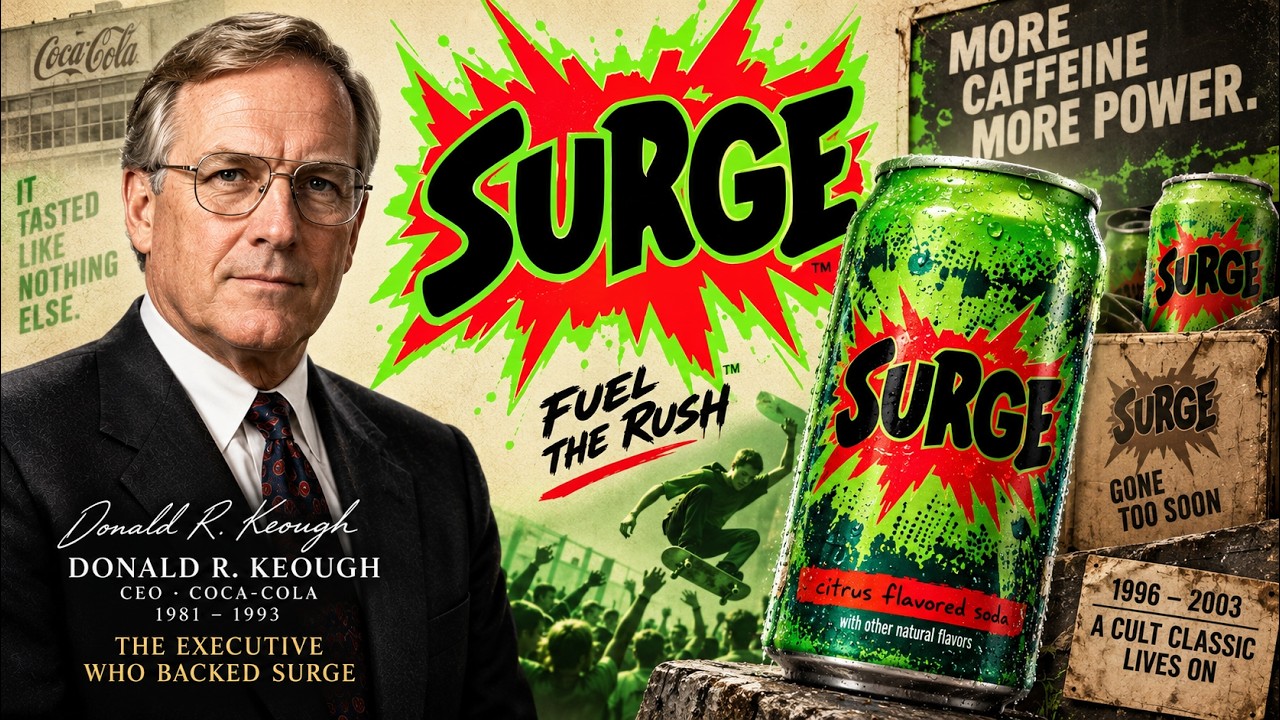
Resale prices on eBay climbed to $100 a case before midnight, meaning people were paying nearly $9 a can for a soda that originally sold for 75 cents. No Coca-Cola product had ever been brought back by three strangers with a rented sign, and no soft drink in American history had inspired that kind of loyalty more than a decade after disappearing from shelves. But the real story of Surge is not the comeback. It is how Coca-Cola spent $25 million engineering a product designed to dominate the soda market, watched it fail against an opponent they never truly understood, and then discovered years later that the people who loved it had never stopped waiting.
The story begins in a boardroom in Atlanta in the winter of 1994. Coca-Cola was the undisputed king of American beverages, posting revenues of roughly $16 billion that year. In the Cola Wars, the decades-long battle between Coke and Pepsi for dominance of the carbonated soft drink market, Coca-Cola was winning in most of the world. But there was a number on a spreadsheet in Atlanta that no one could ignore.
The citrus soda segment—the bright, aggressive, heavily caffeinated corner of the market anchored by Mountain Dew—was growing at 15% per year. The cola segment, the one Coca-Cola owned, was growing at just 2%. Mountain Dew, a PepsiCo product, had spent the early 1990s transforming itself from a regional curiosity into a national phenomenon, aligning itself with extreme sports and the raw energy of a generation that had no interest in the measured sophistication of cola advertising. By 1994, Mountain Dew held roughly 6% of the entire American carbonated soft drink market, a figure representing billions of dollars in annual sales.
Coca-Cola had an answer to Mountain Dew, but it was called Mellow Yellow, a citrus-flavored, caffeinated soda that had existed since 1979 and had never come close to threatening Mountain Dew’s position. The problem was not the formula but everything else. Mellow Yellow felt like a product made by a committee. Mountain Dew’s power came from a cultural identity built over 50 years, rooted in the working-class communities of Appalachia.
Sometime in 1994 and into 1995, a project began inside Coca-Cola with a direct mandate: build a citrus soda capable of taking market share from Mountain Dew—not a refinement of Mellow Yellow, but something new and louder that could go directly at the Dew on its own terms. What they built was first tested in Norway in 1996 under the name Urge. The formula was aggressive, with higher citrus oil concentration than anything in Coca-Cola’s existing lineup, a caffeine level of 51 mg per 12-ounce serving, and a sugar content calibrated to deliver an immediate, forceful impact on the palate. Urge performed well enough in Norway, so Coca-Cola moved forward with an American version.
They called it Surge. The American launch came in January 1996, beginning in Georgia and Tennessee, Coca-Cola’s home territory. The marketing budget for the first year was $25 million, one of the largest single-product launch investments in Coca-Cola’s history to that point. The can was neon green, darker and more aggressive than Mountain Dew’s yellow-green, with bold angular typography designed to communicate one thing: this product does not apologize for what it is.
The slogan was four words: “Feed the rush. ”
Inside Coca-Cola, there was genuine confidence. The distribution infrastructure was in place, the formula had been tested, and the budget was committed. What they had not fully accounted for was the one thing money could not manufacture.
Mountain Dew had been sold in the United States since 1940 and carried 56 years of American identity by 1996. The people who had grown up drinking it had not chosen it because of an advertising campaign. That history was not a marketing asset; it was a wall. The formula Coca-Cola’s food scientists delivered in 1996 was the product of deliberate engineering.
Surge’s flavor profile was citrus-forward in a way nothing else on the American market matched at the time. Where Mountain Dew’s taste was rounded and sweet with a finish that faded quickly, Surge hit the front of the palate with concentrated citrus oil and held there. The carbonation was calibrated tighter, with finer bubbles and higher pressure, creating a sharper initial sensation. The sugar content was elevated above Mountain Dew’s formula, making the energy sensation immediate rather than gradual.
Surge carried 51 mg of caffeine per 12-ounce can, just under Mountain Dew’s 54, but the combination made it feel more intense to most drinkers. The citrus oil tasted less like artificial flavoring and more like actual fruit rind, bitter at the edges and aromatic in a way that lingered after the can was empty. The packaging was engineered with the same intentionality. The can was wide-mouthed by 1996 standards, designed to increase the flow rate on each sip, meaning drinkers consumed more per second.
The specific shade of neon green was chosen to stand out on a refrigerated shelf from 20 feet away. The price at launch matched Mountain Dew almost exactly: 75 cents for a 12-ounce can. Coca-Cola made a deliberate decision not to compete on price. The intent was direct competition on identity, not economics.
Within six months of the January launch, Surge was available in 32 states, moving through Coca-Cola’s distribution network, which reached approximately 98% of American retail points of sale. It appeared in gas stations, convenience stores, grocery chains, college campus vending machines, and crucially, school cafeteria vending machines across the Southeast and Midwest. No new beverage had achieved that geographic penetration that quickly in Coca-Cola’s modern history. The television advertising campaign was unlike anything Coca-Cola had produced before.
The spots were loud, fast, and deliberately abrasive. One early commercial showed young men at a construction site cracking open cans of Surge with urgency. Another featured teenagers performing increasingly reckless physical stunts. The message in every ad was identical: this product is not for careful people.
The campaign ran during prime-time sports broadcasts, Saturday morning programming, and the after-school hours when its target demographic was most likely watching television and thirsty. By mid-1996, Surge was generating genuine consumer excitement in its launch markets. Reorder rates from convenience store chains ran ahead of projections. School vending machine operators in Georgia reported Surge outselling every other product within weeks.
Retailers were asking when Surge was coming to their region. The product had done what it was designed to do in its first year: it found an audience. By 1997, Surge was a national presence. The “Feed the Rush” campaign expanded beyond television into print, radio, and, for the first time in Coca-Cola’s history for a single product, an aggressive early internet presence.
Surge was one of the first major American beverage brands to maintain a dedicated website. The site featured downloadable screen savers, sweepstakes tied to extreme sports events, and a feedback mechanism that allowed drinkers to submit stories about their Surge moments. Tens of thousands of submissions arrived in the first year. Coca-Cola’s marketing team read them as evidence of engagement.
In retrospect, they were evidence of a community forming around the product in a way the company had not planned for. The television spots evolved through 1997 and 1998 to reflect Coca-Cola’s attempt to sharpen the brand’s identity. The construction worker imagery gave way to more explicitly extreme sports content: snowboarding, mountain biking, motocross. The creative direction came from agencies working under a brief that had not changed since 1994: be more extreme than Mountain Dew.
The problem embedded in that brief—that being more extreme than Mountain Dew was a reactive position, not an original one—would not become fully visible for another two years. Surge reached its peak market penetration in 1998. By the most reliable industry estimates, the brand was moving between 400 and 500 million cans annually. It held approximately 3% of the total American carbonated soft drink market, representing roughly $1 billion in retail sales.
In parts of the Southeast, Surge outsold Mountain Dew in specific retail channels. Convenience stores near high schools and college campuses often reported Surge as their single bestselling cold beverage by unit volume. But competing in convenience stores near high schools was not the same as winning the citrus soda war. Mountain Dew was not losing ground; it was gaining it slowly in the markets that mattered most to long-term brand health.
The drinkers who had chosen Mountain Dew before Surge existed were not switching. The drinkers Surge was attracting were overwhelmingly new to the citrus soda category—teenagers who had no prior loyalty to Mountain Dew and were choosing Surge as their first citrus soda because it was there, bright, and tasted unlike anything else they had tried. Surge was not beating Mountain Dew. It was creating Surge drinkers, a distinct group with a distinct loyalty.
In the school cafeterias and gas stations of mid-1990s America, those drinkers were becoming something no amount of market research had predicted: a community. A teenager in 1997 who drank Surge did not think of himself as a Coca-Cola customer. He thought of himself as someone who drank Surge. Meanwhile, parents were paying attention.
If you were 40 years old in 1997 with a teenager bringing home neon green cans, you read the label: 51 mg of caffeine, 46 grams of sugar per 12-ounce serving. You were not the target demographic, but questions about what exactly was in it began surfacing at dinner tables across the country. Those conversations were the early tremors of a pressure that would become structural within three years. The school vending machine was the beating heart of Surge’s commercial success and the source of its greatest vulnerability.
By 1998, Surge had secured placement in vending machines across thousands of American middle and high schools. The arrangement was common, well-established, and entirely legal. What was different about Surge was the product itself: its caffeine and sugar content placed it at the high end of what was available in those machines. For most of 1997 and 1998, this generated no significant public controversy.
Then gradually it did. Parent-teacher organizations in several Midwestern school districts began raising formal objections to high-caffeine beverages in school vending machines in 1999. The objections were not targeted exclusively at Surge—Mountain Dew was cited equally—but Surge’s branding made it a more visible target. A product that advertised itself as a rush was harder to defend in a school board meeting.
The word “extreme” became a liability in contexts where parents argued their children’s school day should not include a delivery mechanism for extreme caffeine consumption. By 1999 and into 2000, school board votes to restrict or eliminate high-caffeine soft drink sales were occurring across multiple states. Each vote removed Surge from another set of vending machines. The channel that had built Surge’s peak penetration was closing one school district at a time, and there was no equivalent channel to replace it.
Coca-Cola’s public position was that Surge’s caffeine content was comparable to other beverages widely available to teenagers. This was technically accurate but strategically inadequate. Meanwhile, inside PepsiCo, a different response was being prepared. In May 2001, PepsiCo launched Mountain Dew Code Red, a cherry-flavored extension of the Mountain Dew line.
It required no new brand infrastructure, no new distribution agreements, no new consumer education. It borrowed 60 years of Mountain Dew equity and attached a new flavor. The launch budget was a fraction of what Coca-Cola had spent introducing Surge five years earlier. Code Red sold 100 million cases in its first year of national distribution and became one of the most successful product extensions in PepsiCo’s history.
The lesson embedded in Code Red’s success was the same lesson Surge’s entire existence had been failing to disprove: brand equity accumulated over decades cannot be manufactured in 18 months. Surge had spent five years trying to build from nothing what Mountain Dew had built from 1940. For Coca-Cola’s internal planning teams, the Code Red launch crystallized what the data had been suggesting since 1999. Surge was not going to win the citrus soda war.
It had found a loyal audience, but that audience was not large enough and was not growing fast enough to justify the continued investment required to maintain Surge as a national brand. The peak was behind them. The question was no longer how to grow Surge but what to do with it. What followed was not a single decision to kill Surge but a series of smaller decisions, each individually defensible, collectively irreversible.
Coca-Cola chose repeatedly to prioritize other things, and Surge died in the space between those choices—quietly, without announcement. The contraction began in the second half of 2001 without a press release. Marketing budgets were redirected toward Coke, Diet Coke, and Sprite. Surge received no new advertising spend after mid-2001.
No new television spots were produced. The “Feed the Rush” campaign simply stopped generating new material. Distributors noticed first. Surge was no longer a priority SKU.
When a convenience store shelf had space for 12 Coca-Cola products, Surge was increasingly the one left on the truck. Not because anyone said remove it, but because no one said fight for it. In the distribution business, that distinction does not exist. The retail evidence accumulated through 2001 and into 2002.
Gas stations in smaller markets began substituting Mellow Yellow in vending machines and cold cases. The substitution happened gradually enough that most consumers did not register it as a corporate decision. They registered it as an inconvenience. By early 2002, Surge’s active distribution had contracted from 32 states to approximately 18.
The consumers who noticed mounted a response that was remarkably organized for 2002. Online message boards filled with threads from Surge drinkers documenting where the product could still be found and directing each other toward remaining stock. Coca-Cola received letters. Consumer correspondence departments logged complaints about Surge’s disappearance throughout 2002 at a rate that exceeded what the brand’s commercial performance would have predicted.
The loyalty Surge had built among drinkers who first encountered it as teenagers was disproportionately intense. A 3% market share brand was generating the kind of consumer advocacy response a 10% brand might have expected. None of it changed the outcome. In 2002, no new Surge advertising was produced, no new distribution agreements were signed, and the formula engineered to defeat Mountain Dew sat in production facilities being quietly repurposed.
Once equipment is reassigned, restarting production requires capital expenditure that must be justified to people who have already decided the brand does not warrant further investment. By early 2003, Surge production had ceased in all but a handful of regional markets. There was no farewell campaign, no final limited edition, no press release. By mid-2003, it was over.
The last can sold quietly. The neon green that had covered 32 states was gone from American shelves. What Coca-Cola did not account for in any of its models was time. Not the time it took to build the brand or dismantle it, but the 11 years during which Surge did not exist, during which the teenagers who had drunk it in 1996 and 1997 grew into adults in their late 20s and early 30s—and what those adults would do when they finally had the tools, the platforms, and the disposable income to act on something they had never stopped wanting.
The Surge movement did not begin with a billboard. It began with a Facebook group. In 2011, eight years after the last can disappeared, a group of adults in their late 20s and early 30s created an online community dedicated to convincing Coca-Cola to bring Surge back. They were not beverage industry professionals.
They were people who had been 14 years old in 1996 and had never fully made peace with the fact that the thing they remembered so specifically no longer existed anywhere they could reach it. The group grew faster than anyone expected. Within two years, the Surge Movement Facebook page had accumulated more than 130,000 members. The membership was not passive.
They wrote letters to Coca-Cola’s consumer relations department, contacted food and beverage journalists, and organized regional meetups where members brought remaining vintage cans, sealed and preserved for years, to share with people who had driven hours to be there. Coca-Cola did not respond to the letters. The company’s official position was that Surge had been discontinued for sound commercial reasons and there were no plans to revisit that decision. This was a defensible corporate position.
It was also, as it turned out, a temporary one. In the summer of 2014, three administrators of the Surge Movement page—Shaun Sheridan, Matt Wein, and Evan Carr—decided that letters were not sufficient. They pulled money raised from the broader community, enough to rent a billboard on North Avenue in Atlanta, positioned directly in the sightline of anyone entering Coca-Cola’s world headquarters. The billboard was simple: a can of Surge, a URL, and a message asking, without irony or aggression, for the product to come back.
The billboard went up in August 2014. Within 48 hours, the story had been picked up by the Associated Press, CNN, food and beverage trade publications, and dozens of regional newspapers. The combination of grassroots organization, the physical audacity of placing a sign in front of one of the world’s most powerful corporations, and the specificity of the product being requested made it the kind of story that traveled naturally across the media landscape of 2014. It was human, odd, and above all completely sincere.
Coca-Cola responded within two weeks. On September 15, 2014, the company announced that Surge would return, initially exclusively through Amazon. A limited quantity of 16-ounce tall boy cans, 12 to a case, was available for purchase online. The price was set at $14 per case.
The listing went live on Amazon at noon Eastern time. Within four hours, every available unit had sold. The Amazon page became one of the most reviewed product pages in the beverage category within days. Reviews ran to multiple paragraphs.
People described where they had been the first time they drank Surge, the specific year, the specific occasion, the specific feeling of a product that had imprinted on them at an age when taste memories form permanently. Grown adults wrote about a soft drink with the precision and emotion usually reserved for describing a place they had loved and lost. The resale market responded immediately. Cases of the new Surge appeared on eBay within hours of the Amazon sellout, priced at $60 to $100.
People paid those prices. This was not the behavior of nostalgia. It was the behavior of a craving that had been deferred for 11 years. Coca-Cola expanded distribution in 2015 and 2016.
By 2018, Surge was available at 7-Eleven locations across the United States and had secured placement in an expanding number of regional grocery chains. It was not a top 10 brand. It was not generating the kind of revenue that would justify a $25 million advertising campaign. But it was alive, in production, and being purchased consistently by people who were not buying it out of curiosity.
They were buying it because it was the thing they had actually wanted for 11 years and it was finally available again. There is one detail Coca-Cola has never addressed publicly and that the Surge movement community debated with genuine intensity following the 2014 relaunch: the formula. Members of the Facebook group conducted blind taste comparisons between the 2014 product and remaining sealed vintage cans from the original run. The results were not unanimous.
A significant portion of testers reported that the 2014 formula tasted different from the original, slightly less aggressive on the citrus note and marginally smoother on the finish. Others tasted no difference at all. Coca-Cola issued no statement on the matter. The original formula specifications remain internal documents.
Whether the Surge available today is chemically identical to the Surge that disappeared in 2003 has never been officially resolved. For some members of the community, this remains an open wound. For others, it is beside the point. The can is green, the taste is close enough, and it is on the shelf.
The Charlotte, North Carolina bottling facility that handled a significant portion of original Surge production through the late 1990s has long since been repurposed to produce other Coca-Cola products. There is no marker outside identifying its role in Surge’s history. Urge, the Norwegian version of the formula that preceded Surge’s American launch in 1996, is still sold in Norway today. It has never been discontinued and has never generated a billboard campaign or a 130,000-member Facebook advocacy group.
It is simply available consistently in a market that never lost it and therefore never had to fight to get it back. What Surge represents at the distance of nearly 30 years is not just a cautionary tale about corporate mismanagement or the limits of engineered authenticity, though it is both of those things. It represents something more specific about the relationship between a product and the people who find it at the right moment in their lives. Coca-Cola built Surge to win a market share battle.
It did not win that battle, but in the process of fighting it, the product found its way into the hands of a generation of teenagers at precisely the age when taste experiences become permanent. When the combination of flavor, circumstance, and adolescent intensity creates a memory that does not fade, those teenagers did not forget. They waited. And when they had the tools to act, they acted with a coherence and persistence that a corporation with a $25 million launch budget had never been able to manufacture.
The lesson is not that consumers are more powerful than corporations. The lesson is that some products matter to people in ways that have nothing to do with market share, and corporations are structurally unable to predict which products those will be until it is too late to do anything but respond.