In 1941, Nazi Germany launched Operation Barbarossa, the massive invasion of the Soviet Union. The campaign inflicted catastrophic losses on the Red Army, with millions of Soviet soldiers falling into German captivity. Thousands of prisoners chose to collaborate with the Germans rather than face the brutal conditions of the camps.
Among those collaborators was a young woman who would become one of the most infamous executioners of the war. Her name was Antonina Makarova, and she was responsible for the deaths of approximately 1,500 people.
Makarova was born on March 1, 1920, in the village of Malaya Volkovka, part of the Smolensk Governorate. She was the youngest of seven children. Her birth surname was Panfilova, but a childhood error changed her identity forever.
When she started first grade at age seven, she was too shy to give her name to the teacher. Her classmates assumed her surname was Makarova, based on her father's first name, and provided that information instead. The mistake was officially recorded and followed her through school and into her passport. Her parents never corrected the error.
As a teenager, Makarova moved with her family to Moscow. After finishing school, she enrolled in a medical technical school with the intention of becoming a doctor. Her plans were interrupted by the outbreak of war.
After the German invasion in June 1941, Makarova volunteered for the front. She served as a canteen worker and nurse. In the autumn of 1941, she was among the survivors of the Vyazma operation, a critical battle near Moscow where German forces encircled four Soviet armies.
Her unit was destroyed or captured. Makarova hid in the forest for several days before being captured by the Germans. She later escaped with a soldier named Nikolai Feduk, and the two traveled together for months, trying to break out of the German encirclement.
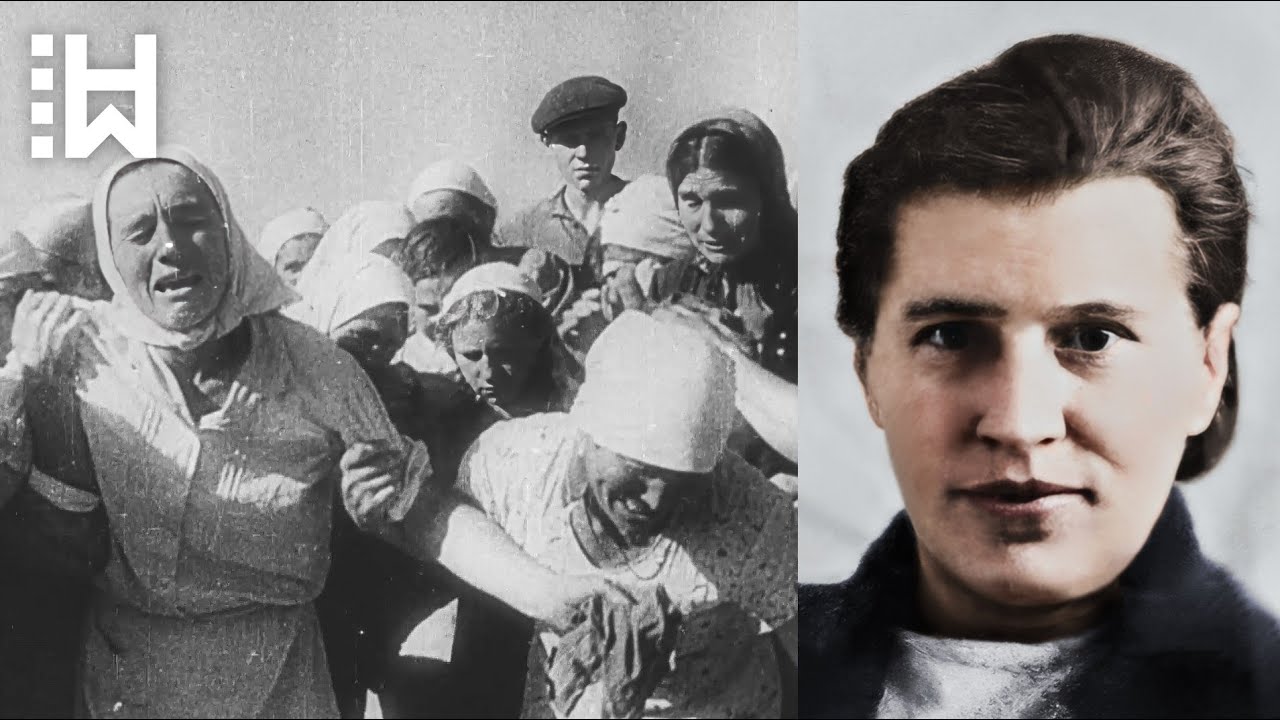
In January 1942, they reached the village where Feduk's wife and children lived. Despite Makarova's pleas, Feduk parted ways with her. She stayed in the village, but local women soon turned against her due to her promiscuous behavior, forcing her to leave.
She wandered through various villages before ending up in the Lokot Republic, a self-governing autonomous region established in October 1941. The region was a puppet state that cooperated closely with Nazi forces and targeted partisans and Jews.
Running out of money, Makarova turned to prostitution. When questioned by the Germans, she criticized the Soviet government and volunteered to join the Lokot auxiliary police. Given her previous experience with machine guns, she was assigned a Maxim machine gun to carry out executions of Soviet partisans and their families.
The Germans were unwilling to perform the executions themselves and entrusted her with the task. As a reward, she received a room at a local stud farm where she kept the machine gun.
At her first execution, Makarova appeared calm but could not bring herself to shoot. The Germans gave her alcohol to steady her nerves. After that, she no longer needed it for subsequent executions.
She was often ordered to execute groups of up to 27 people at a time, as that was the capacity of the partisan holding cells. There were days when she carried out death sentences three times in a single day. Occasionally, after firing, she would approach the bodies and shoot any survivors in the head.
In total, Makarova executed around 1,500 people, though the identities of only 168 have been fully documented. Most of her victims were Soviet partisans, their family members, and civilians, including women, the elderly, and children. She became known as Tonka the Machine Gun Girl.

For each execution, Makarova was paid 30 Reichsmarks, an equivalent of around $2,200 today. Her payment was later compared to the infamous 30 pieces of silver. After executions, she would take clothes she fancied from the corpses, justifying it by saying, "Why let good things go to waste?" She often complained that the clothes were stained with blood and riddled with bullet holes.
Witnesses recalled that Makarova frequently visited the prison where the condemned were held, examining prisoners as if already deciding which belongings she would take after their execution. She also visited the local music club, where she drank heavily and engaged in intimate relationships with policemen and German soldiers, often for money.
Her reckless lifestyle led to a diagnosis of syphilis, and she was sent to a German rear hospital in the summer of 1943. This hospitalization unintentionally saved her from capture by the partisans and the Red Army, who liberated the Lokot region in September of that year.
While staying in the rear, Makarova started an affair with a German soldier who smuggled her to Ukraine and then to Poland. After the soldier was killed, she was sent to a concentration camp in Königsberg, East Prussia.
When the Red Army captured the city in 1945, she assumed the identity of a Soviet nurse using a stolen military ID card. She claimed to have served in the 422nd Medical Battalion from 1941 to 1944. This strategy allowed her to secure a position as a nurse in a Soviet mobile hospital.
There, she met a young Jewish sergeant named Viktor Ginsburg, who had been wounded during the city's storming. His entire family had been murdered during the Holocaust. Within days, they got married, and Antonina adopted her husband's last name.
After the war, the couple settled in the Belarusian town of Lepel. As war veterans, they were highly respected in society. Their photos were displayed in the local museum, and they were honored with various awards. Antonina even spoke to school children about her memories of the war.

Neither her husband, their two daughters, nor family friends knew her true identity. In 1961, Makarova secured a job in the sewing workshop of a garment factory, where she eventually rose to the position of quality control inspector. She was regarded as a responsible and diligent worker, and her photograph often appeared on the local Wall of Honor.
The KGB faced significant challenges in tracking her down. Surviving residents could only provide limited information. The search intensified after her former commander was captured and revealed her name. In total, 250 women named Antonina Makarova matching her age and description were investigated.
The real Makarova was listed in official records under her birth name, Panfilova. The breakthrough came when her brother, who worked for the Ministry of Defense, disclosed in a questionnaire that one of his sisters who had used the surname Makarova since childhood was actually born Panfilova.
Investigators hesitated to arrest the respected war veteran without solid evidence. They began monitoring her and questioning her under the pretext of awarding her a medal. When asked to provide details about her unit and commanders, she cited poor memory, which only increased their suspicions.
In July 1978, a witness identified her as Tonka the Machine Gun Girl. Another witness confirmed her identity during a staged pension recalculating appointment. Antonina Makarova was finally arrested in September 1978.
She accepted her arrest calmly, believing she would face only a short sentence due to wartime circumstances. She was convinced her actions were driven by the harsh conditions of war and saw no reason for severe punishment. Her husband, devastated by her arrest, appealed to Soviet leader Leonid Brezhnev and international organizations.
In November 1978, Makarova was found guilty of murdering 168 people whose identities were confirmed. She was sentenced to death by shooting, a surprising verdict given her exemplary post-war behavior and the fact that 1979 was declared the Year of the Woman in the Soviet Union.
Upon hearing the verdict, Makarova admitted her guilt and accepted the sentence calmly while her husband broke down in tears. She appealed for clemency, requesting that her death sentence be commuted to imprisonment, but all appeals were denied.
Antonina Makarova was 59 years old when she was executed by shooting on August 11, 1979. After the death of Joseph Stalin in March 1953, she was one of only three women legally executed by the Soviet Union. There were no tears shed for Antonina Makarova.