On July 3, 1863, the temperature climbed under a Pennsylvania sun as thousands of Confederate soldiers formed along Seminary Ridge. Across an open mile of farmland, Union forces waited on Cemetery Ridge with loaded cannons and entrenched infantry. The moment before Pickett’s Charge would become the Confederacy’s high-water mark and its breaking point.
Lieutenant General James Longstreet saw the disaster coming before it started. He pleaded with his commander, Robert E. Lee, to reconsider the assault. No one listened.
Longstreet was Lee’s most trusted subordinate, a man Lee called his old warhorse. Born in 1821 in South Carolina and raised on a Georgia plantation, Longstreet graduated from West Point in 1842. He earned distinction in the Mexican-American War, including a wound at Chapultepec that left him with a limp.
When the Civil War began in 1861, Longstreet resigned his U.S. Army commission and joined the Confederacy. His bond with Lee was forged in battle. At the Seven Days Battles in 1862, his corps helped save Richmond. At Second Manassas, his counterattack crushed Union forces. At Antietam, he held the line against overwhelming numbers. At Fredericksburg, his defenses turned Marye’s Heights into a slaughterhouse.
Longstreet favored defensive warfare. He believed in letting the enemy attack on your terms. That philosophy would clash with Lee’s aggressive instincts at Gettysburg.
The campaign began after the Confederate victory at Chancellorsville in May 1863. Lee proposed invading the North, hoping to shift the war out of Virginia, gather supplies in Pennsylvania, and threaten Washington or Philadelphia. Longstreet doubted the plan. He wanted to reinforce the Western Theater instead, sending troops to Tennessee or to relieve Vicksburg under siege.
Lee overruled him. Longstreet agreed to the invasion but expected it to be defensive in nature. In his post-war memoirs, he claimed Lee promised as much. Lee later denied this, calling the claim absurd.
As the Army of Northern Virginia marched into Pennsylvania, Longstreet’s corps guarded the wagons. Confederate cavalry under Jeb Stuart was off on a raid, leaving the army blind to Union movements.
On July 1, Confederate brigades under A.P. Hill clashed with Union cavalry west of Gettysburg. What began as a skirmish grew into a full battle. Union General John Reynolds rushed in reinforcements but was killed early. By afternoon, Richard Ewell’s corps pushed Union forces through town to the high ground south of Gettysburg.
Lee arrived that evening and ordered Ewell to take Cemetery Hill and Culp’s Hill if practicable. Ewell hesitated. The Union army, under new commander George Meade, dug in along a fishhook-shaped line from Culp’s Hill to the Round Tops.
Longstreet arrived later. That night, he urged Lee to maneuver south around the Union left, positioning the Confederates between Meade and Washington. Lee refused. “If the enemy is there tomorrow, we must attack him,” he said.
Longstreet pushed back. “If he is there, it will be because he is anxious that we should attack him. A good reason in my judgment for not doing so.”
On July 2, Longstreet’s divisions under McLaws and Hood arrived after a grueling march. Lee planned coordinated attacks, with Longstreet hitting the Union left and Ewell the right. Delays plagued the operation. Longstreet again suggested flanking the Round Tops, but Lee pointed to the map and ordered an attack up the Emmitsburg Road.
Longstreet confided to Hood, “The general is a little nervous this morning. He wishes me to attack. I do not wish to do so without Pickett. I never like to go into battle with one boot off.”
When the assault finally launched, it was ferocious. Hood’s men charged into Devil’s Den and the Wheatfield. McLaws hit the Peach Orchard, where Union General Dan Sickles had advanced his corps into a vulnerable salient. Hood was wounded early, his arm shattered. Longstreet rode among the troops, steadying the lines.
The Confederates pushed the Union back but could not seize Little Round Top, where Colonel Joshua Chamberlain’s 20th Maine held with a desperate bayonet charge. On the Union right, Ewell’s attacks gained ground but faltered at dusk.
Longstreet later praised his men’s effort as the best three hours of fighting ever done by any troops on any battlefield. But it was not enough. Thousands were dead or wounded, and the Union line held.
That night, Longstreet proposed withdrawing Hood and McLaws to swing around the Union flank. Lee demurred, eyeing the center of Cemetery Ridge. “The enemy is there,” he said, “and I am going to strike him.”
Dawn on July 3 brought more bad news. Ewell’s men had lost ground on Culp’s Hill after a Union counterattack. Lee adjusted the plan. Everything would focus on the center.
Longstreet would command the assault using fresh troops. Pickett’s Virginia division, plus brigades from Hill’s corps under Pettigrew and Trimble, would make the attack. About 12,500 men total. Supporting brigades under Wilcox and Lang would follow. Colonel E.P. Alexander would soften the Union line with a massive artillery barrage.
Longstreet was aghast. He rode with Lee that morning, pleading his case. The terrain was open ground swept by Union guns, with no cover for a mile. The Union position was too strong.
“General,” Longstreet said, “I have been a soldier all my life. I have been with soldiers engaged in fights by couples, by squads, companies, regiments, divisions, and armies, and should know as well as anyone what soldiers can do. It is my opinion that no 15,000 men ever arranged for battle can take that position.”

He warned that pulling troops from the right would expose the flank. Hood and McLaws were holding a mile against 20,000 men, he explained. If they withdrew, the enemy would follow and crush the assaulting column.
Longstreet suggested at least 30,000 men for any chance of success. Lee waved it off. “They will go through anywhere,” he insisted.
Longstreet’s depression deepened. He later confided to his staff, “Never was I so depressed as upon that day.” He felt he was sending his men to slaughter.
He tried to mitigate the damage. Around noon, he sent a note to Alexander. “If the artillery fire does not have the effect to drive off the enemy or greatly demoralize him so as to make our effort pretty certain, I would prefer that you should not advise General Pickett to make the charge.”
Alexander replied that the barrage would weaken the enemy.
At around 1:00 p.m., the cannonade erupted. It was the largest artillery bombardment in the war, with 150 to 170 Confederate guns thundering for nearly two hours. Smoke blanketed the field. Union batteries replied fiercely.
Alexander’s ammunition ran low. He urged Pickett forward. Longstreet rode to check, and when Pickett asked if he should advance, Longstreet nodded silently. Words failed him.
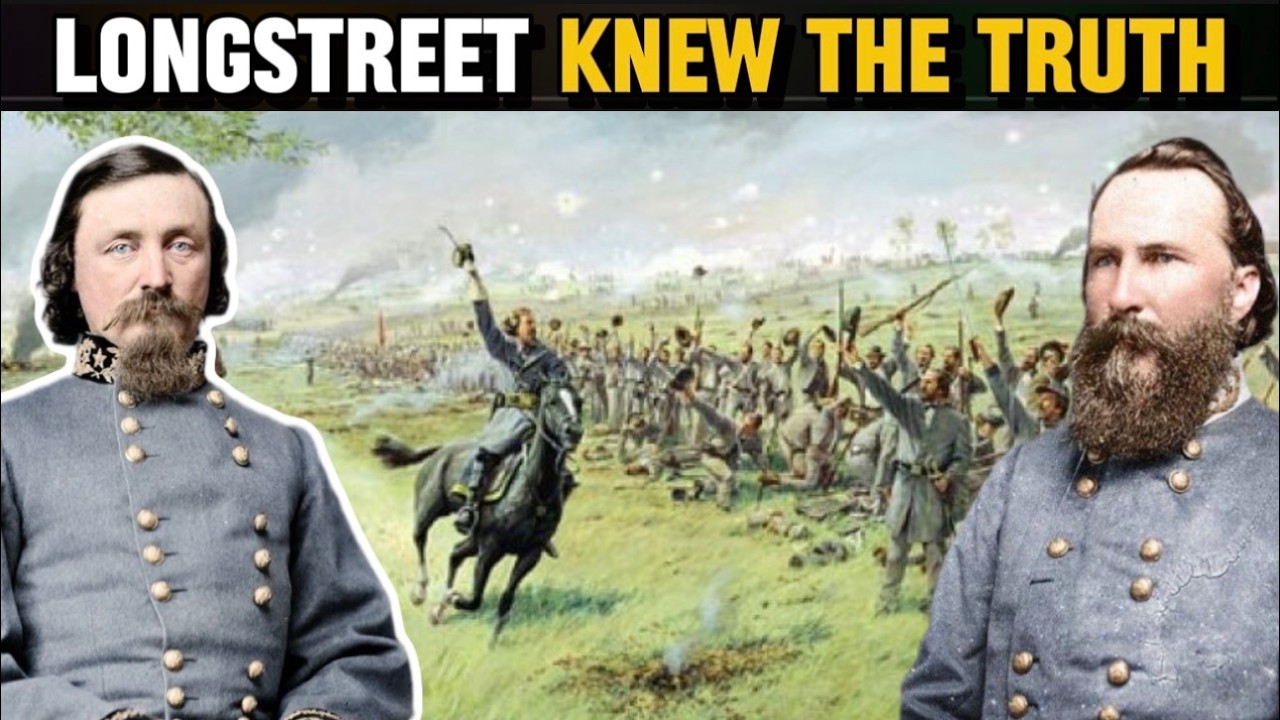
At 3:00 p.m., the charge began. Thirteen thousand gray-clad soldiers stepped out, flags waving, bands playing. They dressed ranks and advanced steadily across the fields.
Union artillery tore gaps in the lines. Canister shot and exploding shells cut men down in heaps. The survivors closed ranks and kept moving, yelling the rebel cry.
Halfway across, fences slowed them. At the Emmitsburg Road, crossfire intensified. Pettigrew’s left crumpled under enfilade fire. Pickett’s Virginians angled right, focusing on a copse of trees near a stone wall bend called the angle.
Lewis Armistead led a final rush, hat on sword tip, over the wall into hand-to-hand fighting. For a moment, they breached the Union line. It was the high-water mark of the Confederacy.

But Union reinforcements poured in. Bayonets clashed. Muskets clubbed skulls. Armistead fell mortally wounded, his hand on a Union cannon.
It was over in about 30 minutes. Survivors staggered back, leaving fields carpeted with dead and wounded. Pickett’s division lost two-thirds of its men. All of its brigadiers were down. Total Confederate casualties that day exceeded 6,000.
When Lee met the remnants, he said, “All this has been my fault. It is I that have lost this fight.”
Longstreet, watching from the ridge, felt vindicated but heartbroken.
The retreat began July 4, amid rain and mud. Meade pursued cautiously, missing a chance to destroy Lee’s army. Combined casualties at Gettysburg reached 51,000, with about 23,000 Union and 28,000 Confederate losses. It was the bloodiest battle of the war.
Lee’s invasion was shattered. Vicksburg fell the same day, splitting the Confederacy.
In the aftermath, blame swirled. Lee took responsibility in his report. But after the war, Lost Cause mythmakers, including Jubal Early and Fitzhugh Lee, scapegoated Longstreet. They accused him of sulking, delaying on July 2, and disobeying sunrise attack orders that never existed.
Longstreet’s real sin in their eyes was becoming a Republican, supporting Reconstruction, and criticizing Lee in his memoirs. He defended himself, writing, “I had offered my objections to Pickett’s battle and had been overruled.”
Historians now side with him. His cautions were sound. Lee’s confidence proved costly.
What if they had listened? A flank maneuver might have drawn Meade out, prolonged the war, or forced negotiations. Instead, Gettysburg marked the turning point. Union morale soared, and foreign recognition for the South faded.
Longstreet lived until 1904, serving as a diplomat and railroad commissioner, but he was always shadowed by Gettysburg. His legacy is that of a brilliant tactician who knew the price of folly.
Today, the fields are preserved as a national park. Visitors honor the fallen and ponder the roads not taken.