Thomas Lipton was a butcher’s son from one of Glasgow’s poorest slums, barely able to read and write. He had no formal education, no connections, and not one single day of experience in tea plantations. And yet, within a few short years, he completely dismantled a trading system that had dominated global tea for two centuries. The most surprising part is that he did it without ever being a tea expert.
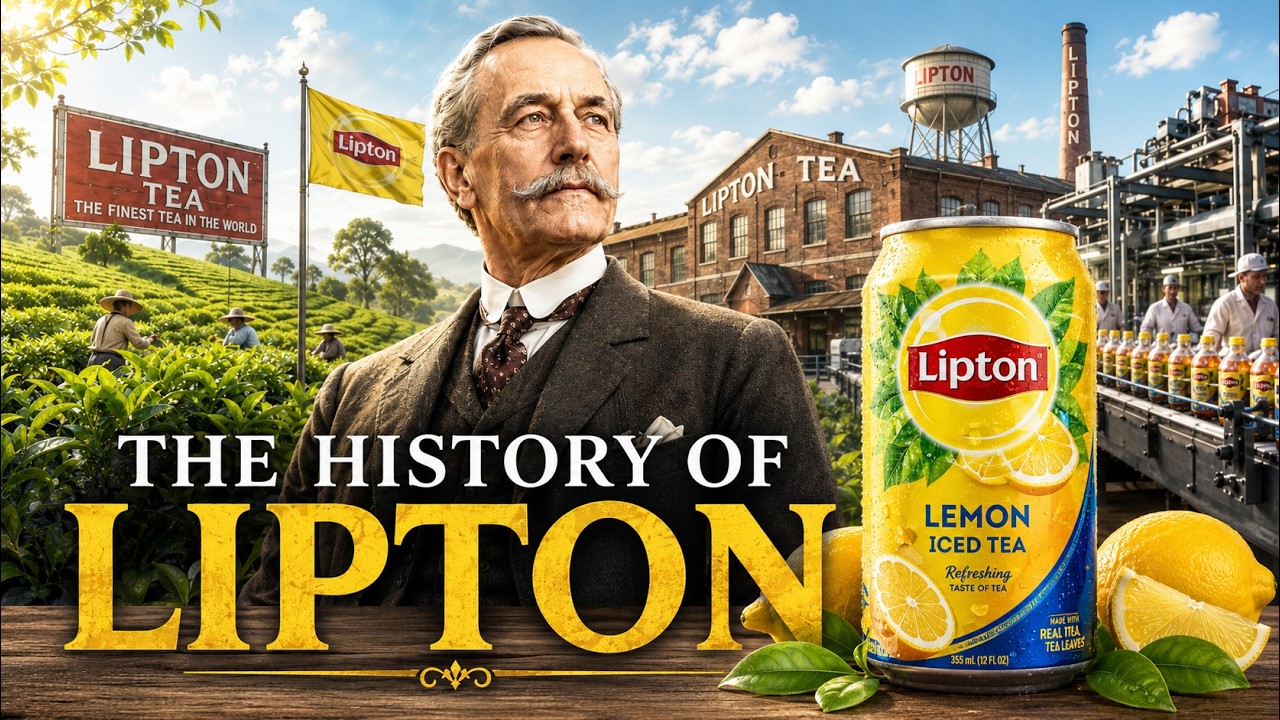
He was a grocer from the Gorbals. By the time he finished, he had made himself one of the richest businessmen in the world by inventing a simple trick more than 130 years ago—one that nearly every supermarket on the planet still uses today. His story begins in the poorest kind of poverty. In the mid-19th century, his family had fled the Great Famine in Ireland and settled in the Gorbals district of Glasgow, then one of Britain’s most deprived neighborhoods.
They lived in a four-room flat on Crown Street. Out of five children, only one survived—Thomas. The family paid three pennies a week for his schooling, a considerable sum for them, but his education did not last long. By the age of seven, the boy was already working, delivering goods and running errands for coins.
There was no childhood in the usual sense—only work. His father eventually ran a small shop, though it barely made enough money to survive. Competition among poor shopkeepers in the district was fierce and locals could hardly afford food, let alone luxury goods. But one small detail set this boy apart from the others.
Thomas was fascinated by street vendors. He could stand for hours watching how market sellers managed to convince crowds to queue up for goods that had previously gone unwanted. His parents assumed it was only a child’s curiosity. They were wrong.
At 15, Thomas made a decision that changed everything. He boarded a ship and sailed to America alone, with almost no money and knowing no one on the other side of the Atlantic. He did not find money there. But he found an idea—and it was that idea that would eventually make him a millionaire.
In the United States in the late 1860s, the young man moved from job to job: farmhand, salesman, clerk in a small store. Thousands of immigrants followed the same path. But while others were simply trying to survive, Lipton was watching and remembering. He noticed something that did not yet exist in the stiff, conservative world of British commerce.
American merchants understood how to sell not just a product but a spectacle. Bright signs, loud advertisements, and live demonstrations inside the store itself—everything British shopkeepers considered vulgar and unseemly. For a British merchant, the shop was a quiet, respectable space where noisy advertising was almost improper. To an American, it was a stage on which the loudest, brightest, boldest person won.
Without realizing it, Lipton received a free education in marketing decades before the word itself became part of everyday language. While other immigrants saved every dollar just to survive, Lipton gathered observations. He studied how a street vendor could convince a crowd, in a single sentence, that this was their final chance to buy something valuable—and how a storefront designed like a theatrical display could draw passing strangers in and turn them into regular customers. In 1869, he returned to Glasgow.
He still had no capital, but he owned something no other shopkeeper in the city had: the understanding that trade could be a form of entertainment. He was about to turn that knowledge into a weapon. The answer began with one small shop on the outskirts of Glasgow and £100—money Thomas, at age 21, had managed to save only after years of exhausting work with almost no sleep. In 1871, using savings he and his mother had spent years accumulating, he opened a small store in Glasgow.
At first nothing about it was unusual—just another grocery among dozens. Then Lipton did something the city had never seen before. He brought in massive shipments of meat and cheese and turned their arrival into a public spectacle: a brass band, a procession through the streets, crowds gathering just to watch. People came simply to see the show—then walked into the shop while they were there.
He invented a trick every modern marketer would recognize. He placed a giant piece of cheese weighing hundreds of kilograms in the shop window as an attraction, with the claim that a gold coin was hidden somewhere inside it. Enter and search for it. Crowds lined up just for the chance.
Before Christmas, he organized processions with whole slaughtered pigs decorated with ribbons, as if performance rather than simple meat delivery. His competitors were shocked. Could you really sell groceries this way? Respectable shopkeepers who had built their reputations over decades looked down on him while secretly envying him, because their stores sat empty while Lipton’s was packed.
He came up with another idea that would outlive him by more than a century. Instead of using round prices, he set them just slightly lower. Customers felt as if they were saving money even when the difference was tiny. Today, nearly every store in the world uses this technique.
In the 1870s, it was a genuine innovation—and it worked brilliantly. By 1880, he already owned 20 shops. By 1890, there were 300 across Britain. Lipton became a national name before selling a single gram of tea.
The real revolution had not yet begun. It would start with a trip he presented to everyone as an ordinary vacation. In 1890, Lipton was 40 years old. He was already rich and famous throughout Britain, but to the wider trading world he was still an ambitious grocer.
Then he told his colleagues he was going on holiday. Supposedly, he sailed to Australia to relax. On the way, his ship stopped at the port of Colombo on the island of Ceylon. Here the real scheme began.
Twenty years earlier, almost the entire island had been covered with coffee plantations. But a fungal disease had virtually wiped out Ceylon’s coffee industry within 15 years. Desperate bankrupt plantation owners were selling their land for almost nothing to salvage whatever they could. Lipton came ashore.
Instead of seeing devastation, he saw the perfect opportunity. Local plantation owners, financially ruined, were ready to sell their land at rock-bottom prices to recover a small fraction of their investment. And there was effectively no competition from the great London tea houses on the island. They were used to buying tea after processing through middlemen in London.
It never occurred to them to travel thousands of miles to become landowners themselves. While the tea traders of Mincing Lane—the street that had set the world tea price for two centuries through its closed network of brokers and auctions—continued to control supplies through layers of middlemen, Lipton quietly began buying up the ruined plantations one by one. Within a few months, he acquired several properties covering more than 15,000 acres, including the famous Dambatenne estate high in the mountains at nearly 1,500 meters. When news finally reached London, people laughed openly.
Who did this grocer think he was? Butcher and cheese seller buying plantations! They would stop laughing soon enough. Lipton was doing something no one had ever done in the tea trade before.
He removed every middleman from the chain. Previously, tea went from the planter to a broker, then to a wholesaler, then another wholesaler, and only then reached the shop—with the price rising at every stage. Lipton owned the plantation, processed the tea himself, packaged it there, and shipped it directly to his 300 shops. There was not a single unnecessary link in the chain.
The result was a price that left his competitors stunned. At the time, the usual price for tea was about three shillings per pound—far too expensive for the working class. Lipton sold his tea for only one shilling and seven pence—roughly half the price. He announced it throughout Glasgow with a procession of brass bands and bagpipers celebrating the arrival of his first shipment of 20,000 chests of tea.
He created a slogan that would live for more than a century after his death: “Direct from the tea gardens to the tea pot. ” For the first time, customers could be certain there was no unnecessary intermediary between them and the fields where their tea was grown. The merchants of Mincing Lane tried to fight back. They spread rumors that tea from newly converted coffee plantations was poor quality—cheap tea for the poor.
But customers who could now drink tea daily instead of only on special occasions did not care what the snobs of the London tea exchange said. Lipton’s sales grew so quickly that the Mincing Lane exchange itself had no choice but to take the prices set by the former butcher from the Gorbals seriously. This is the most important moment of the story. It is not the story of a boy from the slums, nor the shows outside his shop.
It is the story of one man who, almost single-handedly, smashed a commercial system that had stood for two centuries and made a luxury drink affordable to the very people who had once carried coal for pennies—just as he once had. But building the empire was only half the battle. He had to keep it alive. And Lipton’s next trick was so brilliant that it would outlive him personally.
The term “Orange Pekoe” already existed in the tea trade, but it simply referred to the size of the tea leaf—a technical classification used by professionals that meant nothing to ordinary customers. Lipton did something we might today call a brilliant commercial rebranding. He turned a boring technical term into the name of a premium, distinctive tea—as if it were a unique product with no real substitute. Customers had no reason to understand the complexities of tea-leaf classification.
They simply heard the elegant, royal-sounding words “Orange Pekoe” and believed they were buying something exceptional. Then came another trick. In his advertisements, Lipton repeatedly used the word “brisk,” meaning lively or fresh. For professional tea tasters, this simply meant the tea was fresh and had not lost its flavor.
But for customers, it became a promise: fresh, lively, authentic tea—unlike what competitors were selling. In essence, Lipton was one of the first people in the business world to understand something every brand manager knows today: you do not necessarily have to sell a different product. Sometimes, you simply have to tell a different story about it. The same tea leaf was just a leaf when his competitors sold it.
With Lipton, it became fresh Orange Pekoe, coming directly from the plantations with no middlemen. He went even further. At the Dambatenne estate, he built his own tea-processing factory and imposed strict, consistent standards, using the same drying, rolling, and sorting methods across all his plantations. His goal was simple: a cup of tea bearing the Lipton label had to taste identical whether drunk in London, New York, or Cape Town.
Today we call this brand standardization. In the 1890s, no such term existed. Lipton was effectively inventing the concept through his experiments and sales. By the beginning of the 20th century, he was one of the richest men in the British Empire.
Queen Victoria knighted him, and a few years later he received a baronetcy. The boy who had delivered coal for pennies was now Sir Thomas Lipton. It seemed like a perfect ending. But the most surprising part of his story is that Lipton won the love of ordinary people not through victories but through a series of highly public and humiliating defeats.
Sir Thomas had one obsession: yacht racing, specifically the America’s Cup, the oldest and most prestigious trophy in the sailing world. His pursuit of this prize became the passion that defined the last 30 years of his life. In 1899, he entered his yacht Shamrock in the America’s Cup against the Americans. Each new yacht was built with the latest technology, and every attempt cost a fortune—amounts that at the time would have built hundreds of additional shops.
Still, he lost. In 1901, he returned with a second yacht, Shamrock II, with a more ambitious hull design. He lost again. A few years later came a third attempt—another defeat.
Then a fourth, with exactly the same result. Each time, newspapers on both sides of the Atlantic asked the same question: would Britain’s richest grocer finally bring the cup home? And each time, the answer was no. Then, in 1930, when Lipton was in his eighties, he made his fifth and final attempt—and lost again.
Five attempts, 31 years of competition, tens of thousands of pounds invested in sails and yachts, and not a single victory. For a man who had single-handedly broken a 200-year monopoly in the global tea trade, it seemed almost absurd. One of the greatest businessmen of his era was completely helpless before a piece of metal shaped like a cup. But here is the paradox that changes the story completely.
Those defeats were exactly what made him so incredibly beloved. After every loss, he appeared before the press, looking not defeated but with the same familiar smile. He would shake the winner’s hand and promise he would return to try again. British and American newspapers began to call him the greatest loser in the history of sport.
This was not meant as an insult—it was sincere praise. Crowds in the harbors greeted him after his defeats with as much enthusiasm as they would have shown a winner. Why? Because millions of ordinary people—like the man he once had been, delivering coal and working for pennies—could finally see one of the richest men in the Empire not as an untouchable figure but as one of them: someone who tried, failed, refused to give up, and tried again.
A successful businessman earns respect. But a man who loses with dignity and determination earns something rarer: love. On October 2, 1931, Sir Thomas Lipton died at his home in London at the age of 81. He had remained a bachelor his entire life, devoting himself wholly to his business and to the yacht that never once brought him victory.
Then something happened that completed the story and brought it back to where it began. Under the terms of his will, the proceeds of his fortune were placed in a special trust to help the poor of his native Glasgow—in the very Gorbals district where he had delivered coal for pennies as a seven-year-old boy. By the mid-1940s, the trust had provided assistance to Glasgow’s poor equivalent to tens of millions of pounds in today’s money. The brand outlived its founder by decades.
In 1938, Unilever acquired the American and Canadian divisions of his company. In 1972, the rest of the empire followed. Today, more than a century and a half after that poor Irish immigrant stepped onto the shore of Colombo disguised as an ordinary tourist, Lipton remains one of the most recognizable tea brands on earth. The same yellow package sits in the kitchens of hundreds of millions of people around the world, from London to Tashkent.
The Dambatenne estate, where it all began, still stands in the mountains of Sri Lanka. There, at a viewpoint overlooking endless rows of tea bushes, a bench and a statue commemorate the man who once stood in that very spot and looked at the green slopes as if seeing a whole island of opportunity before him—not just ruined coffee fields that no one else had the courage to buy. And that is what you should remember. Every time you pour a cup, you are not just drinking tea.
You are drinking the direct result of a bold adventure and a stroke of genius by a poor boy who decided one day that the rules everyone around him accepted did not necessarily have to apply to him.