In the spring of 1938, a 20-year-old bride walked into Caxton Hall in Westminster for her wedding. Standing beside her, holding the ring, was a boy of 16—a prince with no throne and no country of his own.
The photographers barely noticed him. Within a decade, that boy would marry the future Queen of Englandaint The woman he stood beside that day would later bear two children with no named father. For half a century, the world studied the face of her elder child and swore it saw the prince staring back.
This is the story of Hélène Cordet, the man who became the Duke of Edinburgh, and the son who carried a question to the grave.
## Two Children of a Fallen Throne
When the Greek monarchy collapsed in 1922, a gunboat carried a small Greek family out of a country that no longer wanted them. Among them was an infant prince, not yet 18 months old, asleep in a cot improvised from a wooden fruit crate.
His name was Philip, a prince of Greece and Denmark by blood, and a refugee by every practical measure. His uncle, King Constantine, had abdicated. His father, Prince Andrew, had been arrested, tried, and banished. The throne the family had served was gone.
The exiles drifted toward Paris, where a web of relatives kept them afloat. Princess Marie Bonaparte housed them for some seven years and paid for the children's schooling. Philip's was a boyhood of other people's kindness lived in other people's rooms.
One of those families was the Fufounis family. They were Greek royalists, too—wealthy, displaced, and devoted to the same lost cause.
There were three children who mattered to this story. A son, Yanni, became Philip's inseparable companion. And there was a daughter, older than both, named Helen. She was born in 1917, making her some three and a half years older than Philip.
In later years, she would describe Philip with the unsentimental affection of an older sister. She complained that her mother paid the little prince too much attention, yet allowed that he was a very nice little boy.
Philip's own home life was coming apart. His mother, Princess Alice, was descending into mental illness. His father drifted to the Riviera. His four sisters married into German nobility and were gone. By the time he was 10, he had effectively no settled family.
The steadiness of the Fufounis household meant something. They kept turning up, holiday after holiday, a fixed point in a childhood with almost no other fixed points. A bond formed in that kind of childhood does not dissolve. It follows you into adulthood.
## A Wedding and a Boy of 16
The Fufounis family eventually washed up in England. They opened a restaurant in Mayfair and named it La Belle Hélène, after the daughter who had grown into a striking young woman.
Hélène was dark, poised, fluent in several languages, and entirely at ease in society. In 1938, at age 20, she married. The groom was William Kirby, known as Bill.
The marriage took place on March 30, 1938, at Caxton Hall in Westminster. Standing up as best man, holding the ring, was Prince Philip of Greece. He was 16 years old, still a nobody by the world's measure.
You do not ask a passing acquaintance to be your best man. You ask the person who has been family. To Hélène, Philip was the boy she had half raised, now grown tall and confident. To Philip, Hélène was one of the last living threads to a childhood that had scattered.
The marriage itself was not a success. Within a few years, war came. Bill Kirby was posted abroad Cookies The distance hardened into estrangement.
## The War That Took a Husband
The Second World War fell on Hélène's generation like a blade. Husbands vanished into uniforms and were posted to far corners of the conflict. The marriage, never robust, did not survive the separation.
By the early years of the war, Hélène was, in everything but the cold legal paperwork, a single woman. The divorce lagged far behind the reality.
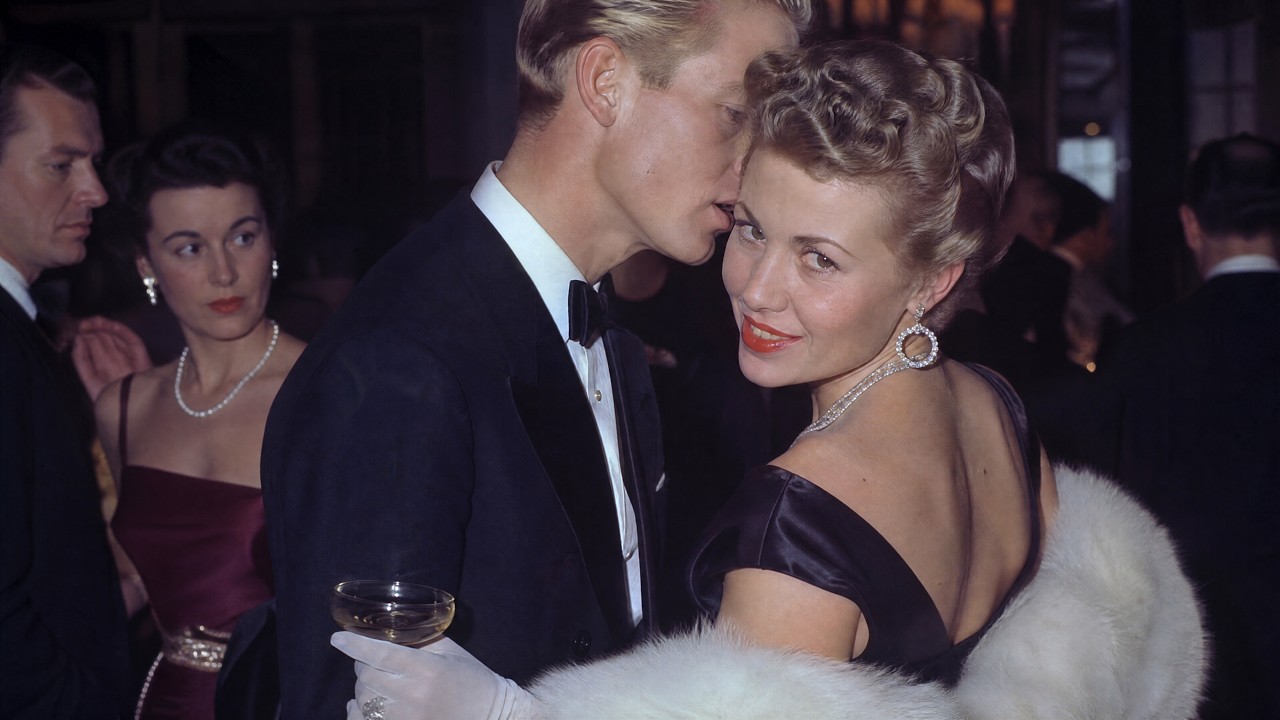
Wartime London loosened the ordinary rules of life. Death was close and constant, and people lived accordingly. Romances flared and burned out in weeks. A generation that did not know whether it would see the end of the war was not inclined to wait politely for the divorce courts.
In the middle years of the war, Hélène gave birth to a son. A little later, she gave birth to a daughter. She was still, on paper, married to a man who was plainly not the father.
When the children were registered, the official record was left to speak for itself. The space where a father's name should go was left blank.
That blank space is the true beginning of the scandal. In an age obsessed with legitimacy, a child registered with no named father was a quiet act of defiance, necessity, or protection.
Hélène named no one. She raised the children, kept her own counsel, and let the empty space stand as the only public answer she would ever give.
## Two Children and No Name on the Page
The boy was born in 1943 and given the name Max. In 1945 came a daughter, Louise. Both were registered with no father named.
In the Britain of the 1940s, illegitimacy carried a heavy and lasting stigma. For a woman to bear a child outside marriage was to invite a particular judgment. Yet here was Hélène doing it twice, declining to offer the world the explanation it demanded.
In 1947, she married again. The man was Marcel Boisot, an officer who had served with the Free French Forces. With the marriage, the children acquired a surname. They became Max and Louise Boisot.
The Boisot name settled the children's future. It could not cover the years that came before it.
## The Duke Who Paid the School Fees
On November 20, 1947, Prince Philip married Princess Elizabeth in Westminster Abbey. The penniless refugee had arrived at the center of British life.
What Philip did next is the documented core of the whole mystery. He became godfather to both of Hélène's children. Then he paid for Max's education.
He sent the boy to Cheam, the preparatory school he himself had attended. Then he sent him to Gordonstoun, the austere Scottish school that shaped his own character—the same school he would later send his own sons to.
Three acts spanned two decades. The best man at her wedding in 1938. The godfather to both her children in the 1940s. The payer of school fees at his own old schools through the 1950s.
Each act was perfectly innocent on its own. Laid beside the others, they formed a pattern the public found impossible to read as mere friendship.
There is another reading. Philip was a man raised on the kindness of others. He knew what it was to be a child dependent on the generosity of grown-ups who chose to care. To pay that debt forward was not the act of a guilty father—it could just as easily be the act of a loyal man settling an old account.
The kindness is real. What the kindness means is the one thing no document can establish.
## A Face the Cameras Loved
While the rumor grew underground, Hélène Cordet became famous above it. Television was coming to Britain, and Hélène was exactly the sort of figure the infant medium was hunting for.
She was given a program called Café Continental, a make-believe evening of continental cabaret. It ran through the late 1940s and early 1950s and made her one of the most recognizable women in Britain.

She was one of the first women to host her own program on British television. She tried film as well, but it was the television work that mattered. It put her face into millions of homes.
Fame in this calculus is not a shield. It is a price tag. The more famous Hélène became, the more valuable her secret grew. A blank space on an obscure birth certificate is of interest to no one. A blank space on the certificate of a celebrated television hostess whose children's godfather is the husband of the Queen was worth a great deal.
## The Roving Eye and the Thursday Club
The rumor did not catch fire on its own. It caught fire inside a larger story the papers were already telling.
In the autumn of 1956, the Duke of Edinburgh left on a long tour aboard the Royal Yacht Britannia, away from his wife for the better part of five months. The press began to talk of a royal rift.
The speculation found a focus in a London institution called the Thursday Club, a gathering of actors, writers, and well-connected men. Mike Parker, Philip's friend and secretary, resigned in early 1957 after his own wife filed for divorce. The press read it through the lens of the story they were already telling.
The palace did something it almost never does. It broke its silence. The Queen authorized her press secretary to issue a public denial that there was any rift between the Queen and the Duke.
But the denial said nothing about the older question—the television hostess, the fatherless children, the godfather who paid the school fees.
## The Book That Answered Nothing
In 1961, Hélène published an autobiography. She called it Born Bewildered.
In it, she wrote warmly about the childhood friendship with Philip. She celebrated the bond. On the question of her children's paternity, she was silent.
She gave her readers everything except the one thing they had come for. When the subject was raised, she would say only that Philip and Marcel had both been wonderful to the children. The sentence acknowledges both men, praises both men, and settles absolutely nothing.
## London's First Discothèque
In 1961, the same year her autobiography appeared, Hélène opened a nightclub. It stood just off Park Lane in Mayfair, and it has a fair claim to be the first true discothèque in London.
She called it the Saddle Room, a theme of horses and hunting. It opened with a starting stock of just 50 records. The fashionable young of London came to dance to the Beatles and the Rolling Stones in a room decorated like a country squire's tack room.
The Saddle Room became the place where the better off began to swing. The club outlasted her involvement by years, surviving into the 1980s.
Refugee, wife, mother, actress, broadcaster, nightclub impresario. Almost no one lives that many lives.
## The Son Who Looked Like a Prince
Every few years, the newspapers printed the same two photographs side by side. On the left, a young Prince Philip. On the right, Max Boisot as a young man.
The implication was wordless. The same long jaw. The same deep-set eyes. The same fair coloring. The papers did not need to make an accusation. They needed only to print two photographs and trust the reader to supply the conclusion.
But a face is not a birth certificate. Resemblance is the weakest evidence there is. The human eye sees what it has been told to look for. Show a person two faces and tell them they are related, and they will find the resemblance every time.

The side-by-side photograph proved precisely nothing. It planted a certainty that no fact could dislodge.
## "My Real Father Lives in Paris"
For all the decades the press spoke about Max Boisot, it rarely let him speak himself. When he did address the rumor, he did so with clarity.
He said he had heard the rumors all his life and that they were ridiculous. He said his father, his real father, lived in Paris. He traced the whole thing back to the childhood friendship between Philip and his mother.
He was flat and unambiguous. Marcel Boisot, the Frenchman who married his mother in 1947, was his father.
The world was offering Max a kind of glamour. He turned it down plainly in favor of the truth as he knew it.
But a denial, however firm, cannot prove a negative. The two people whose word carried weight—his mother and the Duke—never spoke to the point at all.
## The Mind They Never Saw
Behind the tabloid face was one of the more original thinkers of his generation. Max Boisot rose to be a professor of strategic management.
He was associated with IESE in Barcelona. He spent years in China running a pioneering management program in Beijing in the 1980s. He taught in London at Birkbeck.
His real subject was knowledge. His major work, published toward the end of the 1990s, set out a framework for what he called the information economy. It is still read and cited today.
Max Boisot died in September 2011 at age 67. The end came quickly, only weeks after he was diagnosed with cancer.
## The Silence Kept to the Grave
One by one, the people who could have ended the story died, and each took the same nothing with them.
Hélène died in 1996 at age 78. She had spent more than half a century being asked the same question. She never answered it.
Max followed his mother into the same silence. He held to his version without wavering.
Prince Philip died in April 2021, just short of his 100th birthday. He never once addressed the rumor. Not a confirmation, not a denial, not a hint.
Three people, one silence, kept faithfully to three separate graves. The question outlived every person who could have answered it.
## The Difference Between Love and Blood
The record holds two things at once and refuses to choose between them.
What is documented is the love. A boy of 16 standing up at a young woman's wedding because she had been family to him in exile. A man who became godfather to her fatherless children. A prince who paid to send her son through his own old schools.
That is a record of loyalty. Of a debt remembered and repaid. Of a childhood bond that held firm.
What is not documented is the blood. The claim that Philip was Max's biological father has never been proven, was denied by Max himself, and rests on the timing of two wartime births, a resemblance in a face, and a silence that the public chose to read as guilt.
The whole meaning of the story lies in the gap between them. Some questions are not meant to be answered. They are only meant to be kept.