A death certificate filed in Pennsylvania in September 1966 lists the cause of death as acute coronary occlusion—a heart attack. The man it describes was 36 years old. What the document does not mention is that he died strapped into leather restraints on a ward of Farview State Hospital, with other patients watching as guards beat him across the throat and pressed a pillow over his face until he stopped moving. Years later, a forensic pathologist would call the death highly suspicious, and state police investigators would conclude there was strong evidence of murder.
No one was ever charged. The certificate was never corrected. And within that one hospital, such paperwork was not unusual. There was a stack of them.
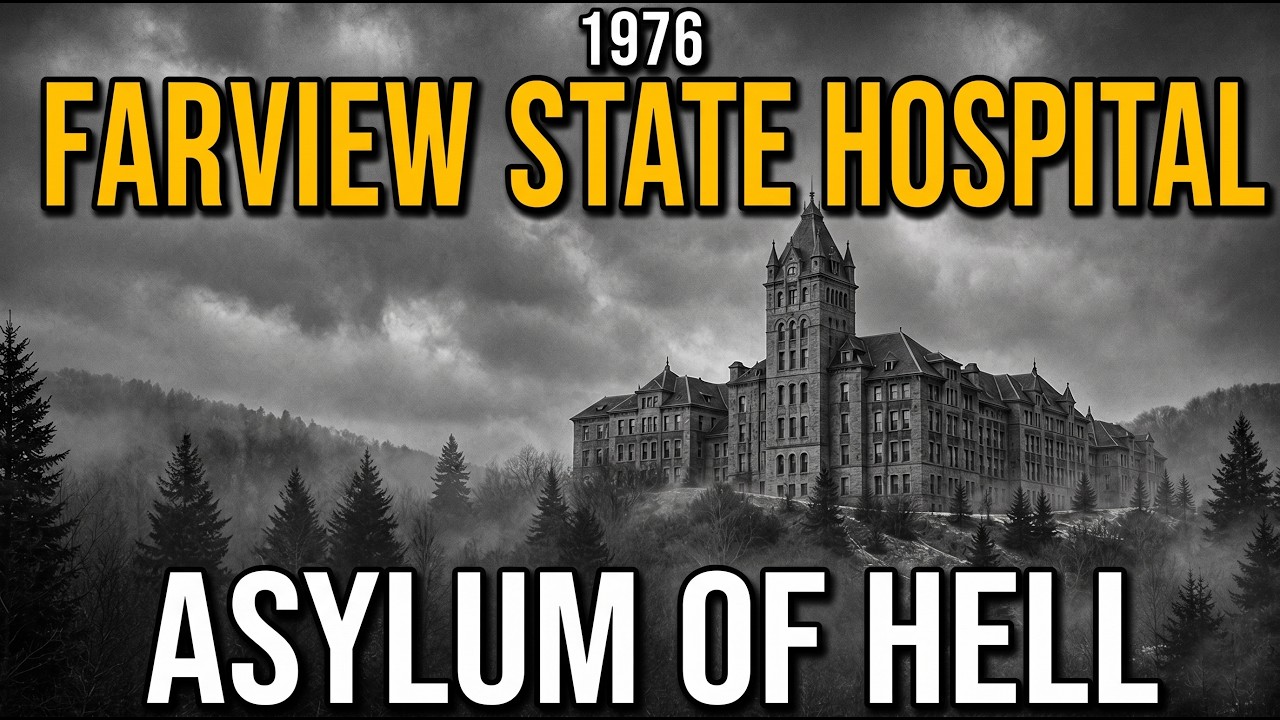
Farview opened in December 1912 on a remote plateau in the Moosic Mountains of Wayne County, Pennsylvania, near the town of Waymart. The state built it to hold a category of men no one else would accept: those judged both criminal and insane. Prisons said they were too sick to hold; hospitals said they were too dangerous to treat. Farview was the state’s answer—a hospital, not a prison, where patients would be treated, not punished.
The location was part of the design. Distance from the cities meant fresh air and farmland, but it also meant isolation. Farview, by definition, held the men with the fewest defenders in Pennsylvania. Their families had often signed them away with relief, and their word, as both criminals and lunatics, counted for nothing twice over.
The institution concentrated the least sympathetic patients in the state and placed them hours from any city, behind walls no journalist had reason to pass and no inspector could reach without a long drive and advance notice. There were four ways into Farview. Courts sent men found not guilty by reason of insanity. Prisons sent convicts who broke down inside.
Other state hospitals sent patients they deemed unmanageable. And the widest door was civil commitment, which allowed a man to be sent to Farview without ever being convicted of anything, on paperwork stating he was insane and dangerous. Once inside, there was no sentence ticking down, because there was no sentence at all. There was only a file.
Release depended on a doctor someday deciding a man was sane, which meant, in practice, that release depended on being examined at all. At Farview, that was not something that reliably happened even once. By mid-century, the institution was overfull. An inspection in 1944 counted more than 1,000 men in a facility rated for roughly 850, and the population peaked at around 1,400 in 1962.
Against those numbers, Farview employed, at times, between two and six physicians—general doctors, not psychiatrists. When investigators checked in the 1970s, there was not one board-certified psychiatrist on the staff of Pennsylvania’s only hospital for the criminally insane. One doctor for several hundred committed men is not treatment. It is storage with a letterhead.
A federal court was later told that some men waited 26 years, some 30, for their first real psychiatric evaluation. In 1971, a federal case called Dixon v. Attorney General forced Pennsylvania to examine who was actually on that mountain. Roughly 100 of Farview’s patients had never been convicted of anything at all.
Hundreds were held long past any sentence they had received. One man, sent away for disorderly conduct with a 30-day sentence, was still inside 30 years later. The court ordered the Dixon men re-examined, and in the years that followed, hundreds were transferred or released. Old men walked out of a fortress they had entered young, into a world built entirely without them.
With doctors absent and courts far away, the wards were run by the guards. And the guards had their own law. A retired Farview guard named John Norton, who had served as secretary of the guards’ union, explained it to reporters in one sentence: when a guard hit a patient, you had to jump in. If you did not, you were pulled off that ward immediately.
The code did not permit violence. It required it. Every guard present had to join a beating, and the man who held back was the one punished. Violence was not an incident at Farview.
It was a duty roster. Around that core, an economy grew. Patients worked without pay, doing the cooking, cleaning, hauling, and farming in a system investigators described as industrial peonage, which survived into the 1970s. Their money, cigarettes, and belongings were extorted or taken by the men who held the keys.
Discipline was brutal: men were forced to strip naked, and some were shackled to cold floors. When muscle was not enough, there was chemistry. Farview’s answer to a difficult patient was Thorazine or Sparine, heavy tranquilizers from the first generation of antipsychotic drugs, given at doses investigators would later describe as toxic. Used carefully, these drugs were a psychiatric breakthrough.
Used the Farview way, they were a chemical version of the leather restraints—a dose calculated to switch a man off. On some wards, guards organized fistfights between patients the way other men organized cockfights. They paired men off, formed a ring, and bet on the outcome. If a man refused to fight, he faced the guards instead.
It was safer to fight. A system like that produces bodies, and bodies require paperwork. In March 1960, patient Thomas Garrett, 37, died. His death certificate said pulmonary embolism—a blood clot in the lungs, the kind of death that simply happens and invites no questions.
The certificate did not mention that Garrett had been struck down in the dining hall in front of other patients a month earlier, his jaw and ribs broken. He lived another month with that face. Then he died, and the paperwork reached for the blood clot. The hospital’s own records contradict each other about his autopsy, and both doctors named in the file as having performed it later denied ever doing so.
In January 1963, patient Russell Sell, 46, died six days after, according to a fellow patient, being beaten by a guard. The beating came not for violence or escape but for complaining that meat was being stolen from the patients’ kitchen. His certificate said heart attack and added a detail nobody had asked for: that there were no wounds or fractures. The autopsy found three broken ribs.
A man named John Rank, 68, died with a sandwich in his throat. The certificate said he choked, which may have been technically true. What it left out was that Rank had been dosed with Thorazine at more than double the therapeutic maximum—a level that suppresses the swallowing reflex—and that no nurse was on the floor and no physician in the building. His body lay unrefrigerated for 14 hours.
An epileptic patient named Alfred Miller, 61, was forced by guards to strip and taunted before he died, according to witnesses. The doctor who certified his death did so by telephone from nearly 20 miles away without ever seeing the body. Not every beating ended in a certificate. Rayford Smith survived a scrotum torn in a beating and, in his words, “urinated blood for 3 months.
” Arthur Pitts had both shins stomped and a tooth kicked out. A witness described the body of Haywood Speaks in 1956 as looking like a piece of raw meat. These men lived, and their files, for the most part, stayed closed. One certificate, more than any other, shows exactly how the system worked from beginning to end.
It belongs to a man the other patients called Stonewall. His name was Robert Jackson. He was 36 years old, nicknamed after the Confederate general who shared his name. The nickname is nearly all the personality the record preserves.
Everything the file keeps about Jackson—the restraints, the certificate, the autopsy that never happened—was written by the institution. On September 24, 1966, guards put Robert Jackson in leather restraints: cuffs at the wrists, straps to the bed frame, a man fixed on his back like cargo. Restraints were routine at Farview. A restrained man is, by definition, no longer a threat to anyone.
He cannot defend himself. He cannot even protect his own face. What happened next was watched by the men in the beds around him. Three patients—William James Wright, William Franklin Sipes, and Clayton Allen Tahune—would later describe it independently.
They said guards beat Jackson while he lay strapped down, striking him across the throat. Then, they said, a pillow was pressed over his face and held there until Robert Jackson stopped moving. The paperwork worked exactly as it had for Garrett and Sell. A doctor recorded the death.
The certificate was typed and signed. The cause of death was given as acute coronary occlusion—a heart attack at 36. The body went into the ground, the file into the cabinet, and the ward back to its routine. For 10 years, the paper version of Robert Jackson’s death was the only version that officially existed.
But the men in those beds did not forget. When investigators finally came asking a decade later, Wright, Sipes, and Tahune each told the same story from their beds: the restraints, the blows to the throat, the pillow. A veteran forensic pathologist, Dr. Halbert Fillinger, reviewed the case and said the death was “of a highly suspicious nature” and that it “may well have been suffocation.
” The Pennsylvania State Police went further, concluding there was strong evidence of murder. Nobody was ever charged with anything. Nobody was charged for Jackson, or for Garrett, or for Sell. Nobody was ever charged for any death at Farview.
The state was given two chances to act. In November 1974, Pennsylvania’s Attorney General Israel Packel ordered an investigation into Farview, naming threats, beatings, illegal contraband, and deaths. Seventeen months later, on April 16, 1975, Packel’s successor, Robert Kane, announced the result: the investigation had found no evidence supporting allegations of criminal violations. In the same period, the state police files on the Jackson case contained their conclusion of strong evidence of murder.
Both sentences were sitting in Harrisburg at the same time. Only one was read aloud. A bureau director named Cecil Yates later offered an answer. The investigation, he said, had been superficial.
When investigators studied injuries, they analyzed the files of injured guards, but not the files of injured patients. Meanwhile, in 1975, a researcher working with the National Institute of Mental Health interviewed 269 former Farview patients. The study was not even about abuse. Nobody asked a single question about violence.
Yet 45% of those interviewed brought it up on their own, unprompted, describing beatings they had seen or received. These were men scattered across different hospitals and towns, interviewed separately, with no way to coordinate a story. Almost half of them volunteered the same account of the same place. The evidence had never been missing.
It walked out of Farview on two legs, hundreds of times over, and the state had simply never asked it anything. At the Philadelphia Inquirer, a complaint about Farview reached the newsroom—accounts differ on who sent it, a grieving mother or a former patient. It landed on the desks of two reporters, Acel Moore and Wendell Rawls Jr. They had no official power.
They could not subpoena a file, exhume a body, or compel an interview. What they had was three months, a car, and the one advantage the state had never used: they actually wanted to know. They found former patients across the state, many of them Dixon men, whose testimony had been worthless for decades because of where they lived, and who now told their stories in their own living rooms. They found former employees willing to talk, including guards.
Then the reporters pulled death certificates and matched them against autopsy records and eyewitness accounts, name by name, date by date. They did what 17 months of official investigation had not done. They read the patients’ files. In the summer of 1976, the Inquirer began publishing what they found in a series that became known as the Farview findings.
They printed the beatings and the code that required guards to join them. They printed the organized fights and the betting, the tranquilizers at toxic doses, the extortion, the forced nakedness, the men shackled to cold floors. And above all, they printed the deaths: Jackson, Sell, Garrett, and the others, laid out next to the certificates that had converted each of them into natural causes. One detail stayed with every reader.
A patient named Calvin Bush, 32, died in October 1973 while eight guards held him down, one of them—a man weighing roughly 200 pounds—sitting on his chest. His certificate blamed a heart rhythm disorder aggravated by excitement. Then a dose of Sparine was injected into him after he was already dead. A syringe was emptied into a corpse, as if the paperwork needed the drug to be somewhere other than the vial.
The series detonated. Pennsylvania could no longer claim there was no evidence. The evidence was on the front page with names. A grand jury was convened, and prosecutors eventually charged roughly three dozen current and former Farview employees.
Then the mountain defended itself one last time. Witnesses were patients, and patients could be discredited. Colleagues closed ranks behind the code. In the end, of all those men, exactly one was convicted of assault.
Everyone else was acquitted or had their cases dismissed. For the deaths—for Jackson under his pillow, for Sell and his three broken ribs, for Garrett’s autopsy that no doctor remembers performing—no one was ever convicted of anything. In 1977, Acel Moore and Wendell Rawls Jr. received the Pulitzer Prize for the Farview findings.
The prize marks not a rescue by the system, but a rescue from outside it. The courts had reached Farview in 1971, the attorney general in 1974, and the mountain had absorbed both. What it could not absorb was two reporters with a stack of death certificates and the patience to read them. After the series, Farview could no longer be invisible, and an institution like Farview cannot survive being seen.
Oversight arrived, the unpaid labor ended, staff changed, and the population fell year after year as courts and doctors finally did the re-examinations that should never have stopped. The wards slowly emptied. In 1995, after 83 years, Farview State Hospital closed. But the building did not become a ruin or a museum.
The state of Pennsylvania kept it, renamed it, and filled it again. The complex on the mountain is now the State Correctional Institution at Waymart, a prison with a forensic treatment center for mentally ill inmates. Men judged both criminal and mentally ill are held there today on the same plateau, behind the same walls, under the same fog. Pennsylvania built Farview as a hospital that was not supposed to be a prison.
It took 83 years for the sign at the gate to catch up with the facts. Paperwork is what this story was always about. In 1912, paper made Farview possible: a commitment order was all it took to move a man onto the mountain forever. In 1966, paper made Farview safe: a certificate was all it took to move a man underground without a question.
And in 1976, paper is what finally brought Farview down, when the same certificates were pulled from the same cabinets and read at last by someone who compared them to the bodies they described. Robert Jackson has no memorial. Neither do Russell Sell, Thomas Garrett, Calvin Bush, John Rank, or Alfred Miller. What they have is a file.
For 60 years at Farview, nobody looked, and the certificate said “heart attack. ” Then two people looked, and the same certificate said “murder. “