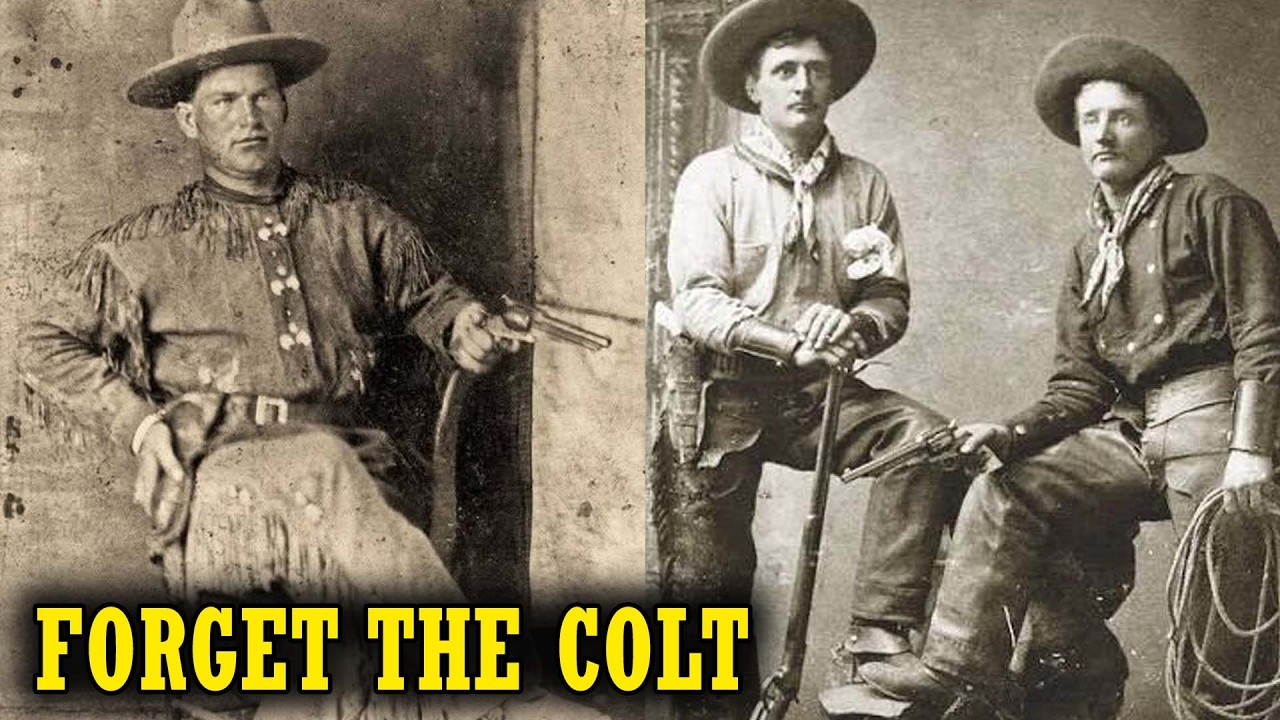
Hollywood has spent decades cementing the image of the Colt Peacemaker as the definitive sidearm of the Old West. But the real frontier was far more diverse, and many of the era’s most innovative and deadly revolvers never made it to the big screen. From heavy imported models to compact hideout guns, these weapons played crucial roles in the hands of lawmen, outlaws, and soldiers.
One of the most sophisticated revolvers of the era was the Merwin Hulbert. Produced by Hopkins & Allen in Connecticut, it was built with watchmaker-like precision. Its standout feature was a selective ejection system that allowed the shooter to rotate the barrel and pull it forward, automatically ejecting spent cartridges while leaving unfired rounds in place. This made reloading significantly faster than with a traditional Colt. The gun was chambered in heavy .44 caliber rounds and was favored by notable figures such as Pat Garrett, John Wesley Hardin, and Sam Bass. Hollywood largely ignored it because its tight tolerances made it difficult to use with modern blank ammunition, and surviving originals are valuable collector’s items.
The LeMat revolver was a Confederate favorite during the Civil War. Designed by Dr. Jean Alexandre LeMat, it featured a unique nine-shot cylinder surrounding a central barrel that functioned as a smoothbore shotgun. A pivoting hammer allowed the shooter to switch between firing revolver rounds and a blast of buckshot. Weighing over four pounds, it was a heavy and imposing weapon. General J.E.B. Stuart carried one throughout the war. Its unusual appearance and complex mechanics made it impractical for Hollywood productions, which favored more familiar silhouettes.
The Starr Model 1858 was a double-action revolver that offered a significant advantage in speed. Designed by Eben Townsend Starr, it used a large lever inside the trigger guard to cock the hammer and rotate the cylinder. The shooter could fire all six rounds by simply pulling the trigger repeatedly, without needing to manually cock the hammer. The U.S. government purchased over 20,000 of these revolvers during the Civil War, making Starr the third-largest supplier to Union forces. Its complex mechanism, however, made it difficult to maintain on film sets, and its rapid-fire capability did not fit the dramatic pacing of classic Westerns.
For those who needed a concealable defensive weapon, the Colt Cloverleaf House Revolver was introduced in 1871. It featured a compact four-shot cylinder with recessed chambers that gave it a distinctive cloverleaf appearance. Chambered in .41 rimfire, it offered more power than typical pocket pistols. It was famously used to kill financier James “Jubilee Jim” Fisk in 1872. Despite its effectiveness, its small size did not project the authority of a full-sized revolver on screen, and surviving examples are rare.
The Savage Navy Model 1861 was one of the most mechanically unusual revolvers of its time. It featured a large heart-shaped trigger guard housing two triggers. The lower ring-shaped lever was pulled with the middle finger to cock the hammer and rotate the cylinder, while the upper trigger fired the gun. It also used a sliding cylinder that moved forward to seal the gap between the cylinder and barrel, improving power and safety. The government contracted for around 12,000 of these revolvers, but the design was complex and production ceased after the war.

The Smith & Wesson Model 3 Schofield offered a major advantage in reloading speed. Its top-break design allowed the shooter to open the gun and eject all six spent cartridges at once using a star extractor. This cut reloading time roughly in half compared to a Colt. The U.S. Army purchased over 8,000 of these revolvers, and they were carried by notable figures like Jesse James, Wyatt Earp, and Theodore Roosevelt. Hollywood preferred the slower reloading process of the Colt because it created more dramatic tension.
The Remington Model 1875 was built for durability above all else. It featured a solid frame with a reinforced barrel support that made it more rugged than the Colt. It was available in powerful calibers, including .44-40 Winchester, which allowed users to carry the same ammunition for both their revolver and rifle. The U.S. Department of the Interior purchased 639 of these for Indian police forces, and the Mexican government bought around 1,000. Frank James described his Model 1875 as the strongest and most accurate revolver ever made. Its visual similarity to the Colt, combined with the abundance of surplus Colts available to studios, kept it off the screen.
The Walsh Pocket Revolver was an ingenious attempt to increase firepower. Patented in 1859, it used a system of superimposed loading, where each chamber held two charges stacked one behind the other. Two hammers and two triggers allowed the shooter to fire both charges from each chamber, giving a small pocket gun a capacity of up to 12 shots. Only about 3,000 of the smaller models were produced, and the design proved commercially unsuccessful.

The Tranter revolver was a British import that saw real use in America. Designed by William Tranter of Birmingham, it featured a double-trigger mechanism that allowed for rapid fire. It was offered in massive calibers, including .442, .500, and even .577, providing tremendous stopping power. Thousands were shipped to the Confederacy during the Civil War, and General J.E.B. Stuart carried one. Its British origins and unusual calibers made it difficult for American film productions to source and maintain.
The British Bulldog was a compact revolver designed for self-defense in crowded urban environments. Produced by American companies like Forehand & Wadsworth, it was chambered in .44 Bulldog, a powerful round for such a small gun. It was extremely popular, often outselling the more expensive Colt Peacemaker among shopkeepers and miners. In 1881, Charles Guiteau used a Bulldog revolver to assassinate President James A. Garfield. Its short barrel and pocket-sized design did not fit the visual style of classic Westerns.
The Old West was a place of remarkable mechanical innovation. While Hollywood settled on a single iconic image, the real frontier was armed with a far stranger and more diverse arsenal. These forgotten revolvers represent a chapter of history that deserves more attention.