In the dim light of a Virginia dawn on April 2nd, 1865, the air hung heavy with gunpowder smoke and the rumble of artillery. For nine long months, the armies had been locked in a brutal stalemate around Petersburg, the gritty railroad hub south of Richmond.
Confederate General Robert E. Lee had held his lines against overwhelming odds, his men digging in like badgers, starving but unyielding. Across the trenches, Union General Ulysses S. Grant had squeezed tighter and tighter, his blue coats outnumbering the rebels nearly three to one.
On that morning, something cracked. The Union assault smashed through at last, and Lee's army began to fracture. Richmond, the Confederate capital, was burning. Evacuation orders flew like sparks from a bonfire.
Lee had no choice but to pull out, heading west, hoping to link up with General Joe Johnston's forces in North Carolina. It was a desperate gamble, a retreat that could turn into a rout if Grant played his cards right.
Grant knew it. He wasn't about to let Lee slip away, not after four years of bloodshed, not after Vicksburg and the Wilderness and all the graves they'd filled.
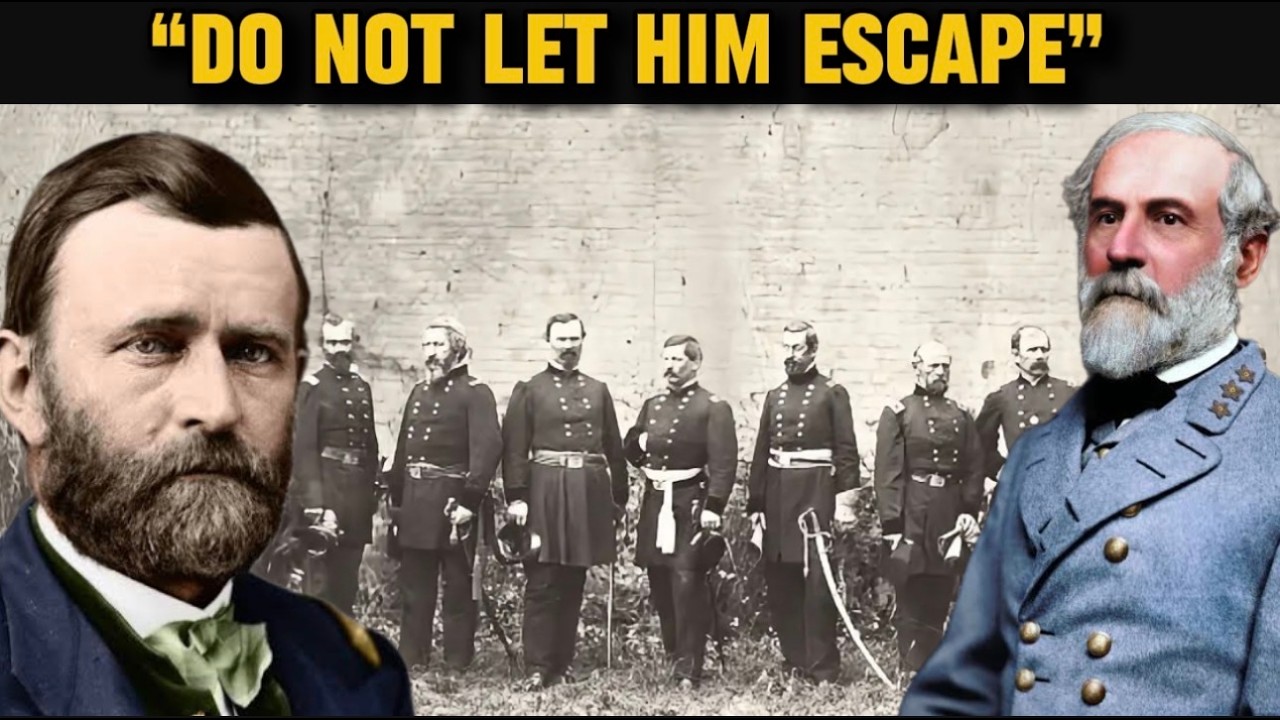
As the sun crept higher, Grant turned to his cavalry commander, the fiery Phil Sheridan. Little Phil, they called him, short in stature but a giant in the saddle. Grant's words were blunt and urgent: Do not let him escape. Cut off his retreat. Keep pressing. Make escape impossible.
Those orders ignited the final chase of the Civil War, a week-long pursuit across muddy roads and swollen creeks where exhaustion and hunger tested men to their breaking point. This is the story of that hunt, the Appomattox campaign, and how it brought the mightiest rebellion in American history to its knees.
The war had dragged on far longer than anyone imagined back in '61. What started as a spat over states' rights and slavery had ballooned into a cataclysm claiming over 600,000 lives. By 1864, the Confederacy was on life support. Its currency was worthless, its ports blockaded, its farms stripped bare by foraging armies.
Lee, ever the tactician, had kept the Army of Northern Virginia alive through sheer will and audacity, whipping the Federals at Chancellorsville and holding at Gettysburg despite the carnage. But Grant's arrival changed everything.
Appointed general-in-chief by Lincoln, Grant brought a new philosophy: not fancy maneuvers, but grinding attrition. "I propose to fight it out on this line if it takes all summer," he'd wired from the Wilderness, where trees caught fire and men screamed in the flames.
By late March 1865, Grant's noose was tightening. He had 125,000 men encircling Petersburg, while Lee could muster barely 35,000 ragged, barefoot souls living on parched corn and hope.
On March 29th, Grant launched the opening moves of the Appomattox campaign. Sheridan, with his 13,000 cavalry troopers, swung southwest toward Dinwiddie Courthouse, aiming to sever the South Side Railroad, Lee's last supply lifeline.
The rebels fought back hard. At Lewis's Farm, Union infantry under Gouverneur Warren clashed with Confederate pickets, pushing them back in a sharp skirmish that cost hundreds on both sides. It was just a taste.
The real fireworks came on March 31st. At White Oak Road, Lee's forces under George Pickett, the same Pickett of that doomed charge at Gettysburg, tried to hold the line. Rain turned the fields to muck, horses sinking to their knees.
Sheridan's cavalry probed, feinted, and drew fire. Then at Dinwiddie, Confederate cavalry under Fitzhugh Lee, Robert's nephew, and infantry slammed into Sheridan's flanks. Bullets whistled through the pines, sabers clashed in the twilight.
Sheridan held barely, his men dismounting to fight as infantry, using carbines like rifles. "I am holding the enemy here," he wired Grant, "but if you can send me infantry, I can turn this into a rout." Grant sent Warren's V Corps, but Warren moved too slow for Grant's liking. That hesitation would cost him his command later.
April 1st dawned clear, and Sheridan pounced. At Five Forks, a dusty crossroads vital for controlling the railroads, Pickett's division was caught napping, literally, some say, with Pickett off at a shad bake picnic.
Sheridan's cavalry swept in from the west, Warren's infantry from the north. The rebels crumbled. Pickett lost over 2,000 captured, his lines shattered. "It was magnificent," one Union officer recalled, "but it was not war, it was murder."
Five Forks sealed Petersburg's fate. Lee wired Jefferson Davis in Richmond: "I advise that all preparation be made for leaving Richmond tonight." The Confederate government fled by train, setting fire to warehouses to deny supplies to the Yankees. Flames lit the sky like a false dawn.
By April 2nd, the dam burst. Grant ordered a general assault along the entire Petersburg line. At Fort Gregg, a small but stubborn rebel outpost, Confederates held for hours against waves of blue coats, buying time for Lee's retreat.
By nightfall, Petersburg fell, and with it, Richmond. Lee's army streamed west along the Appomattox River, wagons creaking under what little they could salvage: ammunition, hardtack, the wounded moaning in the beds.
They aimed for Amelia Courthouse, 40 miles away, where supply trains were supposed to wait with rations. Lee's plan was to resupply, then swing south to Danville, link with Johnston, and fight another day.
Grant wasn't having it. He unleashed his forces in parallel pursuit, infantry under George Meade marching straight west, Sheridan's cavalry arcing south to block escape routes. "Press them without intermission," Grant ordered. The race was on.
Lee's men, many shoeless, trudged through the night, hunger gnawing at their bellies. One rebel private wrote in his diary, "We marched all night, the roads muddy and full of ruts. Men fell out by the dozens, too weak to go on."
Union troopers, better fed and mounted, closed the gap. April 3rd brought the first clashes of the chase. At Namozine Church, Sheridan's advance guard under George Custer, with his flowing locks and reckless dash, ambushed a Confederate rearguard. Sabers flashed, pistols cracked, hundreds of rebels surrendered.
Lee pushed on, reaching Amelia Courthouse on the 4th. But disaster struck. The supply trains had been misdirected. Instead of food, they carried ammunition and harnesses, useless to starving men.
Lee halted for a day to forage, sending wagons into the countryside. It was a fatal delay. "That lost day," one historian later noted, "doomed the Army of Northern Virginia."
While Lee scavenged, Sheridan raced ahead. On the 5th, at Amelia Springs, his cavalry nipped at Lee's flanks, capturing wagons and prisoners. Grant, riding with Meade's column, urged speed. "If we can keep up the pressure," he told his staff, "Lee will have to surrender."

Headaches plagued Grant, migraines that had dogged him for days, but he pressed on, cigar clenched in his teeth.
The climax came on April 6th, a day of reckoning along Sailor's Creek. Lee's army, strung out over miles, was vulnerable. Ewell's Corps lagged behind, separated by the swollen creek. Sheridan's cavalry, reinforced by Horatio Wright's 6th Corps, struck like a thunderbolt.
At the main crossing, rebels formed a hasty line on the hills. Cannon boomed, musket volleys ripped the air. Union infantry charged with bayonets fixed. Ewell's men fought fiercely, but they were outnumbered.
"It was a slaughter," a survivor recalled. Over 7,000 Confederates surrendered, including Ewell himself and six other generals, among them Custis Lee, Robert's son.
When word reached Lee, he exclaimed, "My God, has the army dissolved?" His aide replied, "No, General, but it is sorely pressed."
That same day, at High Bridge, a towering railroad span over the Appomattox, Confederates tried to burn it to slow the pursuit. Union raiders under Theodore Read charged in but were repulsed. Read himself was killed in a saber duel. Still, the bridge survived enough for Grant's men to cross later.
Lee's army staggered onto Farmville, where some rations finally arrived. But Sheridan was already south, blocking the road to Danville.
April 7th saw more skirmishes at Cumberland Church near Farmville. Lee's rear guard under John B. Gordon held off attacks, but at a cost. Grant, sensing the end, sent his first surrender demand.
"The result of the last week must convince you of the hopelessness of further resistance," Grant wrote. "I regard it as my duty to shift from myself the responsibility of any further effusion of blood by asking of you the surrender of that portion of the CS Army known as the Army of Northern Virginia."
Lee replied coolly, "Though not entertaining the opinion you express, I reciprocate your desire to avoid useless effusion of blood, and therefore, before considering your proposition, ask the terms you will offer."
Meanwhile, Sheridan pressed. At Appomattox Station that night, Custer's Brigade captured three supply trains meant for Lee, along with 24 cannon, 200 wagons, and a hospital train. "We've got them now!" Custer whooped.
Lee's men, down to 28,000 effectives, many without weapons, camped nearby, unaware.
April 8th, Lee tried one last push south, but Sheridan's cavalry barred the way at Appomattox Courthouse. Skirmishing flared. Gordon's infantry attacked, briefly breaking through, but Union reinforcements arrived.
Lee realized it was over. "There is nothing left for me to do but to go and see General Grant," he told his staff, "and I would rather die a thousand deaths."

Dressed in his finest gray uniform, sword at his side, he rode out under a flag of truce. The meeting on April 9th, Palm Sunday, unfolded in the parlor of Wilmer McLean's house, a man who'd moved from Manassas to escape the war, only to have it end in his front room.
Grant arrived in a mud-spattered uniform, no sword, just a private's blouse. They shook hands. Lee, dignified and composed, asked for terms.
Grant offered generous ones. Officers would keep their side arms and horses. Men would be paroled and go home, not to be disturbed as long as they obeyed the laws. No trials, no humiliations.
"This will do much toward conciliating our people," Lee said.
As Grant wrote later, "My own feelings were sad and depressed. I felt like anything rather than rejoicing at the downfall of a foe who had fought so long and valiantly."
Outside, as news spread, Union soldiers cheered, then fell silent at Grant's order. "The war is over. The rebels are our countrymen again."
Lee's men stacked arms, many weeping. One rebel artilleryman patted his cannon farewell. "Goodbye, old friend."
Grant ordered rations sent to the starving Confederates, 25,000 meals. Sheridan, ever the hard charger, bought the table where the terms were signed for $20 and gave it to Custer's wife.
What makes this story resonate even now isn't just the battles or the tactics, it's the humanity woven through the horror. Grant, the unyielding pursuer, showed mercy when it mattered most. His headaches vanished the moment surrender came, as if the weight of the war lifted.
Lee, facing ruin, preserved his men's dignity. And the soldiers, ordinary men from farms and factories, had endured so much. A Union private recalled sharing coffee with a rebel. "We were enemies no more."
The Appomattox surrender didn't end the war outright. Johnston held out till April 26th, others longer, but it broke the Confederacy's back. Lincoln, assassinated days later, never saw full peace, but his vision endured.
Grant's chase proved that persistence, not brilliance alone, wins wars. And Sheridan's cavalry, following those orders, "Do not let him escape," turned the tide.
In the end, it was a hunt that healed a nation, however imperfectly. Scars remain, debates rage, but from that parlor in Virginia sprang reconciliation.
As Grant reflected in his memoirs, "The cause was one of the worst for which a people ever fought. But I do not question the sincerity of those who were opposed to us."
That's the paradox of Appomattox: victory without vengeance, an end that allowed a new beginning.