On November 27, 1934, the quiet outskirts of Barrington, Illinois, became the site of one of the most violent confrontations in FBI history. Baby Face Nelson, then Public Enemy Number One, was heading south toward Chicago with his wife, Helen Gillis, and his lieutenant, John Paul Chase. Federal agents had received a tip about Nelson’s movements and had set up a dragnet across northern Illinois and southern Wisconsin.
Two federal cars were racing north on the Northwest Highway, unaware that they were on a collision course with the most dangerous man in America. The first vehicle carried Special Agents Thomas McDade and William Ryan. Behind them, in a more powerful Hudson, were Inspector Samuel Cowley and Special Agent Herman “Ed” Hollis, both seasoned veterans of the FBI’s most high-profile takedowns.
The two groups spotted each other almost simultaneously. Nelson did not flee. Instead, he spun his stolen 1934 Ford V8 around and began aggressively pursuing the agents. What followed was a furious chase, with speeds topping 70 miles per hour on the narrow concrete highway. Gunfire erupted between the vehicles as Helen Gillis crouched low in the back seat, shielded by luggage and a spare tire.
Chase leaned out the passenger window with a Thompson machine gun, spraying rounds at the agents’ sedan. McDade and Ryan returned fire while trying to stay ahead of the outlaws. Then Ryan got the shot that changed everything. A single round from his rifle punched through the Ford’s front grill and radiator, crippling the vehicle.
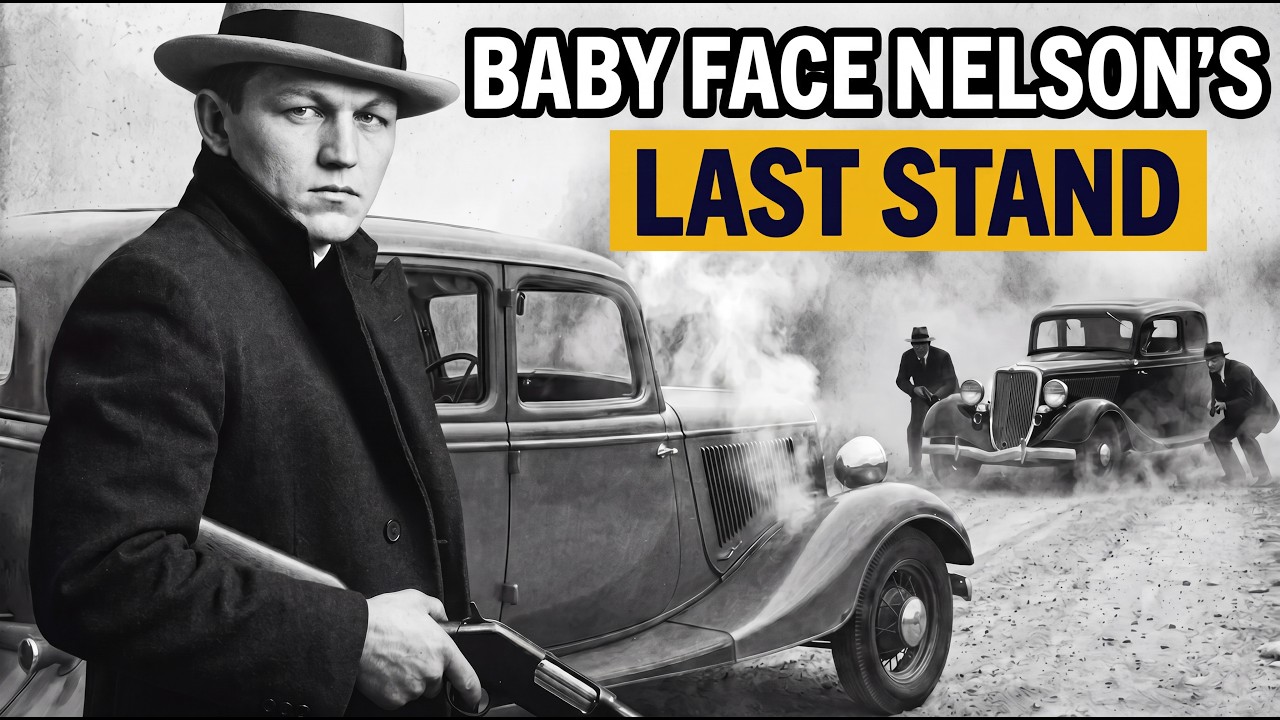
The agents pulled off the road and took up defensive positions, expecting Nelson to keep coming. But Nelson’s car was losing steam, and a second federal car had appeared behind him. Cowley and Hollis had picked up the chase. Nelson was now trapped between the two federal vehicles.
Steam bellowed from under the Ford’s hood. Nelson realized he could not outrun anyone. He made a desperate decision. He veered off the highway and into the entrance of Barrington’s North Side Park, slamming the brakes. Before the car had fully stopped, Nelson and Chase threw open the doors.
Cowley and Hollis overshot the Ford and pulled up about 150 feet away on the opposite side of the road. As they jumped out, Helen Gillis flung open her door and sprinted to a shallow roadside ditch to wait out the firefight. Nelson stepped out into the open, completely exposed, holding a modified automatic rifle. He began walking directly toward the agents, firing continuously.
Chase took cover behind the passenger side of the Ford and unleashed a full drum magazine from his Tommy gun. Cowley and Hollis scrambled into a shallow ditch, returning fire with a submachine gun and a heavy pump-action shotgun. The noise tore through the quiet suburban afternoon.

Then Nelson was hit. A blast from Hollis’s shotgun caught him squarely in the legs. The impact knocked him off balance, but he did not fall. Fueled by adrenaline and rage, he continued his slow march toward the agents, clearing a jam from his rifle as he moved. Cowley scored additional hits on Nelson.
Hollis, seeing that the shotgun shells had not stopped the outlaw, broke cover and ran toward a massive oak tree. It was a fatal mistake. Nelson spotted him, leveled his weapon, and fired. A single bullet struck Hollis in the head and killed him instantly.
At the same time, Cowley was hit by bullets from Chase’s Tommy gun. He fell into the mud of the ditch, mortally wounded, his stomach ripped open by machine gun fire. In less than five minutes, the firefight was over.
The silence that followed was suffocating. Nelson stood over the battlefield, victorious but physically ruined. He had been shot 17 times, with six shotgun pellets and 11 high-velocity rifle bullets riddling his torso and legs. In a single confrontation, he had killed more FBI agents than any criminal in American history at that time.

Chase walked over to the ditch and called Helen. She climbed out of the cold mud and ran to her husband’s side. Nelson was losing blood fast and could barely stand. Together, Chase and Helen loaded him into the agents’ government vehicle and sped away, leaving Hollis dead on the pavement and Cowley dying in the mud.
They drove to a gangster safe house in Wilmette, Illinois. Throughout the agonizing drive, Nelson never screamed. He just gripped his wounds, his face turning pale and his breath growing shallower. At around 7:34 that evening, lying on a bed in the safe house, the 25-year-old public enemy number one took his final breath.
Helen wrapped his body in a flannel blanket and placed it in the back of a car. She said he did not like to be cold. To protect the identities of the underworld figures who had helped them, Chase and Helen drove to a cemetery in Skokie, Illinois, and dumped Nelson’s body into a roadside ditch.
The next morning, an anonymous tip led federal agents to the ditch. The hunt was over. Public Enemy Number One was dead. Inspector Samuel Cowley passed away in a hospital around the same time that Nelson did, never knowing that his final mission had succeeded.
Baby Face Nelson’s last stand was the violent, explosive crescendo of the classic American gangster era. He went out exactly the way he lived, reckless, bloodthirsty, and utterly refusing to surrender.