She was the woman who knelt on a hotel floor in Los Angeles, her hand reaching for a dying husband, and then spent the next fifty-six years building a fortress around his memory. Ethel Kennedy, the matriarch who outlived her husband, her fortune, and four of her eleven children, was not the saintly, rosary-clutching widow of American myth. She was the architect of a carefully controlled narrative, a woman whose iron grip on the legacy of Robert F.
Kennedy was matched only by her ruthless management of the people and stories around her. The public saw the football games, the brood of children, and the unwavering Catholic faith. The private reality, documented in court records, employee testimonies, and the family’s own sanctioned films, reveals a far more complex and often brutal figure whose power derived not from wealth, but from the strategic denial of access.
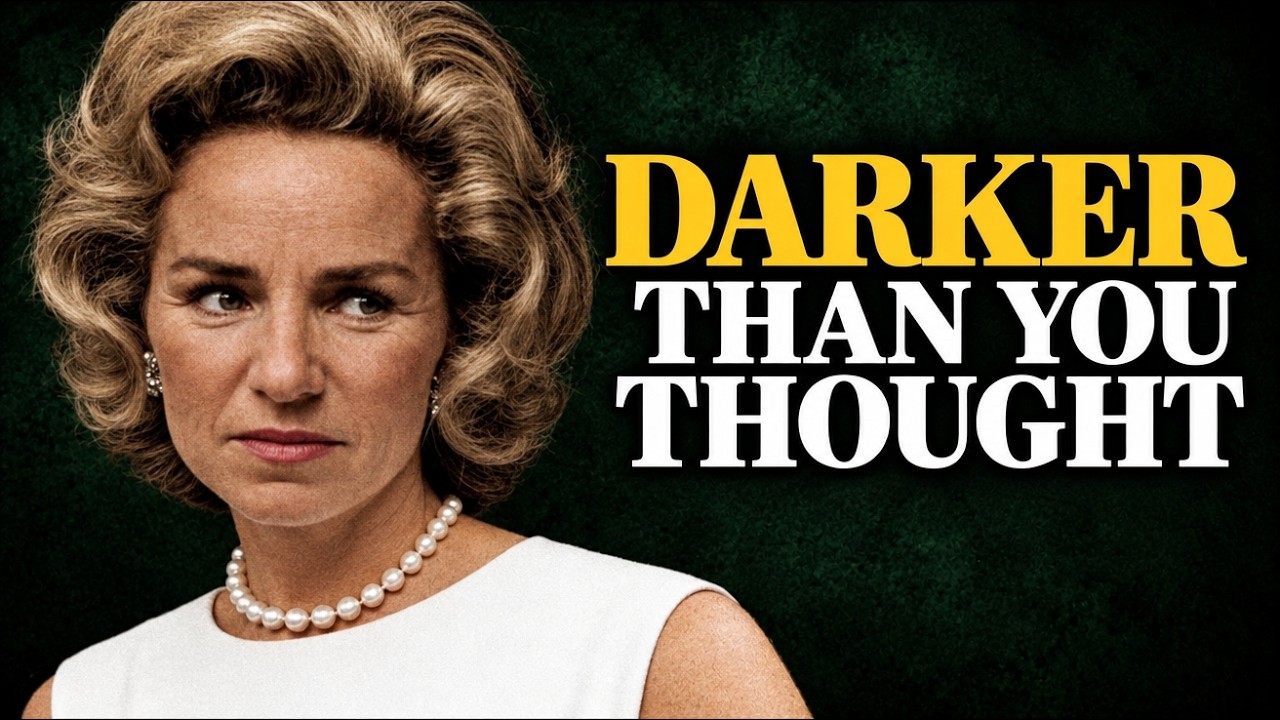 The story begins not with the Kennedy compound, but in Greenwich, Connecticut, in a thirty-room mansion called Rumbleside. George Skakel Sr. had built a fortune from nothing, creating the Great Lakes Carbon Corporation, which supplied coke and carbon products to the steel and aluminum industries.
The Skakel money was new, loud, and in many ways more liquid than anything Joseph Kennedy controlled personally. The household was run with a militant Catholic fervor, but the atmosphere was one of chaos, competition, and violence. Cars were driven at reckless speeds, guns were everywhere, and pranks often crossed into physical harm.
Ethel, the sixth of seven children, learned early that the world was divided into those who broke things and those who cleaned up the mess. There was always a staff, always someone to repair the damage, and consequences were something that happened to other families. This was the foundational lesson of her life: the bill was never her problem, and the narrative was always hers to control.
In 1950, she married Robert Kennedy, a match that was both a love story and a strategic merger. Bobby, the seventh of nine children, was shy, serious, and overshadowed by his brothers. He was also, crucially, a man whose personal wealth was controlled by his father’s trust funds.
Ethel brought her own independent Skakel fortune, which loosened Joseph Kennedy’s grip on his son. She got the name, the project, and the political future that the Skakels could never buy. The marriage was real, the letters and devotion were genuine, but the transaction was clear.
She traded money for access to power, and she accepted the terms of the Kennedy operating system without a moment of visible hesitation. She out-Kennedyed the Kennedys, playing football harder, attending Mass more frequently, and producing children at a faster pace. She had eleven children in eighteen years, a feat that cemented her place in the family hierarchy and earned her the adoration of her father-in-law.
The purchase of Hickory Hill in 1957 was the first major acquisition of her married life, and it came through tragedy. The house was bought from Jackie Kennedy, who could not bear to live there after the stillbirth of her daughter. Ethel filled the six-acre estate with animals, children, and a rotating cast of political figures and celebrities.
She hosted intellectual salons where Nobel laureates debated policy, and she hosted raucous parties where guests, including federal judges, were thrown fully clothed into the pool. This was not mere frivolity; it was a test of loyalty. Being thrown into the pool was a sign of inclusion.
Not being invited to Hickory Hill at all was a sign of exile. Everyone in Washington understood which side of that line they stood on. Ethel was the organizer, the gatekeeper, and the arbiter of who mattered in her world.
It was the only power available to a Kennedy wife in 1962, and she wielded it better than anyone.
 The staff at Hickory Hill experienced a different reality. Turnover was legendary, with nannies, cooks, and gardeners coming and going in a constant stream. Some were fired, many quit, and local vendors in McLean, Virginia, reported for decades that getting paid was a monumental struggle.
Some filed lawsuits. The pattern was so consistent that it became a known local fact rather than a rumor. This was not fraud; she was not desperate for money in those years.
It was a worldview inherited from her childhood. There was always someone else to handle the bill, and the bill was always less important than the party. The people who were supposed to handle it, however, were becoming increasingly scarce.
The Skakel fortune began to evaporate after the death of her parents in a plane crash in 1955, and the death of her brother George, who ran the company, in another crash in 1966. The family business was sold and restructured, and by the 1980s, Ethel’s personal wealth was a fraction of what it had been. She was a rich woman with less and less of her own money, and the budget for Hickory Hill was increasingly dependent on the Kennedy family office in New York.
The assassination of her husband in 1968 was the defining moment of her life, and her response to it was the clearest evidence of her character. She was thirty-nine years old, pregnant with her eleventh child, and she spent the week after his death working the funeral train, moving from car to car, shaking hands with mourners, and thanking them for coming. It was an act of grace under unimaginable pressure, but it was also the same mechanism she had used in 1955 and 1966.
Grief was converted into motion, locked away, and translated into performance. She became the widow of a martyr, the custodian of eleven children bearing the most valuable name in American public life, and the only person on earth who could say what Robert Kennedy would have wanted. She understood the value of this position immediately, and she never let it go.
She founded the Robert F. Kennedy Memorial in 1968, which became a working institution with a board, a grant program, and a staff. She chose the issues: farm workers, prison reform, housing, and civil rights litigation.
She traveled to places where there were no cameras, pressed Congress on specific bills, and was arrested in 1988 outside the South African embassy in Washington protesting apartheid. This was real work, and it was hers.
But the same certainty that drove her advocacy made her incapable of dealing with the grief of her own children. The older boys were teenagers when their father was killed. David was eleven years old, alone in a hotel room, watching the shooting on television.
 What they needed was a mother who could sit with them and talk about it. What they got was a mother who found that conversation almost unbearable, a house with a rotating staff, and a family name that ensured no one outside the family would treat them as normal people. The consequences appeared within five years.
In 1973, Joe Kennedy, then twenty-one, drove a Jeep that flipped over on Nantucket, paralyzing a nineteen-year-old passenger named Pam Kelley. The family settled the matter financially and quietly, closing the file completely. David, who was thrown from the Jeep and suffered a fractured vertebra, was given painkillers that led to a decade-long addiction.
He was beaten and robbed in a Harlem 𝒹𝓇𝓊𝑔 den in 1979, and he went in and out of treatment, with long periods where he was simply not welcome at Hickory Hill. Ethel’s response to her children’s addiction was anger, not accommodation. She treated it as a failure of will, the same way she treated her own grief.
On April 25, 1984, David was found dead in a hotel room in Palm Beach from a combination of cocaine, Demerol, and an anti-anxiety 𝒹𝓇𝓊𝑔. He was twenty-eight years old. Ethel did not go to Palm Beach.
She did not discuss him afterward. The children who survived learned the rule: you were a Kennedy in that house, or you were a problem, and there was no third category.
As the money faded, her control over the narrative tightened. She never wrote her memoirs, gave almost no interviews, and controlled access to her husband’s papers, letters, and home movies. Friendly biographers like Arthur Schlesinger and Evan Thomas received cooperation and access.
Hostile ones, like Jerry Oppenheimer, who wrote an unauthorized biography in 1994, were frozen out completely. The family boycotted the book and attacked it, and it should be read as a hostile account compiled from sources with an agenda, not as a documentary record. This distinction was exactly the one Ethel spent her life enforcing.
She controlled the photographs, the annual pilgrimages to Hyannisport, and the commemorations. She controlled the foundation’s framing of her husband’s image, which is why the public memory of Robert Kennedy is largely the 1968 version, the campaign speeches, the Indianapolis address, and the wave of hope, rather than the 1957 version, the McCarthy counsel and the Attorney General who wiretapped Martin Luther King Jr. That editing was not dishonest, exactly.
It was selective, and it was relentless, and it worked.
 In 2003, she put Hickory Hill on the market for $25 million. The market did not agree. The house had been heavily used for forty-six years by eleven children and a rotating menagerie of animals, and the condition was not what the price suggested.
Offers came and went, deals collapsed, and the property sat on the market for six years. She finally sold it in 2009 for about $8. 25 million, a third of the asking price.
The buyer was a tech executive who spent years and millions of dollars restoring it, because much of the house needed saving by that point. The sale was the final reversal of her life’s transaction. The heiress from Greenwich, who had brought money into the Kennedy family, ended her days as a resident of the Kennedy compound in Hyannisport, living on Kennedy land, in a Kennedy house, supported by the institutional structure her father-in-law had built in the 1920s.
She had lost the money and the house, but she still controlled the guest list. The person who loses the money and the house but still controls the guest list has lost less than you might think.
In 2012, her daughter Rory released a documentary about her life. It was the only Kennedy documentary made by a Kennedy about a Kennedy, with full family cooperation, complete access, and home movies no one outside the family had ever seen. In the film, Rory asks her mother about the night of the assassination.
Ethel, then eighty-four, refuses to answer. She does not deliver a speech or cry. She politely closes the door, the camera keeps rolling, and the daughter leaves the scene in the final cut.
This is not a failure of journalism. This is the evidence on display. You are watching the actual mechanism of Kennedy family memory management for fifty years happening in real time, at a kitchen table, between two women who love each other.
The refusal was not weakness. It was inventory management. By 2012, the Skakel money was gone, Hickory Hill belonged to someone else, four of her children were dead, and the family office in New York had been writing the checks for decades.
She had almost nothing left that was legally and solely hers. Except for the one thing she said no to. She had learned in a thirty-room house on Lake Avenue that there was always someone else to pay the bill.
She had learned on October 3, 1955, that the only safe place for a catastrophe was behind a closed door. And she had spent the next seventy years discovering that what she refused to say was the only asset no one could audit, subpoena, inherit, or sell for a third of the asking price. She took June 5, 1968, with her to Arlington, and she never gave it back.