In 2024, researchers fed every available eyewitness account, indigenous oral record, expedition report, and biological dataset into the AI system Grok, asking it to assess the probability that a creature called Mokele-Mbembe is real. The output was not what anyone expected, and it was not comfortable. For more than a century, witnesses have described the same animal with striking consistency in the Congo Basin. Either this represents the most persistent and geographically focused case of collective hallucination in human experience, or it is evidence that something that should have gone extinct 65 million years ago has not.
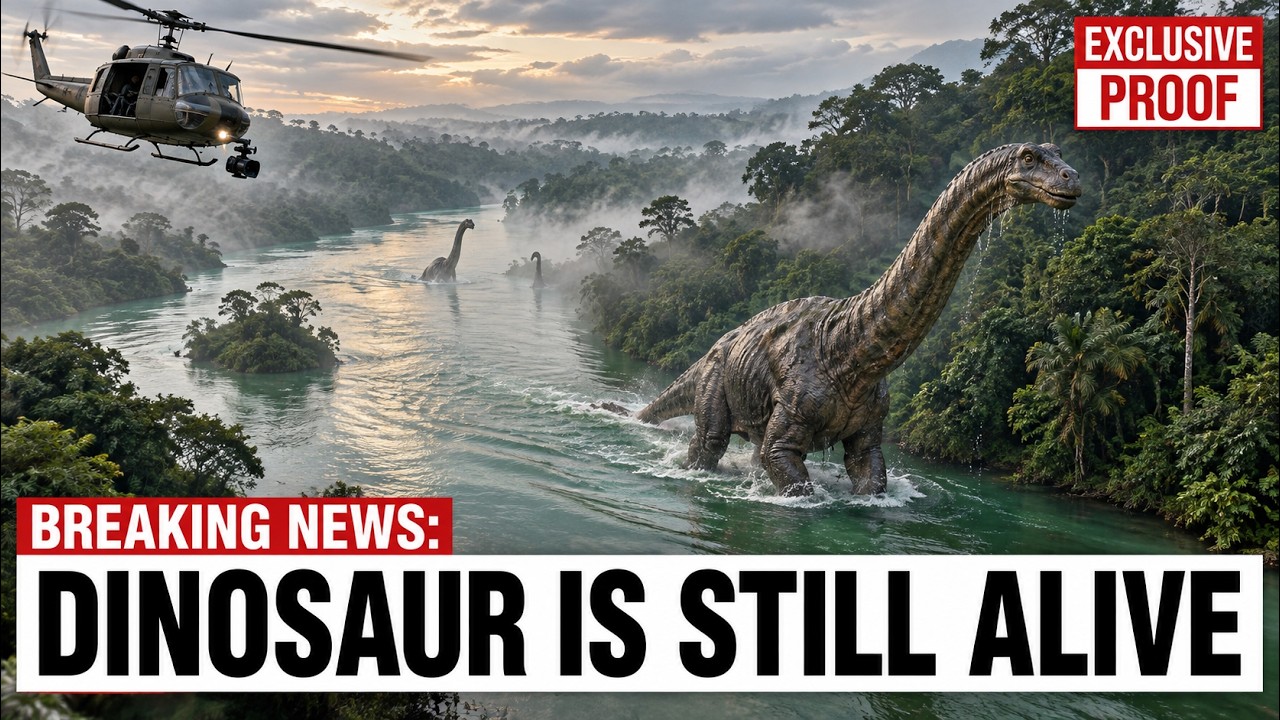
The name Mokele-Mbembe translates roughly from Lingala as “one who stops the flow of rivers. ” It refers not to a supernatural entity but to a physical animal large enough to obstruct water movement in the river systems it inhabits. Different communities across a region spanning hundreds of miles use different names but describe the same creature. The descriptions match the general body structure of a sauropod dinosaur with accuracy that is difficult to attribute to coincidence: a large body, long neck, small head relative to the body, long tail, four legs, semi-aquatic habits, and a plant-based diet.
Multiple independent accounts identify specific plants it feeds on, including the malambo fruit that grows on riverbanks. The temperament is consistently described as aggressive toward anything entering its territory, including boats and their occupants. The Congo Basin is not like other places. It is the second-largest tropical rainforest on Earth, covering approximately 3.
3 million square kilometers across six countries. Parts of it are more mysterious than anywhere in the Amazon. The terrain is exceptionally difficult to cross. Vast swamp systems interlock with dense rainforest in formations that make overland movement extremely slow.
River systems that appear navigable on maps reveal themselves as obstacle courses when approached in practice. The climate adds another layer of inaccessibility, with a heavy disease burden that makes extended fieldwork genuinely dangerous. In practical terms, areas within the Congo Basin have received less systematic scientific survey than the surface of Mars. Satellite imagery of Mars has produced more detailed and comprehensive surface maps than exist for some regions inside the Congo.
Biological surveys consistently yield discoveries of new species, including large mammals and reptiles unknown to science despite local communities knowing them for generations. The okapi, a massive giraffe relative, remained unknown to Western science until 1901. The bonobo, one of humans’ closest genetic relatives, was not formally described until 1929. Eyewitness accounts begin in written records with European explorers and missionaries who arrived in Central Africa in the eighteenth and nineteenth centuries.
They were not looking for dinosaurs. They arrived with agendas involving trade, colonization, and religious conversion, and mentioned the creature incidentally as part of broader accounts of the lands and peoples they encountered. French missionary Lievin Bonaventure Proyart reported in 1776 that local informants described a massive river-dwelling animal capable of killing hippopotamuses. German Captain Ludwig Freiherr von Stein zu Lausnitz submitted a report to the German colonial government in 1913 describing in detail what his expedition’s indigenous guides told him about a creature called Mokele-Mbembe.
He was not a naive man writing for a general audience but a military officer filing an official report to a government that would not have appreciated fictional content. The twentieth century saw a wave of expeditions specifically targeting the creature. American biologist Roy Mackal led two expeditions to the Congo in 1980 and 1981. Mackal was not a marginal figure or hobbyist but a legitimate scientist and researcher from the University of Chicago with a serious academic career.
His expeditions did not produce a specimen or conclusive photographic evidence, but they produced something the scientific establishment found more troubling: additional local testimonies of exceptional consistency, systematically collected from communities across a wide geographic area. In one carefully documented case, Congolese witnesses were shown silhouettes of various animals, including prehistoric creatures from paleontology illustrations they had never encountered. They independently and without prompting selected the sauropod silhouette as closest to what they had seen, not the hippopotamus, not the elephant, not the crocodile, but the sauropod. The standard scientific objection to Mokele-Mbembe is made with the confidence of people who consider the matter settled.
A massive dinosaur could not survive in the Congo Basin without being discovered. The fossil record shows no sauropods after the Cretaceous-Tertiary extinction event 65 million years ago. A breeding population of large animals would produce tangible evidence. This objection is logical and deserves serious consideration.
It is also less conclusive than the confidence with which it is presented suggests. The fossil record of the Congo Basin is exceptionally sparse. The geological conditions of a hot, humid, biologically active tropical environment are completely hostile to fossil formation and preservation. Organic matter decomposes quickly and thoroughly.
Bones of large animals typically do not survive long enough in the Congo to fossilize. The absence of sauropod fossils from the Congo Basin does not prove the absence of sauropods in the Congo Basin. It proves that the geological conditions there are not conducive to producing the kind of fossil record that would document their existence. These are different claims, and conflating them is a logical error.
The breeding population argument is more substantial but also more complex than it first appears. The Likouala swamp system covers approximately 100,000 square kilometers of terrain. It is among the least surveyed on Earth. We have discovered breeding populations of large animals in environments previously thought to be well studied.
The coelacanth, a massive fish known only from the fossil record and believed extinct for 65 million years alongside the dinosaurs, was found alive and breeding in 1938 in waters that had been fished for generations. Grok’s analysis of the full dataset organized its findings around four specific areas of convergence that the research team described as increasingly difficult to explain within a framework of pure mythology or misidentification. The first area was testimonial consistency. The AI analysis of witness statement patterns across two and a half centuries and a geographic range spanning hundreds of miles found a degree of descriptive consistency far exceeding what would be expected from misidentification of known animals.
Descriptions of Mokele-Mbembe do not cluster around any known animal in the Congo Basin. They cluster around a specific body structure that does not exist among current Central African fauna but does exist in the sauropod lineage within the Mesozoic fossil record. The second area was habitat analysis. The AI matched specific locations associated with the most credible sightings against detailed maps of the Likouala swamp system.
The sightings cluster in specific sub-regions with geographic logic consistent with territorial use by large semi-aquatic animals. This type of habitat-linked clustering is characteristic of distributions of sightings of real animals, not mythological distributions which tend to spread geographically and associate with culturally significant sites. The third area was biological plausibility assessment. Based on the full references in paleontology and zoology, Grok assessed the probability that a small surviving sauropod population could persist in the Likouala environment without producing conclusive evidence.
This assessment was not a confirmation of existence, but it was far less dismissive than the traditional scientific stance. The combination of habitat access barriers, limited fossil records in tropical environments, the documented history of large animal discoveries in the Congo Basin, and the biological characteristics of a hypothetical surviving population produced a probability assessment the research team described as non-trivial. The fourth finding was the most surprising. The comparative analysis of Mokele-Mbembe accounts against accounts of mythological animals from other cultural traditions found structural differences that distinguish Mokele-Mbembe accounts from purely mythological creatures.
Mythological animals accumulate symbolic characteristics over generations of storytelling. Mokele-Mbembe accounts show remarkably little of this accumulation. The creature is consistently described in biological rather than symbolic terms. It feeds on specific plants.
It inhabits specific habitats. It behaves in specific, consistent ways. It does not appear in creation stories or moral fables the way true mythological animals do. Several expeditions returned from the Congo with tantalizing evidence precisely because they fell short of conclusively settling the matter.
In 1981, a Congolese man named Nicolas Mondongo reported a direct close encounter with Mokele-Mbembe at Lake Tele, the remote lake most associated with sightings. His account included precise details about the creature’s movement patterns and physical characteristics that matched accounts independently collected from other witnesses. In 1983, a Japanese expedition to Lake Tele led by Marcelin Agnagna, a Congolese biologist from the Brazzaville Zoo, produced a documented sighting. The account was controversial because film Agnagna claimed to have taken produced no usable footage due to a camera error.
Skeptics cite this as evidence of fabrication, while believers cite it as evidence of the persistent bad luck that has characterized this research program. What distinguishes the Agnagna case is that he was a trained biologist with professional credibility to lose, working in his home country with local colleagues. His account matched the existing body of evidence with the addition of new observations about the creature’s behavior. The expeditions that came closest to obtaining conclusive evidence share a common feature that Grok’s analysis flagged as significant in itself.
They consistently face logistical failures at the most critical moments. Equipment breakdowns, weather forcing early withdrawal, permit complications appearing suddenly, and disease affecting key team members at pivotal points in fieldwork. The AI carefully noted it drew no conclusions about why this pattern exists, but noted the pattern is unusual in its consistency compared to expedition failure rates in other difficult research environments. The question of Mokele-Mbembe concerns more than just one animal.
If a surviving sauropod lineage exists in the Congo Basin, the implications extend far beyond the zoological excitement of the discovery itself. It would mean the extinction event 65 million years ago was not as comprehensive as assumed. It would mean the silence of the fossil record reflects the limited fossilization in tropical environments rather than the actual absence of living populations. It would mean our confidence in what the fossil record tells us about extinction requires substantial reassessment.
The conservation biology implications would be immediate and significant. If a massive animal has persisted in the Congo Basin for 65 million years without humans driving it to extinction or even conclusively documenting its existence, something about its survival strategy is extremely effective. Understanding that strategy would have direct applications for conservation programs attempting to protect large animals in other threatened environments. The research team noted that the persistence of the Mokele-Mbembe question across more than two centuries of investigation, the consistency of the evidence despite the failure to provide conclusive documentation, and the pattern of institutional rejection applied to serious researchers who examined that evidence is structurally identical to patterns identified in the handling of anomalous findings in other fields.
The mechanism is not dramatic suppression but structural institutional disincentives to pursue questions that threaten established consensus. It was never proven impossible that a Congo dinosaur exists. It simply became professionally unwise to seriously investigate the possibility. These are different things, and the difference matters.
The Likouala swamps still exist. They remain largely unmapped, largely unsurveyed, and largely inaccessible to the kind of systematic scientific investigation that might settle the Mokele-Mbembe question in a way the institution could no longer ignore. The witnesses are still there too, continuing to describe the same creature in the same consistent terms their ancestors used. Not as mythology, not as cultural symbol, but as a massive animal living in deep water channels that should not be approached when encountered.
Grok’s analysis of the complete evidence set did not confirm the existence of Mokele-Mbembe. It could not do so, and the research team was clear about this point. Confirmation of an animal’s existence requires physical evidence of that animal, and no physical evidence has been produced despite multiple serious attempts by credentialed researchers. Instead, the AI produced a formal analytical assessment that the complete evidence set does not fit the hypothesis of pure myth, does not fit the hypothesis of collective misidentification, and does fit a third hypothesis that the scientific community structurally and methodologically lacks the incentives to investigate with appropriate resources and seriousness.
This is not a confirmation of existence, but it is not a dismissal either. It is the kind of formal finding that merits a substantive response from the scientific community rather than the automatic rejection that has characterized institutional handling of this matter for most of the past century. Somewhere within a swamp system covering 100,000 square kilometers of terrain that no satellite can penetrate and no expedition has comprehensively crossed, there is something in the water. The people who live there know it.
They have known it longer than the scientific institution that dismisses their accounts has existed. They describe it with the practical, direct, specific accuracy of communities that do not consider knowledge of what shares their environment to be an academic exercise but a practical survival necessity. They have not changed their description across generations because they have not changed the facts. Whether it is a surviving giant reptile that somehow escaped an extinction event 65 million years ago, an unknown large reptile that evolved convergently to resemble sauropod form in response to similar environmental pressures, or something else entirely, the question can only be answered conclusively by going to the Likouala region with the resources, patience, technological advancement, and scientific seriousness the complete evidence set deserves.
Witnesses have been saying the same thing for 250 years of documented records and generations beyond that in undocumented oral tradition. At some point, the burden of explanation shifts from them to us. The AI analysis of the complete evidence set suggests that point has already passed.