Dick Butkus was the most feared defensive player of his era, a man whose very name became synonymous with controlled violence on a football field. But in 1974, the man who had terrorized a generation of quarterbacks made a confession that shattered his public image: he admitted to the New York Times that he had left a game with tears in his eyes, unable to bear the pain any longer. Born in December 1942 on Chicago’s South Side, Butkus was the youngest of nine children in a working-class Lithuanian immigrant family. His father worked as an electrician, his mother in a laundry.
There were no shortcuts in that household, only a hard-edged Chicago toughness that shaped the kind of player he would become. By the time he starred at the University of Illinois in the early 1960s, he was already regarded as one of the most devastating linebackers in college football history. A unanimous All-American, he played both middle linebacker and fullback with the same relentless intensity. The Chicago Bears drafted him in 1965, and over the next nine seasons, Butkus became a force of nature at the heart of that defense.
Quarterbacks changed their pre-snap reads because of him. Offensive players braced for impact before reaching the line of scrimmage. He earned first-team All-Pro honors five times and appeared in eight Pro Bowls in nine NFL seasons, a level of dominance few players at any position have matched. He recorded more than a thousand tackles, hundreds of assists, and 22 interceptions from the linebacker position.
But there is a part of that story that almost never appears in highlight reels. While Butkus was building that legend, the team around him was doing little to support it. Over his nine seasons in Chicago, the Bears posted a combined record of 48 wins, 74 losses, and four ties. Despite arguably having the best defensive player in the sport patrolling the middle of the field, Butkus never played in a single NFL playoff game.
He gave that franchise the best years of his career and the most intimidating reputation in professional football. In return, he received one losing season after another. All the while, his body was quietly deteriorating beneath him. The problems actually began before the NFL, with tendon issues that first surfaced in high school.
Things worsened in 1970 when Butkus suffered a significant injury to his right knee and underwent what was supposed to be a preventive surgery before the next season. The surgery did not hold. Over the next several years, Butkus played full seasons, full violence, full contact at the most physically demanding position on the field, on a knee that was already damaged, supported by treatment that, according to his later claims, was not solving anything. According to his account given to reporters at the time, Butkus received repeated cortisone injections directly into that knee, treatments meant to mask the pain rather than address the underlying damage.
He later said he genuinely believed those injections, given repeatedly over multiple seasons, caused irreversible harm to the joint. He also said no one on the Bears’ medical staff fully explained the potential long-term consequences of that treatment plan. Before the 1973 season, still trusting the organization enough to commit his future to it, Butkus signed a five-year, non-cancelable contract worth $575,000. It was a deal built on the assumption that his body could still hold up its end of the agreement for years to come.
It could not. On October 14, 1973, in a game against the Atlanta Falcons, Dick Butkus did something that stunned the people who thought they knew exactly who he was. He left the field in the middle of the game on his own, not carried off, not ordered out by the coach. He simply could no longer endure the pain.
He made that decision himself in that moment, in front of a stadium where he had spent nine years absorbing hits that would have ended other players’ careers without appearing to even limp. He told the New York Times the following year exactly what he felt in that moment. He said the pain was so intense that tears filled his eyes. For a man whose entire public identity was built on the idea that nothing on a football field could hurt him, that admission was seismic.
He tried to return. A specialist examined him and essentially asked how a man in his condition could continue playing football, or why he would even want to. That conversation, more than any hit or any single game, appears to be the moment Dick Butkus finally accepted what his body had been telling him for years. In May 1974, at just 31 years old, he announced his retirement from professional football.
Here is what no one outside the organization expected. Dick Butkus did not leave quietly. Shortly after announcing his retirement, he filed a lawsuit against the Chicago Bears and the team doctor, seeking $1. 6 million in damages.
The suit alleged the organization had breached the contract he signed a year earlier, failed to provide the medical care it promised, and that team doctors repeatedly injected his knee with cortisone and other drugs without clearly informing him of the long-term damage those treatments could cause. According to the filing, doctors who examined Butkus told him he might never regain the physical condition required to play professional football. Yet, according to his account, the organization kept sending him back onto the field, game after game, season after season, relying on injections instead of the surgery he says he actually needed. This was not a bitter former player trying to squeeze his old team for money on the way out.
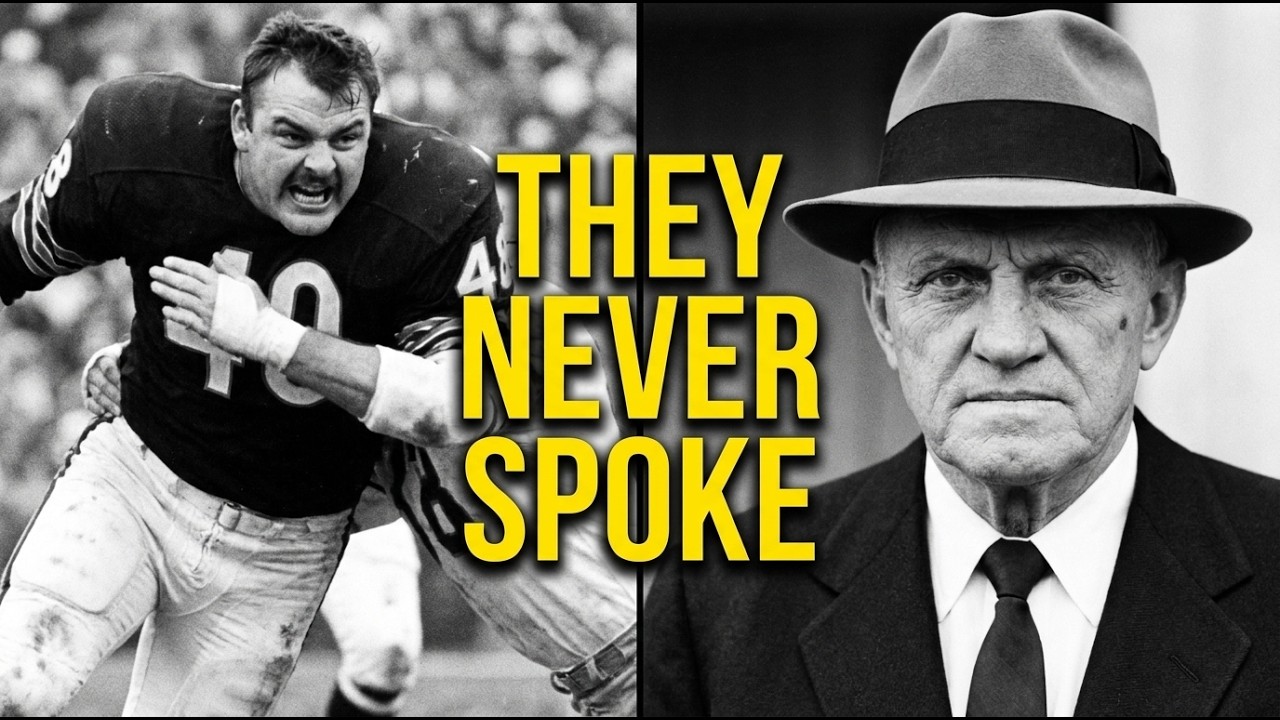
This was arguably the most respected and feared defensive player of his generation standing in a Chicago courtroom to say that the organization he had terrorized opponents for had treated his body as something disposable. The lawsuit inevitably strained his relationship with George Halas, the legendary owner and founder of the Chicago Bears, the man synonymous with the entire franchise. According to people close to both men, Butkus and Halas did not speak to one another for a full five years after the suit was filed. A long, painful silence between a player and the only owner he had known throughout his career.
A silence born directly from a dispute over what that owner’s organization allegedly did, or failed to do, to protect his body. The case was ultimately settled out of court in 1976 for $600,000, a fraction of what Butkus originally requested, but a documented, real acknowledgment that something in the handling of his injury had gone badly wrong. This was not the last time football would have this exact conversation. Butkus’s case became one of the earliest and most prominent examples of a player publicly challenging how NFL team doctors handled serious injuries, a full generation before concussion cases and painkiller scandals became a constant part of the national sports conversation.
Decades later, when journalists covering subsequent medical malpractice cases against other teams wanted historical context, they consistently returned to Dick Butkus’s 1974 lawsuit as the case that began that dialogue in professional football. The damage to his knee never fully disappeared. For the rest of his adult life, until November 1997, Dick Butkus lived with the consequences of those years. Pain that limited even ordinary activities most people never think twice about.
A quiet, daily physical toll that does not show up in the stat sheet or in the highlight reels. In 1997, more than two decades after his last NFL game, he finally underwent a full knee replacement, receiving an artificial joint that he said eased suffering he had carried since the early 1970s. It is a strange and thought-provoking detail. The most terrifying defender in football history spent nearly a quarter century after his career ended still paying a physical price for the seasons he played through pain.
Pain that no one outside that training room fully understood. Yet here is the part of this story that says more about the true character of Dick Butkus beyond his reputation. That five-year silence with George Halas did not last forever. Over time, however it happened, the relationship between Dick Butkus and the Chicago Bears organization genuinely recovered.
He remained connected to the team for the rest of his life. He was celebrated, as the club’s president later described at his death in 2023, as a “Bear” in every sense of the word. He was inducted into the Pro Football Hall of Fame in 1979, in his first year of eligibility, proof of how untouchable his athletic legacy remained regardless of the lawsuit that followed. The Butkus Award, founded in 1985 to honor the best linebacker in college football, still bears his name and his personal involvement every year, connecting his legacy directly to the next generation of players at the position he defined.
When Dick Butkus died in his sleep at age 80 in October 2023, the tributes that poured in from across the football world did not focus on a legal dispute from decades earlier. They remembered a fierce, passionate competitor who helped define an entire position in the sport. In the end, that lawsuit did not tarnish his legacy. Rather, it added a dimension most fans do not consider when watching his old footage.
Greatness of that kind carries a heavy price, and Dick Butkus was one of the first players in sports history willing to stand publicly and insist that someone confront that price. He was a working-class kid from the South Side of Chicago who gave a struggling football team nine years of the most brutal, terrifying defensive football anyone had ever seen. He never got a chance to play in a single playoff game for those efforts. He spent his final season as a player battling pain so severe it brought tears to the eyes of a man the entire league feared.
He did not stay silent about what it cost him. He stood up, put his name on a lawsuit, and forced a conversation about how football treats the bodies of the men who make it worth watching, a conversation the sport is still having in many ways decades later. Perhaps that is the real legacy Dick Butkus left, buried beneath the All-Pro selections and the Hall of Fame bust.
Not just a standard of ferocity every linebacker since has chased, but a quieter example of a man who gave everything the organization asked of him, and when he finally realized what it cost, refused to let it go unanswered, unspoken, or unresolved.