Between the 1890s and the late 1910s, more than forty American cities built a vast network of public bathhouses, a major civic investment that has almost entirely faded from popular memory. These buildings—often grand brick and stone structures with arched windows and carved entrances reading “Public Baths”—were designed to handle hundreds of gallons of water an hour and serve thousands of working-class residents a day. Today, most of them have been converted into churches, artist studios, warehouses, or private homes. Few passersby ask what they were for, because the simple answer sounds almost unbelievable.
The movement was born out of a brutal reality. At the end of the nineteenth century, a study of Manhattan’s Lower East Side found roughly one bathtub for every 79 families. Tenement residents shared a single cold-water tap in a hallway or courtyard and hauled water by hand. A hot bath meant boiling pots on a coal stove and filling a kitchen basin, a task most families lacked the fuel, space, or time to do more than a few times a year.
Workers returning from twelve-hour shifts in textile mills or steel plants often remained covered in soot and grime out of necessity. The public health consequences were severe. Cholera and typhoid spread rapidly through crowded, unsanitary tenements, and the emerging germ theory of the 1880s linked personal hygiene directly to epidemic control in the minds of physicians and reformers. A wave of new immigration from southern and eastern Europe intensified their sense of urgency.
One of the most persistent voices was Dr. Simon Baruch, a Manhattan physician who had emigrated from Prussia as a teenager and served as a Confederate Army surgeon during the Civil War. After decades of practicing medicine among the poor of the Lower East Side, he became convinced that many of the diseases he treated stemmed directly from the absence of basic bathing infrastructure. In an 1889 editorial in the New York Times, he made the first public case in the nation for municipally funded public baths, modeled on systems he had studied in Germany.
The reception was cold. Mayor Hugh Grant reportedly summed up the official attitude in four blunt words: “People won’t bathe. ” Baruch continued to push, and six years later, in 1895, the New York legislature passed a law requiring every city in the state with a population over 50,000 to build and maintain free public baths, open at least 14 hours a day with free hot and cold running water. New York was not alone.
Between roughly 1890 and 1915, more than 40 American cities established similar systems, driven by reform-minded mayors, settlement house workers, and women’s civic organizations. Philadelphia founded its own public bath association and in 1898 opened what its founders considered the first bathhouse in the country to combine bathing and public laundry under one roof. Baltimore took a different path—after a city commission reported its findings in 1901, shipping and railroad heir Henry Walters offered to pay for the construction himself. All but one of Baltimore’s public baths that operated over the following decades were personal gifts from Walters, funded by his money and run by local government.
Many of these operations doubled as informal classrooms. Public health nurses used the bathhouses to teach immigrant children—and sometimes their parents—specific hygiene habits like handwashing, tooth brushing, and bathing on a regular schedule, which reformers considered essential to what they called “Americanization. ”
The first practical model opened four years before the New York law. In 1891, a private charity opened the People’s Bath on Centre Market Place in Manhattan, where five cents bought a bath, a small piece of soap, and a towel—a price deliberately low enough for a factory worker to afford during a lunch break.
Its engineers would go on to design most of the public bathhouses that followed. The Rivington Street Baths, later renamed for Baruch, was completed in 1901 as the city’s first year-round, municipally funded bathhouse. Over the next thirteen years, New York opened 13 more, including the Milbank Memorial Bath, completed in 1904, which could accommodate 3,000 bathers a day. Inside, the buildings shared a uniform design regardless of the architect.
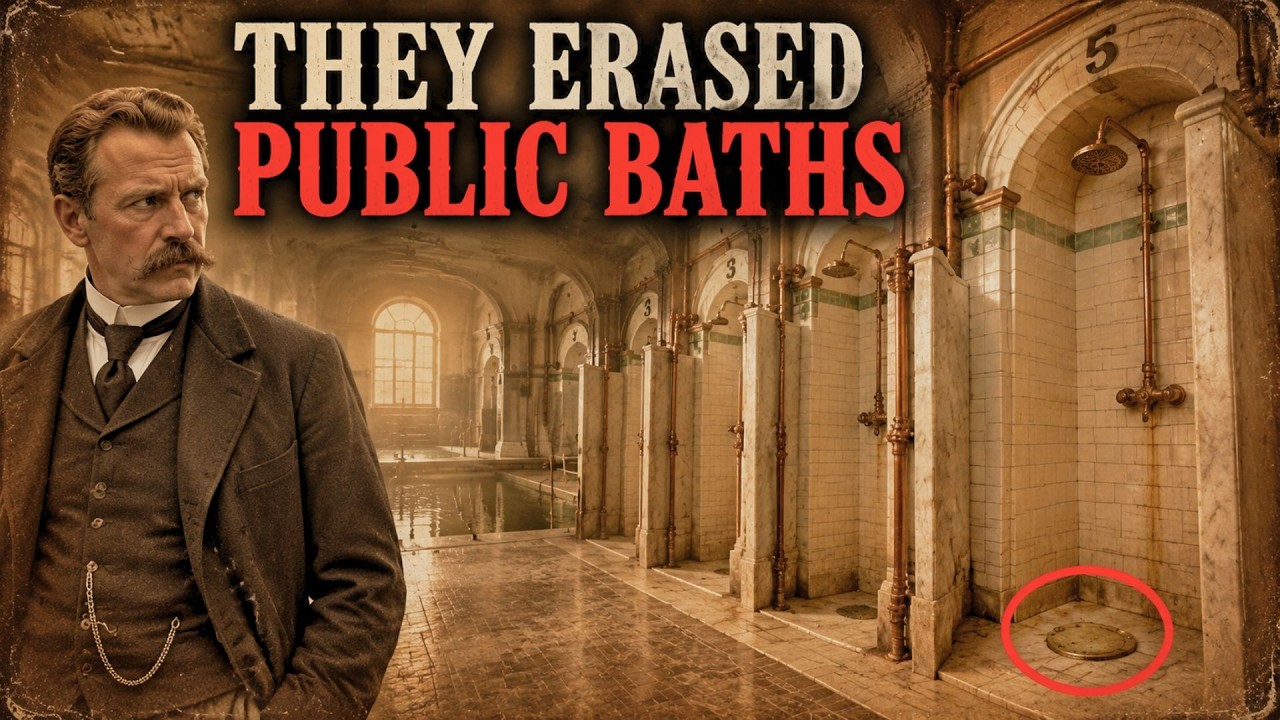
A long central hall was lined with numbered individual stalls, each with a drain, a showerhead, and a narrow wooden bench. Polished marble or tile covered the lower walls—partly for aesthetics, partly for easy cleaning between visitors. A changing room held rows of numbered hangers and clothes cages under the watch of an attendant. Operating these buildings required real effort, not just plumbing.
Each employed a staff of assistants, women’s section supervisors, ticket collectors, and laundry workers. For many immigrant women in cities like New York and Chicago, a towel-distribution job at a municipal bathhouse was among the first steady, government-paid positions available to them. A visit followed a consistent pattern: buy a ticket at the window, get a locker key, receive soap (or bring it wrapped in newspaper), then enjoy 15 or 20 minutes under the shower before an attendant’s knock signaled the next person in line. Saturdays in summer saw queues stretching around the block.
Chicago split its week by gender—five days for men and two for women—and in many immigrant neighborhoods, each ethnic group was informally assigned its own day. The aim was efficiency, not comfort: pushing as many clean bodies through as few showers as possible. Chicago’s program had a different origin story from New York’s, driven not by a single male physician but by a coalition of women reformers. Starting in 1892, three doctors—Gertrude Wellington, Sarah Hackett Stevenson, and Julia Lathrop—organized what became the Free Bath and Sanitary League, backed by Jane Addams’s Hull House and the Chicago Women’s Club.
Their pressure led to the opening of the Carter H. Harrison public bath in 1894, the first of 21 buildings spread across the city’s poorest neighborhoods by 1918. Chicago’s reformers deliberately rejected the grand style favored in New York, insisting public baths should be modest and cheap enough to expand quickly. Boston adopted its own municipal bathing policy in 1895 and eventually operated 12 bathhouses.
One of them, the North Bennet Street Bath and Gymnasium in the North End, was built between 1906 and 1908 with a Beaux-Arts facade intended to signal that the city considered the building worthy of the same architectural investment as a courthouse or a branch library. This architectural ambition permeated the entire movement. The buildings appeared just as American civic architecture came under the spell of the 1893 World’s Columbian Exposition and the City Beautiful movement that followed, which held that essential civic infrastructure should be dressed in the shared classical language of columns and pediments. Public bathhouses were no exception.
A surviving photograph from the era shows a crowd outside a New York bathhouse on a summer morning—men in shirtsleeves, women holding children—waiting in line before a facade using the same classical vocabulary as the city’s courthouses two blocks away. Mill and mining towns in western Pennsylvania pursued the same goal through a completely different structure: private philanthropy. Andrew Carnegie incorporated the public bath directly into his company library system. His first library, opened in Braddock in 1889 and funded entirely by Carnegie Steel, included a public bathhouse in the basement for mill workers, accessible by a tunnel from the front entrance, at a time when the vast majority of steelworkers’ families had no running water.
Over four decades, the building nearly doubled in size with the addition of a pool, gymnasium, and music hall. But the basement bath remained the most-used section for ordinary workers, allowing a man to wash off the day’s furnace grime before stepping upstairs among the marble floors and books. Carnegie repeated this formula in Homestead in 1898, in his namesake library in 1901, and in Duquesne in 1904—four steel towns along the Monongahela River, each library built around the same basic offer: education and entertainment upstairs, bathing below. Not every steelworker wanted much to do with a library built by the company that set his wages; many preferred saloons and union halls.
But others used the evening classes to learn English, and their children grew up treating the marble stairs and the pool as ordinary parts of childhood. Civic reformers in Pittsburgh pursued a parallel path, far removed from the steel companies. In 1895, members of the Twentieth Century Club and the Council of Jewish Women formed the Civic Club of Allegheny County specifically to expand free public bathing across the city. Their argument, preserved in the club’s records, focused as much on character as on hygiene.
The committee argued that the public bath could teach both individual and community cleanliness and, in their words, help make the people it was built for better persons. By the time the movement peaked, it had gained institutional weight. In 1912, Baruch became the first president of the newly formed American Association for the Promotion of Hygiene and Public Baths, a position he held until his death in 1921. The organization standardized bathhouse design, published comparative operating costs between cities, and lobbied the few states that had not yet passed laws like New York’s.
Architects who specialized in this style built real professional reputations through it. Trade publications covered the opening of new bathhouses with the same seriousness they gave to new courthouses or bridges. Nothing about this looked like an industry approaching its end. The official explanation for what happened next is documented and straightforward: as private plumbing gradually spread through American housing during the first half of the twentieth century, people needed public bathhouses less, and attendance declined.
Historian Marilyn Thornton Williams, whose study of the movement remains the standard reference, dates the turning point to around 1915, when a wave of housing reforms—many derived from New York’s Tenement House Act of 1901—began installing toilets and eventually showers in buildings that had never had them. But the decline did not happen because every apartment finally got a working shower. In some jurisdictions, indoor plumbing was not even a legal requirement for all housing until the late 1950s, well after most cities had already begun shuttering their bathhouse programs. The buildings closed because the health boards that ran them—the very same reform coalitions that had fought so hard to build them a generation earlier—gradually stopped considering personal bathing the first line of defense in public health.
They began treating it as a lower priority than the water and sewer infrastructure being built beneath the cities themselves. Jersey City became the first public water supply in the country to receive continuous chlorination in 1908, under physician John Leal, and the technique quickly spread. Once it became possible to treat drinking water and waste at the source, centrally, on a scale that included every resident automatically, the argument for continuing to fund hundreds of individual washing stations lost most of its original necessity, regardless of the actual state of any particular family’s bathroom. Filtration plants followed in city after city over the same two decades, treating entire municipal water supplies at once rather than relying on any household, business, or bathhouse to manage exposure to contaminated water on its own.
Public health departments, established in many cities specifically to fight the epidemics the bathhouse movement was designed to prevent, increasingly measured their success by falling city-wide typhoid and cholera rates—a target that centralized water treatment achieved far more efficiently than any network of shower stalls ever could. There was also a smaller, more mundane pressure. The winter of 1917 to 1918 was the first in which the federal government rationed coal nationally to support the war effort, a reminder of how directly a building’s fate was tied to the simple operating cost of its boiler. A public bathhouse existed only because a municipal budget was prepared to pay year after year for hot water, heating fuel, paid staff, and constant plumbing repairs—in exchange for a usage rate that historians of the movement themselves admit rarely approached what planners had originally hoped.
Many cities solved this arithmetic by changing the buildings’ purpose rather than closing them outright. Baths with large open pools, originally built for group bathing sessions, easily converted to public swimming pools—a use that required fewer staff per visitor and generated no expectation that anyone would leave perfectly clean. Several buildings mentioned in the historical record spent their final decades operating exactly this way: still technically open, still technically city-owned, but serving an entirely different purpose than the words carved in stone above their doors. The closures that followed were not synchronized and left no unified record, but the pattern across cities is so similar it seems coordinated, even though every decision was made locally and separately, usually with no meaningful public notice.
New York kept its baroque Rivington Street bath as a public swimming pool for decades, until the city finally entombed the structure in concrete in 1975. Brooklyn’s Huron Street bath, with its terracotta Greek key frieze, ceased operation in 1959 and now houses artists’ studios. Chicago held on longer than most, closing its last public baths in 1979, with only four of the original 21 buildings still standing. One, the former Lincoln Bath, was later renovated into a private residence listed for nearly $6 million, complete with an outdoor kitchen and a basketball court where the public washing floor once stood.
Boston’s North Bennet Street bath suffered visible neglect through the 1940s and 1950s despite repeated complaints from residents who still used it, closed officially sometime in the 1970s, and reopened as a community center in 1985. Baltimore lasted longer than any other city. Attendance there had been declining since 1915, but the city kept its Walters-funded public baths operating for more than four decades before the Board of Estimates finally voted to close every remaining one by the end of 1959. At Walters Public Bath No.
2 on Washington Boulevard, a customer whose name no one bothered to record was still in the shower five minutes before five o’clock on December 31 of that year. He finished, dried off, and walked out into the evening like anyone else on any other night. At exactly five o’clock, the water was shut off for good, and with it ended the last public bathhouse in an American city, 68 years after the People’s Bath first opened its doors for five cents on a side street in New York. None of this was a purely American invention.
Cotton mill towns in Lancashire, England, had been building public baths since the 1850s. By the time American cities built their own networks, the basic argument—that an industrial workforce needed bathing facilities it could not afford on its own—had already traveled across the Atlantic and back. The Pittsburgh steel town libraries followed a slower, more complex path, tied to the fortunes of the mills rather than to any bathing policy. The Braddock Library, including its bath, remained in continuous public use until 1974, when a roof collapse and lack of maintenance funding forced its closure; a group of local residents, led by its last librarian, then bought the building for one dollar and slowly brought it back to life.
The basement space where mill workers descended through a tunnel to wash off their shift now serves as a pottery studio, its original tiles still visible on floor and walls. Carnegie’s philanthropy in that town came, notably, only a few years after a far less generous event. In 1892, six years before the Homestead Library opened its bathhouse to steelworkers a few miles upriver, Carnegie’s private security forces violently clashed with striking workers at the same plant, killing ten men in a wage dispute the company itself had provoked. The library, pool, and bath arrived as a very different kind of offering.
The steelworkers who used them were left to draw their own conclusions about the sequence. The Braddock and Duquesne libraries eventually passed entirely out of the original Carnegie trust and were handed to local school districts in the 1960s, as the steel companies quietly stepped back from what they had once considered a source of pride. The Homestead Library, built in the second of Carnegie’s four Monongahela Valley towns, had a completely different fate. It never closed at all.
The successor company to the steel works continued paying its endowment allowance until 1988, two years after the Homestead plant shut down for good, and the borough of Munhall then took over financial responsibility, keeping it operating through grants and the interest on Carnegie’s original gift to this day. Nobody in Homestead ever had to buy back the building for a dollar as Braddock residents did, because it never reached a point of needing rescue in the first place. Three libraries built by the same man in three towns along the same river for the same stated purpose ended up with three different fates: one handed to a school board, one nearly lost then saved by its own community, and one that never stopped working. Nothing in the original design predicted which path any of them would take.
Baruch did not live to see any of this unfold. He died in 1921, still president of the association created to expand the movement he had spent 30 years advancing, at a moment when the project looked from the inside like something just beginning. The slow decline that Williams later documented had barely begun to show in attendance figures by then. He got to see the buildings rise.
He did not live to see them empty. By the time the pattern became unmistakable, most of the people who had fought hardest to establish these buildings were also gone, leaving no one with a personal stake in noticing or caring about their disappearance. This ending, it turns out, is common for this kind of infrastructure generally. The decision to build is often linked to a specific name—an activist physician, a women’s club, a steel baron cutting a ribbon.
The decision to stop rarely has a name attached. It is made in increments, by whichever official happens to review that year’s budget, none of whom necessarily sees themselves as ending anything at all. There is one final quiet irony in how many of these structures are treated today. A handful—including some described here—have since been granted landmark status by city preservation commissions, their facades protected by law precisely because of the architectural seriousness the early reformers insisted upon.
The plaques tend to describe the buildings in purely architectural terms: Ionic columns, terracotta friezes, Beaux-Arts facades, with a line barely mentioning what actually happened inside, or why a whole generation of American cities once agreed that public baths were worth building. What links all these closures together, city after city and across the decades, is not a memo or a single boardroom decision but shared, distinctly unglamorous institutional accounting. As municipal health departments directed their limited budgets toward water treatment plants, expanding sewer networks, and ultimately the swimming pools and recreation centers that many old bathhouses quietly became, the original mission—cleaning an unbathed population before disease broke out among them—stopped being everyone’s most pressing problem. Those buildings did not require a decision to close by a single authority.
They only required someone, somewhere along a long chain of routine budget meetings spread over half a century, to decide over and over again, in dozens of separate cities, that the money would be more useful spent elsewhere. Other Progressive Era institutions quietly absorbed the hygiene function the public baths had once performed almost alone. High schools began installing locker room showers as a standard feature. The YMCA expanded its athletic and bathing facilities into neighborhoods once served by the municipal system.
None of these alternative providers carried the same explicit public health mission, and none replaced what was lost so much as made its absence easy to ignore. Later, as home ownership and suburban development expanded rapidly after World War II, the private bathroom—the true monument to the reformers—became available to nearly everyone for the first time in American history, completing a transition that had begun quietly, almost casually, in the tenement housing reform laws the public bath advocates themselves had demanded. What remains today survived almost by accident, through adaptive reuse rather than any deliberate preservation effort. A former public bath in Manhattan houses artists instead of factory workers.
A former public bath in Chicago sells for the price of a small apartment building. A former public bath in a steel town outside Pittsburgh hosts pottery classes in the same tiled basement where a man once scrubbed furnace soot from his arms before climbing the stairs to borrow a book. A former public bath in Boston hosts after-school programs for a neighborhood whose grandparents once lined up outside it on a Saturday morning with a towel under one arm. These buildings did not need to be hidden or erased to vanish from public memory.
They simply outlived the crisis that caused them to be built. Budget cycle after budget cycle, no one ever wrote the plaque explaining what came next. Somewhere in most of these cities, inside a file cabinet or bound ledger no one has digitized, the construction cost, the opening day attendance figure, and the final closing date for each one probably still exist, awaiting a local historian with the patience that Marilyn Thornton Williams brought to finding the same numbers on a national scale. Return to that brick building on the corner of Miltown Street, the one with the faint words “Public Baths” still visible above a door that now leads to a church basement or a furniture gallery.
That lettering was never a secret, and no one ever tried to hide what the building used to be. It was civic pride at one time, carved in stone by a town that wanted everyone passing by to know exactly what the building was for and why the reformers of that era thought it worth building at all. The only thing that changed, slowly and without ceremony, is that the reason stopped applying—city by city, budget by budget—until the letters above the door became the only surviving part of the story.