On the afternoon of July 3, 1863, the temperature at Gettysburg reached 87 degrees, and the humidity made the air feel almost suffocating. Confederate soldiers lay flat in the trees along Seminary Ridge, exhausted, hungry, and low on water. In front of them stretched nearly a mile of open farmland, and beyond that ground stood the Union Army behind stone walls with artillery at the ready. Any enlisted man could calculate the odds.
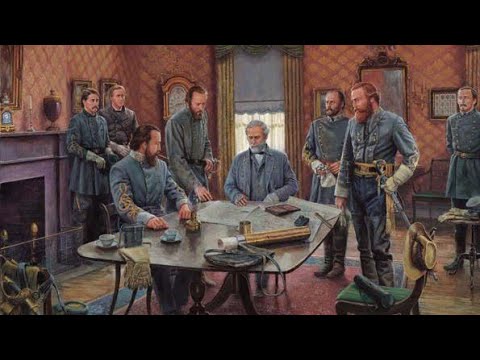
Advancing across that field meant walking directly into concentrated cannon and musket fire. But within moments, General Robert E. Lee, the Confederacy’s most celebrated commander, ordered them to rise and advance anyway. History remembers this as Lee’s gravest error.
Scholars often describe it as the high-water mark of the Confederacy, but many accounts omit the crucial exchange that took place just before the order was finalized. James Longstreet, Lee’s most trusted subordinate, did not merely object. He argued intensely. He warned Lee with chilling precision about what the casualty figures would look like.
He even proposed an alternative strategy that might have secured victory without sacrificing thousands on that open ground. Lee refused. The explanation for that refusal goes beyond battlefield tactics or personal pride. It traces back to a deeper failure inside the Confederate command structure that had begun unraveling days earlier.
To understand the disagreement, it helps to understand the terrain. Gettysburg was not carefully selected. It was stumbled upon by accident, the result of converging roads and a desperate search for supplies. The Army of Northern Virginia was hungry.
The invasion of Pennsylvania was driven not only by ambition but by necessity. The Confederates needed cattle, grain, and famously, shoes. By the morning of July 3, the Union Army under General George Meade occupied the high ground in a defensive formation resembling a fish hook. Culp’s Hill formed the barb.
Cemetery Hill curved into Cemetery Ridge. The Round Tops anchored the end. Meade held the interior lines, positioned at the center of the arc, allowing him to shift forces rapidly to any threatened sector. If Lee attacked one flank, Union troops could march across the inside of the formation within minutes.
Lee, by contrast, had to maneuver along the outside of the curve. Moving a division from one flank to the other could take hours. For two consecutive days, Lee had assaulted the Union flanks at the Peach Orchard, at Devil’s Den, and at Culp’s Hill. The Union line bent under pressure but did not collapse.
Lee convinced himself that the center must be vulnerable, imagining that Meade had weakened the middle to reinforce the edges. Longstreet saw catastrophe instead. Unlike the flamboyant cavalry commander J. E.
B. Stuart or the late Stonewall Jackson, Longstreet was methodical and pragmatic. He understood that warfare had evolved. The rifled musket had transformed combat.
In earlier conflicts, smoothbore muskets required soldiers to approach within 50 yards to achieve accuracy, but rifled weapons now allowed defenders to kill at distances of 300 yards or more. The mathematics were unforgiving. Infantry advancing in formation moved at roughly 75 yards per minute. Crossing nearly a mile of open terrain would expose them to artillery fire for close to 20 minutes of relentless destruction.
Longstreet approached Lee that morning. The air was already oppressive. The stench of decomposing bodies and horses from two days of combat filled the landscape. Lee gestured toward a small cluster of trees at the center of the Union line.
“The enemy is there,” Lee declared. “And I intend to strike him. ”
Longstreet studied the ground and then faced his commander. He reminded Lee that he had spent his entire life in military service and had observed soldiers fighting in pairs, companies, regiments, divisions, and entire armies.
In his professional judgment, no 15,000 men assembled for battle could seize that position. It was as close to open defiance as he dared. Lee did not waver. Part of the problem was uncertainty.
Normally Lee possessed a clear understanding of his enemy’s strength and movements, but on that day, his most vital source of intelligence was absent. J. E. B.
Stuart, the cavalry commander and the army’s eyes and ears, was not present. He had been conducting an extended ride around the Union forces, capturing supply wagons and seeking glory, but failing in the essential task of reconnaissance. Without accurate information, Lee was operating on assumptions. Longstreet proposed a different strategy.
He suggested maneuvering south, positioning the army between Meade and Washington, D. C. , and forcing the Union to attack. Politically, President Abraham Lincoln could not tolerate a Confederate army threatening the capital.
Meade would be compelled to assault prepared southern defenses. The same principle had brought victory at Fredericksburg, strategic offense combined with tactical defense. Lee rejected the proposal. He was deep in hostile territory with no secure supply line, and every day consumed resources that could not be replaced.
He believed a decisive victory had to be achieved immediately. The artillery bombardment began shortly after 1:00 p. m. Nearly 150 Confederate guns erupted along Seminary Ridge.
Union artillery answered. The explosions shook the earth, creating one of the loudest man-made sounds ever heard on the continent up to that time. Yet the bombardment faltered. Ammunition was limited.
Many fuses malfunctioned. Smoke obscured visibility. Numerous shells overshot the Union positions and exploded harmlessly in rear areas. Union Artillery Chief Henry Hunt conserved ammunition and temporarily silenced portions of his line, creating the illusion that Confederate fire had been effective.
It had not. At approximately 1:45 p. m. , the cannonade subsided.
Colonel Porter Alexander urged an immediate infantry advance before ammunition was depleted. George Pickett, eager and ambitious, approached Longstreet for confirmation. “Shall I advance? ” Longstreet could not voice the order.
He nodded silently. About 12,000 Confederate soldiers stepped forward in formation, from the divisions of Pickett, Pettigrew, and Trimble. Their line stretched over a mile. They advanced in disciplined ranks, flags waving and drums beating.
Then reality asserted itself. They had to cross the Emmitsburg road, navigate fences, and execute a left oblique maneuver that exposed their flank. Vermont regiments under General George Stannard pivoted and fired into the vulnerable side of the advancing line. Union artillery unleashed enfilade fire from Cemetery Hill and the Round Tops.
Cannonballs ripped through ranks lengthwise, cutting down multiple men with a single shot. Gaps tore open. Officers shouted for the men to close ranks, and they stepped over fallen comrades and continued forward. At the Emmitsburg road, intact fences forced them to slow and climb under intense musket fire.
They bunched together. Union gunners switched to canister, a devastating load of iron balls that transformed cannons into enormous shotguns. The front ranks disintegrated under the blasts. Still, survivors pushed onward.
At the stone wall known as the Angle, General Lewis Armistead led a small group over the barrier, urging his men forward with his hat raised on his sword. He briefly reached a Union cannon, marking the deepest penetration of the Confederate assault. Moments later, he collapsed, mortally wounded. Union reinforcements flooded the breach.
Hand-to-hand combat erupted, but the disparity in numbers was overwhelming. The Confederate attack collapsed. Lee rode among the retreating soldiers and accepted responsibility, telling them the fault was his alone. When he asked Pickett to reorganize his division, Pickett responded that he had no division left.
By nightfall, thousands lay dead or wounded. Casualties approached 50 percent. The Army of Northern Virginia withdrew to Virginia and never again attempted a large-scale invasion of the North. Longstreet had understood that warfare had entered a new era.
Rifled weapons and fortified positions favored defense. The grand Napoleonic charge was obsolete. He urged adaptation, digging trenches and compelling the enemy to attack. Lee believed in decisive offensive action guided by honor and boldness.
After the war, southern memory elevated Lee to near mythic status. Longstreet, who later affiliated with the Republican Party, became a convenient scapegoat. Critics accused him of hesitation and disloyalty, preserving the legend of Lee at his expense. Yet with historical distance, a different picture emerges.
On that sweltering July afternoon, amid fear and decay, James Longstreet perceived the future of warfare. He anticipated the entrenched slaughter of the First World War decades before it occurred. Whether his alternative strategy could have altered the Confederacy’s ultimate fate remains uncertain. The Union possessed superior industry, manpower, rail networks, and naval power.
Perhaps the outcome was determined long before Gettysburg. Or perhaps the decision on that ridge closed the final possibility. If placed in Lee’s position, would you have ordered the charge or turned to maneuver instead?