In November 1944, a German field hospital operated inside a confiscated school east of the Saar River. Senior surgeon Heinrich Vollmer stood over a zinc basin, washing another man’s blood from his forearms in cold water because the water heater had been broken for nine days. He had been operating since 4 a. m.
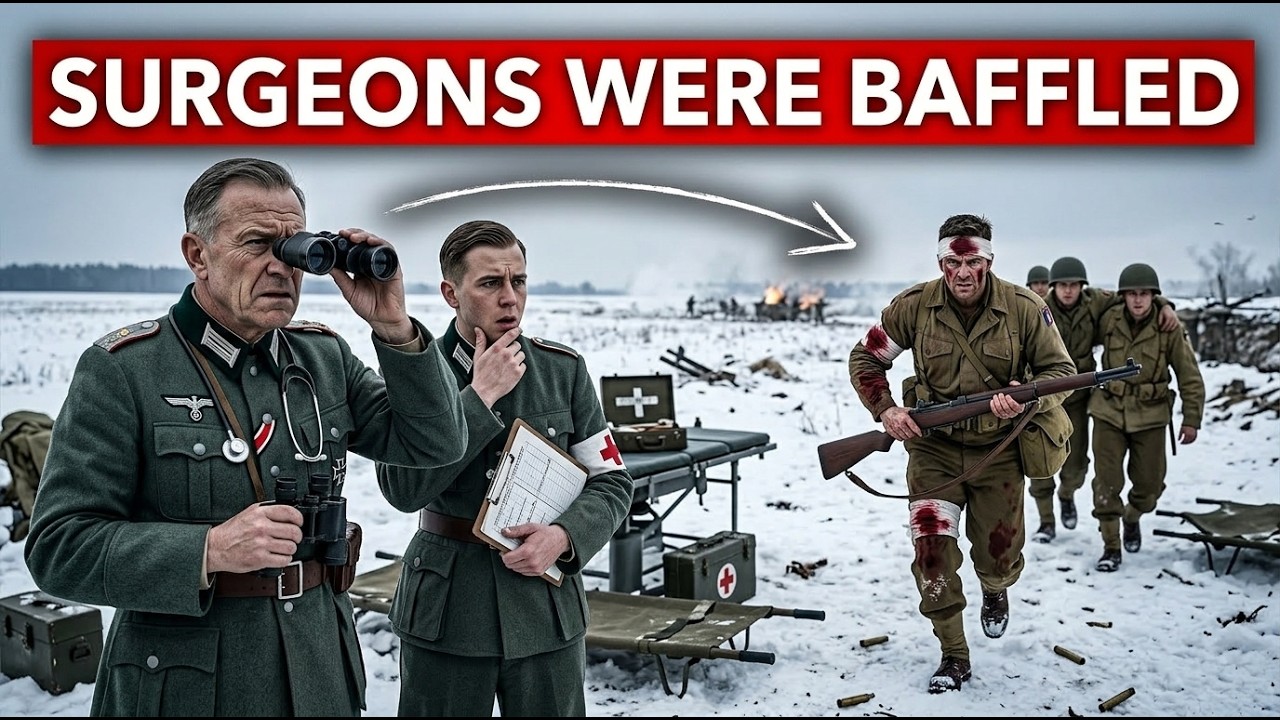
Vollmer had spent four years in military service, including a winter outside Kharkiv and eleven months in Italy. He had performed more abdominal surgeries under artillery fire than most civilian surgeons would see in a lifetime, using equipment already considered outdated in Berlin before the war. On a table behind him sat something one of his assistants had taken from a captured American aid station that morning. It was a cardboard box containing two metal tins: one held a vacuum-sealed bottle of yellow powder, the other 400 cubic centimeters of sterile distilled water.
Attached to the side was a rubber tube and a double-ended needle. Vollmer knew exactly what it was. It was dried human plasma. He knew it needed no blood type matching, no refrigeration, and would still be usable after two years in a truck in Tunisia or a cellar in Belgium.
What he did not understand was the writing on the box. There was no mark of rarity or value on it. Instead there was a batch number and a date printed quickly, as though someone were marking something they planned to produce by the tens of millions. A second document lay on the table: a captured American medical summary, poorly translated by an intelligence section that did not believe it either.
The report included a statistic on severely wounded American soldiers who reached a medical facility alive. About 96 out of every 100 survived. Vollmer’s own hospital, in a good week, in a quiet sector, with a full staff and an intact supply line, could not approach that number. Neither could any German facility where he had served.
He read the page twice. Then he said what German medical officers had been saying to each other for eleven months, from Normandy to the Rhine: “These figures are fake. ”
He was wrong. Not because he was a poor doctor, and not because German medicine was backward.
He was wrong because the American number was not a medical achievement at all. The uniform was medical, but the achievement was logistical, and the German medical service had no category for it, no terminology for it, and no way to produce it even if they had fully understood it. The American system was rooted in a mobilization of the home front. Between February 1941 and the end of the war, American civilians walked into Red Cross donation centers and gave 13,326,242 units of blood.
This was not an estimate. It was a precise count. German medicine in 1939 was not behind American medicine. In many fields it was ahead.
Gerhard Domagk, research director at Bayer in the I. G. Farben works at Wuppertal, had discovered in the early 1930s that a red textile dye called Prontosil cured streptococcal infections in living animals. He tested it on his own daughter after a needle prick gave her a fatal infection, and she survived.
Domagk opened the era of sulfa drugs. A man with an infected wound in 1943 had a chance that a man with the same wound did not have in 1917. Domagk was awarded the Nobel Prize in 1939, but the regime would not let him accept it. The Gestapo arrested him and held him until he signed a letter refusing the honor.
German surgery was also world-class. Ferdinand Sauerbruch, working at the Charité in Berlin, was considered by doctors on both sides of the Atlantic to be among the two or three finest surgeons alive. In thoracic surgery, orthopedics, wound care, and anesthesia, Americans in 1939 were still reading German journals to catch up. The German army medical service was not improvised.
It followed a written, trained doctrine. A wounded man moved backward through a chain: company stretcher bearers, the battalion aid station, the regimental collecting post, the division clearing station, the field hospital, the evacuation hospital, the hospital train, then Germany. The system was elaborate, and it worked in Poland in 1939 and France in 1940. The Germans also understood blood transfusion.
Karl Landsteiner, the man who discovered blood types, was Viennese. The theory was Central European. What the Germans practiced was direct transfusion, donor and recipient in the same room, connected by a tube, warm blood passing from arm to arm. The donor was usually a lightly wounded man from the same unit, sometimes a medical orderly, rarely a prisoner.
Physiologically, fresh whole blood passed directly from arm to arm was excellent. But it had one drawback, and it was not medical. It was not scalable. To give a man four pints this way required four healthy donors with known blood types present in that building at that hour.
If an aid post received 80 casualties in one night, the arithmetic collapsed immediately. Faced with this obstacle, German medical science found a substitute. Bayer laboratories developed a synthetic colloid, a polymer solution sold to the German army under the name Periston, alongside an electrolyte solution. The idea was sound, the same one the Americans were pursuing.
A man bleeding to death dies primarily from loss of blood volume. If fluid could be returned to his circulation, his blood pressure could be restored, and if his blood pressure was restored, he might live long enough for a surgeon to close the hole. Periston went into production and was distributed widely. But it had two problems.
First, the polymer did not leave the body. The human body had no mechanism to eliminate it. It accumulated in the liver, spleen, and lymph glands, remaining for months, sometimes years, sometimes permanently. Second, and worse, Periston did not carry oxygen.
A man who lost four pints of blood had not only lost blood pressure. He had lost the red cells that carry oxygen from lungs to tissues. Clear fluids could restore the pressure on paper, but the tissues still starved for oxygen. The numbers improved while the man did not.
If he was taken to surgery on that basis, he died on the table. The Americans discovered the same thing, but they had an exit. The only solution was red cells, and red cells come from people. This was a challenge Germany could not solve, because building a national blood supply required an enormous civilian mobilization.
It required asking millions of ordinary citizens to give part of their bodies to a stranger they would never meet. Germany in 1941 was governed by a state whose founding principle was that the identity of the stranger mattered enormously. Blood was not just a fluid in Nazi Germany. It was the central metaphor of the entire ideology: blood and soil, purity of blood, blood as inheritance, as race, as something never to be mixed.
A mass anonymous blood donation campaign was structurally impossible under such a system. Accordingly, the German wounded waited longer, arrived colder, sicker, and anemic, and entered a hospital short on supplies and donors. German surgeons had the skill, the chemistry, the doctrine, and practice. What they did not have was 13 million units of blood, and no surgical skill could replace that.
The American medical service, by contrast, had not started well. In November 1942, the units landing in North Africa were inexperienced and badly supplied. At the Kasserine Pass in February 1943, American units collapsed, and with them the medical supply line. German forces overran aid stations, and the wounded lay on the ground for a day or more.
When the Germans captured American medical stocks, they captured plasma in enormous quantities, because the American principle in 1942 was that plasma was the solution. Plasma is remarkable. It contains the proteins that keep fluid in the blood vessels. It can be dried to powder, stored for years, and given to anyone regardless of blood type.
It saved enormous numbers of lives. But plasma also carries no oxygen. This was the American version of the Periston problem, and they hit it in Tunisia, Sicily, and Salerno. Surgeons reported the same thing again and again.
A man arrived in shock. Plasma was poured in. His pressure rose. He went to surgery.
He died. Or he survived surgery and died six hours later of what surgeons called secondary shock, which was actually oxygen deficiency that no amount of clear fluid could fix. The American answer to this discovery is the whole story. It required four separate elements assembled by people who did not know they were building a weapon.
The first was storage science. In 1937, at Cook County Hospital in Chicago, a physician named Bernard Fantus set up a facility to preserve donated blood chilled for later use, and gave it a name that had never existed before: a blood bank. The name was the invention. It redefined blood as something deposited, stored, and withdrawn.
The second was chemistry. In 1943, two British researchers devised an acid-citrate-dextrose anticoagulant solution that extended storage from about a week to three weeks or more. Three weeks made the difference between a local resource and a shippable commodity. The third was fractionation.
At Harvard, biochemist Edwin Cohn developed a process using cold ethanol to separate plasma into its component proteins, including serum albumin, a concentrated volume expander in a small, easily carried bottle. Its first real field use came on December 7, 1941, when supplies were rushed to Pearl Harbor and used on burned men pulled from the harbor. The fourth system moved blood from civilian arms to soldiers’ veins. Its engineer was surgeon Charles Richard Drew.
Born in Washington, D. C. , he studied at Amherst, then at McGill University in Montreal, because American medical schools in the 1930s were largely closed to him. He was Black.
Returning to Columbia, he became in 1940 the first African American to earn a Doctor of Science in medicine there. His thesis was titled “Banked Blood. ”
In the fall of 1940, with Britain under bombing, Drew became medical supervisor of the “Blood for Britain” project, which collected plasma in New York for shipment across the Atlantic. It succeeded.
Drew standardized collection, processing, sterility controls, and record-keeping. He was then brought in to help establish the American Red Cross blood donation program, which began collecting in February 1941. This is how the system he designed worked once it was running. Six and a half million Americans gave blood, not soldiers but civilians: shipyard workers in Baltimore, teachers in Des Moines, women whose husbands were in the Pacific, older men who could not be drafted.
Donors who reached one gallon received a pin, and people wore it. Out of those arms came 13,326,242 units of blood, and from that, more than 10 million packages of dried plasma for the armed forces. Starting in the summer of 1944, the Americans added the element that saved the most lives. They began flying whole blood across the Atlantic.
Banks in the United States drew type O low-titer blood, the universal donor type. It was packed in insulated boxes over ice, loaded onto transport aircraft, flown to Scotland, moved to depots, then to field blood banks, then pumped forward to field hospitals in Normandy, Lorraine, and the Ardennes. About 380,000 units of blood made that trip before the end of the war, alongside quantities collected from soldiers in Britain. Then came the final piece that turned all of this into real military power.
The Americans built a dedicated room for blood volume restoration, called the shock ward. It was usually a tent attached to a field hospital, pushed forward near a division clearing station, an hour or two from the point of attack rather than twelve hours. A man arriving there was not taken straight to the operating room. He went first to the shock ward.
He was warmed. He was given plasma, then whole blood, bottle after bottle, sometimes six, sometimes ten, sometimes twenty units, while a team watched his pressure, his color, his urine output, and waited. They did not operate on a man in shock. They tried to resuscitate him until he was able to survive surgery.
This is an unambiguous doctrine that any German surgeon in the world would have adopted within hours. It requires only one thing: an unlimited supply of donor blood. The wounded returned. By fall 1944 the U.
S. Army was not flush with infantry. It had gambled on a limited number of divisions, and after Normandy, the Hürtgen Forest, and Lorraine, rifle companies were severely understrength. There were not enough replacements coming from home.
In such a situation, the hospital was less an act of charity than a factory for manpower. Look at the arithmetic. In the American infantry in 1918, about eight of every hundred men who reached a medical facility alive died of their wounds. In 1944-45, that figure had dropped to about four and a half per hundred.
Among nearly 600,000 men admitted for battle wounds, that decline meant tens of thousands of soldiers survived who would otherwise have died. Most of those survivors did not go home. They went to a general hospital, then to a rehabilitation program, and then a large fraction returned to their units. Penetrating abdominal wounds had killed nearly half of those who suffered them in World War I.
By 1945, the U. S. Army figure was about a quarter. Chest wounds improved even faster.
The reason was time and blood, in that order. In 1918, the average interval between wounding and surgery for an abdominal wound was measured in tens of hours. By 1944 it was under six, and in well-managed sectors under two. That closeness came from pushing surgical capacity forward.
Field hospital platoons and auxiliary surgical teams operated almost on top of clearing stations. Surgical capacity could only be pushed that far forward if blood could be pushed to the same level. Otherwise, you were simply moving the place where men died. Compare the German evacuation system.
It relied on roads and railways, and the Kriegslazarett system operated by moving wounded backward over long distances by hospital train. Allied fighter-bombers spent 1944 destroying German locomotives, marshaling yards, junctions, and bridges. The German wounded man’s problem was not that his surgeon was worse. It was that his surgeon was ninety kilometers behind him, and the road between them was cut at 3 a.
m. by an airplane no one saw. Then there was penicillin. It was discovered by a Scot and turned into a drug by a team in Oxford.
What was American was the decision to treat it as a production problem rather than a laboratory problem. Production began in government labs in Peoria, moved through corn steep liquor, and into deep-tank fermentation plants built by companies including Pfizer in Brooklyn. By the Normandy invasion, the United States had roughly two and a third million doses ready. By 1945, the price of a dose had fallen from about twenty dollars to under one dollar.
The Germans had sulfa drugs, which they had invented, but they had almost no penicillin. They knew what it was and had captured samples, but they could not produce it in quantity. This is what the chain looked like from the other end. A man was hit.
An American medic reached him within minutes with morphine, a sulfa packet, and often a unit of plasma. He reached a battalion aid station within the hour, then an advanced surgical facility within two hours. Before surgery, whole blood, real red cells flown from Ohio, was pumped into him until he could physically tolerate anesthesia. A surgeon closed the wound.
Penicillin was given to prevent infection that would have killed him in 1918. He was evacuated by air. Ninety days later, he walked to a supply depot carrying a duffel bag. Every one of those steps existed in some form in German military medicine.
None of them existed at that speed, in that volume, or in that order. The men who did the first part of that were not extraordinary people. Alfred Wilson was a fifth-grade technician, a medic, in the 328th Infantry Regiment, 26th Infantry Division. He came from Verchans, Pennsylvania, a coal and coke town in Fayette County, the kind of place that sends its sons to war and gets them back or not.
On November 8, 1944, in France, his battalion came under heavy German artillery fire. Wilson was badly wounded in the same barrage. Ordered back, he refused, because men were on the ground around him who would die if no one reached them, and he was the one who reached them. He continued treating the wounded while his own wounds were killing him.
When he could no longer move among the men, he stayed where he was, instructing other soldiers in how to treat their hands, how to stop bleeding, where to apply pressure, how to use plasma. He supervised the treatment of men he could no longer crawl to. He was credited with saving at least ten of them. He did not survive.
He was posthumously awarded the Medal of Honor. That was what the far end of the pipeline looked like: thirteen million donors, an ocean crossing, air transport command, the blood fractionation industry, and finally, a 25-year-old coal miner’s son from western Pennsylvania, bleeding to death while teaching a soldier how to hang a bottle. Now return to Vollmer at the sink, and the sentence he wrote in the margin of a translated document: “These figures are fake. ” He was not stupid and he was not a fanatic.
He was doing what any trained professional does when presented with a result outside the range his entire experience allows. He was rejecting the data. German medical officers gave the same reasoning consistently under interrogation, in captured correspondence, and in accounts after surrender. Their logic ran this way.
First, the Americans must be defining wounded differently, counting scratches and minor fragment wounds, inflating the denominator and thus the survival rate. That was a reasonable doubt, and wrong. Post-war comparison of classification systems proved it wrong. Second, the Americans must be losing severe cases before the count starts.
Men who die between wounding and reaching an aid station do not appear in admission statistics. That is partially true, and it is a sensible objection. But it misses the point, because the entire American design targeted exactly that interval, compressing it until men who would have died during it arrived alive. Third, it is propaganda.
The numbers are boosted for morale and not real. This third answer is the most common, and it reveals the true flaw in German thinking. The German medical officer knew exactly how much blood a severely wounded man needed. What he could not accept was the supply.
Set yourself in his place and do the arithmetic honestly. He is told that one wounded American in a field hospital might receive ten, fifteen, or twenty units of stored whole blood in a single night. He looks at his own facility. He has a few donors of known type he could call on short notice.
His refrigerator is a cellar. His anticoagulant supply is irregular. He has cartons of an artificial colloid he secretly distrusts. For the American number to be true, there must exist, three thousand miles away, an industrial-scale civilian donation network, a national processing industry, a cold chain, and a dedicated air bridge shipping perishable human tissue across the ocean in the middle of a world war.
Not for a strategic weapon, but to treat individual infantrymen. He does not believe this exists because in his world it does not and cannot exist. So he concludes the number is a lie. It is the only conclusion left.
There is a second reason he could not see it. German military medicine measured itself the way surgeons had always measured themselves: case by case. Did the operation succeed? Was the technique sound?
Was the resection correct? Was the closure clean? Was the outcome good? By those standards, German surgeons were often as good as anyone.
By 1944, American military medicine was measuring something entirely different, and it was not measuring it in the hospital. It was measuring at the replacement depot. The American metric was: how many riflemen will be standing in line ninety days from now who were lying in a ditch today? These are not the same question, and a service organized around the first question cannot even see the second one being asked.
Vollmer was grading an exam the Americans were not taking. Here is the part that should be troubling rather than satisfying. The Germans did discover the truth, most of them eventually. During the Rhineland campaign in the spring of 1945, German wounded fell into American hands in huge numbers, and American medical units treated them under the Geneva Convention and because it was standard practice.
German soldiers who had been told for twelve years that blood was inheritance, that blood was race, and that the mixing of blood was the original crime, were placed on American tables and received American blood: anonymous blood, pooled blood, blood drawn from the arm of a stranger in Missouri or Oregon who would never know where it ended up. Captured German medical officers who were compelled to work alongside American crews later described the same thing again and again. It was never the surgery that amazed them. It was the supply.
It was walking into a supply tent and seeing plasma boxes stacked to the canvas, and penicillin being dispensed to prisoners for infections that would not kill them, and being told this was normal, and another truck would arrive on Thursday. That was where the falsification argument died. Not in an argument. In a warehouse.
So the answer to what Vollmer wrote in that margin is this. The numbers were not fake. He had to disbelieve them, and they were true. The Germans were right in many ways.
They were right that frontline American medical practice, from a purely surgical perspective, was sometimes less refined than their own. They were right that American frontline surgeons were often young, quickly trained, working from simplified protocols. They were right that the Americans used enormous quantities of material to achieve results that a more skilled, more economical service might have achieved with less. They were right that much of what the Americans did was not elegant.
In short, they were right that the Americans were not better doctors. But their error was treating this as a competition between doctors. It was not. It was the same competition the Germans lost in artillery ammunition, aircraft production, and trucks, and it had the same shape.
They mistook it for inefficiency, waste, and a lack of professional discipline, when it was actually a deliberate decision made at a level above the one they were looking at. The German system was built to optimize a scarce resource. That is what scarcity does to an institution. It makes it precise, economical, skilled, and small.
Every German drop of blood had to be justified because there was no second drop. The American system was built on the assumption that the resource was renewable, because a resource coming from the arms of six and a half million volunteers is renewable in a way steel can never be. There is no need to ration something that regenerates in the donor’s body within weeks and arrives daily in enormous quantities. So the Americans stopped rationing it.
They gave a patient twenty units where a German surgeon would have hesitated to give two. Not out of waste, but because the right amount was what the patient needed, and they were uniquely positioned to provide it. Once they could afford the blood, they built a doctrine that spent it on the forward field hospital, the shock ward, the pre-operative resuscitation base. That doctrine was not American genius.
It was what any competent medical service would do once blood lost its scarcity. The Germans could not adopt it, not because they did not understand it, but because adopting it would have emptied their supply by lunchtime. Germany fought the war as a series of battles, perfecting its preparation for each one. America fought the war as an integrated system, improving its operations across the entire year.
A German surgeon saving a soldier was saving a soldier. An American surgeon saving a soldier was manufacturing an infantryman, and the manufacturer had a lead time of about ninety days, and that time was recorded somewhere at headquarters. This meant that the wounded American soldier was not, in American accounting, a loss at all. He was inventory in transit.
That sounds cold, and it was. But it was also the most humane arrangement any army in that war made for its own men, and the two truths cannot be separated. The system kept soldiers alive because it needed them, and it kept them alive. Vollmer’s question was how these numbers could be explained.
The answer is that they were never medical numbers at all. They were the medical readings of a civilian mobilization: the arithmetic of thirteen million ordinary Americans who stood in line, gave part of themselves without recognition, took a biscuit and a pin, and went back to work. There was no secret. That was the secret.
There was nothing to reveal because there was nothing hidden.