On the night of May 4, 1970, on a private Greek island that no outsider could reach, one of the richest women in the world was found dead in her room. The official cause of death was ruled a barbiturate overdose. But when the medical examiner examined her body, he found something the pills could not explain: bruises on her head, bruises on her throat, and bruises on her chest. The woman was Eugenia Niarchos, wife of shipping tycoon Stavros Niarchos, one of the two richest Greek men alive at the time.
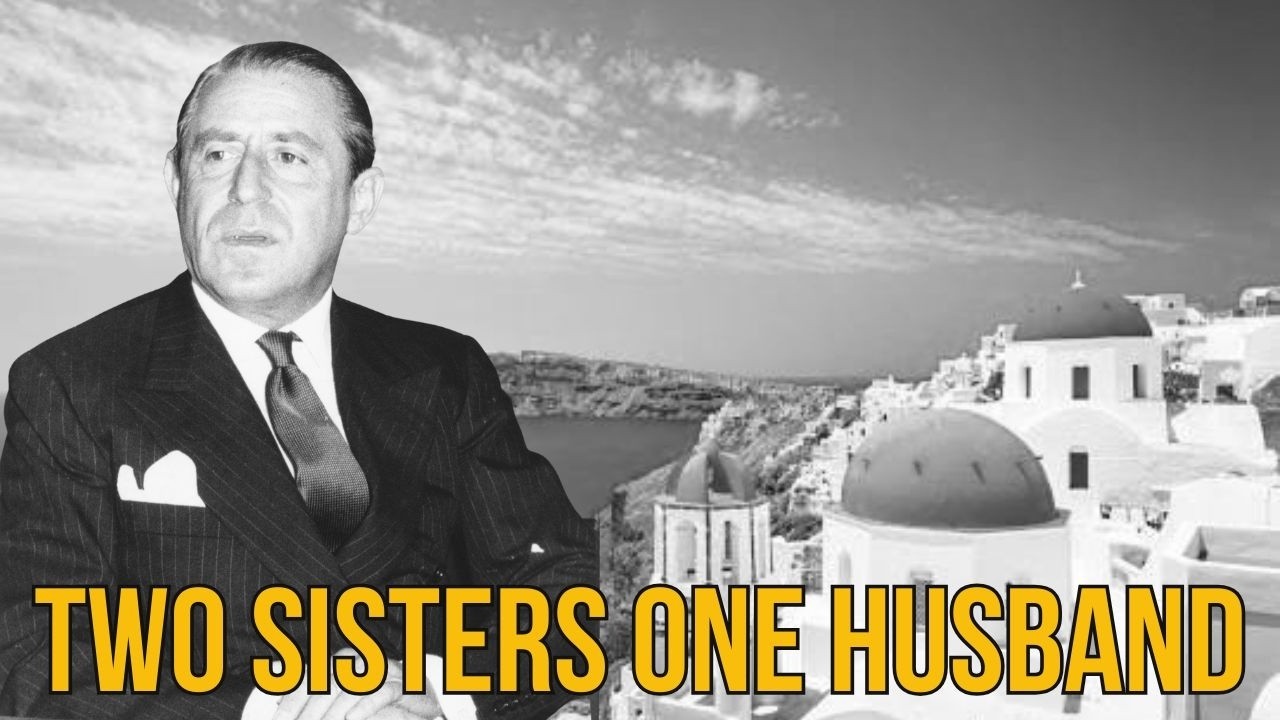
Within weeks, a public prosecutor was attempting to bring charges against her husband in connection with her death. He was never convicted. The case faded away, as cases involving figures of such power often do. Four years later, Eugenia’s younger sister—who had married the same man—was found dead as well.
Also from barbiturates. Also at the age of 45. Two sisters, one husband, and the same death repeating itself twice. To understand how two women died the same way in the same billionaire’s bed, one must first understand the rivalry that consumed them.
This was no ordinary business competition. It was an obsession-fueled war between two men, Aristotle Onassis and Stavros Niarchos, who together dominated the seas in the decades after World War II. Both men built fleets of oil tankers and amassed fortunes comparable to small nations. They became the twin faces of Greek shipping wealth.
But they were not partners. Every possession one acquired, the other had to surpass. When Onassis bought a famous yacht and turned it into a floating palace for presidents and movie stars, Niarchos built a bigger one. They competed in business, in society, in elegance, in art collections, and in the grandeur of their parties.
Each man measured his success not by absolute standards, but by comparison to the other. The strange reality is that these two warring titans drew their wealth and status from the same source: the same father, the same family that sat atop the Greek shipping world. That father was Stavros Livanos, one of the most powerful shipowners on Earth before either Onassis or Niarchos reached the top. Livanos had something more valuable to these status-hungry men than any contract or ship: two daughters, Eugenia and Athena—the younger known throughout her life as Tina.
The sisters were heiresses to one of the greatest shipping fortunes in the world. Marrying a Livanos daughter meant direct entry into the aristocracy of the shipping world. In 1946, Aristotle Onassis married the younger sister, Tina, when she was 17. His bitter rival Stavros Niarchos married the older sister, Eugenia.
Two rivals, two sisters—the rivalry had reached into the heart of a single family. The weddings appeared to be fairy tales. But the two women were not chosen for love alone. They were acquired, drawn into a conflict that had nothing to do with them, and turned into living symbols of two men’s ambitions.
The sisters were placed on a chessboard, additional pieces in a game Onassis and Niarchos played against each other their entire lives. In that game, women were never the players. They were always the stakes. Tina, who married Onassis at 17, bore him two children—a son, Alexander, and a daughter, Christina.
She lived a dazzling life as the wife of the most famous Greek in the world. But Onassis was not a man built for a stable family life. His affairs became public gossip. By the late 1950s, the marriage was collapsing in the most public and humiliating way imaginable: Onassis entered into a relationship with opera legend Maria Callas, a scandal that shook two continents.
Eugenia’s marriage to Niarchos sat at the heart of the darkness. Niarchos was brilliant, charming when he chose to be, and fiercely controlling. His marriage to Eugenia lived in the shadow of his obsession with Onassis. Niarchos was not a faithful husband either.
In a striking display of these men’s grasping nature, Niarchos divorced Eugenia in the mid-1960s to marry an American, Charlotte Ford of the automotive dynasty, as a new trophy from an even bigger industrial family. That marriage lasted only a year before collapsing, and Niarchos returned to Eugenia, remarrying the wife he had cast aside. By the end of the 1960s, both sisters had learned a painful lesson: their husbands’ deepest passion was not for them, but for the ongoing war each man waged against the other. They had every luxury the planet could provide—islands, yachts, jewelry, palaces—but not the one thing that would have made it bearable: a husband for whom they were the first priority.
Eugenia, the elder sister, was the more fragile of the two—sensitive, often unhappy, and increasingly dependent on the sleeping pills that the wealthy and desperate of that era obtained easily. She spent most of her life on her husband’s private island, Spetsopoula, a paradise that was also an isolated golden cage where Stavros Niarchos was absolute master. On the evening of May 3, 1970, Eugenia went to sleep on Spetsopoula. By the morning of May 4, she was dead.
She was 45 years old. The first account was simple: she had taken an overdose of barbiturates, possibly a tragic accident or a desperate act by an unhappy woman. On an island owned by her husband, with her husband’s staff present, that explanation might have quietly closed the case. But the examination of the body revealed something the pill bottle could not explain.
Eugenia’s body bore bruises—on her head, her throat, and her chest. These were not the marks of a peaceful overdose. They were injuries, the kind that suggest a struggle, violence, or human hands. Niarchos gave his account: he said he found his wife unconscious, tried desperately to resuscitate her, and that the bruises were the result of his frantic attempts to bring her back to life.
He claimed they were resuscitation marks, not marks of harm. The medical evidence was not clearly in his favor. The injuries to her throat and chest were difficult to reconcile with a simple overdose. A Greek public prosecutor examined the case and concluded there was enough evidence to pursue Stavros Niarchos in connection with his wife’s death.
For a brief moment, it seemed the shipping magnate might actually face court. The case did not hold. The investigation became a tangle of conflicting medical opinions, contradictory expert reports, and the immense silent pressure that wealth of that scale can exert. In the end, no charges were brought.
Stavros Niarchos was never tried, never convicted, never forced to justify the bruises on his late wife’s throat. The official conclusion settled back into the realm of overdose. He walked free, his fortune intact, his empire untouched. It must be noted: it was never proven that Niarchos harmed his wife.
He was investigated. A prosecutor sought to charge him. The case collapsed. He was convicted of nothing.
In the eyes of the law, Eugenia’s death remains officially an overdose. But the bruises were real. The prosecutor’s suspicion was real. And the sense that a rich, powerful man had made a terrible question simply disappear was also real, lingering over Niarchos’ name for the rest of his life.
After Eugenia’s death, after the bruises, after the prosecutor, after the unanswered questions, her younger sister Tina married the widower. Tina married Stavros Niarchos—the man whose first wife, her own sister, had just died in his bed under circumstances mysterious enough to trigger a homicide investigation. To grasp the strangeness, follow the entanglement. Tina Livanos was first married to Aristotle Onassis, Niarchos’ lifelong bitter rival.
After that marriage collapsed amid the Maria Callas scandal, Tina married an English aristocrat, the Marquess of Blandford, in a brief second marriage. Then, in 1971, Tina Livanos married Stavros Niarchos. With that single act, she became the wife of her former husband’s sworn enemy, and the second Livanos sister to share that enemy’s bed. The two rivals had each married both Livanos sisters.
Their fates had merged into one knot of marriage, rivalry, and death. History offers no clear answer as to why Tina did this. Perhaps there was genuine affection. Perhaps there was an attraction to a small, closed world where the same handful of titans and heiresses kept marrying each other.
Whatever the reason, she entered a marriage her sister’s death should have made unthinkable. She took her sister’s place beside Niarchos. On October 10, 1974, Tina Niarchos was found dead. She was in Paris, at Niarchos’ residence, the Grand Hôtel de Chanel.
The stated cause of death was pulmonary edema. But the shadows around her were the same as those around her sister. It was widely understood to involve a barbiturate overdose—the same class of drugs that killed Eugenia. Tina was 45 years old, the same age at which her sister died.
Two sisters, ultimately married to the same man, both dead from barbiturates, both at age 45, four years apart. No charges were ever filed in the second death either. Stavros Niarchos was never accused in any court of causing Tina’s death. Her death was officially attributed to natural causes aggravated by her own fragility.
Again, the world was left staring at a pattern too chilling for any official explanation to erase. Whatever the literal truth of each death may be, the larger truth is undeniable: being a Livanos sister married to Stavros Niarchos was a deadly condition—twice. Now consider who survived and who did not. Eugenia died at 45.
Tina died at 45. Both sisters were consumed by the rivalry. The two men who built that rivalry, the titans who turned everything from oil tankers to wives into trophies, endured. Onassis lived until 1975, dying as an old, wealthy, famous man.
Niarchos lived until 1996, dying in his seventies as one of the richest men in the world, having outlived both sisters who had been his and his rival’s wives, and never being held accountable for either death. But the deaths did not end. Tina had given birth to a daughter, born directly onto the chessboard at the heart of the two families’ war. Her name was Christina Onassis, daughter of Aristotle Onassis and Tina Livanos.
She was a child of one rival, a niece of the deceased Eugenia, and, after her mother’s marriage to Niarchos, a stepdaughter of the other rival. Christina was born with more money than any woman could dream of, into a family already saturated with grief. She witnessed her parents’ marriage shatter publicly. She witnessed her aunt’s death on a private island under a cloud of suspicion.
She witnessed her mother marry the man at the center of that suspicion, then die the same way four years later. In 1973, her only brother, Alexander—Onassis’ beloved son and chosen heir—died in a plane crash at the age of 24, a blow from which his father never recovered. In 1974, her mother Tina died in Paris. In 1975, her father Aristotle Onassis died, leaving Christina, still in her twenties, the heir to one of the largest fortunes in the world, and almost entirely alone.
Within barely two years, she had lost her brother, her mother, and her father. Christina inherited the wealth. She did not inherit happiness, and she never found it. She married four times, each marriage a search for the love and stability her gilded, grief-drenched life had never provided.
Each marriage failed. She struggled with her health, her weight, depression, and dependence on pills—a chilling echo of the same drugs that killed her mother and aunt. In 1988, Christina Onassis was found dead in Argentina. The stated cause was heart failure and pulmonary edema.
But again, the shadows of pills and a body worn down by years of dependence hung over her death. She was 37 years old. The full, terrible accounting of these families: Eugenia died at 45. Tina died at 45.
Alexander died at 24. Christina died at 37. The fathers and rivals built empires meant to control the seas and crush each other. What those empires actually produced was a procession of early deaths.
When Christina died, the entire Onassis fortune settled onto the shoulders of one small child: Athena, Christina’s only daughter, who was just three years old when her mother died. The sole survivor, the last of the line, heiress to an ocean of money and a desert of dead relatives she would never know. The world looked at the Onassis and Niarchos families and saw pure fantasy: oil tankers, private islands, yachts, wealth so vast it bent governments. Stripped of its glamour, what the two men actually built was a machine for turning people into property.
They competed for wives the same way they competed for ships. They acquired the Livanos sisters as status symbols and traded them according to the logic of their rivalry. When you build a world where human beings are just trophies, to be won, displayed, and replaced, you build a world that devours its inhabitants generation after generation. The sisters were devoured.
Then the children were devoured. The wealth kept flowing, unconquerable, while the family that owned it crumbled from within. Onassis and Niarchos spent their lives measuring success against each other. By that measure, both won.
They both died rich, famous, and old, having conquered the world and nearly conquered each other. It cost them two sisters, a son, a daughter, and the soul of everything they claimed to be building. There is one small, fragile mercy at the end of the story. Athena, the small child left to carry the entire legacy, was raised away from that world, in Europe, kept at a distance from the empire and its ghosts.
Given the chance her mother and great-aunts never had—to live as a person rather than a trophy—she chose to step back from much of the shipping inheritance, preferring a quieter life. In that choice lies the only real answer this story offers: the way to survive a family that treats people as property is to finally refuse to be one of them. The wealth was never the inheritance worth claiming. The truth remains that no one will ever know with certainty what happened in those rooms.
No court ever settled it. But the deeper truth of this story was never about how each woman died. It was about how they lived as trophies in a war between two men who turned everything they touched—even the people they married—into spoils to be won.
In such a war, those who keep score are never the ones who pay the price.