A clock tower stands alone in a parking lot on the eastern edge of Worcester, Massachusetts. The four-story black brick building with its peaked roof and working clock is now completely detached from any structure. There are no walls, no wings, no doors leading to it. Just the tower, the parked cars, and the grass.
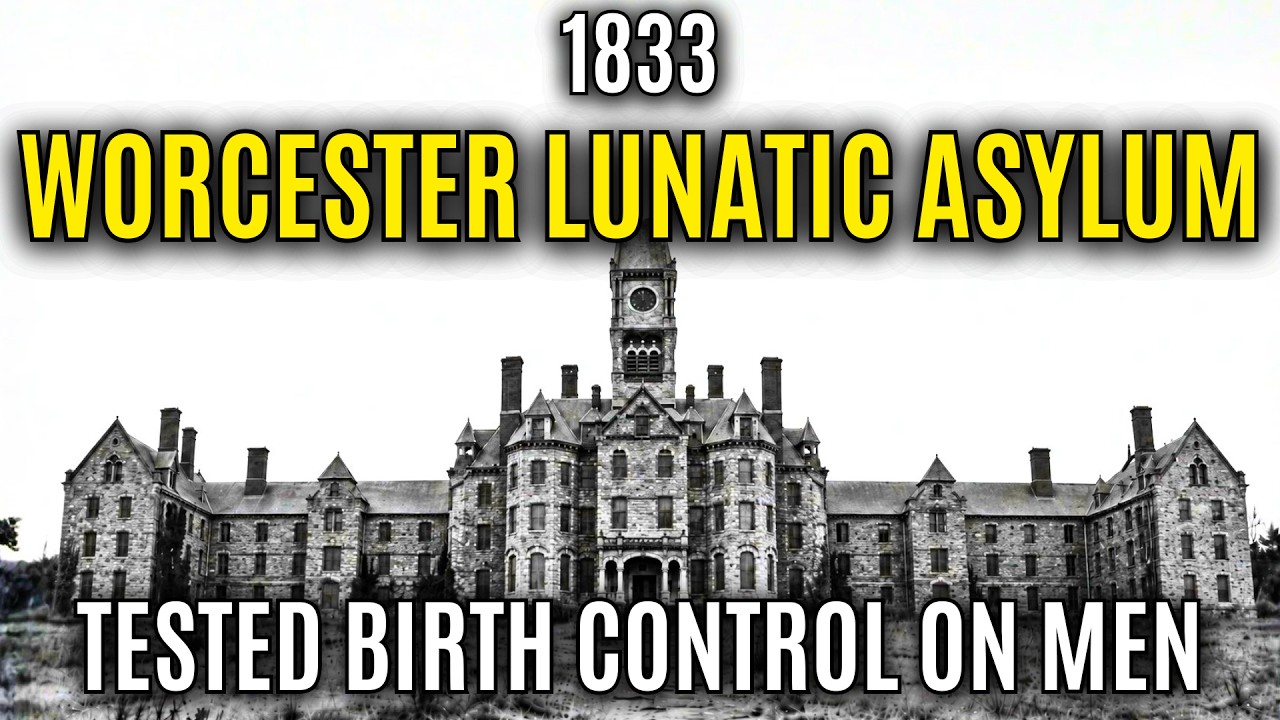
The bricks are not new. They were salvaged from the walls of the building that once stood behind them. In 1954, a shipment arrived inside that building in unlabeled containers. Its contents were given to 16 men.
None of them were told what it was. This was Worcester State Hospital, Massachusetts’ first public mental hospital, the institution that taught America that the insane could be cured. The institution whose own records later proved this cure was an accounting error. It was built to give people their lives back.
It ended as a place where the country came when it needed lives that could be used without question. Testicular biopsies without anesthesia. Uteruses opened to observe eggs. Hormones in unlabeled bottles.
A consent no one asked for and no one recorded. But the story does not begin with the bottles in 1954. It does not even begin when the doors opened in 1833. It begins in 1829, when a clerk in every town in Massachusetts sat down to count.
On February 23, 1829, a committee of the Massachusetts House of Representatives presented a set of orders. One order asked whether it was practical and expedient to build a hospital at the commonwealth’s expense for the protection of insane and frantic persons. The second order was the most important. It directed the selectmen of every town in the state to submit the number, age, sex, and color of all persons believed to be insane and frantic, whether free or confined, and where and how long they had been confined.
The man who submitted these orders was Horace Mann, who later became famous for an entirely different reason. By January 7, 1830, the returns were laid before the House. Fragments of what they described survive today. People covered in torn rags, dark dungeons, no beds, filthy straw, no light, air so foul it caused nausea.
Massachusetts had no failed predecessor to build on. There was no institution at all. If your family had money, you could send a relative to the McLean Asylum outside Boston or to the Hartford Retreat across the Connecticut border. If you had no money, your relative was kept in an almshouse, a town jail, a locked room, or in chains.
In 1830, Massachusetts became the sixth state in the Union to appropriate public money for the care of the mentally ill. On March 10 of that year, the legislature passed a proposal to build a mental hospital with space for 120 patients, with a request for $30,000. The commission chose Worcester over Boston because it sat in the middle of the state. Worcester’s merchants were desperate to have it.
They sat on the board of trustees and bought bonds to cover construction costs, because a state institution meant state money and state prestige for a city that then had neither. They chose twelve acres on Summer Street. In their own words, it was an uncommonly even and beautiful elevation, commanding a view of the whole town, near enough to market for necessary supplies, yet secluded enough to guard against unwanted intrusion or annoyance. The city paid $2,500 for it.
The location was chosen so carefully for a reason. The theory the commissioners were working from held that the site was not just a location. It was part of the treatment itself. The theory had a name: moral treatment.
It originated in England, at a Quaker institution near York, where the Tuke family had argued for a generation that madness responds to kindness, routine, work, and light rather than to suppression and purging. In 1815, Samuel Tuke published Practical Hints on the Construction and Economy of Populous Lunatic Asylums. It was a construction manual for healing people. Nobody can prove the Worcester commissioners read it.
What can be proven is that they built a window of exactly the same design as the one used at the York Retreat, a coincidence of the kind that stops being a coincidence. Moral treatment had specific requirements. The asylum had to look and feel materially different from ordinary dwellings, because you could not take a person out of a distorted life and put them into a building that looked like their old life. It had to be warm, lit, ventilated.
It had to be secure without looking like a prison. Above all, it had to allow for classification, because the doctrine held that the quiet should be kept apart from the violent, and new patients kept apart from chronic ones, or the chronic would infect the new. So Worcester was built as two symmetrical wings extending from a central block, men on one side, women on the other, and within each wing patients were separated by social rank and type of illness. The center of the building was not an office.
It was a home. The superintendent lived there with his wife and children, because the doctrine of the time said the asylum was a family and the superintendent was its father. The man chosen to be that father was Samuel Bay Woodward, then a physician at the Hartford Retreat. Woodward believed, and wrote, that the benign influence of sympathy and mercy could disarm the fury of a madman and turn him into a calm, peaceful, intelligent, and rational human being.
He also believed that drunkenness should be treated as a disease rather than a crime, a near-radical position in 1832. Whatever else happens in this story, the founding idea was humane. It was specific, and the people who held it meant it. The building Woodward opened lasted 44 years, and the reason it was replaced tells you more than the reason it was built.
By the late 1860s, the city had grown around the Summer Street hospital, and the hospital had outgrown its capacity. In 1869, Superintendent Merrick Bemis secured title to a rise of land at the east end of the city, overlooking Lake Quinsigamond. The legislature approved it, and the state bought it the following year. Bemis wanted one kind of building.
He got another. What the state approved in 1873 was a linear-design hospital. The design is named for Thomas Story Kirkbride, superintendent of the Pennsylvania Hospital for Mental Diseases. If you have seen a picture of any nineteenth-century American mental hospital, you have seen his idea: a central administration building with long, staggered wings receding to the rear, so that each ward gets its own light and air and no ward faces another.
The triage was built into the geometry. Patients believed most likely to recover were kept closest to the center. Violent patients were sent to the ends of the wings, as far as architecture could put them from the hopeful ones. There is disagreement about who deserves credit for the plans.
The National Register lists the firm of Weston & Rand. Other documents cite only George Dutton Rand, or Worcester’s Fuller & Delano. Construction began in the early 1870s and was finished in 1876. The legislature had approved the new hospital for 400 patients.
Before construction was far along, the plan had to be redrawn for 500, because the old building already held nearly that many. At the design stage, the replacement was already too small. At the time it seemed like a technical adjustment. It was not.
What they built was a four-story structure of stone slabs and brick, with wings extending 500 feet on either side of a clock tower. The wards were named for places in Massachusetts and for the founders of American psychiatry. The first patients came on October 8, 1877. The transfer took fifteen days.
By October 23, 430 people had been walked or carried out of one building and into another. The old Summer Street building was renamed the Asylum for the Chronic Insane. The state had built a hospital for the people it thought it could cure, and kept the old one for the people it had given up on. Construction costs were another matter.
Every account says the same thing: more than a million dollars. None of them give a specific figure. The number is not in the records. The building outgrew every doctrine practiced inside it.
Back up. Before all of this, there was a time when the place worked, and without that time you cannot understand the fall. Samuel Woodward was born in Torrington, Connecticut, in 1787. He was licensed to practise medicine at 21 and had helped his friend Eli Todd found the Hartford Retreat.
He took charge at Worcester in September of 1832, moving his family in as soon as the residence was finished, and stayed 14 years. In the first year, the hospital received 164 patients. In the reporting year ending in 1838, it was admitting 177 patients a year. By the end of 1842, 1,557 people had been admitted since opening.
Of those, 1,319 had been discharged. Of those, 676 were recorded as recovered. Recovered. That was the operative word, and people believed it.
By 1844, the total number admitted was 2,013. The trustees’ report that year opened with a sentence that captures the whole era in one breath: the hospital was more crowded than ever before, and its operations were more successful and beneficial than in any previous year. Both parts of that sentence were true, and the second was about to overwhelm the first. Its annual reports were circulated as a national model.
In 1843, statistician Edward Jarvis called the hospital’s recovery rate one of the brightest examples of humanity. When Woodward retired on June 30, 1846, 360 patients were in a building built for 120. Four years later, he died suddenly at Northampton on a January evening. The first warning was not in 1846.
It was not in 1840. It is in the trustees’ report dated December 31, 1833. Eleven and a half months after the doors opened, the trustees wrote that the hospital was in a very crowded state and that applications for admission were necessarily rejected for want of room. Before the first winter was over, the building was full.
Who was coming? Start with the question the state asked, because it shaped the answer. The towns were not asked to report on sick people. They were asked to report on persons believed to be insane and frantic, their number, age, sex, color, whether free or confined, and where and how long they had been confined.
That is not a medical inquiry. It is a nuisance inventory. When the hospital opened, Massachusetts had no established legal definition of insanity and no law governing the condition of the insane. The institution’s own history describes the first year plainly: every town in the state was trying to dump its unwanted patients on the new institution.
A private asylum could refuse a patient. Hartford could refuse. Worcester could not. Woodward wrote that he was forced to receive some of the most deplorable patients, and within a few years he was writing something harder: he feared the hospital would become a mere receptacle for foreign insane, idiots, imbeciles, and incurables.
Read that list again. It is not a list of diagnoses. It is a list of people the commonwealth found inconvenient. By 1847, Woodward’s successor George Chandler was noting the rising number of foreign-born among the insane and directly blaming immigration.
In the following decades, administrators repeatedly asked the legislature for separate buildings for four groups: imbeciles, violently insane African-Americans, and immigrants. Those requests are in the records. What the physicians were thinking when they wrote them is not. How hard was it to get out?
Look at the discharge statistics and note what happened in specific years, like 1853 and 1886. In both years, the number of patients discharged not recovered jumps sharply. Historians who have examined the reports found the reason, and it was not medical. In those years, the hospital was reducing its numbers by sending quiet chronic patients to almshouses and jails.
“Discharged not recovered” is institutional language for being sent somewhere with worse food. Think about what that does to the numbers you were just given. A hospital that accepts anyone the towns send, that cannot refuse, that counts anyone as cured once they walk out the door, and that periodically empties its backward wards into poorhouses when the census numbers become embarrassing. The population inside that building was not created by diagnosis.
It was created by everyone else’s convenience. Were there any checks? In 1855, the Massachusetts State Commission on Lunacy visited the Summer Street hospital. Its chief investigator was Edward Jarvis, the same man who had praised the place twelve years earlier.
He found an unsatisfactory drainage system, obsolete ventilation and heating, and serious structural defects. His recommendation was explicit: sell the property and use the money to build a new, satisfactory hospital with every modern convenience. The state did not do that. Instead, it built a second hospital at Northampton, finished in 1858, and both were overcrowded almost immediately.
Worcester ran for another two decades with crowding getting worse, until someone moved it. Now take the new building with the clock tower and remember the number it had to be redrawn for. In 1890, it held 785 patients. By 1908, it held more than 1,200, more than double its designated capacity.
By 1912, the capacity was said to be 1,141. In the 1950s, the figure 3,000 circulates, and that number deserves a warning. No primary census supports it. It comes from secondary sources, and it may be right, but the state’s own count was never published.
Administrators said it themselves. The hospital was so crowded that officials were overwhelmed with routine duties, making it impossible to give each patient special care and attention. Later came a blunter version: Worcester had not only ceased to be regarded as a model institution but had fallen to the rear in the march of progress. What did that look like in the corridors?
The water supply system was inoperative. The sewage system was overloaded. There were not enough bathing facilities or dining spaces. The wiring was so defective that administrators described it as a permanent fire hazard.
There was not enough refrigeration for food. And there was no place to put a sick person. In a building crowded to twice its capacity, no extra ward means no quarantine, so when a disease arrived, it went everywhere. Diphtheria, smallpox, influenza, scarlet fever, measles, dysentery.
Outbreak after outbreak is listed in the records for decade after decade. By 1914, the hospital’s own administrators were writing that many people currently in the institution, though clearly insane, might be productive if returned to society. It took the state another 60 years to act on that judgment, and when it finally did, it was for an entirely different reason. When a hospital becomes a laboratory, you look for obvious causes.
A war requiring rapid answers. A eugenics law stripping a class of people of legal standing. A superintendent with an agenda. None of that happened here.
What happened here was a donation. In 1927, a woman named Katherine Dexter McCormick began funding research on schizophrenia at Worcester State Hospital. She had trained in biology at MIT. She was one of the most influential women’s suffrage activists in the country, and she had a personal reason.
In September 1906, her husband Stanley McCormick, heir to the International Harvester empire, was admitted to McLean Hospital and diagnosed with dementia praecox, later called schizophrenia. By 1909, he had been declared legally incompetent. She spent the next 20 years looking for someone who could tell her what had happened to her husband. She bet on endocrinology, and she attached a condition.
According to the psychologist David Shakow, who worked there, she directed that the money be used only for biological research, not for anything pertaining to psychiatry or psychology. Think about what that condition does to a hospital. It creates a research program inside a mental institution that is contractually forbidden to study the mind. What is left to study is the body, and the bodies were already in the building.
In 1927, four methods were in use at Worcester, sequenced over more than a century. The first was the building. Moral treatment’s instrument was architecture and routine, and its measure of success was removing the chains that plainly worked on individuals. It stopped working the moment the wards filled, because the doctrine required individual attention and arithmetic made individual attention impossible.
A theory that requires one physician for a small number of patients does not survive a ratio of 300 to 1. It became a custodial institution with better windows. No one at Worcester decided to abandon moral treatment. Overcrowding killed it.
The second method was the glands. In 1927, the Schizophrenia Research Service at Worcester State Hospital was established under Roy G. Hoskins, one of the founders of American endocrinology. It ran in some form for about two decades.
Hoskins’ hypothesis, in his own words from 1933, was that schizophrenic patients had a general hypometabolism, an abnormal metabolic process, and he listed related symptoms: secondary anemia, low blood pressure, decreased body temperature, and a lower-than-normal oxygen consumption rate. He thought the disease was like a slow engine. So he tried to speed it up. The treatment tested on Worcester patients was oral adrenal cortex extract and glycerine.
For years, patients were dosed and measured, blood was drawn, and temperature, blood pressure, and metabolic rate were recorded. It did not work. Every evaluation over two decades reported minimal results. It produced no treatment for schizophrenia, and it produced no treatment for Stanley McCormick, who died in 1947 with none of it having helped him.
The third method was the coma. In the late 1930s, Worcester was running insulin coma therapy on seriously ill patients. A person was injected with enough insulin to drive their blood sugar down rapidly. They were allowed to become unconscious and then brought back with glucose, on the theory that this sudden shock reset some part of the body.
Worcester’s contribution to the research published in 1939 was a study of what happened to serum lipids during the procedure. Alongside it came the rest of the mid-twentieth-century toolkit: hydrotherapy, shock therapy, hormone therapy, lobotomy, psychoanalysis, all in the same building, at the same time, on the same people. How many lobotomies were performed at Worcester was never published. Patient files are sealed.
The fourth method was the hormones. By the 1950s, Worcester State Hospital had a standing arrangement with Harvard, and biologist Gregory Pincus’s colleagues had been running experiments on patients there for years through a channel opened with Katherine McCormick’s earlier money. Pincus now needed something specific. He needed a group of women whose ovulation he could control, observe, and disrupt without interference.
And he needed a place where Massachusetts’ birth control laws could not reach him. The deal was simple. McCormick offered superintendent Birdwell Flower money to refurbish the hospital. In exchange, the researchers got the wards.
The research was presented as a test of the drug’s possible calming effect. Now think the whole thing through on your own. It is 1954, and you are in a ward in Worcester. You have a mental illness diagnosis, which in that decade means your signature is worth nothing.
A doctor hands you a tablet. No one tells you it is experimental. No one tells you what it is for. No one gives you a list of what it could do to you.
If you are one of the women, you are taken to an operating theatre and cut open so someone can look directly at your ovaries and see whether the tablet worked. If you are one of the men, tissue is cut out of your scrotum, without anesthetic. Sixteen men. Every source agrees on that number.
With the women, they do not agree. One account says 12, another says 16. And in 1956, a separate procedure was performed on 20 men. These numbers were never reconciled, and neither was the question of consent.
A public television account of these trials says Pincus obtained permission from patients’ relatives. An academic encyclopedia entry says plainly that participants did not know they were part of a study, were not told about side effects or risks, gave no informed consent, and were unknowingly given varying doses of estrogen and progesterone. Both accounts come from credible sources. Both cannot be right.
What sticks with you is why the men came in. Journalists examined Pincus’s letters and a draft paper held at the Library of Congress and learned what the testicular biopsies were meant to reveal. He was interested in men’s fear of castration. The drug came in unlabeled containers from the pharmaceutical company.
At the center of this story is that object. A plain jar with no label, carried into a ward of a hospital founded to bring people back to reason. After the results were published, a physician wrote to the editors of The Lancet. He wrote that the use of chronic mental patients, who are incapable of giving valid permission or refusal, as guinea pigs in this type of physiological research must surely be as repugnant to many of your readers as it is to me.
The letter’s number and date cannot be found. Take the quotation as it has come down. The male arm of the research was not dropped for ethical reasons. It was dropped because the results were inconsistent.
Then the whole program left Worcester for a reason that has nothing to do with conscience. The patient numbers were too small. You cannot get a drug approved on 16 men and a dozen women. They needed hundreds of patients.
So they moved to Puerto Rico. No one knows the names of those 16 men. Not one. They were the only people in this whole story who were truly essential to the discovery, and their names are not in the records.
Match some faces to the rest. Adolf Meyer arrived in 1895 as the hospital’s first pathologist. He was a Swiss physician who became the most influential psychiatrist in America. At Worcester, he did something no one there had done.
He built the laboratory and insisted that mental illness be not merely treated but studied. Administrators reported that the hospital now possessed a scientific spirit and atmosphere. He left in 1902. The city’s archival museum states the outcome directly.
This new policy dehumanized patients, who were used essentially as guinea pigs for experimental testing and treatment against their will. That was not Meyer’s intention. But he paved the road. Gregory Pincus was told in 1937 that Harvard would not give him tenure.
In the years before, the press had called him “Dr. Frankenstein” for creating rabbit embryos without fertilization. In 1944, he and Hudson Hoagland went door to door in Worcester asking plumbers and shopkeepers to contribute what they could, and set up an institution in a garage in Shrewsbury. He cleaned his own animal cages.
At one low point, he moved his wife and children into a state mental hospital and did research there. He later bought shares in the pharmaceutical company he was working with on the pill. He died in 1967 at 64. John Rock was a respected clinical professor of gynecology from the Harvard Medical School class of 1918, a devout Catholic who ran a fertility clinic.
His reputation rested on a discovery called the “Rock rebound. ” Of 80 infertile patients given high doses of hormones, 13 became pregnant after treatment stopped. The medical world noticed the pregnancies. Almost no one noticed the other side of the results, which was that the hormones had stopped ovulation.
After Stanley’s death, Katherine McCormick inherited 33 or 35 million dollars, depending on which account you read, and paid 23 million in inheritance taxes. From 1953 she funded Pincus directly at $100,000 a year, rising to $180,000 before her death in December 1967. She left another million dollars in her will to Pincus’s foundation. What she was ultimately paying for she never got.
Instead, she got the birth control pill. Then there is the man who tried. Merrick Bemis rose to superintendent in 1856. He emphasized the profession as treatment.
He reduced physical restraint and seclusion. He appointed the institution’s first female physician, no small thing in the 1850s. And he had a plan for the new hospital. He wanted a central building for the seriously ill, perhaps a third of the patients.
The other two-thirds, the quiet and the sick, he wanted in separate cottages of 15 to 20 people, so their lives would resemble the ordinary life of a community. His proposal was rejected. The legislature and trustees built the opposite: one vast linear building with everyone arranged by corridor. After 24 years in state service, Bemis resigned, opened a small private hospital in Worcester, and practised quietly until his death in October 1904.
What a contrast. The man who argued that Worcester should not be one vast building was the one who went out and secured the land on which the vast building was built. Then there is Howard Trus. Before the hospital even existed, Trus was known across a wide region of Massachusetts villages.
In the words of those who wrote about him, he was treated as a monster. He had been bound in chains and exhibited as a spectacle, meaning someone took money at the door and people came to look at him. Woodward took him in early and deliberately as a demonstration, and the demonstration worked. In a letter to Horace Mann, Woodward reported with visible pride that Trus was now without his chains and associating with our better class of patients, and is still perfectly quiet and inoffensive.
Note the letter’s date. The surviving copy is dated March 1832, ten months before the hospital opened. Either the copy is misdated, or the letter belongs elsewhere in the chronology. The sentence itself is real.
Then Trus relapsed. The change moral treatment had made in him did not hold. The hospital built a special room to confine him, and over the next decade he escaped from it. Not once.
Several times. The record stops there. No discharge, no death date, no grave. The man Massachusetts used to prove its new hospital could give a person their life back has a record that ends at the point where he was repeatedly escaping.
Then the paper ends. He was the most important patient in the institution’s early history, and the state kept no account of what became of him. The money trail shows the priorities. In April 1835, two years after opening, the legislature appropriated $25,000 to enlarge the hospital, $3,000 for a chapel, and $7,000 for more land.
That was the pattern for the next century. Never enough, always late, and money only after the crowding had already happened. The hospital also ran itself the oldest way. It farmed.
Under John Park, the state bought 130 acres of hillside farm in Shrewsbury for the growing herds. In 1901, a branch opened at Grafton, a farm colony for patients considered non-violent. Grafton classified patients not by diagnosis but by behavior: violent, excited, quiet, and peaceful. The colonies were named after trees: Pine, Elm, Oak, Willow.
By 1945, agriculture was the main activity there and medicine had fallen behind it. The patients worked those fields. Whether the farms produced anything of value, who bought it, and whether any part of it was ever credited to the people who produced it, cannot be established. No ledger of patient labor survives in accessible form.
What survives is the land valuation. In 1940, the hospital reported owning about 585 acres worth $343,273. The staff were another part of the economy. In 1902, the nurses went on strike.
Their own complaints were about wages and hours, and those were real. But read what the strikers also recorded on behalf of those who could not strike: inedible food, lack of beds, vermin, and neglect from being understaffed. What came of the strike is not in the accessible sources. Jump to 1991 and look at the number that finally moved the commonwealth.
A working group found that about 47% of the entire Department of Mental Health budget was going to its state hospitals, and those hospitals served about 6% of the department’s clients. 47% of the money for 6% of the people. It was this statistic that closed them. Not the crowding, not the neglect, not 150 years of complaints.
The ratio. And then the last number, which tells you what this state can do when it makes up its mind. The hospital built on Worcester State’s site cost $32 million. It was the largest state-funded building project in Massachusetts history at the time.
It was not a modest road. It cost about $60 million a year to run. $32 million for 320 beds. Then there is the kind of thing in this story that is neither proven nor disproven, because the gaps are not an accident of research.
They are the institution’s actual shape. An archive of newspaper coverage of the hospital contains three clippings. The first, from the Lime Springs Herald, dated October 4, 1934, concerns scalding. The second, from the Mansfield News Journal, dated October 12, 1936, concerns a killing.
The third, from the Newport Daily News, dated September 23, 1952, concerns an escape. The papers and dates are known because they are indexed. Who was scalded? Who was killed?
Who escaped? And what happened to any of them? That is not known, because the contents are not transcribed anywhere accessible and the record contains no follow-up. In 1936, a killing in a state hospital produced a single clipping in an Ohio newspaper and, according to the available records, nothing else.
In 1902, nurses said the food was inedible and patients were neglected. No investigation is on record. The wards with no quarantine produced epidemics for decades. Diphtheria, smallpox, influenza, scarlet fever, measles, dysentery, all named in the reports.
None of them have a single death count attached. Patient records were sent to the Massachusetts State Archives, where access is restricted. When descendants write to the city’s historical museum asking where their grandmother is buried, they get this answer. Contact the State Archives.
There are no names for those 16 individuals, no follow-up, and no note of what happened after the research ended. None of it will be guessed here. The rejection is the point. Every one of these items could have been established cheaply at the time by asking.
Nobody asked. The end was not a single event. It was a process, and it took about 30 years. In 1958, the state opened a new building on the campus named the Bryan Building after William A.
Bryan, superintendent from 1921 to 1940. It was modern. Over the following decades, functions moved into it, and the old Kirkbride building was progressively emptied without repair. By 1985 it was abandoned.
The commonwealth boarded up its windows and left, and the clock tower stood above a building no one was using. Then the money ran out. In the autumn of 1990, the Massachusetts Association for Mental Health published a paper identifying three hospitals as prime candidates for closure. In February 1991, Governor William Weld appointed a 17-member special commission to review the state’s institutions.
The commission visited 31 facilities and held 15 hours of public hearings. In June 1991, Weld adopted a recommendation to close nine mental health and public health centers within three years, as part of a larger program of privatizing the state’s services. On July 22, 1991, a five-alarm fire broke out in the abandoned Kirkbride building at Worcester State Hospital. It destroyed the left wing and damaged the right.
Roofs and floors were lost. What survived was the administration building, the clock tower, and part of one wing. The burnt structures were bulldozed, and salvaged stone was used to fill the massive gaps where the destroyed wings met the surviving ones. The building was repaired with fragments of itself.
No one was injured. There is no one to name, because the building had been empty for six years. The cause was never determined. Reports blamed vagrants.
Later accounts named a contractor who had submitted a bid to demolish a wing. No fire marshal’s decision can be found. It is as absent from the record as anything in this story. The sequence is documented.
In June, the state adopted a plan to close institutions. In July, the building burned. Those two events will not be connected here, because the record contains nothing that connects them, and because the honest version of this story is the one that ends in writing. In 1992, the state declared the site substantially damaged.
Between 1991 and 1993, ten Massachusetts institutions were closed. The rest was paperwork. In 2004, the Department of Mental Health presented a report to the legislature recommending a new facility combining Worcester and Westborough. In 2005, the legislature created a feasibility commission.
In 2006, that commission recommended siting the new hospital on the existing Worcester campus. In the spring of 2008, the remaining parts of the wings were demolished along with the rotunda and staff residences. In the spring of 2009, construction began. In 2013, the administration block and the original clock tower were demolished.
It took eight years from the state’s formal proposal to close the doors to the doors actually closing. From the first patient entering the building on Belmont Street to the last patient leaving: 135 years. And in the middle, more than 20 years of the building sitting empty. Those years matter more than you would think, because almost everything people now believe about this place was made in that time.
From 1985 the wings stood empty. From 1991 they stood burned. The administration building and its tower lasted until 2013. You might say 23 years for the wards and 28 years for the tower, fenced off, guarded, otherwise left to the weather.
After the fire, the commonwealth boarded up the windows, and inside, the effect was total. In 2012, a photographer working in the surviving wards needed more than ten minutes to photograph a single corridor. Think about that. A building designed on a doctrine that counted sunlight as medicine had been sealed so perfectly that a camera took ten minutes to see one hallway.
And here is the thing no one expects. The surviving wards were beautiful. High ceilings, wide corridors, long days, big windows in the right places. The people who went inside in those years and wrote about it said the same thing again and again.
Before the crowding, before the census doubled and tripled, this would have been a decent place to be ill. What came out of those decades was first documentation, then folklore, in that order. Michael Newton, a man who videotaped the 1991 fire, posted his footage online in February 2009. Tom Kirsch photographed the ruins for his site Opacity.
A photographer working at the Kingston Lounge published a long series from inside in August 2012, arguing against demolition of the tower and calling the state’s plan a hollow monument. A social media campaign was run to save the clock tower. Now the ghosts. You will find Worcester State Hospital on lists of haunted places.
Go to their sources. What comes up is this: there is no paranormal claim from before the place was abandoned. Not one from the 1950s. Not even one from when it was operating.
The stories begin once the building was empty, dark, and excellent to photograph. And they are told by people who were never inside it while it was a hospital. The clearest example is fairly recent. In February 2023, a woman posted publicly to the Worcester Historical Museum’s page asking for permission to visit and record at the hospital, because she was a medium and wanted to contact her grandmother.
In April of that year, the archivist replied. No one would stop her, he said. But the hospital no longer exists. This conversation is the real horror.
A woman whose real grandmother was a real patient, a building that no longer exists, and an archive she was not permitted to give the file to. The number of arrests and trespassing incidents in those years is published nowhere. The place manufactured something that reached the whole world, and it was not ghost stories. Follow the sequence.
The trials began at Worcester in 1954. When the patient numbers proved too small, the work moved to Puerto Rico in 1956, and from there further trials were conducted in Haiti and Mexico. In the summer of 1960, the FDA approved norethynodrel for contraceptive use. By 1965, more than 5 million American women were taking it, with some estimates as high as 6.
5 million. According to UN data, by 2019 more than 150 million women worldwide were using the oral contraceptive pill. That is the sequence from a ward in Worcester to 150 million people. Whatever you think of the pill, it has given women more control over their own lives than almost any other object of the twentieth century.
The first people it was tested on in that building could not consent, and their names were never released. Now another misconception, older and wider. Every account of this hospital’s golden age repeats the same claim: a 90% recovery rate for patients admitted within six months of becoming ill. This statistic was published in Woodward’s own annual reports, and hospitals across the country were publishing numbers like it.
People began to believe that admission was nearly the same as cure. Here is the arithmetic from Worcester’s own tables. In the first decade, the recovery rate as a proportion of all patients admitted in a given year was roughly 41 to 54 percent. Across the full decade, 40.
7% of men and 46. 3% of women admitted were recorded as recovered. About half. Not 90%.
Then Pliny Earle broke even that calculation. Earle was superintendent at Northampton. In 1876 he published the first of a series of studies on the curability of insanity. His discovery was an accounting matter.
The hospitals were counting cures, not people. A patient who returned four times and left four times produced four cures. Earle argued that the real measure was the proportion of persons treated who recovered, and he blamed the rivalry among Worcester’s superintendents for the inflation. One patient was declared cured seven times in a single year.
That is the whole idea of curability in one line. To be honest, even at 45%, even counting cases instead of people, Worcester in the 1830s was better than the almshouse, the town jail, and the chain. The real number is still remarkable. It is just not the number they sold.
One more correction, though small. In 2008, the makers of Shutter Island wanted to shoot at this location. Permission was denied because demolition was already scheduled, and they went to Medfield State Hospital instead. If you watched that film and thought you were seeing Worcester, you were not.
So what is there now? 309 Belmont Street. Worcester Recovery Center and Hospital. 320 beds, of which 260 are adults and 60 are adolescents, though the state’s own documents divide the adolescent number in two different ways.
The 428,000-square-foot building was designed by Ellenzweig Associates, built by Gilbane, and certified for its environmental performance. The state lists its completion date as March 2012 in one document and September 2013 in another. The wards are organized as houses, in neighborhoods opening toward downtown around a village green. The building was kept small to reduce its stigma.
Inside, the ceiling fixtures have no parts from which a person could hang themselves. The light switches are partially covered so no one can deliberately electrocute themselves. The walls are made of a high-impact material that absorbs even a fist. The historic designation includes the things that no longer exist.
The Worcester Asylum and associated buildings were listed on the National Register on March 5, 1980. The hospital farmhouse on Plantation Street, built by Fuller and Delano in 1895, was listed separately in July 2017. What actually survives from 1877 is a round brick building called Hooper Hall. Everything you can see outside it is reconstruction.
Both sides of the argument had merit. The preservationists were right. The state said the new hospital allowed it to close two of its nineteenth-century facilities and meet the coming need for private bedrooms. They were right too.
Look at what happened to the others, and you will understand what Worcester could have been. Danvers closed in June 1992 and was demolished in 2006 for apartments, with controversy over the cause of a large fire during construction. Northampton closed in 1993, and by 2007 every building was gone. Metropolitan State closed in January 1992 and became condominiums.
Medfield still stands, and you can walk its grounds from dawn to dusk. Grafton, Worcester’s own farm colony, was demolished entirely. In its cemetery lie 1,041 former patients no family ever claimed. The first was buried in October 1917, the last in February 1973.
Worcester got a parking lot with a replica tower inside it. Go back to the promise. Samuel Woodward believed the benign influence of sympathy and mercy could disarm the fury of a chained man and give the world back a calm, peaceful, intelligent, and rational human being. He was not lying, and he was not a fool.
He did it at least once, with a man who 120 years later was exhibited as a spectacle in the same institution, had unlabeled jars put in the hands of sixteen people in a ward, and had tissue cut out of their bodies without anesthetic. Worcester was built to give people their lives back. It ended as a place where the country came when it needed lives that could be used without question. That is not a betrayal of the founding idea.
That is what happens to a founding idea when no one pays for it. It was not a bad hospital. In 1955, America’s state mental hospitals held 558,239 patients. By 1994, that number was 71,619.
Massachusetts was the first state to systematically organize institutional care for the insane, and one of the last to dismantle it. Its replacement sits on the same site. In 2014, there were more than 425 assaults on staff at Worcester Recovery Center and Hospital. Of those, 394 were workplace injuries.
Over two years, those injuries cost the facility a total of 5,600 lost workdays. According to the Department of Mental Health’s own serious incident reports, between January 2016 and December 2018 there were 96 assaults requiring medical attention, including an unknown number of sexual assaults. On May 8, 2019, a television news team broadcast an investigation into conditions there. Four days later, the same station reported that a 59-year-old woman had died of a suspected drug overdose in a hospital bathroom.
The nurses’ union said the cause was lack of security, understaffing, and inadequate training. $32 million, and understaffing. No one planned that. No one planned the crowding of 1833.
No one planned the 90% statistic. No one planned that a research institution would be contractually forbidden to study the mind. No one planned that the names of sixteen people would be lost. Count what this ground has been.
Twelve acres of high ground over a canal. A hospital that was a model to a nation. A receptacle for foreign insane, idiots, imbeciles, and incurables. A farm.
A laboratory for adrenal extract. A laboratory for the contraceptive pill. A ruin. A photograph.
A parking lot. And now a rehabilitation center with covered light switches. One thing has not moved. Behind the new hospital, Hooper Hall still stands.
It was built in the 1870s. It survived the fire that consumed its wings. It survived the demolition that took everything else. It is the last real piece of the building, and it is made of the same material the state paid for when it believed a building could make a person well.
The bricks outlived the doctrine. They outlived the doctors. They outlived the patients. All of them, even the ones whose names no one wrote down.
So the question is, and it is not a question about a building. Massachusetts counted its insane in 1829 because they did not know how many there were. They built a hospital because they did not know what else to do with them. The hospital filled to double, then triple, and then whoever had money rented the bodies inside.
When the ratio became embarrassing, the hospital was closed, a new hospital was built, and that one is understaffed too. What is the number today? Who is counting? And when the next building fills, whose signature will be worth nothing?
The record gives no answer. It only keeps.