Bernie Mac, the comedian who built an entire career on fearless, unapologetic storytelling, rose from crushing poverty and personal tragedy to become one of the most recognizable faces in Hollywood. His famous declaration that he wasn’t scared of anyone was not just a stage persona—it was a survival mechanism forged through a childhood marked by abandonment, grief, and the brutal realities of Chicago’s South Side. Bernard Jeffrey McCullah was born on October 5, 1957. His biological father was largely absent, and Bernie was raised primarily by his mother, Mary, in a crowded, multi-generational home on the city’s South Side.
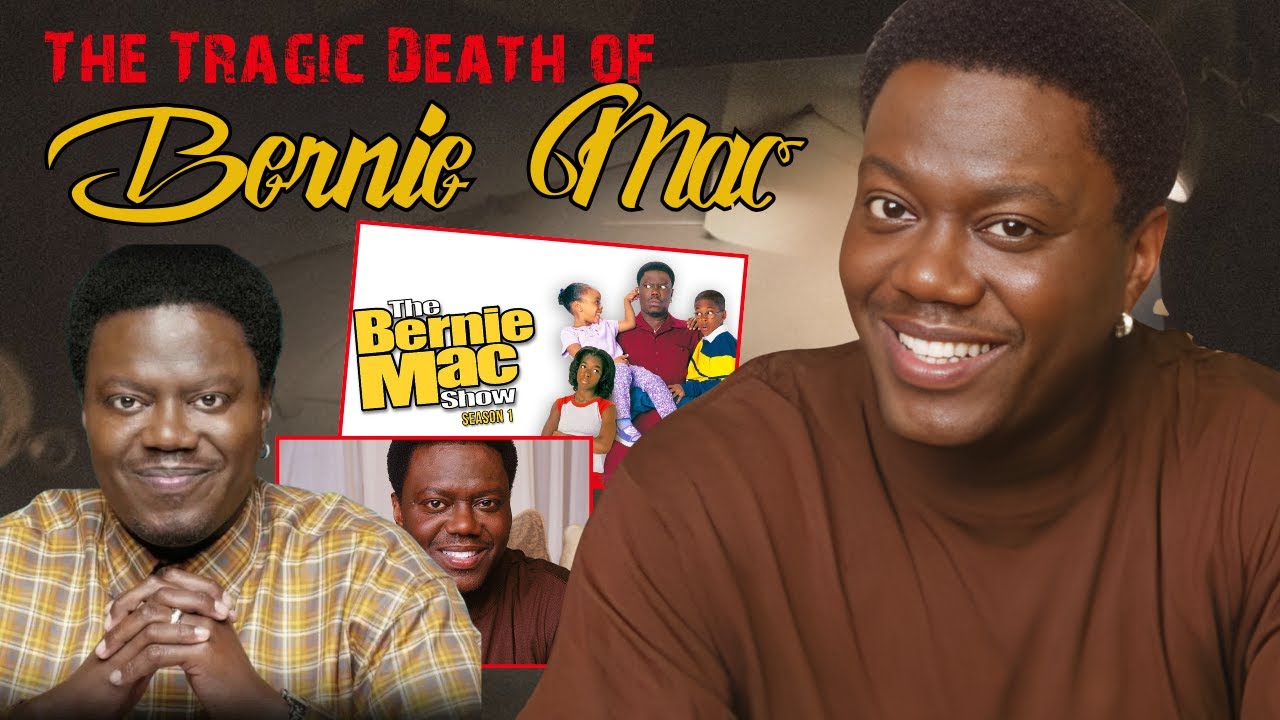
Life there was loud, chaotic, and governed by a tough-love mentality that would later become the foundation of his comedy. The defining moment of his childhood came at age four. He walked into the living room to find his mother weeping, overwhelmed by the weight of single motherhood and financial hardship. Unable to fight the invisible force causing her pain, he wandered into his grandfather’s bedroom, put on an oversized suit and work shoes, and shuffled back into the living room imitating the old man’s grumpy walk.
His mother laughed through her tears. That moment became his origin story. Bernie later said he knew then that he was meant to be a comedian, that he could control the energy in a room and turn suffering into joy. But the universe was about to test him mercilessly.
After a stint as the class clown at Chicago Vocational High School, tragedy struck. In 1974, when he was a sophomore, his mother was diagnosed with breast cancer. Two years later, at age 16, he watched her take her last breath. Shortly after, his older brother, Estrol, died of a heart attack at 27.
His estranged father died soon after. By 18, Bernie Mac was effectively an orphan. At that crossroads, he chose a path of stability. He married his high school sweetheart, Rhonda Gore, in 1977.
She became his anchor, and their daughter, Janice, gave him a reason to fight. For nearly 15 years, however, the fight had nothing to do with comedy. The man who would later command arena stages worked as a janitor for General Motors, moved furniture, cooked, and loaded packages for UPS. The job that became part of his mythology was driving a bread truck for Wonder Bread, waking at 3 a.
m. to haul crates through frozen Chicago streets. During those years, he honed his craft wherever he could find an audience. He performed in subway stations, hat on the dirty floor, shouting jokes at rushing commuters.
He graduated to dive bars and eventually the Cotton Club on the South Side, where tough audiences had zero patience for mediocrity. He developed his aggressive, commanding stage presence in those rooms, learning to become louder and faster than any heckler. At age 32, essentially ancient in the youth-obsessed comedy world, he entered the Miller Lite Comedy Search. He won the $3,000 prize and put the money directly into a savings account for his daughter.
The win earned him an appearance on the Arsenio Hall Show, but the real breakthrough came in the mid-1990s on Russell Simmons’ Def Comedy Jam in New York City. The night that defined his career, the comedian before him bombed so badly that the audience was merciless and hostile. Bernie walked onstage and roared, “I ain’t scared of you…” The room froze, then erupted. He flipped the dynamic in ten seconds, transforming a toxic crowd into a standing ovation.
His willingness to confront hostility head-on became his brand. Throughout the 1990s, Hollywood used him as a scene-stealing supporting player. He appeared in House Party 3, Friday, and The Players Club, often playing charismatic antagonists. He was well-known in Black households, but mainstream white America still had no idea who he was.
In 2000, that changed. Bernie Mac joined Steve Harvey, Cedric the Entertainer, and D. L. Hughley for The Original Kings of Comedy tour, playing arena-sized venues.
Spike Lee filmed the tour for a documentary that grossed $38 million on a $3 million budget. In the film, Bernie closed every show, delivering brutally honest comedy about family life based on his real experience of raising his sister’s children after she struggled with addiction. Fox executives saw the response and offered him a sitcom. Bernie insisted on doing it his way, no laugh track, single camera, and breaking the fourth wall to speak directly to the audience.
The Bernie Mac Show premiered in November 2001 and became an instant hit. It won a Peabody Award, an Emmy for writing, and earned Bernie multiple acting nominations. He had become the biggest star on television by playing a version of himself. While his star rose, a silent enemy was at work.
In 2005, he revealed that he had been living with sarcoidosis, an inflammatory disease that was slowly attacking his lungs, since 1983. He had been hiding the condition for over two decades while performing some of the most physically demanding comedy in the industry. In 2001, he joined the cast of Ocean’s Eleven alongside George Clooney, Brad Pitt, Matt Damon, and Julia Roberts. Playing Frank Catton, the smooth-talking con man, he proved he could hold his own with Hollywood royalty.
He returned for Ocean’s Twelve and Thirteen, starred in Charlie’s Angels: Full Throttle and Mr. 3000, and became one of the most recognizable faces in the world. But the physical toll was enormous. The medications used to treat sarcoidosis weakened his immune system and ravaged his body.
By 2007, he announced he was retiring from stand-up, telling David Letterman that it wasn’t fun anymore. The public read it as a creative choice; the subtext was physical. His lungs could no longer take the abuse. On July 16, 2008, he made one of his final public appearances, headlining a fundraiser for then-Senator Barack Obama.
He launched into his raw, unfiltered act, which included jokes about menopause, infidelity, and the pullout method. Campaign aides reportedly went pale, and the press criticized him. His response was defiant: he was a comedian, not a politician, and he told the truth. Less than a month later, he was admitted to Northwestern Memorial Hospital in Chicago with pneumonia.
The initial public statement said he was responding well to treatment. But this was not routine pneumonia. It was a catastrophic infection attacking lungs already scarred by 25 years of sarcoidosis, while the immune-suppressing drugs he took left his body with no defense. On August 9, 2008, Bernie Mac died at age 50.
The news hit like a physical shockwave. George Clooney said the world had gotten a little less funny. Brad Pitt mourned the loss of a ferociously funny and hardcore family man. His fellow Kings of Comedy were devastated, with Steve Harvey declaring at the funeral that the king was gone.
The funeral was held at the House of Hope church on Chicago’s South Side, where 10,000 seats were filled. Samuel L. Jackson, Chris Rock, Ashton Kutcher, and Don Cheadle were among the mourners. The service mixed weeping and laughter, exactly as Bernie would have wanted.
A recording of his voice played over the speakers, giving him the last word even in death. Three films featuring him were released posthumously: Madagascar: Escape 2 Africa, Soul Men, and Old Dogs. Watching them was a surreal experience for fans who knew he was gone while watching him perform at the peak of his power. Bernie Mac’s legacy extends far beyond the laughs.
He proved that a performer could remain completely authentic, unapologetically himself, and still achieve global superstardom. Before him, the standard for Black TV fathers was aspiration and perfection. Bernie was the opposite, loud, frustrated, imperfect, showing that you don’t have to be perfect to be a hero to your family.
A late bloomer who was 32 when he won his first contest and 44 when he got his own show, he became the patron saint of the grinder, the man who proves that if you stay in the room long enough, your time will come.